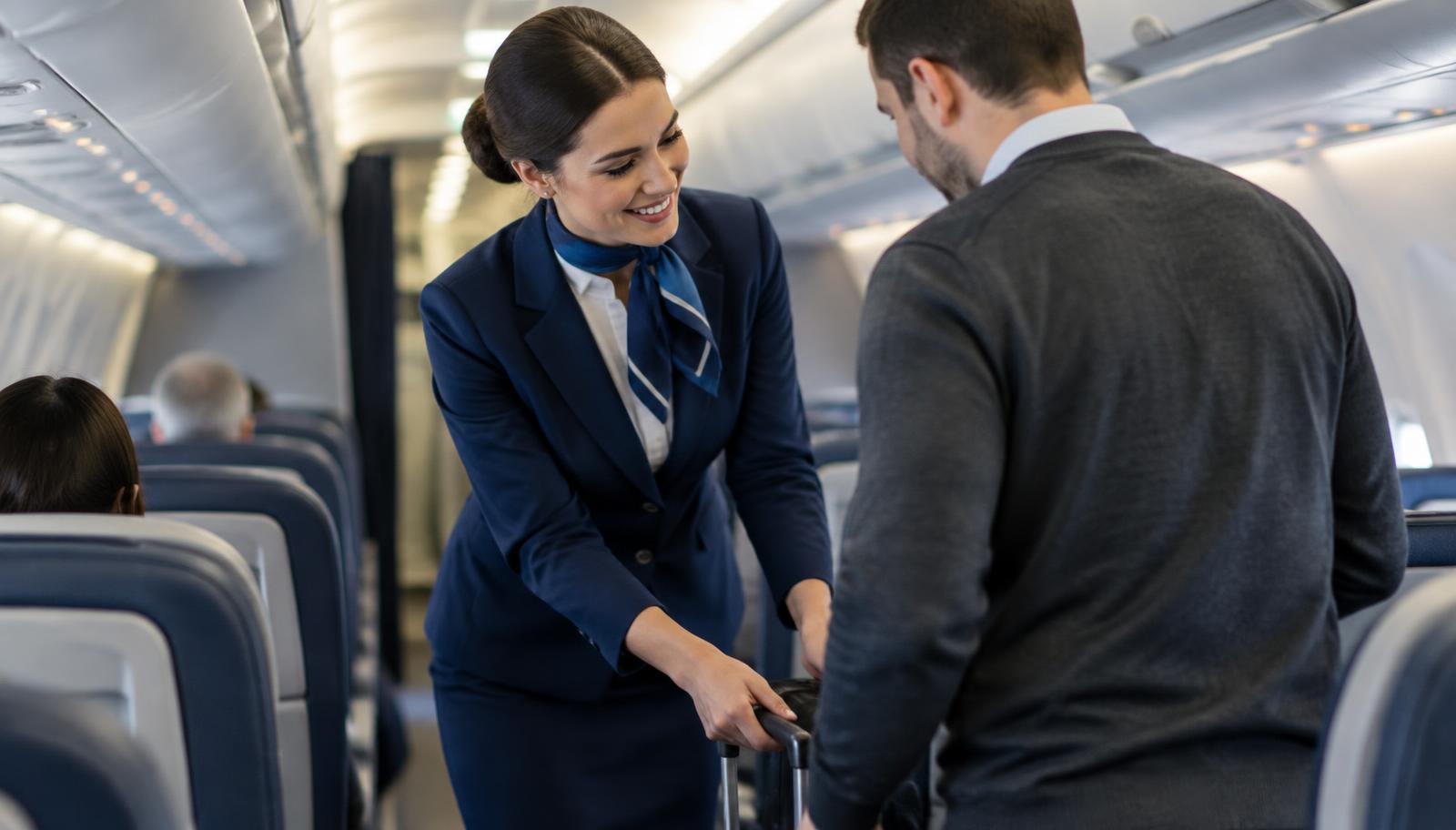
Meal service on a full sector
Two hundred short exchanges, half of them with passengers whose English is limited. Formulas have to be automatic.
PROFESSIONAL ENGLISH · UNITED ARAB EMIRATES
Written for crew flying from UAE bases and for candidates preparing for an assessment day: the English of the cabin — service, announcements, safety instructions, de-escalation — and the English of getting hired, where a group exercise and a competency answer decide everything.
THE SHORT ANSWER
Cabin crew English has three separate parts, and candidates usually prepare only one. First, service English: short, courteous, repeatable exchanges with passengers in a noisy cabin. Second, safety and command English: clear, unambiguous instructions that must be understood first time, including by passengers whose English is limited. Third, recruitment English: the group discussion, role-play and competency answers used on airline assessment days. Englify trains all three in live private one-to-one classes on Google Meet, with teachers who speak English, French and Arabic. UAE prices are published: AED 599, 699, 899 and 999 per month for 8, 12, 16 and 20 private hours. The first class is a free trial with a level assessment.
Written and reviewed by Mourade Boulanouar — Founder & Head of Teaching, EnglifyLast reviewed
A cabin is a hard place to use a second language. There is engine noise, passengers are tired, the exchange lasts four seconds, and half the people you speak to are also using English as a second or third language. What works there is not broad vocabulary — it is a small set of clear, courteous, repeatable formulas delivered at a steady pace.
The UAE makes this sharper than almost anywhere. Flights from Dubai, Abu Dhabi and Sharjah carry passengers from dozens of language backgrounds on a single sector. Crew rotate through the cabin speaking to a Japanese family, then a Nigerian businessman, then an elderly Egyptian passenger who prefers Arabic. Being clearly understood by non-native listeners is a different target from sounding native, and it is the right target.
Safety English raises the stakes again. In a normal service exchange a misunderstanding is inconvenient. In a safety instruction it is not. That is why safety phrasing is short, imperative and repeated in the same words every time.
Most language problems in the cabin come from using the wrong register rather than from a lack of English.
The command register is the one Arabic-speaking candidates most often over-soften, because directness can feel impolite. In a safety instruction, directness is the politeness.
Two hundred short exchanges, half of them with passengers whose English is limited. Formulas have to be automatic.
You switch from service warmth to command clarity mid-sentence and the cabin has to comply immediately.
Acknowledge, state the limit, escalate calmly — without raising your voice or losing courtesy.
Crew-to-crew English: fast, factual, no decoration, no ambiguity about what you need.
Six candidates, one task, assessors watching how you contribute, listen and disagree in English.
"Tell me about a time a customer was unhappy." Two structured minutes about your real experience.
Your listeners are mostly non-native; clarity beats sounding British or American.
Pace, pausing and stress are assessed, and all three are trainable quickly.
Short imperatives that a frightened passenger understands first time.
A fixed ladder of phrases that keeps you calm when the passenger is not.
Entering, agreeing, disagreeing and summarising in English while being observed.
Situation, task, action, result — in two minutes, without wandering.

This is operational language: the words below are used with precise meanings, and near-synonyms cause confusion in the cabin.
The crew member in charge of the cabin on that flight.
The kitchen area where the service is prepared.
المطبخ على الطائرة
The closed storage above the seats.
To put something away and secure it. "Please stow your bag under the seat in front."
Check seatbelts, tray tables, seat backs and stowage before landing or turbulence.
The folding table in the seat back.
The seat returned to its vertical position.
Seat positions, asked about constantly during boarding.
الممر / النافذة
The document showing the passenger's seat and flight.
The protective posture instructed before an emergency landing.
The inflatable jacket demonstrated in the safety briefing.
Rough air. The word passengers hear most and understand least.
To land at a different airport from the scheduled one.
The onward flight a passenger must catch after this one.
Goods sold on board without local tax.
A child travelling without an adult, handed over formally at each stage.
Read each group aloud. Speed comes from repetition of fixed phrases, not from inventing new sentences under pressure.
One from the cabin, one from the assessment room. Read both parts aloud, then only the crew part.
The crew member never argues about the facts and never raises the volume. The ladder does the work.
PassengerI booked an aisle seat. This is the middle. This is unacceptable.
CrewI can see this is frustrating. Let me look at what's happened — may I see your boarding pass?
PassengerI've been travelling for eleven hours.
CrewI understand. The seat map shows the aisle seats are taken, but boarding isn't finished. Once the doors close, I'll check again and come straight back to you.
PassengerAnd if nothing is free?
CrewThen I'll be honest with you rather than promise something. I'll also note it so the ground team sees it. Can I bring you some water in the meantime?
Four sentences, in order. The assessor is listening for structure, not drama.
AssessorTell me about a time you dealt with an unhappy customer.
CandidateIn my last role at a hotel front desk, a guest arrived at midnight and his room wasn't ready.
AssessorWhat did you have to do?
CandidateMy task was to keep him comfortable and get him into a room quickly. I apologised without blaming the team, offered the lounge and a drink, and called housekeeping myself to confirm a time.
AssessorAnd the result?
CandidateHe was in a room within twenty minutes, and he mentioned it positively at checkout. What I took from it is that a specific time calms people far more than an apology does.
These pairs are about register, which is what separates a competent English speaker from a competent crew member.
WeakerSit down!
StrongerSir, I need you to sit down.
Keeps the command clear while retaining authority and courtesy — bare imperatives sound like aggression outside an emergency.
WeakerMaybe, if it is possible, could you perhaps fasten the seatbelt?
StrongerFasten your seatbelt, please.
In a safety instruction, stacked softeners hide the instruction. Directness is the professional choice.
WeakerNo, we don't have chicken.
StrongerI'm afraid the chicken has finished. May I bring you the pasta instead?
Never leave a passenger with only a refusal; the alternative follows immediately.
WeakerI am sorry, it is not my fault.
StrongerI'm sorry this happened. Let me sort it out for you.
Defending yourself escalates; taking the next action de-escalates.
WeakerPlease, you can put this in the up locker.
StrongerPlease stow your bag in the overhead locker.
Operational vocabulary is fixed, and the correct term is understood faster by colleagues and frequent flyers.
WeakerI have 4 years experience in the customer service.
StrongerI have four years' experience in customer service.
Possessive with a time period, and no article before an uncountable field — a very common assessment-day slip.
In a cabin, consonants are what survive engine noise. These drills are about being understood at the first attempt, not about changing your accent.
Arabic has no /p/, and this job is full of it.
passenger, passport, purser, pillow, prepare, cockpit
English meaning often sits on the last sound; dropping it changes the word.
seat / seats, stow / stowed, seated, secured, fastened
Practise the tongue between the teeth; "tree" and "three" are different rows.
three, thirty, thank you, through
Stress the operative word so it carries over the noise.
fasten your SEATBELT · seat back UPRIGHT · tray table STOWED
Reduce your normal speed by about twenty per cent and pause between sentences.
Ladies and gentlemen — [pause] we're expecting some turbulence.
Service English is built from a handful of patterns. Learn them until they are automatic and your attention is free for the passenger instead of for the grammar.
The reliable pattern is acknowledge, act, confirm. "Of course" (acknowledge), "I'll bring it from the galley" (act), "is there anything else while I'm there?" (confirm). It sounds natural, it works in four seconds, and it works when you are exhausted on a night sector.
Offers and refusals need care. "Would you like chicken or pasta?" is an offer; "I'm afraid we've run out of the chicken — may I bring you the pasta, or would you prefer a vegetarian option?" is a refusal that keeps the passenger comfortable. The apology comes first, the alternative comes immediately after, and the passenger is never left with only a no.
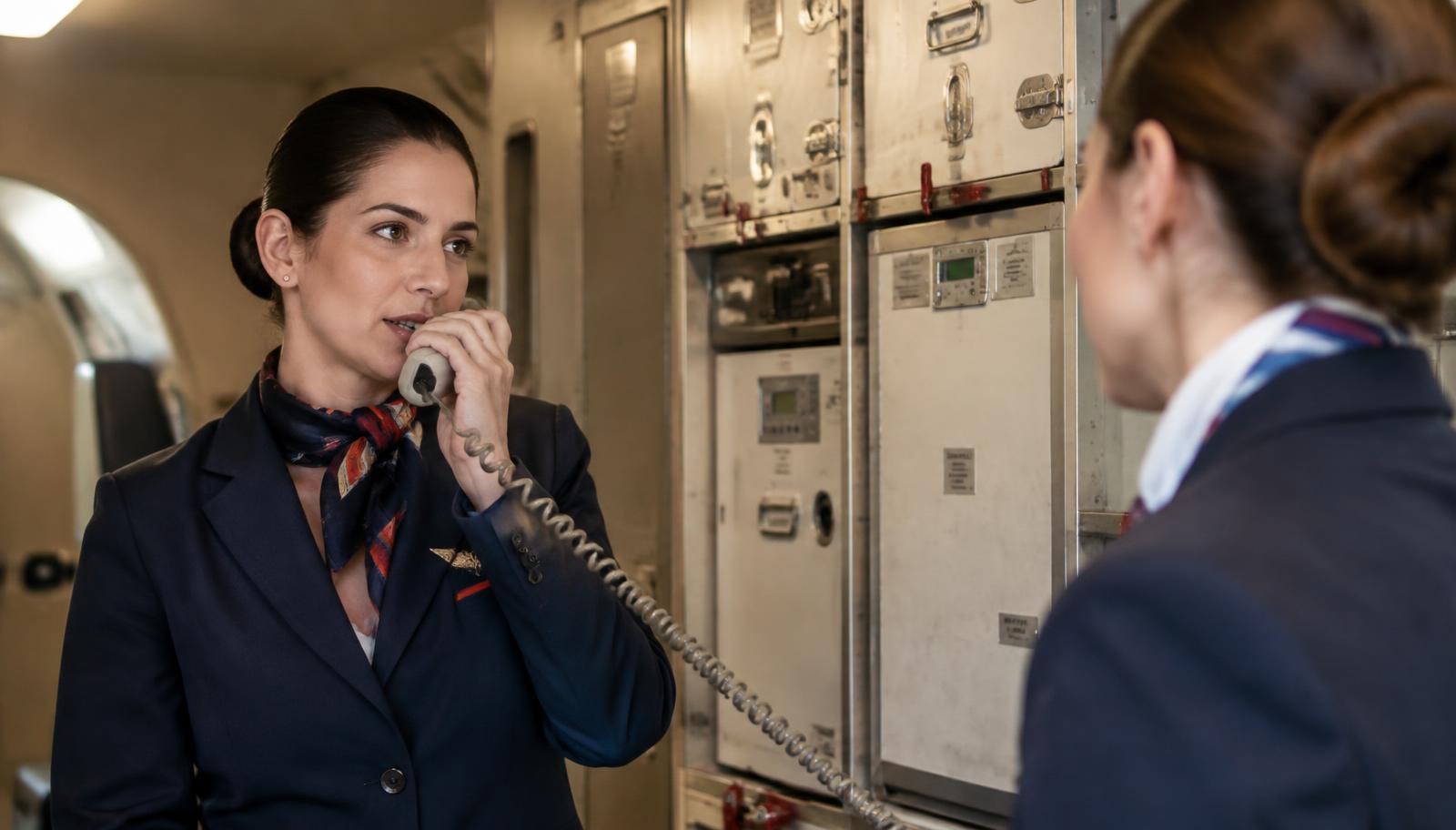
An announcement is a performance, and it is graded as one in recruitment. What crew are assessed on is not accent but intelligibility: pace, pausing, stress on the words that carry meaning, and the discipline to follow the airline's wording.
Every announcement has the same skeleton: address the cabin, state the fact, state the action required, state the reason if it helps compliance, close courteously. "Ladies and gentlemen — we're expecting some turbulence. Please return to your seat and fasten your seatbelt. Cabin service will resume when it's safe. Thank you."
Three practical habits: slow down roughly twenty per cent compared with your normal speech; pause at the end of each sentence instead of running them together; and stress the operative word — seatbelt, seated, overhead, secured. Reading the same announcement aloud five times with a teacher correcting your pace is one of the fastest improvements available in this job.
Safety language is deliberately narrow. It uses imperatives, avoids conditionals, and repeats. "Brace, brace." "Leave everything. Come this way." "Head down, stay down." It is designed to be understood by a frightened passenger with limited English, which is why crew never improvise it.
Englify teaches this as language: clarity of consonants, volume control, the discipline of repeating identical wording, and the confidence to sound authoritative in a second language. The operational content, procedures and certification belong to your airline's own training — Englify is not an aviation training provider and makes no claim to teach safety procedures.
Almost every crew interview asks about a difficult passenger, and almost every flight provides one. The English of de-escalation follows a ladder, and each rung has its phrases.
What breaks this ladder is not weak vocabulary — it is speed and volume. Slowing down is itself a de-escalation technique, and it is practised in class.
UAE-based airlines recruit in stages, and each stage is a language test disguised as something else. The CV screen tests written accuracy. The group exercise tests whether you can contribute, listen and disagree politely in English while being watched. The role-play tests service and de-escalation language under pressure. The final interview tests whether you can structure an answer about your own experience.
The group exercise is where strong candidates most often fail, and the cause is usually language behaviour rather than language level: speaking too little, interrupting, or repeating what someone already said. The fixes are phrases — "building on what Amira said", "can I offer a different view?", "shall we agree on the first two and come back to the third?" — and they can be rehearsed until they are natural.
For the interview itself, structure your answers: situation, what you had to do, what you did, what happened. Two minutes, in order, without wandering. Englify's private classes rehearse exactly this, using your own work history so the story is true and yours.
These are high-frequency language patterns that transfer from Arabic. Each is one rule, and each shows up in the cabin every day.
Classes are private one-to-one, live on Google Meet, at times agreed with you in UAE time — which matters when you are on rotation, because hours can be moved around a roster.
Sessions are speaking-led. You deliver announcements out loud and are corrected on pace and stress; you role-play a passenger complaint and then do it again with better phrasing; you answer competency questions and rebuild the answer until it is two clear minutes. Your teacher also takes the other roles in the assessment-day tasks, so the group discussion language is rehearsed with a real interlocutor.
After each session you receive a written report of what was corrected and what to practise, and your hours and attendance stay visible in the student area. Englify teaches English: it does not recruit, does not prepare you for aviation certification, and makes no claim about hiring outcomes.
Englify Online Academy is a Morocco-based online academy teaching English and French. Classes are live 60-minute sessions on Google Meet, in small groups or one-to-one, after a free level test and a free trial class.
This is how Englify teachers typically sequence work with a candidate taking two or three private hours a week. It is a preparation plan, not a prediction about being hired.
Level assessment, then the first announcement read aloud and corrected on pace, pausing and stress only.
Acknowledge–act–confirm drilled until automatic, plus offers, refusals and alternatives.
Multiple announcement types delivered, recorded and compared; command phrasing practised without over-softening.
The phrase ladder applied to angry, anxious and non-compliant passengers.
Entering, agreeing, disagreeing and summarising, rehearsed with your teacher taking the other roles.
Three real stories from your own history rebuilt into two-minute structured answers.
Role-play day: announcement, service exchange, difficult passenger, group task and interview, with written feedback.
AFTER EVERY LIVE SESSION
The report keeps your work-specific vocabulary, corrections and next focus in one place. This is a visual example, not real student data.
Published UAE monthly prices in AED. The first class is a free trial with a level assessment.
AED 599 / month
Private one-to-one · about AED 75 per hour
AED 699 / month
Private one-to-one · about AED 58 per hour
AED 899 / month
Private one-to-one · about AED 56 per hour
AED 999 / month
Private one-to-one · about AED 50 per hour
Every plan on this page is private one-to-one teaching. Hours are booked in UAE time and can be moved when your schedule changes.
REAL LEARNERS. REAL LEARNING.
These reviews were written in English by Englify learners based in the United Arab Emirates and are published exactly as written. They are not specific to this profession.
I wanted to improve my speaking skills for meetings and presentations. The private classes at Englify were focused on exactly what I needed, and the lessons were adapted to my level and work.I was looking for flexible English lessons because of my busy schedule. The private classes allowed me to choose convenient times, and I noticed a real improvement in my confidence when speaking.My main goal was to communicate more naturally at work. The teacher corrected my mistakes without interrupting the conversation too much, which helped me become more comfortable speaking English.The lessons were very practical. We worked on professional vocabulary, conversations and situations that I actually face at work rather than only studying grammar.I needed English for dealing with international clients. The private sessions were personalized around sales conversations, presentations and professional communication.I had studied English before but still felt nervous speaking. The private classes gave me the opportunity to speak much more during every session, and gradually I became more confident.What I liked most was the flexibility. We could focus each lesson on the areas where I needed the most help, especially speaking and communicating with colleagues.The lessons were organized and easy to follow. I particularly enjoyed the speaking activities because they helped me use new vocabulary instead of just memorizing it.I joined because I wanted to improve my English for professional communication. The lessons were customized to my objectives and included realistic workplace situations.I wanted to feel more comfortable speaking English with customers and colleagues. The private lessons gave me a lot of speaking practice and helped me express myself more clearly.The teacher quickly understood my level and adjusted the lessons accordingly. We focused on speaking, vocabulary and professional situations relevant to my career.I appreciated that the classes were not just grammar exercises. We had conversations, discussed different topics and worked on vocabulary that I could immediately use.I needed to improve my English before applying for opportunities abroad. The private lessons helped me work on both my speaking confidence and overall communication.My biggest problem was understanding and responding quickly in English. The lessons included a lot of conversation practice, which made real-life communication much easier for me.The private format worked very well for me because I could ask questions whenever I needed to. The sessions were personalized instead of following the same program for everyone.I wanted to improve my fluency and pronunciation. The classes gave me regular opportunities to speak, receive corrections and practice expressing my ideas naturally.As a business owner, I often communicate with international partners. Englify's private classes helped me become more confident during professional conversations and meetings.I needed English for both professional and everyday communication. The lessons were adapted to my needs and gave me practical vocabulary and speaking practice.I had a good understanding of English but struggled to speak fluently. The private lessons focused heavily on conversation, which was exactly what I was looking for.The flexibility of private classes was a major advantage for me. We could work around my schedule while keeping the lessons focused on my personal English goals.Airlines publish their own requirements and they can change, so always check the carrier's current criteria. In practice candidates need to hold a fluent conversation, understand fast speech in noise, read a manual and deliver an announcement clearly — typically a solid B1 to B2 range or above. Englify assesses your level free in the trial class and tells you honestly where you are.
Read the same announcement aloud repeatedly with a teacher correcting three things only: pace, pausing and which word carries the stress. Recording yourself and comparing is the second half of the method. This is one of the fastest-improving skills in the job because the text is fixed and only the delivery changes.
We prepare the English used in them: the group discussion, the service and de-escalation role-play, and the structured competency answer. Englify is not a recruiter, is not affiliated with any airline, and makes no claim about being hired.
Yes. Lessons are booked at times agreed with you in UAE time and can be rescheduled when your roster changes. Private plans run from 8 to 20 hours per month, so you can take fewer hours in a heavy month.
Yes. Your teacher takes the other roles in the task, so you rehearse entering a discussion, agreeing, disagreeing politely and summarising with someone who corrects the phrasing on the spot. Private hours also cover announcement delivery, pronunciation and rebuilding interview answers.
Private one-to-one plans are AED 599, 699, 899 and 999 per month for 8, 12, 16 and 20 hours. The first class is a free trial with a level assessment.
No. Safety procedures and certification are taught by your airline. Englify works on the language — clarity, volume, command phrasing and intelligibility — and does not present itself as an aviation training organisation.
FREE TRIAL CLASS
Tell us whether you are flying already or preparing for an assessment day, and we will arrange a free trial class with a level assessment on Google Meet. Private plans start at AED 599 for 8 hours a month.
Talk to Englify on WhatsAppTell us whether you are flying already or preparing for an assessment day, and we will arrange a free trial class with a level assessment on Google Meet. Private plans start at AED 599 for 8 hours a month.