Knowledge hub
English Levels Explained: CEFR A1 to C1
"Intermediate" means nothing on a CV. The CEFR gives you a shared scale — A1 to C2 — that schools, employers and exam boards all recognise. Here is what each level actually looks like in practice.
Written and reviewed by Mourade Boulanouar
Founder & Head of Teaching, Englify · Last reviewed September 2026
In short
CEFR is the shared European scale that schools, employers and exam boards use to describe English: A1 and A2 (basic), B1 and B2 (independent), C1 and C2 (advanced). B2 is the level most Moroccan employers mean by "good English" — you can work, present and negotiate in it. The only reliable way to know your level is a placement test with a spoken part, and each level normally takes several months of steady practice.
Key takeaways
- A1–A2 basic, B1–B2 independent, C1–C2 advanced
- B2 is what most Moroccan employers actually ask for
- "Intermediate" on a CV means nothing without a CEFR level
- A spoken placement test gives a trustworthy level
- Levels cannot be skipped, but they can be crossed faster
- Englify offers a free placement test, separate from the trial class
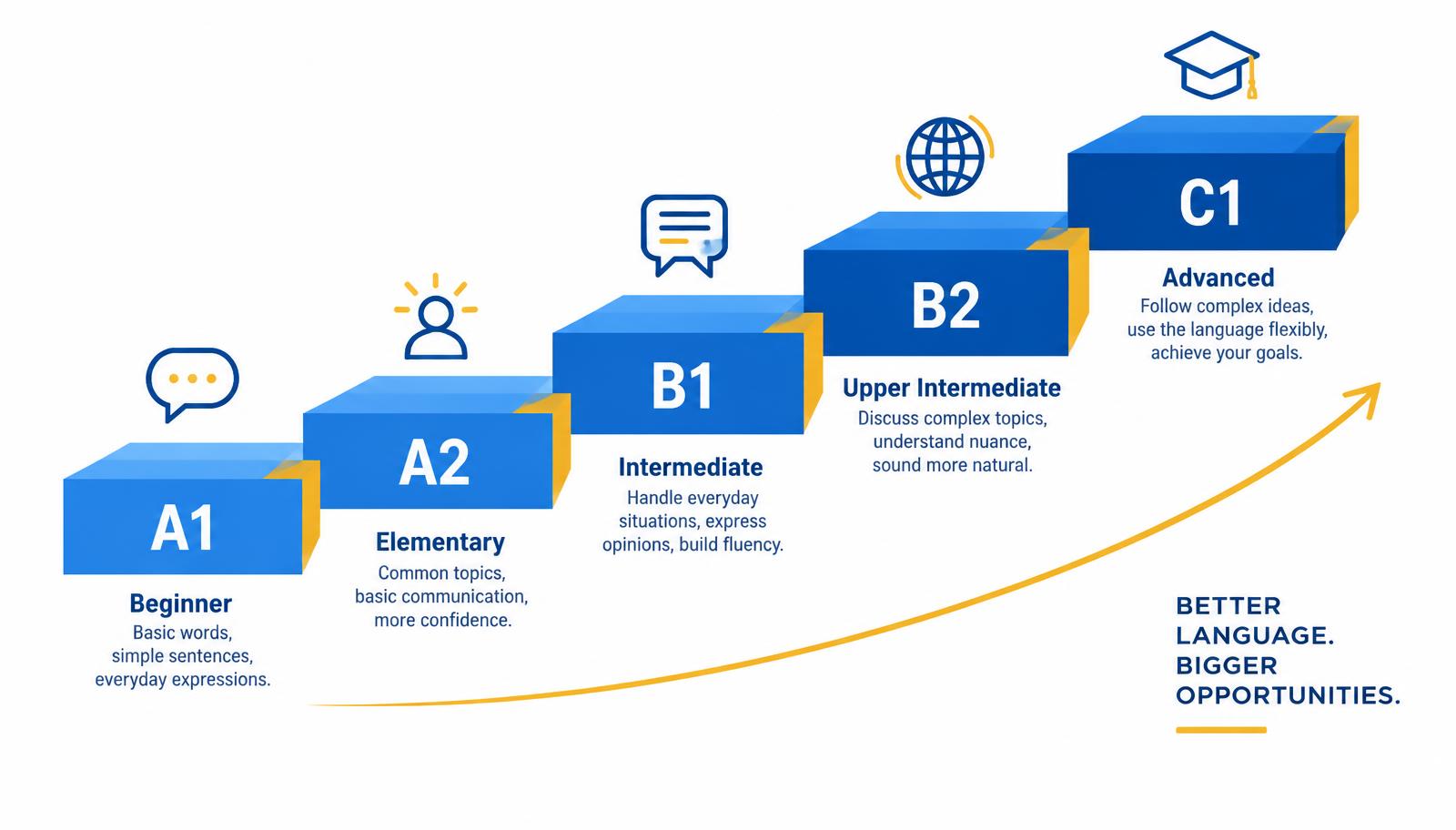
A1 — Beginner
You handle fixed situations: greetings, your name and job, numbers, prices, very short questions. You need the other person to speak slowly. Reaching A1 from zero usually takes 60 to 80 hours of class.
A2 — Elementary
You describe your routine, your family and your work in simple sentences, and manage everyday transactions. Most Moroccan learners who studied English at school but never practised sit between A2 and low B1 when tested.
B1 — Intermediate
You cope with most daily situations, tell a story, explain a problem and give a simple opinion. Conversations work as long as the topic is familiar. B1 is where self-study typically stalls without speaking practice.
B2 — Upper intermediate
You discuss abstract topics, defend an opinion, take part in meetings and understand films without subtitles. B2 is the level most employers and universities mean when they write "good English" or "professional level".
C1 — Advanced
You use English flexibly and almost without searching for words, handle nuance and register, and write structured professional or academic documents. C1 is required for many international programmes and senior roles.
How CEFR maps to IELTS and TOEFL
These are approximate bands, not guarantees: exam scores also depend on exam technique, timing and task familiarity, which is why exam preparation is a separate course.
- B1 — roughly IELTS 4.0–5.0, TOEFL iBT 42–71
- B2 — roughly IELTS 5.5–6.5, TOEFL iBT 72–94
- C1 — roughly IELTS 7.0–8.0, TOEFL iBT 95–120
How long between levels?
Counting from A1, each level takes roughly 150 to 200 hours of guided study, and the gaps get wider at the top. With regular live classes plus daily practice, one level in 4 to 6 months is a realistic pace.
The six levels at a glance

| Level | Name | In one sentence |
|---|---|---|
| A1 | Beginner | You can handle very simple, familiar situations if people speak slowly. |
| A2 | Elementary | You can talk about your routine, family and work in simple sentences. |
| B1 | Intermediate | You can manage most everyday situations and give a simple opinion. |
| B2 | Upper intermediate | You can discuss, argue and work in English with some effort. |
| C1 | Advanced | You can use English flexibly for work and study, including nuance. |
| C2 | Proficient | You can understand almost everything and express yourself precisely. |
Start with a free trial class
Take a free level test, meet an Englify teacher and get an honest assessment of your English level — with no commitment.
What you can actually do at each level
The official CEFR descriptors are written in general "can do" terms. The table below translates them into everyday and work situations, so you can recognise your own level more easily.
| Level | Speaking | Listening | Writing |
|---|---|---|---|
| A1 | Introduce yourself, ask a price | Understand slow, simple questions | Fill in a form with your details |
| A2 | Describe your day and your job simply | Follow short, clear announcements | Write a short message or note |
| B1 | Tell a story, explain a problem | Follow the main points of clear speech on familiar topics | Write a simple email or short text about experiences |
| B2 | Take part in meetings, defend an opinion | Follow most films and talks on familiar topics | Write a clear, structured email or report |
| C1 | Present and negotiate fluently | Understand long, complex speech without much effort | Write detailed, well-organised professional texts |
How to recognise your level honestly
A quick self-check before a real test
Talk for two minutes about your work or studies
If you stop often to search for basic words, you are probably around A2. If you keep going but make regular mistakes, you are likely around B1.
Watch a short video on a familiar topic without subtitles
Understanding the main idea but not the details points to B1. Following most of it, including opinions, points to B2.
Write a short email asking for something
If you can write it clearly with a polite opening, a reason and a closing, you are probably at B1 or above in writing.
Take a real placement test
A self-check only gives you a direction. A placement test with a spoken part gives you a level you can trust.
Which level do you need for your goal?
Requirements vary between employers, universities and programmes, so always check the exact requirement for your situation. The table below gives common general targets as a starting point, not official rules.
| Goal | Usual target |
|---|---|
| Everyday travel and simple conversations | A2 to B1 |
| Working in an office that uses some English | B1 to B2 |
| Customer-facing or international roles | B2 to C1 |
| University study in English | Often B2 to C1, depending on the programme |
| Senior or highly specialised roles | C1 |
Moving from one level to the next
What changes between levels
Lower level
A2: "I work in a bank. I like my job."
Next level
B1: "I work in a bank, mainly with customers, and I like it because every day is different."
Longer sentences with reasons and connectors.
Lower level
B1: "I think remote work is good because it is flexible."
Next level
B2: "Remote work gives people flexibility, although it can make teamwork harder if communication isn't clear."
Balanced arguments and contrast.
Lower level
B2: "We need to change the plan because there is a problem."
Next level
C1: "Given the delays we've had, it might be worth revisiting the plan before we commit to new dates."
Nuance, softer language and precise vocabulary.
Where the B1 plateau comes from, and how to get past it
B1 is where many self-taught learners stop improving. At B1 you can get by, so the pressure to improve drops, and the mistakes you make no longer stop communication, so nobody corrects them. They become habits.
Getting to B2 usually means three things: speaking about less familiar topics, being corrected on the same mistakes until they disappear, and learning more flexible ways to connect ideas. Regular live classes with correction are the most direct way to do that.
At B1 you can get by. B2 is where you can work comfortably in English.
How Englify uses CEFR levels
Englify Online Academy places each learner on the CEFR scale before classes start, using a free placement test. This is a separate step from the free trial class. Courses cover A0 to C1, and every session lasts 60 minutes, live on Google Meet.
Group classes are organised by level, run three times a week on a fixed timetable and have up to 6 learners. Private classes follow your own level and goal. Learners get session reports and short quizzes to review what was covered.
Englify prepares learners for exams such as IELTS and TOEFL but does not run the official exams or give official certificates; those are handled by the official exam organisations.
Frequently asked questions
- How do I know my CEFR level?
- Take a placement test that includes a spoken part. At Englify the free placement test is a separate step from the free trial class, and it tells you your level and the gap to your target.
- What level do employers in Morocco ask for?
- Requirements differ, but roles that use English every day often ask for B2, and customer-facing or international roles often ask for B2 to C1. Check the job advert for the exact level.
- Can I skip a level?
- Sometimes. Learners with strong reading and listening but little speaking practice can move through a level quickly once they start speaking every week.
- Is A0 a CEFR level?
- No. A0 is an informal label for a complete beginner. The official CEFR scale starts at A1. Englify courses start at A0 for learners with no English.
- Does Englify give official CEFR certificates?
- No. Englify assesses your level for teaching purposes and prepares you for exams, but official certificates come from the official exam organisations.
Mourade Boulanouar
Founder & Head of Teaching, Englify
Founder of Englify Online Academy. He designs the teaching method used in every Englify class and reviews each guide in this knowledge hub.
More about EnglifyStart with a free trial class
Take a free level test, meet an Englify teacher and get an honest assessment of your English level — with no commitment.
Free trial · No card required · Teachers speak English, French & Darija