Knowledge hub
How to Get IELTS Band 7: A Practical Guide
Band 7 is the score most universities and immigration programmes ask for. It is reachable from a solid B2, but only with exam technique on top of language level — most candidates lose points on the format, not on English.
Written and reviewed by Mourade Boulanouar
Founder & Head of Teaching, Englify · Last reviewed September 2026
In short
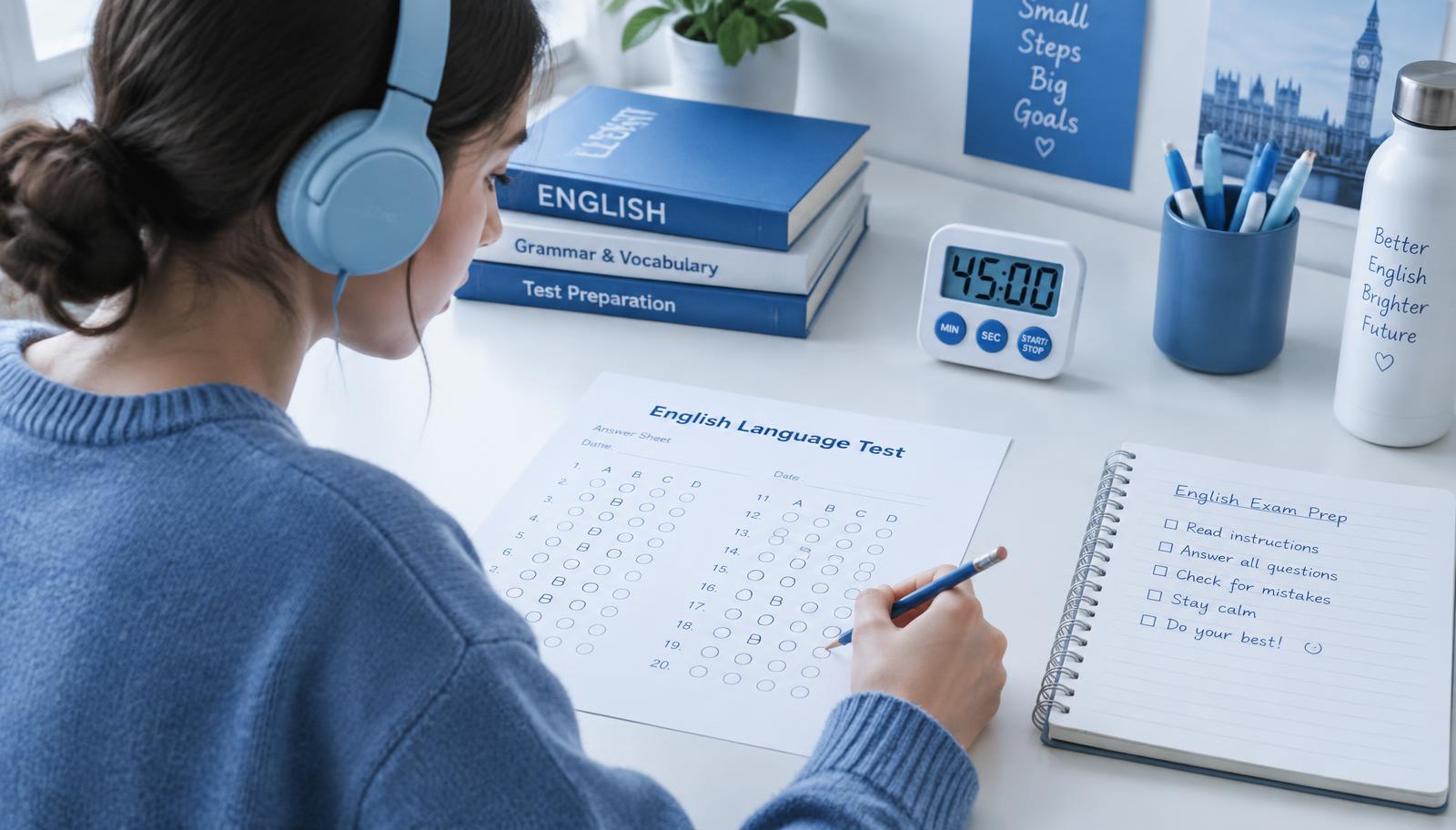
IELTS Band 7 is roughly a functional C1 and is the score most universities and immigration programmes ask for. It is reachable from a solid B2, but only by adding exam technique on top of language level — most candidates lose marks on the format, especially Writing Task 2 and Speaking Part 3, not on their English. Going from 6.0 to 7.0 typically takes a few months of structured preparation with timed practice and corrected writing.
Key takeaways
- Band 7 corresponds to a functional C1 level
- Reachable from solid B2 with exam technique added
- Most marks are lost on format, not on language
- Writing Task 2 and Speaking Part 3 need the most work
- Timed mock tests plus corrected writing are essential
- Englify prepares IELTS candidates online across Morocco
What band 7 actually means
Band 7 describes an operational command of English: you handle complex language well, with occasional inaccuracies. In CEFR terms that is a strong B2 to C1. If your current level is B1, plan for language work first and exam technique second.
Listening and Reading — technique wins points
- Listening: around 30/40 correct answers for band 7 — practise predicting answers before the audio starts
- Reading (Academic): around 30/40 — learn to skim for structure, then scan for keywords instead of reading fully
- Always transfer answers carefully; spelling counts and costs easy marks
Writing — the section where most candidates lose 7
Task 2 is worth twice Task 1. Band 7 needs a clear position held throughout, paragraphs that each develop one idea, and a range of structures used accurately. Memorised template phrases are penalised, not rewarded.
- Spend 5 minutes planning Task 2 before writing
- Two well-developed body paragraphs beat four thin ones
- Write 260–290 words, not 400 — accuracy drops with volume
- Get every essay corrected against the official band descriptors
Speaking — fluency and range, not a perfect accent
Examiners score fluency and coherence, lexical resource, grammatical range and pronunciation. Accent is irrelevant; hesitation and repetition are not. In Part 3 you must give reasons and examples, not one-sentence answers.
- Extend every answer with a reason and an example
- Practise the Part 2 long turn with a timer, twice a week
- Build topic vocabulary for education, technology, environment and work
Start with a free trial class
Take a free level test, meet an Englify teacher and get an honest assessment of your English level — with no commitment.
A realistic preparation timeline
- From strong B2: 8 to 12 weeks of focused preparation
- From B1: 4 to 6 months — general English first, then exam technique
- Minimum: 2 full timed mock tests, with corrected writing and recorded speaking
Common mistakes we see in Morocco
- Booking the exam date before knowing your real level
- Practising only Reading and Listening because they are easy to self-mark
- Writing essays nobody corrects against the band descriptors
- Translating from French or Arabic sentence structure into English
Frequently asked questions
- How long does it take to go from 6.0 to 7.0?
- Typically 8 to 12 weeks of structured work, with weekly corrected writing and recorded speaking practice. The Writing and Speaking sections are usually what hold candidates at 6.5.
- Is IELTS Academic or General better for me?
- Academic for university study; General Training for most immigration and work routes. Check the exact requirement of your target institution before booking.
- Does Englify offer IELTS preparation online?
- Yes. Our IELTS course is fully online, with timed mock tests, corrected writing against the band descriptors and recorded speaking practice.
- How much do English lessons cost in Morocco?
- At Englify, small-group online English classes are the most affordable option and private one-to-one classes cost more per hour, because a private teacher works with one student only. Current group and private prices are confirmed on WhatsApp (+212 724 744 137) and on our prices page, since they depend on the format, the number of hours per week and the length of the plan. The trial class is free and no card is required.
- Are Englify classes online or in person?
- Every class is 100% online and live on Google Meet, at Morocco time. Nothing is pre-recorded: a teacher is in the room with you, correcting you as you speak. Students join from Casablanca, Rabat, Marrakech, Tangier, Fez, Agadir and smaller cities, and from abroad.
Mourade Boulanouar
Founder & Head of Teaching, Englify
Founder of Englify Online Academy. He designs the teaching method used in every Englify class and reviews each guide in this knowledge hub.
More about EnglifyStart with a free trial class
Take a free level test, meet an Englify teacher and get an honest assessment of your English level — with no commitment.
Free trial · No card required · Teachers speak English, French & Darija