Knowledge hub
IELTS Tips for Moroccan Students
Moroccan candidates usually arrive at IELTS with solid grammar and reading from school, and lose marks in Writing Task 2 and Speaking Part 3. These tips target exactly that pattern.
Written and reviewed by Mourade Boulanouar
Founder & Head of Teaching, Englify · Last reviewed September 2026
In short
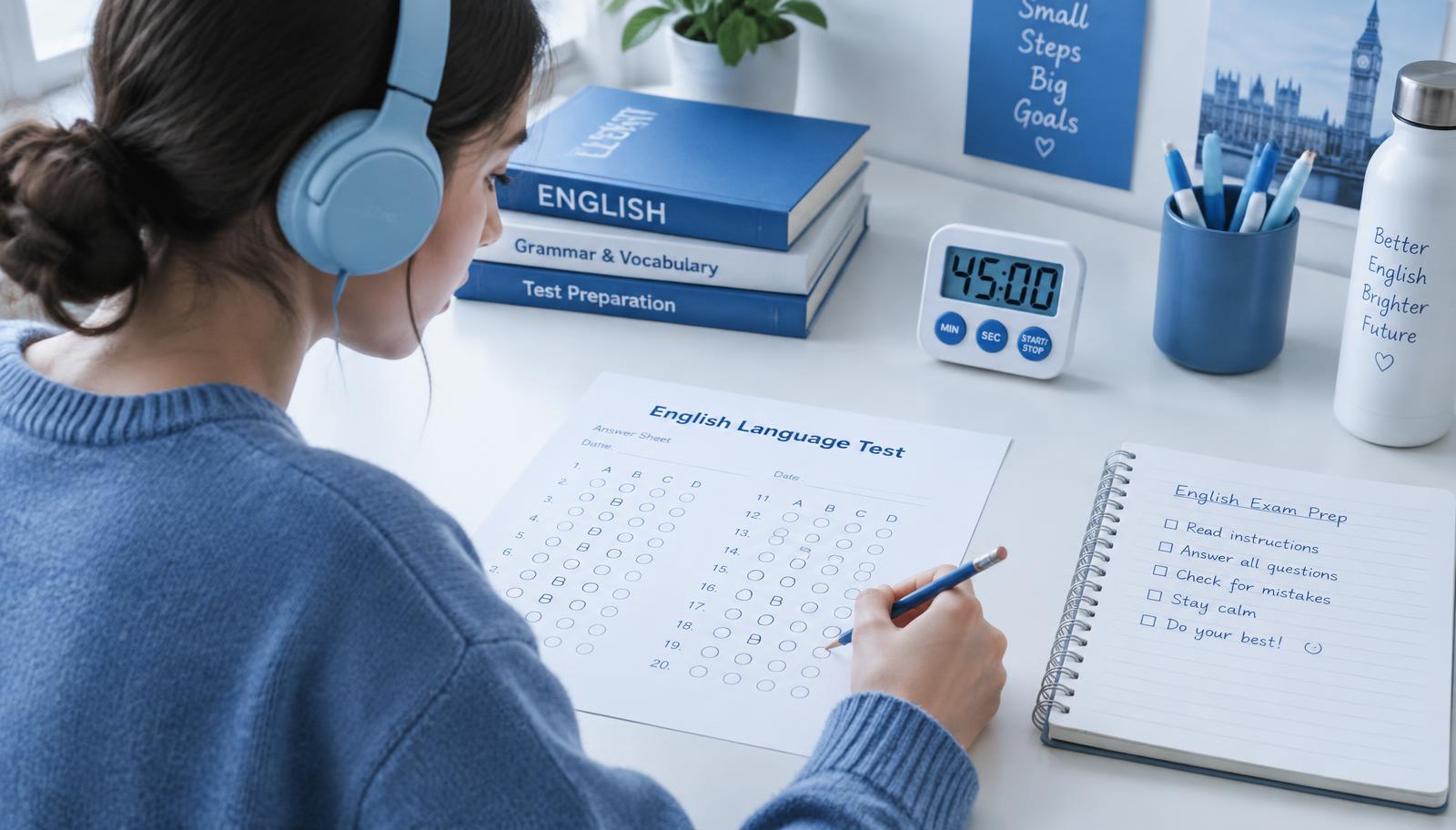
Moroccan IELTS candidates usually arrive with strong grammar and reading from school and lose marks in Writing Task 2 and Speaking Part 3. The most useful tips are: learn the exact task requirements before practising, write to a fixed essay structure, time every practice attempt, develop your answers in Speaking instead of stopping after one sentence, and get your writing corrected by a teacher. Start preparing at least two to three months before test day.
Key takeaways
- Writing Task 2 and Speaking Part 3 lose the most marks
- Learn the task requirements before doing practice tests
- Always practise under real exam timing
- In Speaking, extend answers with reasons and examples
- Corrected writing is what raises Writing scores
- Allow 2–3 months of preparation before the test date
Know your real starting band first
Before buying books or booking a test date, sit a full timed mock exam and have the Speaking and Writing parts marked by a teacher who knows the band descriptors. Self-assessment is unreliable: most candidates over-estimate Speaking and under-estimate Reading.
Speaking: answer the question, then extend it
The most common Moroccan pattern in Part 1 is answers that are too short, and in Part 3 answers that drift away from the question. Aim for two to four sentences in Part 1 and a clear position plus one reason and one example in Part 3.
- Never memorise scripted answers — examiners hear it and it caps your band
- Fill hesitation with English fillers, not silence: "that's a good question", "well, it depends"
- Self-correct once and move on; repeated restarts hurt fluency
- Practise the 2-minute Part 2 talk with a timer, out loud, weekly
Writing Task 2: structure beats vocabulary
You are marked on task response, coherence, lexical resource and grammar. Candidates who lose marks usually answer only half the question or never state a clear position. A four-paragraph plan written in two minutes protects your task response score more than any advanced word list.
- Underline the question type: opinion, discussion, problem-solution, two-part
- State your position in the introduction, keep it consistent to the conclusion
- One idea per body paragraph, developed with a reason and an example
- Leave five minutes to check articles, plurals and verb tenses
Reading and Listening: it's a timing skill
Reading is not a comprehension problem for most Moroccan candidates; it is a clock problem. Practise with a strict 60-minute limit and 20 minutes per passage, and never leave an answer blank — there is no penalty for a wrong guess. For Listening, read the questions during the pauses and accept that a missed answer is gone: keep following the recording.
Start with a free trial class
Take a free level test, meet an Englify teacher and get an honest assessment of your English level — with no commitment.
Watch the French and Arabic interference
Some errors are specific to learners who also speak French or Arabic: false friends ("actually" for "currently", "assist" for "attend", "sensible" for "sensitive"), missing articles, and prepositions translated directly. Keep a personal list of your own interference errors and review it before the test.
A realistic timeline
From a solid B1, reaching band 6.5 typically takes three to four months of regular classes plus daily practice — lesson frequency is personalised to your target band, deadline and budget; band 7 usually needs a strong B2 and four to six months, mostly spent on Writing and Speaking. Book the test date only once your mock scores are consistently at your target.
Frequently asked questions
- How long before the test should I start preparing?
- Plan three to six months depending on your current level and target band. Start with a mock exam so the timeline is based on your real starting point rather than a guess.
- Should I take IELTS Academic or General Training?
- Academic for university admission, General Training for most immigration and many work applications. Always confirm with the institution you are applying to before booking.
- Can I prepare for IELTS online from Morocco?
- Yes. Preparation needs timed practice and marked Speaking and Writing feedback, all of which work in live online classes. Our IELTS students prepare online from across Morocco.
- How much do English lessons cost in Morocco?
- At Englify, small-group online English classes are the most affordable option and private one-to-one classes cost more per hour, because a private teacher works with one student only. Current group and private prices are confirmed on WhatsApp (+212 724 744 137) and on our prices page, since they depend on the format, the number of hours per week and the length of the plan. The trial class is free and no card is required.
- Are Englify classes online or in person?
- Every class is 100% online and live on Google Meet, at Morocco time. Nothing is pre-recorded: a teacher is in the room with you, correcting you as you speak. Students join from Casablanca, Rabat, Marrakech, Tangier, Fez, Agadir and smaller cities, and from abroad.
Mourade Boulanouar
Founder & Head of Teaching, Englify
Founder of Englify Online Academy. He designs the teaching method used in every Englify class and reviews each guide in this knowledge hub.
More about EnglifyStart with a free trial class
Take a free level test, meet an Englify teacher and get an honest assessment of your English level — with no commitment.
Free trial · No card required · Teachers speak English, French & Darija