Knowledge hub
How to Learn English in Morocco: A Realistic Plan
Learning English in Morocco is mostly a problem of practice, not of talent. Almost every learner we test already knows more grammar and vocabulary than they can use. This guide gives you a plan that fits a working or studying week.
Written and reviewed by Mourade Boulanouar
Founder & Head of Teaching, Englify · Last reviewed September 2026
In short
To learn English in Morocco, start with a CEFR placement test that includes a spoken part, choose one goal for the next three months, then keep a weekly routine of regular live classes plus short daily listening and speaking practice. Get corrected by a teacher every week, and re-record yourself monthly to check progress. With about 4 to 5 hours a week, most learners move up one CEFR level in 4 to 6 months, and from A2 to B2 in roughly a year — without leaving Morocco.
Key takeaways
- Begin with a spoken placement test, not a written quiz only
- One clear goal per three months beats five vague ones
- Regular live classes plus 20–25 minutes daily practice
- Weekly correction by a teacher is what breaks the B1 plateau
- One CEFR level usually takes 4–6 months; A2 to B2 about a year
- No travel abroad needed — live online classes work Morocco-wide
Step 1 — Find out your real level
Start with a CEFR placement test that includes a spoken part. Written tests alone overestimate Moroccan learners, because school English trains reading and grammar much more than speaking. A short conversation with a teacher gives you a level you can trust: A1, A2, B1, B2 or C1.
Step 2 — Choose one goal, not five
Pick a single goal for the next three months: hold a 10-minute conversation, pass a job interview in English, reach IELTS 6.5, or handle client emails. A specific goal decides your vocabulary, your materials and how you should be tested.
- Conversation goal — speaking classes and weekly speaking clubs
- Work goal — business English, meetings, email and calls
- Exam goal — IELTS or TOEFL preparation with timed practice
- School goal — support for the school syllabus plus speaking
Step 3 — Build a weekly routine you can keep
Consistency beats intensity. Four short sessions a week works better than one long weekend session. A realistic week for a working adult in Morocco looks like this:
- 3 live classes per week (60 minutes each) with a teacher
- 15 minutes a day of listening — podcasts, series without subtitles
- 10 minutes a day of speaking out loud, even alone, recording yourself
- One weekly written task corrected by a teacher
Step 4 — Get corrected, every week
Practice without correction locks your mistakes in place. What changes a level is a teacher who hears you speak, corrects the same recurring errors, and gives you the exact structure to replace them. This is the main reason self-study plateaus at B1.
Step 5 — Measure progress every month
Once a month, record yourself answering the same three questions and compare with the previous month. In our classes we back this up with session reports, quiz scores and an end-of-level assessment, so progress is visible instead of guessed.
How long does it take?
With regular live classes plus daily short practice, most learners move up one CEFR level in about 4 to 6 months. Going from A2 to B2 — the level most employers ask for — usually takes around a year of steady work.
What a realistic week looks like
The routine that works is rarely the most ambitious one. It is the one you can still follow in week nine, when work is busy and the first motivation has gone. Plan your week around fixed live classes, then fill the gaps with short tasks you can do on a phone.
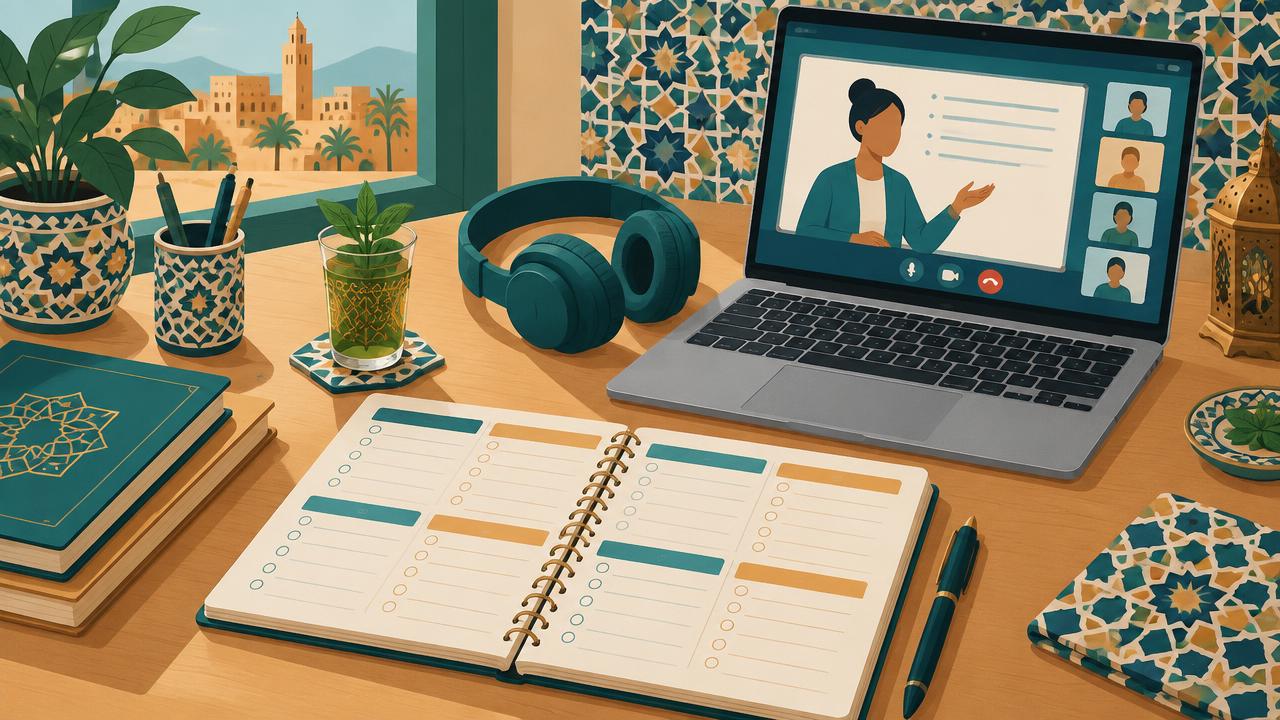
The table below is an example plan, not a rule. Adjust it to your schedule, but keep the balance: live speaking with a teacher, daily listening, daily speaking out loud, and one piece of corrected writing.
| Day | Main task | Time |
|---|---|---|
| Monday | Live class with a teacher | 60 min |
| Tuesday | Listening (podcast or series) + 10 min speaking out loud | 25 min |
| Wednesday | Live class with a teacher | 60 min |
| Thursday | Review your corrections + shadowing a short clip | 25 min |
| Friday | Live class with a teacher | 60 min |
| Saturday | One short written task (email, paragraph, summary) | 20 min |
| Sunday | Rest, or re-record yourself answering 3 questions | 10 min |
The Moroccan starting point: what usually helps and what gets in the way
Most learners in Morocco are not starting from nothing. Many studied English at school, often after French, and most already hear English every day through music, films, games and social media. That passive exposure is an advantage: your ear is often better than you think.
The typical gap is between understanding and producing. School English is mostly graded on reading, grammar and written answers, so many adults can follow a video but struggle to answer a simple question aloud. The plan in this guide is built to close that specific gap.
- Helps: daily exposure to English media, strong reading habits, grammar learned at school
- Helps: speaking Arabic, Darija and often French already, which trains you to switch between languages
- Gets in the way: little speaking practice, fear of being judged, and translating from French word by word
- Gets in the way: long gaps between study periods, which erase speaking fluency quickly
Start with a free trial class
Take a free level test, meet an Englify teacher and get an honest assessment of your English level — with no commitment.
Choosing the right format: group, private or self-study
There is no single best format. The right one depends on your goal, your budget, your schedule and how much correction you need. Many learners combine two: a live class for speaking and correction, and self-study for vocabulary and listening.
| Format | Best for | What to expect | Englify price |
|---|---|---|---|
| Small group class | Steady progress, speaking with others, a fixed routine | 3 sessions a week, 60 min, up to 6 learners | 250 MAD / 1 month, 650 MAD / 3 months, 1,000 MAD / 6 months |
| Private class | A precise goal, a busy schedule, more correction time | 60-minute one-to-one sessions, frequency agreed with you | 100 MAD per hour, or packs of 4/8/12/16/20 h for 500/900/1,200/1,700/2,000 MAD |
| Self-study only | Vocabulary, listening, reading at your own pace | Apps, videos, books; no live correction | Free to low cost |
Your first 90 days, month by month
A three-month plan
Month 1: foundations and habit
Take a placement test that includes speaking, fix your class days, and start a small notebook of useful phrases. The only target this month is to never miss a planned session. Record yourself once at the start answering three questions: introduce yourself, describe your work or studies, and explain why you want English.
Month 2: correction and repetition
Ask your teacher for your three most repeated mistakes and work only on those. Re-use the same phrases in every class until they come out without thinking. Add one short written task a week and have it corrected.
Month 3: pressure and real use
Practise the situations your goal needs: a short presentation, a phone call, a job interview answer, or a timed exam task. At the end of the month, record the same three questions as in month one and compare.
Free and low-cost resources that are worth your time
Free resources are excellent for input: listening and reading. They are weak at the one thing that changes your level fastest, which is being corrected while you speak. Use them to support your classes, not to replace speaking practice.
- Listening: podcasts made for learners at your level, then podcasts made for native speakers once you reach B1
- Series and films: English audio with English subtitles, then no subtitles for scenes you have already seen
- Vocabulary: a spaced-repetition app, filled with phrases from your own classes rather than random word lists
- Reading: short news articles or graded readers; read one piece a day rather than one book a month
- Speaking: your phone's voice recorder, which is free and more honest than any app
Mistakes that slow most learners down
Common habits, and what to do instead
Slows you down
Studying grammar rules for weeks before speaking
Works better
Speaking from the first week, with simple structures you already know
Slows you down
Learning long lists of single words
Works better
Learning whole phrases you can reuse: "I'm in charge of…", "It depends on…"
Slows you down
Changing app, book or method every month
Works better
Keeping one plan for three months, then reviewing it
Slows you down
One long session on the weekend
Works better
Short sessions spread through the week
Slows you down
Translating each sentence from French or Darija
Works better
Answering with short sentences directly in English, then extending them
How to check your progress without guessing
"I feel better" is not a measurement. Pick two or three things you can observe and check them once a month. If none of them move after two months, change something in the plan, such as more speaking time, more correction, or a different class format.
- Speaking: how long you can answer a question without stopping, compared with last month
- Listening: how much of the same video you understand without subtitles
- Accuracy: whether your three most repeated mistakes still appear in your recordings
- Real use: tasks you can now do that you could not before, such as a call, an email or a short presentation
Record the same three questions every month. It is the clearest proof of progress you will get.
When to start with Englify, and what the first steps are
Englify Online Academy teaches English 100% online on Google Meet, from Meknès, to learners across Morocco. Courses cover levels from A0 (complete beginner) to C1. Every session lasts 60 minutes.
The free placement test and the free trial class are two separate steps. The placement test tells you your level. The trial class lets you see how a session works before you decide. After that, you choose a group or private format.
If you pay and change your mind, you can ask for a refund within 14 days of your first class. The details are on the refund policy page.
Frequently asked questions
- Can I learn English in Morocco without traveling abroad?
- Yes. What you need is regular speaking practice with correction, which you can get in live online classes from anywhere in Morocco. Travel helps with immersion, but it is not required to reach B2 or C1.
- Is it too late to learn English as an adult?
- No. Adults are often quicker than children at understanding grammar and building vocabulary; what they usually need is more speaking practice to lose the fear of making mistakes.
- How many hours per week do I need?
- Plan for around 4 to 5 hours a week in total: live classes plus short daily listening and speaking practice. Englify group classes are three 60-minute sessions a week.
- Should I choose a group or private class?
- Groups suit learners who want a fixed routine and speaking with others; Englify groups have up to 6 learners. Private classes suit a precise goal or a busy schedule. Private English costs 100 MAD per hour, or packs from 500 MAD for 4 hours.
- Is the placement test the same as the trial class?
- No. At Englify they are separate steps: the free placement test tells you your level, and the free trial class shows you how a real session works.
- Can I start as a complete beginner?
- Yes. Englify English courses start at A0, for learners with no English at all, and go up to C1.
Mourade Boulanouar
Founder & Head of Teaching, Englify
Founder of Englify Online Academy. He designs the teaching method used in every Englify class and reviews each guide in this knowledge hub.
More about EnglifyStart with a free trial class
Take a free level test, meet an Englify teacher and get an honest assessment of your English level — with no commitment.
Free trial · No card required · Teachers speak English, French & Darija