Knowledge hub
Business English for Meetings That Actually Work
Practical business English for meetings: agenda phrases, interrupting politely, clarifying, summarising, and follow-ups you can use this week.
You join the call on time, the agenda looks simple, and then the conversation moves fast enough that you stop speaking. Someone from London asks for a decision, a colleague in Dubai talks over you, and by the time you find the right words, the meeting has already moved on. That's the core problem with business English for meetings: it's not about knowing more vocabulary, it's about having the right sentence ready at the exact moment you need to interrupt, clarify, disagree, or close.
For professionals in Morocco, the UAE, and other multilingual workplaces, that matters more than most phrase lists admit. The British Council notes that employees in non-English-speaking markets spend an average of 57% of their working time communicating through meetings, email, and chat, and that more than 95% of employers in those markets value English skills, which makes meeting English a working skill, not a classroom topic (British Council business skills source). When you can't contribute clearly, ideas stay half explained, responsibilities stay fuzzy, and follow-up becomes guesswork.
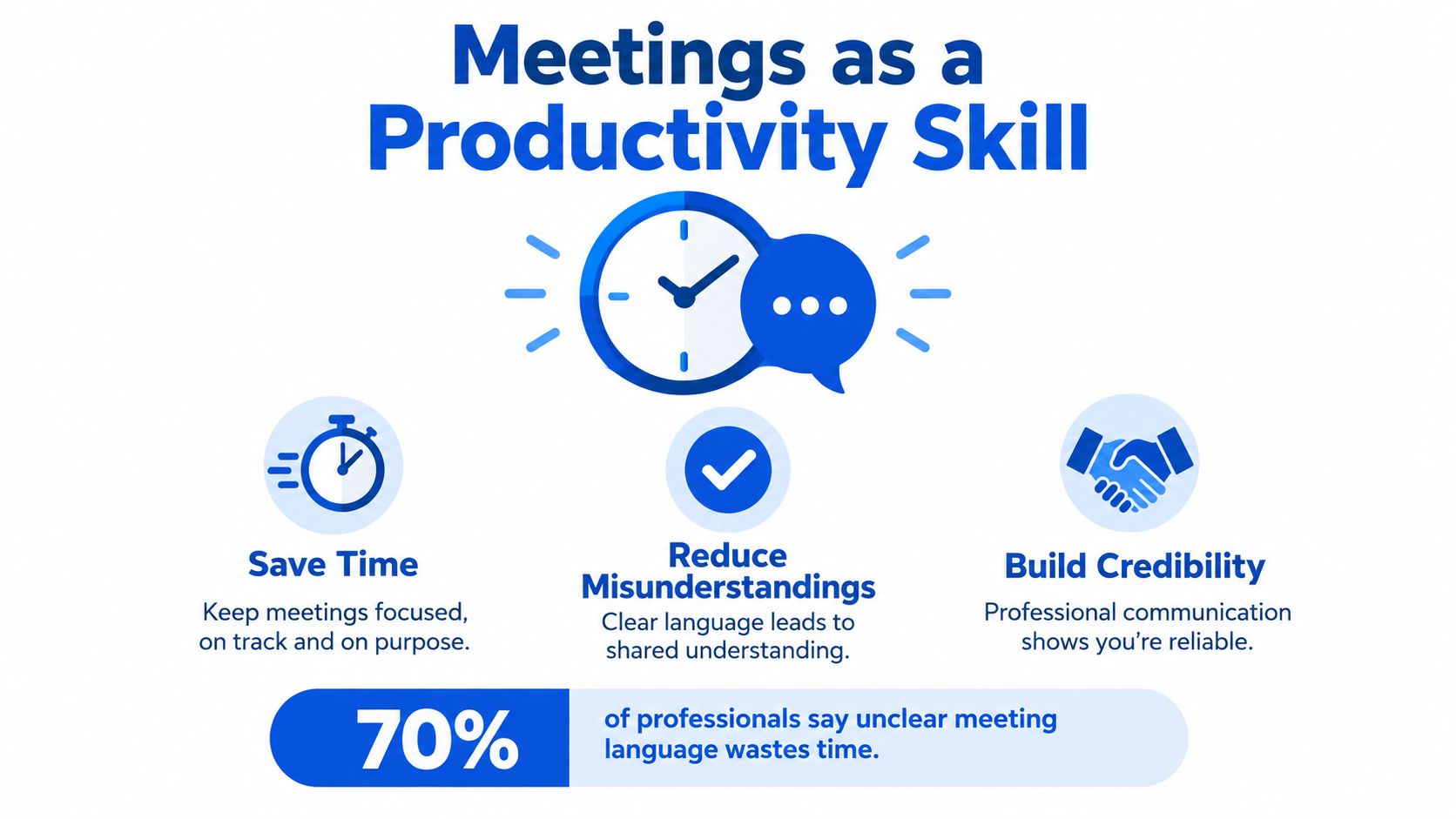
Table of Contents
- Why Business English for Meetings Matters More Than You Think
- The Meeting Lifecycle, Phrases for Before, During, and After
- Interrupting, Clarifying, and Disagreeing Without Sounding Rude
- Speaking Up in Inclusive Meetings and AI-Mediated Calls
- Summarising, Confirming Decisions, and Closing With Clear Follow-Up
- Building a Personal Practice Plan That Sticks
Why Business English for Meetings Matters More Than You Think
A manager in Casablanca can sound fluent in everyday English and still miss the exact moment a decision is being made. In a fast-moving Dubai call, a senior voice can take the floor, the room can move on, and the person with the clearest insight never gets to finish the thought. Meeting English matters because it lets people turn private understanding into shared action, especially when the room is moving quickly.
That point matters more than a generic language label suggests. In real meetings, the problem is rarely a lack of vocabulary. The problem is that a clear question, a short challenge, or a clean summary arrives too late, or not at all. When that happens, the meeting may still end on time, but the outcome is fuzzy, and the next step is left to interpretation.
The useful shift is to stop collecting phrases as isolated lines and start linking them to the exact meeting moment where they work. A phrase for interrupting has a different job from a phrase for disagreeing with a senior colleague. A repair phrase after a misunderstanding has a different job again. That is the practical difference between sounding like you studied meeting English and sounding like someone who runs meetings.
One reason this matters is that meetings are not just talk, they are decision points. Harvard Business Publishing recommends framing agenda items as questions the group has to answer, because that gives the discussion a target (Harvard Business Publishing). That same logic applies to speaking inside the meeting. If you can state the issue, ask for clarification, or confirm ownership in simple English, the group can move. If you stay silent because you are searching for a textbook-perfect sentence, the decision often moves without you.
A practical example makes the gap obvious. A Casablanca manager may know exactly why a proposal needs one more review, but if the right sentence does not come out in time, the room hears agreement by default. A short line like “I'm not ready to sign off yet, because one dependency is still open” does more work than a polished paragraph said after the moment has passed. In meetings, timing changes the value of the sentence.
The same applies to closing. A meeting that ends with vague goodwill creates more work later, because people leave with different interpretations of what was agreed. Clear meeting English keeps that from happening. It helps you name the decision, assign the next action, and leave no doubt about who owns what.
The Meeting Lifecycle, Phrases for Before, During, and After
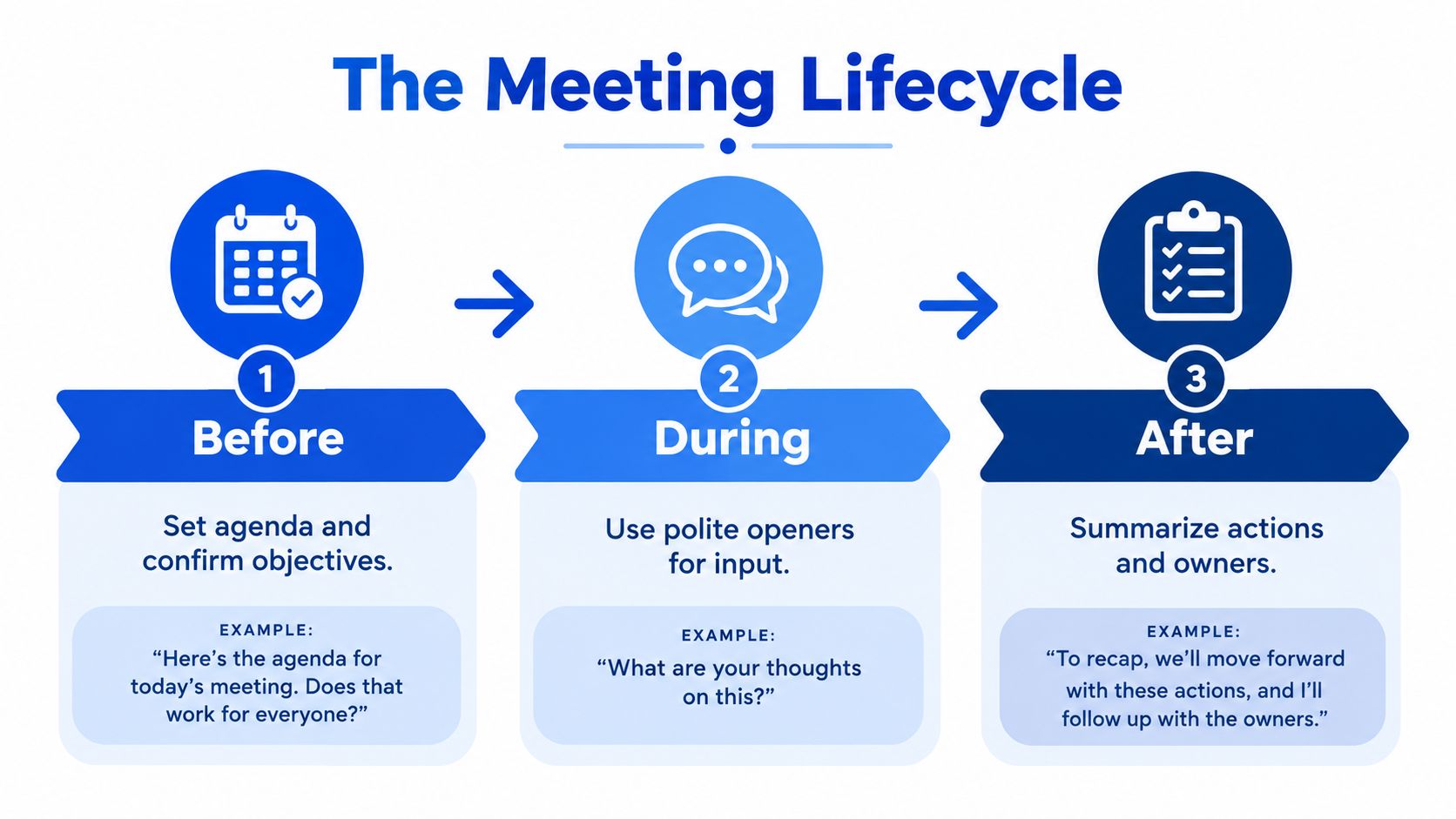
The easiest way to improve meeting English is to stop sorting phrases by grammar and start sorting them by timing. Before the call, you are setting expectations. During the call, you are steering the discussion. After the call, you are turning agreement into recordable action.
Before the meeting
A good pre-meeting message does more than send a calendar invite. It tells people what they should do before they join, whether that means reading a document, preparing feedback, or checking whether the timing works across time zones. If you need to request input before the meeting, keep the ask direct: “Please review the attached notes before the call” or “Can you confirm whether this time works in your timezone?”
That matters because the meeting starts before anyone speaks. If people arrive cold, they spend the first ten minutes catching up instead of discussing the issue.
Use phrases like these to set the meeting up cleanly:
- For pre-reading: “Please review the attached deck before we meet.”
- For timing: “Can you confirm whether this slot works for your team?”
- For input before the call: “If you have comments, send them through beforehand.”
- For preparation: “I'd like everyone to come ready with one question.”
The wording should sound like something you would send to a colleague, not a template. Short instructions are easier to act on, and they usually sound more confident. For email language that follows the same principle, see English professional emails.
During the meeting
The middle of the meeting needs signposting. That is the language that tells listeners where the discussion is going, especially when the call runs long or people join late. Phrases like “the main issue is,” “to summarise,” and “let's move to the next point” keep the room aligned.
A few lines sound natural in real calls:
- Opening the discussion: “Thanks, everyone. The main issue today is the rollout date.”
- Moving between topics: “That point is clear. Let's move to the budget.”
- Bringing the group back to the goal: “We still need a decision on ownership before we close.”
Textbook English often sounds stiff here. “We shall now proceed to the next subject” is grammatical, but it does not sound like a manager running a live meeting in 2026. “Let's move to the next point” does the job faster and feels usable in real time.
After the meeting
Closing language should make follow-up easy to write and easy to check. A useful meeting ends with decisions, owners, and a next step that can be copied into email or chat. “To recap,” “I'll share the minutes,” and “we've agreed that” are the phrases that make that handoff straightforward.
Keep this habit: if the action cannot be repeated back in one sentence, it is probably not clear enough yet.
The value of this structure is practical. You stop hunting for one perfect phrase for every moment and build a small set for setup, discussion, and close. That is what makes meeting English usable under pressure, especially when the room is moving quickly and everyone needs to know what happens next.
Interrupting, Clarifying, and Disagreeing Without Sounding Rude
Most learners already know how to say “I agree” and “thank you for your time.” The hard part is getting into the conversation when the room is moving too fast. That's where interrupting politely, clarifying confidently, and disagreeing without losing status matter more than perfect grammar.
Research on global teams found that language anxiety and frustration can create an “us versus them” dynamic between native and non-native speakers, and that some employees cope by avoiding meetings altogether (Harvard Business School Working Knowledge). That's exactly why repair language matters. It gives you a way back into the discussion when something is unclear, rushed, or subtly hostile.
Interrupting and clarifying
The goal is not to sound formal. The goal is to sound calm and useful.
Too stiff: “I would like to interrupt if I may.”
More natural: “Sorry to jump in, but can I add one quick point?”
Too stiff: “I beg your pardon, but I didn't understand.”
More natural: “Just to make sure I'm following, could you unpack that last point?”
Too stiff: “Could you repeat that, please?”
More natural: “Could you say that one more time, just so I've got it right?”
That last pattern is the one many fluent colleagues use without thinking. It works because it treats clarification as normal meeting behavior, not as a confession of weakness. In a fast call, that tone matters.
Disagreeing with senior colleagues
Disagreement usually lands better when you first acknowledge the goal, then challenge the method.
- Soft but clear: “I see the goal, but I'm not sure this approach gets us there.”
- More direct: “I'm not fully convinced this timeline works for the team.”
- Useful in hierarchy-heavy rooms: “That's a fair point. Could we also look at the risk on the delivery side?”
The key is to keep the content sharp and the form polite. “I'm sorry, but I have to disagree” can work, but it often sounds heavier than needed. In many 2026 calls, “I see where you're coming from, but I'd look at it a different way” sounds more natural and less defensive.
If you want to practice those moves in a structured setting, a business English negotiations guide is useful because the same language patterns show up whenever people push back, compare options, or defend a proposal. The actual topic changes. The conversational mechanics don't.
Speaking Up in Inclusive Meetings and AI-Mediated Calls
Better English helps, but the meeting environment matters too. If people get the agenda late, the call starts late, or one speaker dominates for twenty minutes, even strong language skills won't fix the imbalance. Inclusive meeting habits give non-native speakers a fairer chance to contribute.
Microsoft's research on remote-meeting practices links effective meetings with behaviors like sharing an agenda in advance, starting and finishing on time, making clear who's attending and why, encouraging appropriate video use, and providing pre-reading when needed (Microsoft). Those are not cosmetic habits. They shape who gets to think, prepare, and speak.
Phrases that support inclusion
If you need to ask for a better setup without sounding confrontational, use plain language.
- For an agenda: “Could you send the agenda before the call so I can prepare?”
- For the objective: “Just so I'm clear, what do we need to decide by the end?”
- For turn-taking: “Can we hear from the other side before we decide?”
- For pacing: “Could we slow down a little on that point?”
Those phrases do two things at once. They protect your own access to the discussion, and they model the kind of meeting behavior you want from others. That's especially useful in multilingual teams, where the fastest speaker is not always the clearest one.
AI note-takers change what people say
AI recording tools have changed meeting behavior fast. A 2025 survey reported that 75% of professionals use an AI note-taker in work meetings, 47% of users have experienced unintended recording or sharing, and 84% say they change what they say when a note-taker is present (Fellow AI). That means meeting English now includes a privacy layer, not just a speaking layer.
| Meeting situation | Best phrase categories to use | Behaviour to model |
|---|---|---|
| Recording may be active | Consent, clarification, privacy | Ask before sensitive discussion |
| Transcript looks wrong | Correction, repetition, confirmation | Restate names and numbers clearly |
| Someone speaks off the record | Boundary-setting, refusal, redirection | Move confidential topics elsewhere |
| You need a clean action log | Summary, ownership, deadline | Name the owner and the date |
| The conversation moves too fast | Interruption, pacing, paraphrase | Slow the room down politely |
| You want to include quieter voices | Invitation, turn-taking, confirmation | Invite input by name |
When a note-taker is present, speech has to be clearer, not longer. Names, dates, acronyms, and owners should be easy to hear and easy to transcribe. A useful line is, “Before we go on, can we confirm the exact owner and deadline?” It helps both the humans and the transcript.
Summarising, Confirming Decisions, and Closing With Clear Follow-Up
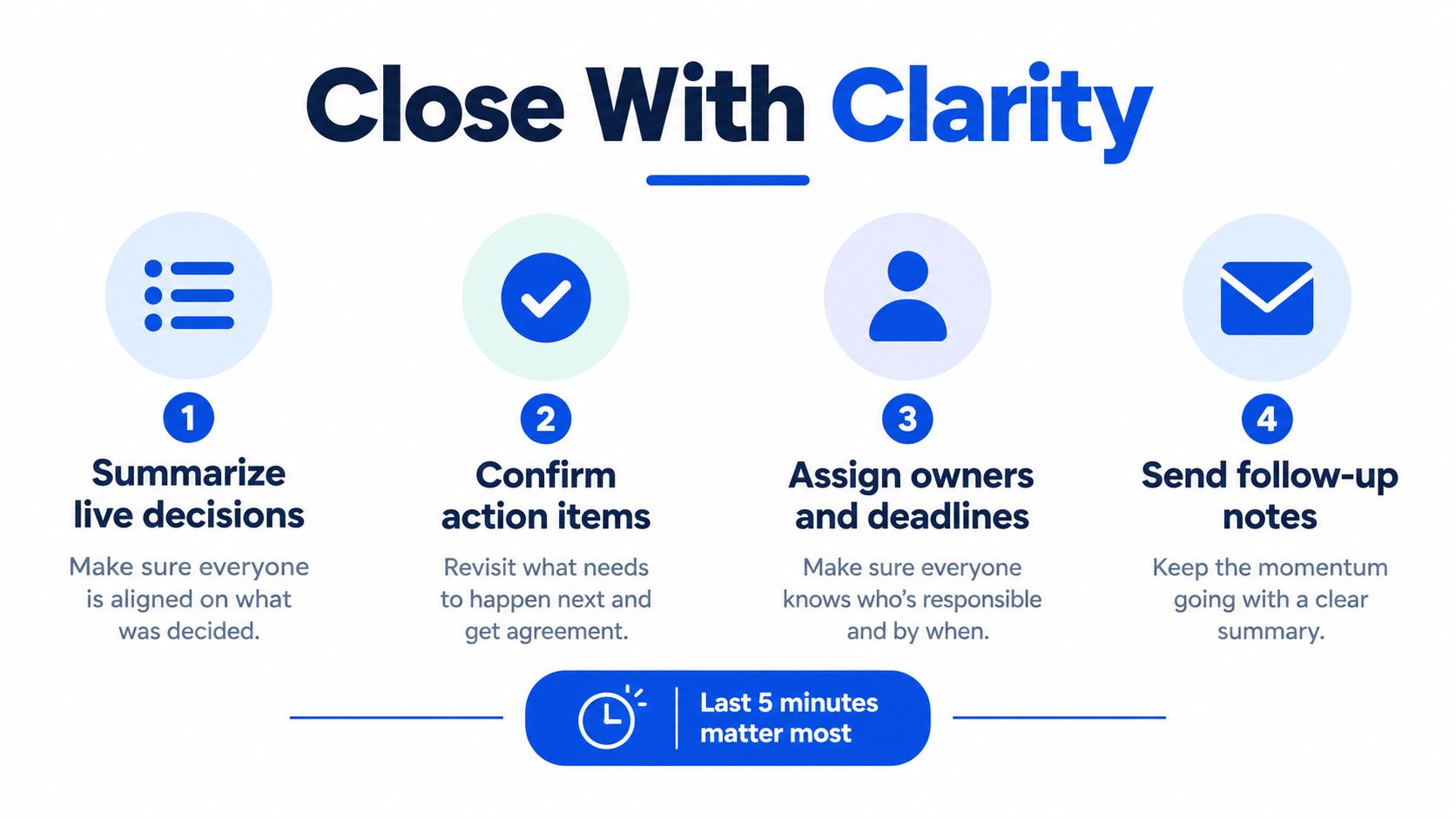
The last five minutes of a meeting decide whether the hour was useful. If the close is vague, people leave with different memories of the same conversation. If the close is tight, the follow-up email almost writes itself.
Microsoft's research on speech-based meeting analysis found that action items scored only a mean of 2.23 per item in evaluation, which shows how often teams discuss work without saying exactly what happens next (Microsoft Research). That's not a grammar problem. It's a clarity problem.
A close that actually works
The simplest closing routine is also the most reliable.
- Summarise live: “So far, we've agreed on the scope and the launch target.”
- Confirm decisions: “The final decision is to keep the current timeline.”
- Assign ownership: “Samira will send the revised proposal by Thursday.”
- End cleanly: “I'll share the minutes after the meeting.”
That sequence matters because each line removes a different kind of ambiguity. The summary checks shared understanding. The decision line locks the outcome. The owner-and-deadline line turns discussion into action. The final line creates a written record that people can work from.
What weak closings sound like
Weak closings often sound busy but leave the room unclear.
Vague: “We'll follow up on the next steps.”
Better: “Ali will send the updated file by Tuesday, and Sara will review it on Wednesday.”
Vague: “Let's keep talking offline.”
Better: “Let's take the confidential part to email and keep the action items here.”
Vague: “Thanks, everyone.”
Better: “Thanks, everyone. I'll circulate the notes and the deadlines this afternoon.”
A clean close is also the easiest place to sound professional without sounding formal. You don't need extra polish. You need ownership, timing, and one sentence that anyone on the call could repeat back.
Building a Personal Practice Plan That Sticks
Improvement in meeting English happens through repetition tied to real meetings, not through passive reading. Since executives today spend nearly 23 hours per week in meetings, compared with fewer than 10 hours per week in the 1960s, the amount of speaking practice you need is tied to the amount of meeting time modern work demands (Austin Community College business communication chapter). That's why a practical routine beats a one-off burst of motivation.
A simple weekly routine
Use a small practice loop that fits into your actual calendar.
- Shadow one short meeting recording. Listen for how people interrupt, soften disagreement, and close.
- Rehearse three interruption phrases. Say them out loud until they stop feeling rehearsed.
- Run a two-minute role-play. Use a real agenda item from your week.
- Review one phrase after each meeting. Ask yourself, “What would I say differently next time?”
For learners who prefer solo work, practising English speaking alone is still useful if it includes real meeting language and spoken repetition, not just silent review. The point is to train your mouth, not just your eye.
Self-study or a structured course
Self-study works when you already know your weak spots and you can rehearse consistently. A structured programme helps when you need live correction, accountability, and pressure-tested speaking with other people in the room. In a business context, that usually means you need both fluency practice and feedback on phrasing, pronunciation, and timing.
Englify offers live online classes on Google Meet, including small-group and private options, CEFR-based levels from A0 to C1, and a free placement test plus a free trial session. For professionals who want meeting practice with correction while speaking, that kind of live format is easier to use than trying to build every scenario alone. The goal is not to collect more notes, it's to make the right sentence come out naturally when the meeting gets tense.
If you want to speak more confidently in meetings, use Englify's live online English classes to practice the exact situations that matter, interrupting, clarifying, disagreeing, and closing with clear action items. Visit Englify to book a free placement test or a free trial session, and start turning your meeting English into something you can rely on.