Knowledge hub
Why Are Words Important in Business English
Why are words important in business English? Discover how precise vocabulary shapes clarity, productivity, trust, and outcomes at work, with practical examples.
You can write a grammatically correct email and still lose your reader. One wrong verb, one vague deadline, or one overly blunt sentence can turn a simple update into a five-message thread, and by then the meeting room is already crowded with confusion.
That's why why are words important in Business English isn't a grammar question, it's a workplace question. In a real job, the words you choose affect time, trust, accuracy, and action, and that's why careful vocabulary matters in emails, meetings, presentations, interviews, and AI-assisted writing. If you work with clients, suppliers, or colleagues across borders, the right wording helps your message land the first time.
Table of Contents
- A Meeting That Nearly Went Sideways
- What Business English Vocabulary Covers
- Why Word Choice Drives Real Business Outcomes
- Vague Words Versus Precise Words at Work
- The Relationship Cost of Choosing the Wrong Words
- Building Your Own Business English Collocation Bank
- Editing AI Drafts So They Still Sound Like You
- Frequent Questions About Workplace Vocabulary
A Meeting That Nearly Went Sideways
A project lead sends a short message before a team call: “Please handle the client issue soon.” Everyone reads it differently. One person thinks it means today, another thinks it means this week, and the client-facing colleague assumes someone else will take ownership.
The call starts with a debate that should have been avoided. Twenty minutes later, the team still hasn't agreed on who will act, what will be sent, or when it's due.
That's the reason Business English vocabulary matters. The wrong verb, a vague deadline, or an unclear subject can create extra work even when everyone is intelligent and experienced. In many offices, the problem isn't a lack of English knowledge, it's that the words are too loose for the task.
Practical rule: if a sentence could be interpreted two ways, it usually needs a better verb, a clearer owner, or a specific deadline.
For learners and professionals, this changes the goal. You're not trying to sound “advanced” by using bigger words. You're trying to make the next action obvious, so the team doesn't waste time guessing.
That's the logic behind this guide, and it's also why an internal resource like Business English for meetings is useful in practice, because meetings expose vague wording very quickly.
The takeaway is simple. In the workplace, words are not decoration. They're part of the operating system.
What Business English Vocabulary Covers
Business English vocabulary is more than a list of “professional” words. It includes word choice, register, collocations, and phrasing, and each part shapes how your message lands and how people respond.
The four parts that matter
Word choice decides which term fits the situation. “Discuss” may suit a meeting, while “finalize” fits a handover note. If you say “fix the problem” in a casual team chat, people may understand you, but “resolve the issue” sounds more standard in a work context.
Register is the level of formality. A quick message to a teammate can be direct, while a note to a client usually needs softer wording. Register matches the relationship and the setting, and politeness is only one part of that choice.
Collocations are word pairs or chunks that sound natural together. People usually say meet a deadline, allocate resources, or reach an agreement, not random alternatives built word by word. That is why memorizing isolated nouns often helps less than learning the phrase around them.
Phrasing is how you shape the whole sentence. “I need this today” may be fine internally, but “Could you send this by the end of today?” changes the tone while keeping the request clear.
A simple workplace example makes the difference obvious. In a project chat, “The report is late” tells the team there is a problem. “Please send the revised report to finance by 3 p.m. Thursday” tells them what to do, who needs it, and when it is due. One version reports a problem. The other gives clear action.
Why Word Choice Drives Real Business Outcomes
Words shape business outcomes because they change how quickly people understand, decide, and respond. Clearer language reduces friction, and friction is expensive in offices where every misunderstanding creates another email, another call, or another round of edits.
One plain-language comparison involving U.S. naval reports found that officers read the clearer version 17.2% faster, and the study estimated that applying plain language to all naval memos could save approximately US$26.5 million in staff time each year, based on officers' wages and a baseline of 50 pages read weekly. A separate organizational example recorded a 10.5% reduction in call duration, a 77.1% decrease in employee errors, and a 36.9% increase in overall productivity after improving communication clarity from the plain-language evidence base.
These figures matter because the workplace effects are easy to recognize even without a spreadsheet. Clearer wording can shorten meetings, reduce clarification emails, prevent rework, and help customers act correctly the first time. In multilingual companies, it also helps information move more smoothly between headquarters and local teams, which is why shared terminology is more than a school topic, it's a coordination tool for multinational language flow.
Why this matters in daily work
- Fewer delays: Clear instructions reduce back-and-forth.
- Cleaner handovers: The next person understands what happened and what comes next.
- Better customer response: Clients can act without asking for a second explanation.
- Less rework: Teams spend less time correcting avoidable mistakes.
For readers who want to connect this to workplace communication more broadly, business English for communication is where these habits show up across email, speaking, and collaboration.
The point is not that one word magically changes a company. The point is that thousands of small wording choices shape how fast work moves.
Vague Words Versus Precise Words at Work
Vague wording often sounds harmless because it's short. In practice, it pushes the burden onto the listener, who has to guess what “soon,” “improve,” or “deal with it” really means.
Precise wording does the opposite. It names the action, the owner, the deadline, and sometimes the expected format. That makes the message easier to act on, and it usually sounds more professional too.
Side-by-side rewrites
| Vague wording | Precise workplace alternative | Best context |
|---|---|---|
| Handle this soon | Please send the revised file to the finance team by noon Tuesday | Emails, task requests |
| Improve the report | Revise the summary section and add the latest figures before sharing it | Draft feedback |
| Follow up with them | Call the supplier this afternoon and confirm delivery timing | Vendor coordination |
| Let's discuss it later | Please bring the pricing question to Friday's meeting | Meeting agendas |
| Deal with the issue | Escalate the complaint to the customer service manager now | Service recovery |
A few sentence pairs show the shift clearly.
“Can you deal with this soon?” becomes “Could you send the signed PDF to finance by noon on Tuesday?” The second version gives the reader a task they can complete.
“I think the presentation needs work” becomes “Please tighten the recommendation slide and remove the duplicated chart.” That version is easier to edit, because the action is visible.
“We should improve communication” becomes “Please post the weekly update in the team channel every Monday morning.” Now the expectation is concrete.
Clear business wording doesn't need to sound stiff. It needs to be specific enough that the other person knows what success looks like.
The habit to build is simple. When you draft a message, ask yourself: what exactly do I want this person to do, by when, and in what format? If the answer isn't visible in the sentence, the sentence probably isn't ready.
The Relationship Cost of Choosing the Wrong Words
Simpler words are not always better. In multicultural teams, a sentence can be grammatically correct and still land badly if it sounds too harsh, too vague, or too distant.
Compare these pairs. “You must send this today” is direct, but it can sound controlling. “Could you send this by the end of today?” keeps the request clear while leaving room for cooperation. “I disagree” is clean and brief, but “I see it differently” often protects the working relationship when the topic is sensitive.
Tone tools that matter
Modal verbs help you control force. “Will” sounds firmer than “may,” and “could” often softens a request without removing it.
Hedging gives you room to be precise without sounding absolute. Phrases like “I think,” “it seems,” or “might be worth” are useful when you need to challenge an idea carefully.
Politeness markers such as “could you,” “please,” and “would you mind” are not weak language. They help manage hierarchy, urgency, and trust.
Workplace communication also takes up a large share of the day, with meetings, email, and chat accounting for an average of 57% of working time in the British Council's cited business material as noted in British Council business guidance. That means tone choices repeat every day, not once a month.
A helpful distinction is this. Grammatical clarity tells people what the sentence means. Pragmatic fit tells them whether the sentence suits the person, the relationship, and the moment. Good Business English needs both.
Building Your Own Business English Collocation Bank
A collocation bank gives you ready-made phrase chunks for the moments that matter most at work. Instead of collecting isolated words, you store phrases by situation, so the right wording is easier to reach under pressure.
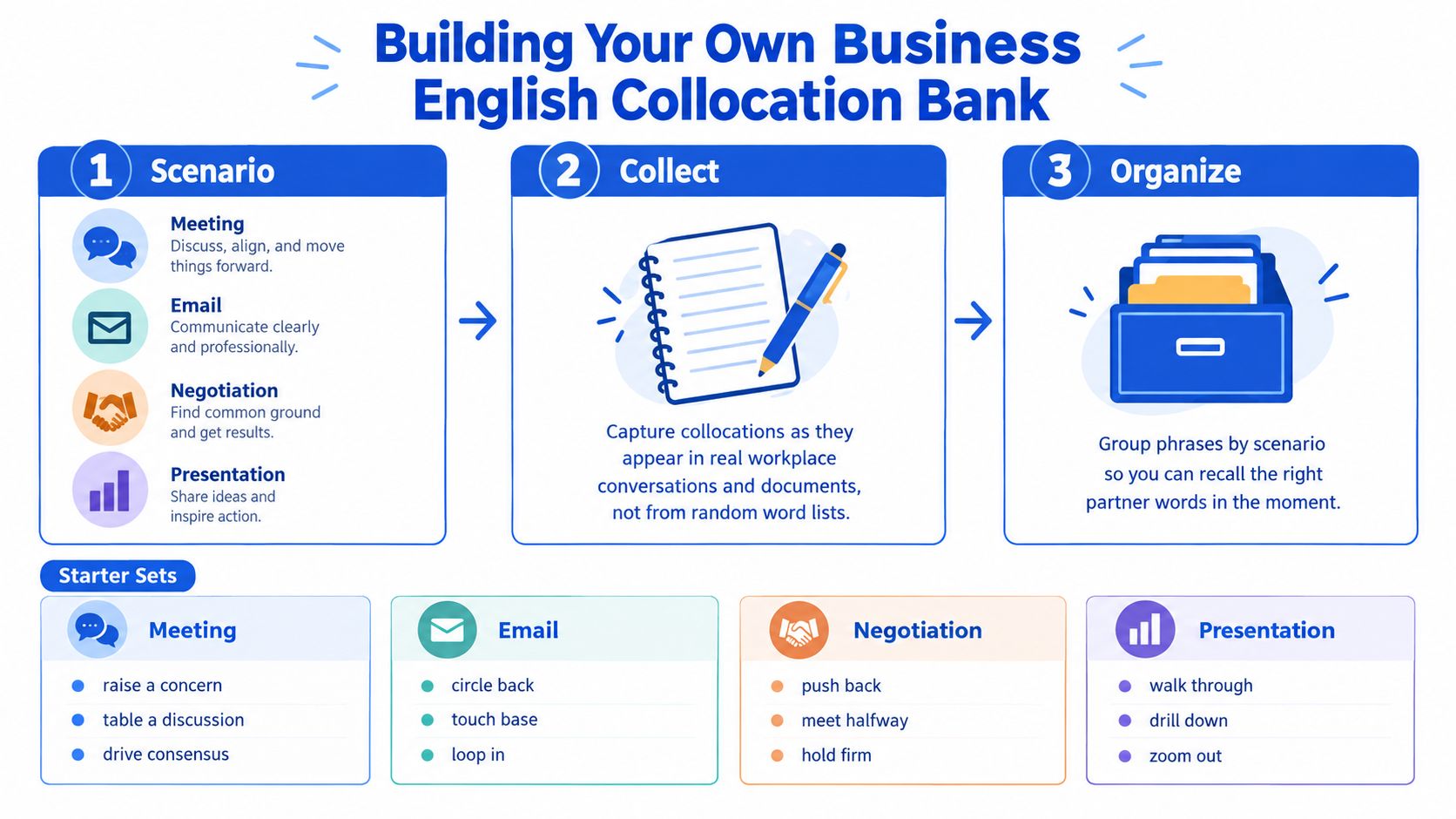
Start with the situations you face every week
A meeting needs different wording from an email. For meetings, phrases like open the floor, drive the agenda, and park the topic help you guide the discussion instead of hunting for words while others wait.
Email needs its own set. Build around flag a risk, share an update, and request approval. These cover a lot of workplace writing and keep the message short and clear.
Presentations call for a different rhythm. Phrases such as deliver the headlines, walk through the data, and land the recommendation make the structure easier to follow.
Interviews need language that sounds prepared but natural. Collect expressions like highlight impact, walk through my background, and close on next steps so you can answer without translating live in your head.
A simple system works well:
- Capture phrases when you hear them in real work conversations.
- Group them by scenario so your brain links the phrase to the task.
- Recycle them in short role-plays until they come out naturally.
For readers who want more examples of work-ready phrase sets, this guide to Business English words can sit beside this method as a practical reference.
Aim for a small bank of phrases you can use in your next meeting, email, or interview without freezing.
Editing AI Drafts So They Still Sound Like You
AI can speed up a first draft, but the result can still sound flat, stiff, or strangely generic. That tone stands out fast in feedback, congratulations, complaints, and thank-you notes, where readers expect some human judgment, not a template that was filled in.
The concern is not just style. A 2025 survey reported that 30% of workers used AI to write emails or reports, and 32% used conversational AI tools at work in the 2025 workplace AI report. In a University of Florida study summary, messages with high AI assistance were seen as sincere by only 40%–52% of supervisors, while low-assistance messages reached 83%; perceived professionalism also dropped from 95% to 69%–73%. Those numbers explain why a draft can read smoothly and still feel off.
A quick editing routine
Start with the verbs. If a draft says “utilize” or “facilitate,” replace them with clearer choices like “use” or “support.” Strong business English often depends on the verb doing the right job, the way a well-set tool controls the job in a workshop.
Then add one human marker. A short personal reference, a real project detail, or a first-person line helps the note sound like it came from a person who was in the work.
Tone matters too. A congratulations note, a complaint, and an interview follow-up should not all sound as if they were written for the same inbox.
A few practical rewrites show the difference:
- “I appreciate your support on the initiative” can become “Thanks for helping with the client proposal yesterday.”
- “We regret the inconvenience caused” may feel too flat for a close working relationship, so “I'm sorry this caused trouble on your side” often sounds more natural.
- “Please find my attached application” can be rewritten as “I've attached my application, and I'd be glad to discuss the role further.”
If a message reads smoothly but sounds like nobody you know would say it, keep editing.
The skill lies in judging, personalizing, and correcting the draft so it stays clear and still sounds credible.
Frequent Questions About Workplace Vocabulary
How long does it take to feel the difference at work?
Usually, the first change shows up when your messages become easier to act on. You'll notice fewer follow-up questions when your verbs, deadlines, and owners are clearer.
Does memorizing word lists help?
Only a little. Lists help recognition, but workplace fluency comes from using phrases in real tasks, especially meetings, emails, presentations, and interviews.
How can I practise if my daily life isn't in English?
Use short, repeated tasks. Rewrite one email, prepare one meeting update, or rehearse one answer out loud. If you need guided practice, a free placement test or a free trial session with a structured Business English focus can help you see your current level before you commit to a course.
Which scenarios give the fastest return?
Start with client updates, interviews, and meetings. Those situations force you to be clear, polite, and specific, which means the vocabulary pays off quickly.
What should I focus on first if I often sound too direct?
Work on modal verbs, hedging, and polite requests. They let you keep the message firm without making it sound harsh.
For learners who want live practice, Englif y offers online Business English classes through Google Meet, including small-group and private options, with CEFR-based levels, placement support, and personalized work on meetings, emails, presentations, and interviews. If you want a structured way to turn clearer wording into stronger workplace communication, visit Englify and see whether a placement test or trial session fits your current goals.