Knowledge hub
Business English for Communication: Skills That Work
Sharpen your business English for communication with practical skills for emails, meetings, presentations, and calls. Clear examples and workplace tips.
You're in a video meeting with a client in another country. You understand the project, but the discussion moves quickly. You wait too long to speak, send a vague follow-up email, and leave everyone unsure about the next step. In the same situation, a colleague uses a clear sentence, confirms the decision, and sends a short summary. The difference isn't perfect grammar. It's practical communication.
Business English for communication is the practical English used across emails, meetings, calls, and presentations to get work done. It helps you explain an idea, ask for action, clarify a misunderstanding, negotiate a deadline, and make your contribution visible. This guide focuses on four workplace channels and turns each one into repeatable language habits, with examples you can use whether you work in Casablanca, Dubai, or with colleagues abroad. For a broader view of workplace language skills, see this guide to Business English for professionals.
Table of Contents
- Why Business English for Communication Matters at Work
- The Four Channels You Use Every Day
- Writing Clear and Effective Business Emails
- Speaking Confidently in Business Meetings
- Handling Phone and Video Calls with Clarity
- Presenting in English with Structure and Impact
- Building a Weekly Practice Routine That Sticks
Why Business English for Communication Matters at Work
A project manager sends this message to a supplier:
“Please send the updated quotation by Thursday at 3 p.m. Include delivery costs and confirm whether the installation date remains available.”
The supplier knows what to provide, when to provide it, and which detail needs confirmation. Compare that with, “Could you maybe send us the new offer soon, with the other information?” The second message sounds polite, but it leaves the action, timing, and required details unclear.
English has become a working language across international organizations. A Cambridge English report discussed in a Springer Nature publication estimates that 85% of international organizations use English as one of their working languages. In countries where English isn't a native or official language, more than two thirds of employers say English matters for their business, and the report notes that English skills are important for over 95% of employers in many non-English-speaking countries.
That makes Business English a workplace skill, not a niche academic subject. Reading leads in 12 industries, while speaking leads in 8 industries, according to the same report. Professionals need both channels because a strong email may prepare a meeting, a meeting may lead to a call, and a presentation may determine whether a proposal receives support.
Communication matters more than grammar perfection
Grammar still matters, but workplace success usually depends on whether people can understand your point and act on it. A message with a small article error can work perfectly if the request is specific. A grammatically polished message can fail if nobody knows what to do next.
In training sessions, I encourage professionals to build four habits:
- State the purpose early: Tell the listener or reader why you're contacting them.
- Use a clear sentence frame: Keep reliable phrases ready for requests, disagreement, clarification, and summaries.
- Confirm meaning: Don't assume that silence means understanding.
- Close with action: Name the person, task, and timing when a decision has been made.
These habits support client trust, team efficiency, and professional confidence. They also make it easier to participate when English isn't your first language. You don't need to sound like a textbook. You need language that works under pressure.
The Four Channels You Use Every Day
Workplace English doesn't happen only in formal presentations. A 2026 study on digital pragmatics in Business English reported that 85.7% of respondents used email, 71.4% used meetings, and 71.4% used presentations. The same data recorded video-conferencing use at 66.7%, instant messaging at 54.8%, and both spoken and written communication at 61.9%. These figures appear in the Business English workplace usage overview.
The practical lesson is to prioritize channels by both frequency and consequence. Email usually creates the highest volume of daily work. Meetings often carry the biggest decisions. Calls demand fast listening and immediate clarification. Presentations put your message in front of an audience, so structure and confidence become highly visible.
| Channel | Typical Frequency | Stakes | CEFR Target |
|---|---|---|---|
| Very frequent in routine coordination | Clear tasks, records, deadlines | B1 for clear transactional writing, B2 for tactful requests | |
| Meetings | Frequent, with concentrated decision-making | Agreement, disagreement, ownership | B1 for contributing, B2 for managing discussion |
| Phone and video calls | Regular real-time clarification | Accurate listening and immediate response | B2 for clarification, C1 for interruptions and complex discussion |
| Presentations | Less frequent, but highly visible | Influence, credibility, audience questions | B2 for structured delivery, C1 and above for difficult Q&A |
The CEFR, or Common European Framework of Reference for Languages, describes language ability across six levels, from A1 to C2, grouped into basic, independent, and proficient users. The British Council explanation of CEFR levels provides the framework behind these targets.
Don't try to improve every channel equally at once. Start with the channel that creates the most friction in your current role. If you write dozens of emails but avoid one sentence in meetings, improve email structure first while adding a small speaking goal. If calls regularly leave you uncertain, listening and clarification deserve priority.
The following sections turn each channel into a compact system. You'll find reusable sentence frames rather than long grammar explanations.
Writing Clear and Effective Business Emails
A useful business email lets a busy reader answer three questions quickly: Why are you writing? What do you need? When is it needed? Build the message around those questions.
Use a dependable email structure
A practical structure looks like this:
- Subject line: Name the topic and, when useful, the action.
- Greeting: Match the relationship and level of formality.
- Purpose sentence: Explain the reason for writing immediately.
- Details or request: Give only the information needed for action.
- Next step: State the deadline or expected response.
- Sign-off: Close professionally and identify yourself.
Formal and neutral openings both have a place. “I hope this finds you well” can suit a formal external message, while “Quick question about Thursday's agenda” is natural for a familiar colleague. The right choice depends on the relationship, not on a fixed rule that one phrase is always better.
Consider this unclear request:
“Hi, can you send me the information about the event when you have time? We need it for the team. Sorry for the late message.”
A clearer version gives the recipient an action and a deadline:
Subject: Event agenda for Thursday
Hi Samira,
Could you send me the final event agenda by Wednesday at noon? Please include the speaker names, session times, and room details. I'll share the completed version with the team after that.
Best,
Youssef
The second email is more direct without sounding rude. It removes unnecessary apology, replaces “the information” with specific items, and gives the recipient a clear time. At B1, this kind of structure supports clear transactional writing. At B2, you can add tact when negotiating a request: “Would it be possible to send the revised version by Wednesday at noon? If not, please let me know what timing would work.”
Watch the tone traps
Over-apologizing can make a normal request sound like a burden. Vague verbs such as “handle,” “look at,” or “sort out” can also hide the action you need. If a deadline matters, write it plainly instead of hoping the reader notices it in a long paragraph.
Use this immediate checklist before sending:
- One purpose: Is the email mainly asking, informing, confirming, or resolving one issue?
- Specific action: Can the reader identify exactly what you need?
- Clear deadline: Have you written a date or time when timing matters?
- Single point of contact: Does the reader know who will receive the reply or own the next step?
The guide to professional email writing offers a useful next resource for practicing this channel.
Speaking Confidently in Business Meetings
A meeting contribution doesn't need to be long. It needs a clear function. You may be opening the agenda, adding a point, challenging an idea, or confirming action. Prepare a sentence frame for each function so you aren't translating every thought word by word.
Four moves that keep you active
Open the agenda. Use a phrase that gives the group direction:
- “Let's start with the delivery timeline.”
- “The main point for today is the client feedback.”
- “Could we first confirm the priorities for this week?”
Contribute a point. Signal your idea before explaining it:
- “I'd like to add one point.”
- “From the operations side, the main concern is capacity.”
- “My recommendation is to test the revised process first.”
Disagree politely. Separate the idea from the person:
- “I see the benefit, but I'm concerned about the timing.”
- “I'm not sure that approach will solve the main issue.”
- “Could we consider another option before we decide?”
Close with action. Turn discussion into ownership:
- “So, Amine will confirm the figures, and I'll update the document.”
- “To recap, we've agreed to move the launch meeting.”
- “Are we comfortable assigning this to the sales team?”
A hesitant version might be: “I'm not completely sure, but maybe we could perhaps look at another option?” A more decisive version is: “I recommend that we review another option before approving this.” The second sentence remains respectful, but it gives the group something clear to consider.
Hold the floor and make space
To interrupt politely, use “Can I add something here?” or “May I clarify one point?” If someone interrupts you, keep your turn with “Let me finish this point, and then I'll come to you.” When a colleague speaks too quickly, say, “Could we pause there so I can make sure I've understood the decision?”
Recapping helps colleagues who are joining from different language backgrounds. It also protects the project from assumptions:
Practical rule: If a decision affects a deadline, write or say the decision, owner, and next action before the meeting ends.
Keep a phrase wallet on your phone. After each meeting, save five useful expressions and reuse them during the same week. Repetition turns a phrase from something you recognize into something you can produce naturally.
For more targeted practice, see English phrases and strategies for meetings. After your next meeting, ask yourself: Did I open the discussion, contribute a point, disagree once when necessary, and close with an action?
Handling Phone and Video Calls with Clarity
Calls expose a listening problem that email can hide. You can reread an email, but you usually need to understand a call while the speaker continues. The EF English Proficiency Index discussion of the workplace skills gap reports that listening trails reading by more than 20 points globally, while speaking remains the weakest overall skill even in relatively high-proficiency countries.
That gap matters when people use unfamiliar accents, poor connections, background noise, or overlapping speech. Strong call communication isn't only about speaking clearly. It's about controlling the conversation when comprehension becomes difficult.
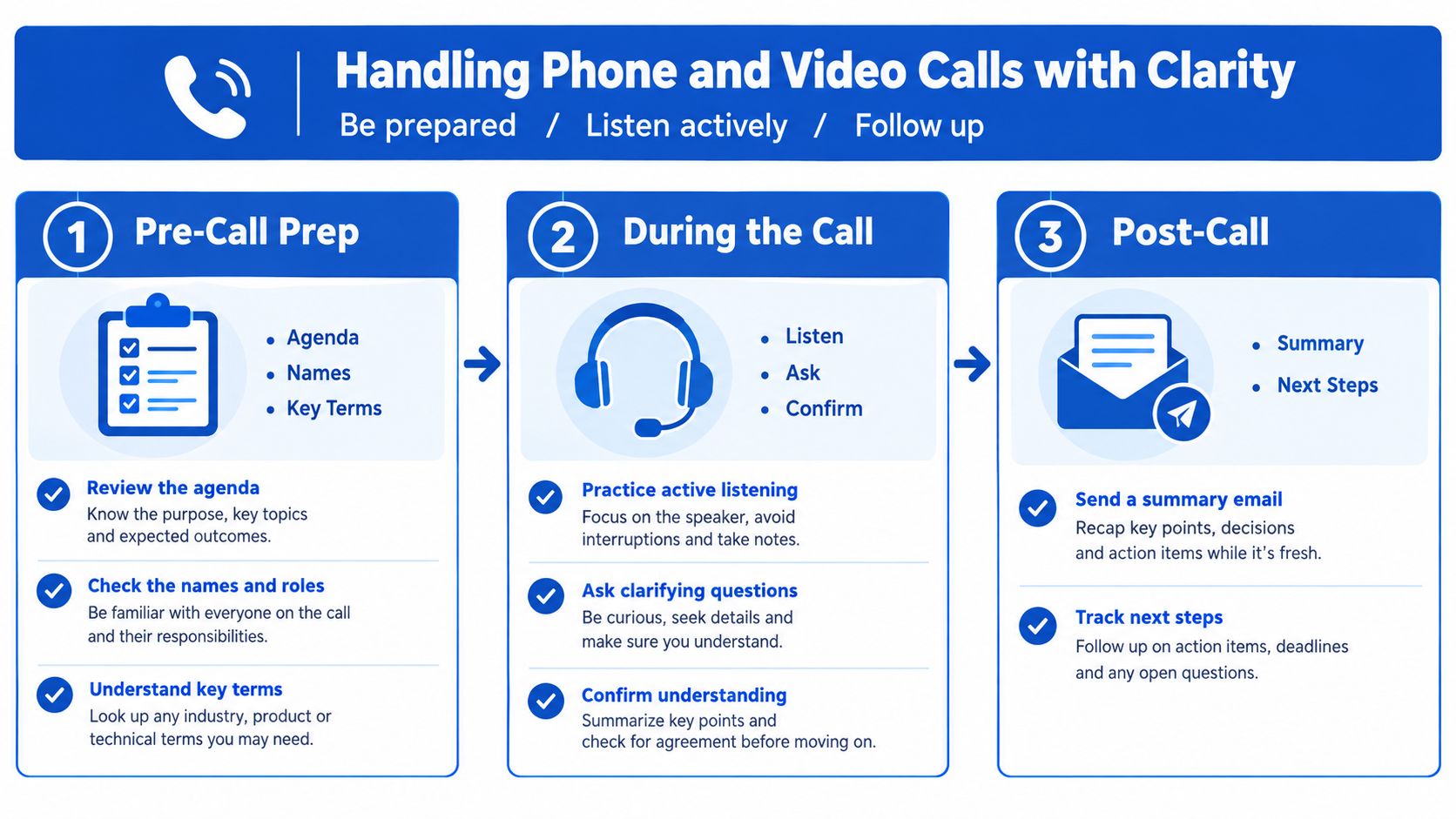
Prepare, listen, confirm
Before the call, write the agenda, participant names, and key terms. If the topic includes product names, figures, or technical vocabulary, keep them visible. Start with, “I'd like to cover the delivery date, the revised scope, and the approval process.”
During the call, use signposts so listeners can follow your direction: “Let's move to the second point.” To check details, say, “Could you confirm how you spell that name?” or “Let me repeat the figure to make sure I've got it right.” If the connection is poor, be specific: “The audio is breaking up. Could you repeat the last sentence?”
You don't need to apologize repeatedly for asking someone to repeat. Try:
- “Could you say that once more, please?”
- “I caught the first part, but I missed the deadline.”
- “Do you mean the revised contract or the original version?”
- “Let me paraphrase that. You'll send the draft today, and we'll review it tomorrow. Is that correct?”
After the call, send a concise recap with decisions, owners, and next steps. A written summary protects people from different interpretations and gives absent colleagues a reliable record.
Make pronunciation easier to hear
On calls, focus on word stress, chunking, and the schwa. Stress the important part of a word rather than giving every syllable equal force. Group words into meaningful chunks, such as “by Friday afternoon” or “the revised delivery schedule.” In unstressed syllables, the schwa sound often makes natural speech shorter and less distinct, so practice hearing the full phrase rather than expecting every vowel to sound fully pronounced.
Numbers and dates deserve special attention. Say “the fifteenth of May” slowly when accuracy matters, and confirm it by asking, “Is that May fifteenth?” For prices, quantities, and times, repeat the information and invite confirmation.

Presenting in English with Structure and Impact
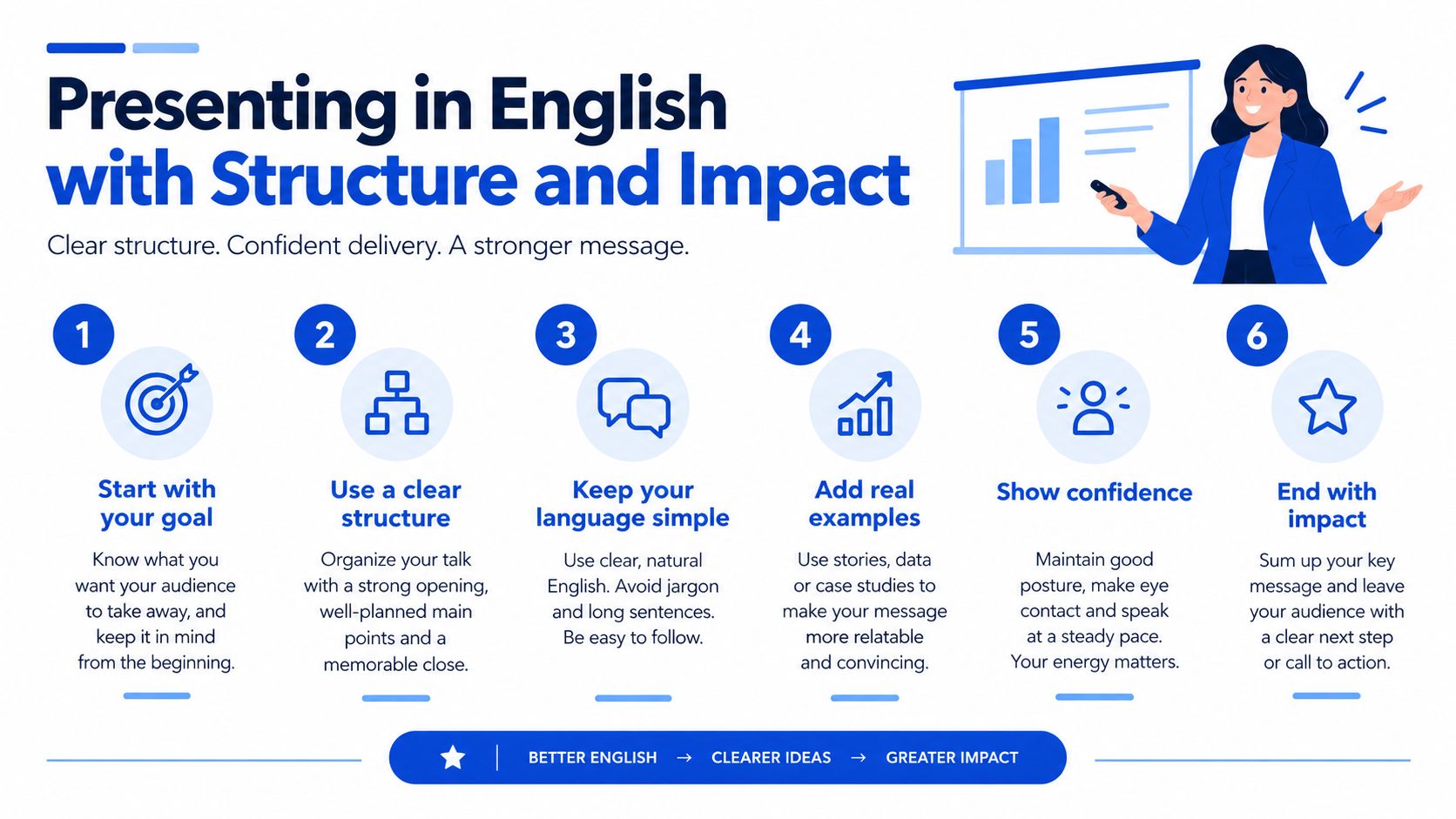
A manager once prepared a quarterly update as a list of figures, department names, and unfinished actions. The content was accurate, but listeners couldn't identify the main message. The manager changed the talk into three parts: a short opener that stated the business point, two signposts that guided the audience, and a close that asked for a decision. The same information became easier to follow because the audience knew where it was going.
Use a simple presentation shape
Start with a 15-second hook that states the point. It might be a problem, a recommendation, or a result:
“Our delivery process is slowing down new orders, so today I'll recommend a simpler approval step.”
Then give the roadmap:
“I'll explain the current delay, compare two options, and finish with the action I'm asking us to approve.”
Use two or three signposted sections:
- “First, let's look at the current process.”
- “The second point is the effect on customer communication.”
- “Finally, I'll outline the recommended next step.”
End with a clear close:
“To summarize, the revised process removes one approval stage. I'm asking the team to approve a short trial and review the results at the next meeting.”
This structure helps you manage questions as well. To buy time, say, “That's a useful question. Let me separate the short-term effect from the long-term effect.” If you don't know, protect your credibility with a precise answer: “I don't have that figure with me, so I won't guess. I'll confirm it and send it after the presentation.” Then summarize the part you can answer: “What I can confirm is that the current proposal keeps the delivery date unchanged.”
Prepare with four questions:
- Audience: Who is listening, and what do they already know?
- Key message: What single idea should they remember?
- Three points: Which points support that idea?
- Clear ask: What decision, action, or response do you need?
A presentation isn't a test of how many advanced words you know. It's a test of whether people can follow your message and understand what happens next.
Building a Weekly Practice Routine That Sticks
Busy professionals don't need a complicated study plan. They need short practice that connects directly to work. Use one weekly cycle for the four channels, then test each phrase in a real interaction.
A practical weekly cycle
Monday, email drill: Rewrite one real work email. At B1, check the purpose, request, and deadline. At B2, adjust the tone for a polite negotiation.
Tuesday, meeting phrase practice: Read five meeting expressions aloud and use shadowing. Listen to a short professional exchange, pause, and repeat the speaker's rhythm. B2 learners can practice disagreement and qualification, such as “The benefit is clear, but I'd like to examine the risk.”
Wednesday, call listening log: Listen to a short business recording and note where you lose meaning. At C1, focus on interruptions, accents, connected speech, and recovery phrases. Record the sentence you missed, then write the clarification you could use.
Thursday, presentation signposts: Give a brief spoken update using an opener, roadmap, two signposts, and a close. At C2, add difficult question practice. Answer directly, qualify your answer, and summarize it in one sentence.
Friday, self-review: Check the week using the same workplace actions:
- Email: Did I state one purpose and one clear action?
- Meeting: Did I contribute and confirm an action?
- Call: Did I clarify rather than guess?
- Presentation: Did I guide the audience and make a clear ask?
The levels above are practice targets, not labels you need to memorize. Your best next step depends on your current ability, role, and communication demands. A placement assessment can help identify your strengths, weaknesses, and suitable level before you choose a course.
Track one workplace interaction each week. Write down the sentence frame you used, what worked, and what you'll change next time. Englify offers live online Business English classes through Google Meet, including small-group and private options, CEFR-based levels from A0 to C1, session recordings, learner reports, a free placement test, and a free trial session.
Take the free placement test and explore Englify to identify the communication skills you need for emails, meetings, calls, and presentations. You can then discuss a practical learning path through live online classes with personalized content and regular progress feedback.