Knowledge hub
Free Placement Test for Homeschool: Find the Right Level
Learn how a Free Placement Test for Homeschool measures English level by skill, how to read the results accurately, and which next step fits your child.

You've found an English course that looks suitable, but your child finishes the reading exercises easily and struggles to answer a simple spoken question. Before choosing harder materials or starting again with a beginner book, you need to know which skills need attention.
A free placement test for homeschool can help, provided you read the result as a learning profile rather than a final judgment.
Table of Contents
- What a Free Placement Test Tells Homeschool Parents
- CEFR Levels at a Glance and What Each One Means
- How to Run the Test at Home Step by Step
- Reading Your Results and Their Limits
- Matching Your Level to a Learning Format
- Confirm the Level and Book a Free Trial
What a Free Placement Test Tells Homeschool Parents
A free placement test estimates the English a learner can use now, skill by skill, so you can choose a suitable starting level and materials. It's a diagnostic starting point, not a school grade, a certificate, or a verdict on your child's whole ability.
Homeschool learners don't all follow the same curriculum sequence. The National Center for Education Statistics' overview of homeschooling describes differences in how families organize education, which helps explain why a previous grade label can't tell you everything about readiness.
Say a 12-year-old reads an English paragraph comfortably but freezes when asked to introduce herself. A useful assessment would show stronger reading and less-developed speaking, allowing you to prioritize oral practice without replacing reading materials she already enjoys.
What a useful report includes
- Separate skills: Reading, listening, grammar and vocabulary, speaking, and writing where assessed.
- Approximate levels: A CEFR estimate for assessed communication skills, with untested areas clearly identified.
- Specific gaps: For example, understanding written instructions but missing spoken questions.
Grammar and vocabulary scores support the profile, but they shouldn't automatically become stand-alone proficiency levels.
For families in Morocco or the UAE using different combinations of Darija, Arabic, French, and English, record where the child encounters each language. School reading experience and everyday conversation opportunities may be quite different.
If you're also assessing early literacy, Queens Online School's primary reading assessments explained for parents offers a separate resource for understanding reading assessment. Keep literacy decisions distinct from English-language placement.
Practical rule: Choose materials from demonstrated skills, not from the age printed on the cover.
Use level descriptions to name those skills, then keep the profile beside you when planning practice.
CEFR Levels at a Glance and What Each One Means
The Common European Framework of Reference for Languages, or CEFR, describes what learners can do with a language, from basic communication to advanced use. The Council of Europe's global scale provides the official reference descriptions summarized below.
CEFR levels and typical abilities
| Level | What the learner can usually do | Typical next step |
|---|---|---|
| A0, informal beginner label | Recognises a few familiar words and simple phrases, and needs visual support and repetition | Build basic vocabulary, sounds, and short spoken routines |
| A1 | Introduces themselves and answers basic personal questions when the other speaker is slow and clear | Join a structured beginner course with short daily speaking tasks |
| A2 | Understands sentences about family, shopping, and routines, and handles simple exchanges on familiar topics | Practise connected speech and short descriptions, and build grammar through use |
| B1 | Follows the main points of clear speech on familiar work, school, and travel topics, and explains experiences in simple connected text | Extend fluency, opinions, and longer reading and listening tasks |
| B2 | Understands the main ideas of complex texts and interacts with fluency and spontaneity | Refine accuracy, argument, and detailed written work |
| C1 | Understands demanding longer texts and implicit meaning, and uses language flexibly for social, academic, and professional purposes | Focus on precision, nuance, and specialist vocabulary |
A0 isn't an official CEFR level. Some academies use it as an informal label for absolute beginners below A1, the start of the official scale.
How to read the descriptions
Choose the level where your child consistently demonstrates most relevant abilities, not the highest level reached through a lucky answer. Recognizing an advanced word doesn't establish advanced proficiency if the learner can't understand or use it in context.
Consider a child who speaks Darija at home and studies French at school. They might understand simple written English while needing substantial support to answer spoken questions, so the profile should preserve that difference rather than average it away.
Age-appropriate tasks matter, too. A young learner doesn't need a workplace presentation to demonstrate language ability; explaining a game or describing a school activity may provide more useful evidence.
For more detail on the terminology, use our guide to English levels and CEFR explained. Treat the level as a starting profile that can change during a term, not a permanent identity.
Before testing, prepare a log with spaces for each skill and its estimated level. Leave room for observations, because the way your child completes a task can be as useful for planning as the answer itself.
How to Run the Test at Home Step by Step
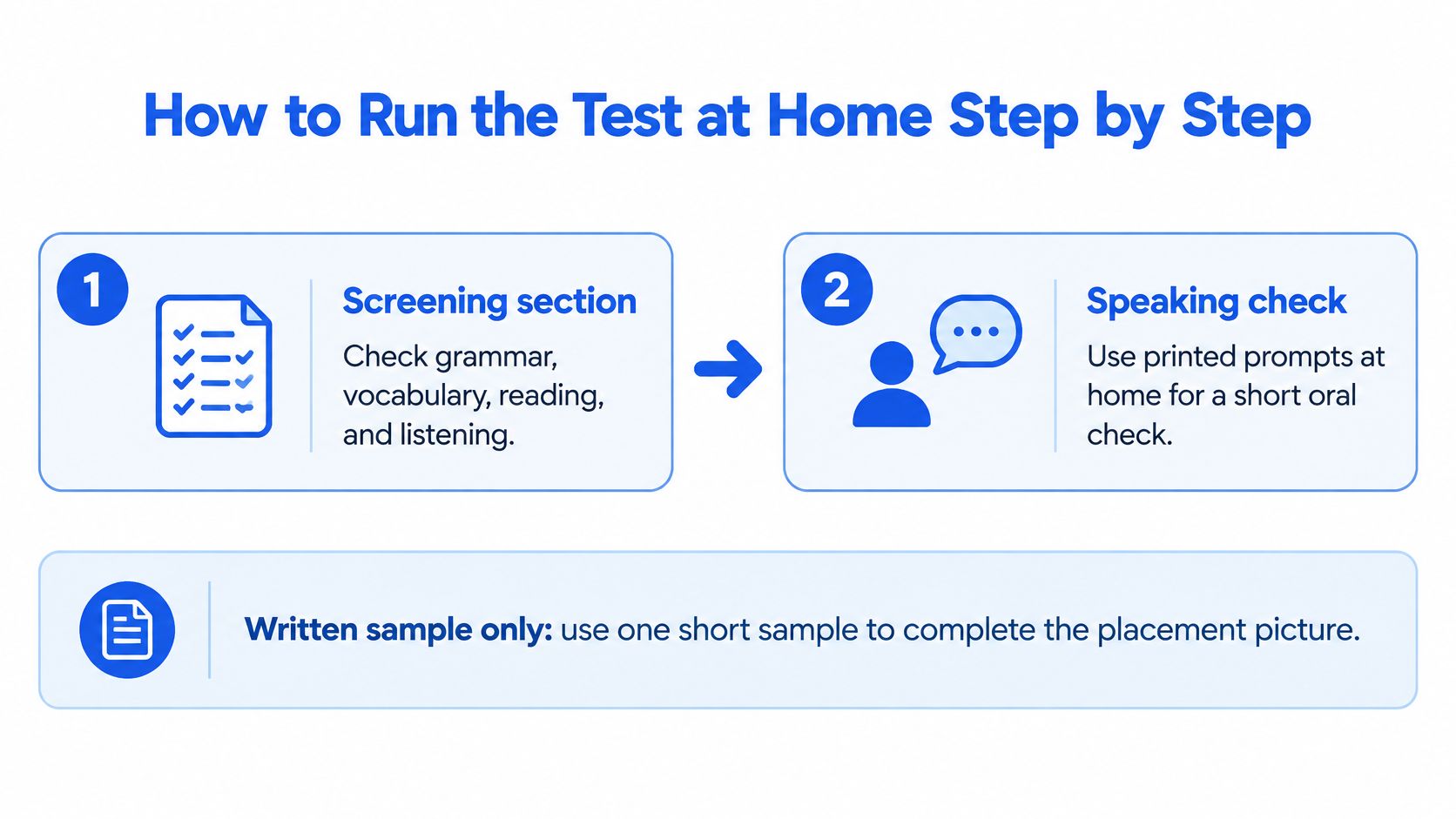
Use a screening section followed by a speaking check. The screening samples grammar, vocabulary, reading, and listening; the oral check lets you observe whether the child can produce English without choosing from prepared answers.
This structure reflects the emphasis on matching assessment tasks to intended language abilities in the Council of Europe's language test development manual. Add a short written sample only if your child is old enough and comfortable writing.
Prepare, observe, and record
Pick a quiet time. Use comparable conditions for each sitting, with background screens switched off, so distractions don't become part of what you're measuring.
Let your child work independently. Don't coach, hint, or translate test questions, because that would make it difficult to distinguish independent performance from supported performance.
Score the screening by skill. Record reading, listening, grammar, and vocabulary separately rather than keeping only a total, so a strong area doesn't hide a weaker one.
Run the speaking check using printed prompts. Ask for a self-introduction, a picture description, and an explanation of a daily routine, recording the answers on a phone only if your child agrees.
Note how the child worked. Record repeated instructions, reliance on translation, or unfinished answers, because these observations help explain uncertain results.
Compare performance with CEFR descriptions. Match what your child demonstrated to the relevant abilities, rather than converting the score into a school grade.
Complete a simple assessment log. Save the date, skill estimates, overall starting estimate, and supporting observations so you have a usable reference for later decisions.
If the test doesn't provide subscores, don't invent precise levels from the answer sheet. Note the observed strengths and gaps and mark any level estimate as provisional.
Keep encouragement separate from assistance: reassure your child that mistakes are useful information, without supplying the English needed to answer.
Make the follow-up comparable
Keep a copy of the prompts and a brief description of the testing conditions. After several weeks of instruction, use similar tasks to check whether the placement still provides manageable challenge.
You can complete this home process without outside help. If the recording is difficult to interpret, a teacher's review is an optional follow-up, not a requirement for finishing your home check.
Reading Your Results and Their Limits
A percentage is not a grade. A multiple-choice screening may show that a child recognizes correct English without establishing whether they can communicate spontaneously.
The Council of Europe's guidance on assessing CEFR levels emphasizes validity: an assessment needs evidence that it measures the intended language ability. For home placement, keep reading and listening distinct from speaking and writing, and report an approximate range or skill profile supported by the oral check.
For entry into a communication-focused course, use the lowest skill the child clearly demonstrates. Treat that as a cautious starting decision, not a reason to remove appropriately challenging work in stronger areas.
Match the pattern to a response
The explanations below are possibilities to investigate, not diagnoses.
Result patterns, meanings and responses
| Result pattern | What it usually means | Practical response |
|---|---|---|
| Reading and grammar high, speaking low | Knows the rules but cannot produce English spontaneously | Place by speaking level and add oral tasks |
| Reading high, listening low | Struggles with natural speed and connected speech | Use audio practice, starting slow and moving to natural speed |
| Vocabulary strong, grammar weak | Knows words but not how to build sentences | Practise grammar inside short speaking tasks |
| Slow answers, many blanks, good speaking | Possible test anxiety or unfamiliar format, not necessarily low ability | Allow breaks and oral answers, then retest in a familiar format |
| Uneven scores with no clear pattern | Possible mixed curriculum coverage in homeschool | Choose the course by the lowest clearly demonstrated skill |
| Large gaps across several skills | Possible learning difference or interrupted schooling | Consider a professional evaluation before deciding when the cause remains unclear |
For a reading-high, listening-low profile, start with a short recording on a familiar topic. Ask your child to identify the main message, then replay it for details before checking a transcript.
If vocabulary is stronger than sentence-building, practise a useful pattern through changing details. Your child might describe what different family members do each morning instead of completing another isolated word list.
Correct the common misreadings
- A placement level isn't a school grade or official certificate. It recommends a starting point for instruction.
- A low score doesn't mean low ability. It describes performance on particular tasks under particular conditions.
- A fast result doesn't prove mastery. Check whether answers were accurate and independently produced.
- A short test doesn't cover every skill. Mark missing speaking, writing, or listening evidence as unassessed.
- An English result doesn't measure general academic readiness. A learner may understand a concept well in another language.
Accessibility deserves attention before you settle on an interpretation. Johns Hopkins' reporting on the homeschool trend highlights the diversity of homeschooling families and the importance of special learning needs.
Children learning English, multilingual learners, and children with dyslexia, attention differences, or anxiety may need breaks, oral responses, or a different format. Record any adjustment: an oral response can reveal understanding, but it doesn't establish independent reading performance.
Check the technology as well. A phone on a weak connection can interrupt audio and distort a listening result, so use a stable connection or an appropriate offline option.
Log the pattern and reassess after several weeks. Consider professional evaluation when substantial gaps remain across several skills and the cause is unclear, particularly after interrupted schooling.
Matching Your Level to a Learning Format
Choose a format that addresses the pattern of skills, not just the overall level. A learner who needs more spontaneous speaking has a different practice priority from one who mainly needs longer reading tasks.
At Englify, we offer live online English and French classes through Google Meet, with small groups, private classes, personalized content, session recordings, and learner reports. Our learning pathway runs from the informal A0 beginner category through C1.
Choosing a format after placement
| Format | Best fit | What to check |
|---|---|---|
| Small group | Skills sit at the same CEFR level and the learner wants regular speaking practice | Confirm the group level matches the placement result |
| Private class | Speaking lags well behind reading or grammar, or the learner needs targeted support | Ask for a plan built on the skill profile |
| Self-study materials | Learner needs extra reading or listening practice at a confirmed level | Use alongside a speaking check, not instead of it |
Balance level, age, and participation
For our group placement process, we use the assessment to identify suitable level options. Age-appropriate topics still matter, but age alone shouldn't determine the difficulty of the English.
A child with uneven skills may benefit from targeted support before joining learners who speak more independently. Another child may already have the language needed for a group but need time to feel comfortable taking turns.
Our guide to online English for kids can help parents consider the learning environment as well as the level. Session recordings and learner reports also give you concrete material to review rather than relying on your child's general impression of a lesson.
Choose a format your child can participate in consistently, not merely one they can complete on their strongest day.
Self-study can extend practice, but it doesn't provide the same evidence as an exchange requiring an unrehearsed answer. Pair independent work with opportunities to respond aloud.
Keep qualification terminology separate, too. The Online College of Art & Design's guide to entry level to Level 3 pathways is useful when exploring art-course progression, but those course levels aren't equivalents of CEFR English levels.
Confirm the Level and Book a Free Trial
Before acting, compare the screening result with the speaking check and the work you see at home. If they broadly agree, you have a reasonable starting point; if they disagree, ask a teacher to review the speaking before making a course decision.
Bring evidence rather than only a score. A short recording, a writing sample where appropriate, and notes about independent work will make the discussion more specific.
Use the trial to resolve uncertainty
At Englify, the first step in our guided assessment process is a free trial: the student takes the placement test, a teacher assesses speaking, and the student receives plan options at their level. You can also take the level test first and then book the trial to explore the format.
The free placement test and free one-hour trial class are separate. Completing the test doesn't automatically book the trial, and sending an enquiry doesn't reserve an appointment.
- Bring the profile: Share the skill estimates and any testing adjustments.
- Discuss the mismatch: Explain whether speaking, listening, or independent writing was harder than expected.
- Observe live participation: Notice whether your child understands instructions and can answer without you stepping in.
- Review the assessment: After the trial, parents receive a written report covering the placed CEFR level, strengths, and next steps.
Our guide to the free trial English class explains the live assessment context. Use the Google Meet session to see whether the proposed level works in an actual exchange, rather than trying to settle every uncertainty from a quiz.
Decide without pressure
Taking the placement test doesn't oblige you to register or buy a package. Read the current class, schedule, and policy details before committing, and choose a next step when your family is ready.
If the level fits, keep the plan and monitor participation. If speaking remains the main obstacle, prioritize a speaking-focused approach while preserving suitable reading and listening work.
The useful outcome isn't the highest possible label. It's a starting point that helps your child participate, practise independently, and make progress you can describe.
Englify offers online English and French learning with live communication practice and level-based guidance. Visit Englify to take the free placement test, then book a separate free trial when you're ready to confirm your child's starting level in live practice.