Knowledge hub
English Language Proficiency: Levels and Skills
Learn what English language proficiency means, how CEFR levels differ by skill, and how to assess and improve it.
In the 2025 EF English Proficiency Index, Morocco's adults scored 492 overall against a global average of 488, yet their reading score of 532 sat a full 72 points above their listening score of 460. One number would have hidden that entirely.
The gap is normal, and it is the point. A proficiency profile works like a report card with four grades: reading, listening, writing and speaking each grow at their own speed, and the average can look respectable while one skill falls behind. The mix differs from learner to learner. One reads comfortably but answers hesitantly, another chats with ease yet writes slowly, and a third passes every written exercise while losing the thread of a fast exchange.
Employers and exam boards meet all four skills at once, so a learner can look strong on paper and still struggle the moment the weaker skill is called on.
Table of Contents
- English Language Proficiency in Plain Terms
- CEFR Levels and What Each One Lets You Do
- When Reading Is Stronger Than Speaking
- How Placement and Exams Measure Proficiency
- What Level Fits School Work and Exams
- How to Improve the Skill That Is Holding You Back
- Take a Placement Test Before You Set a Target
English Language Proficiency in Plain Terms
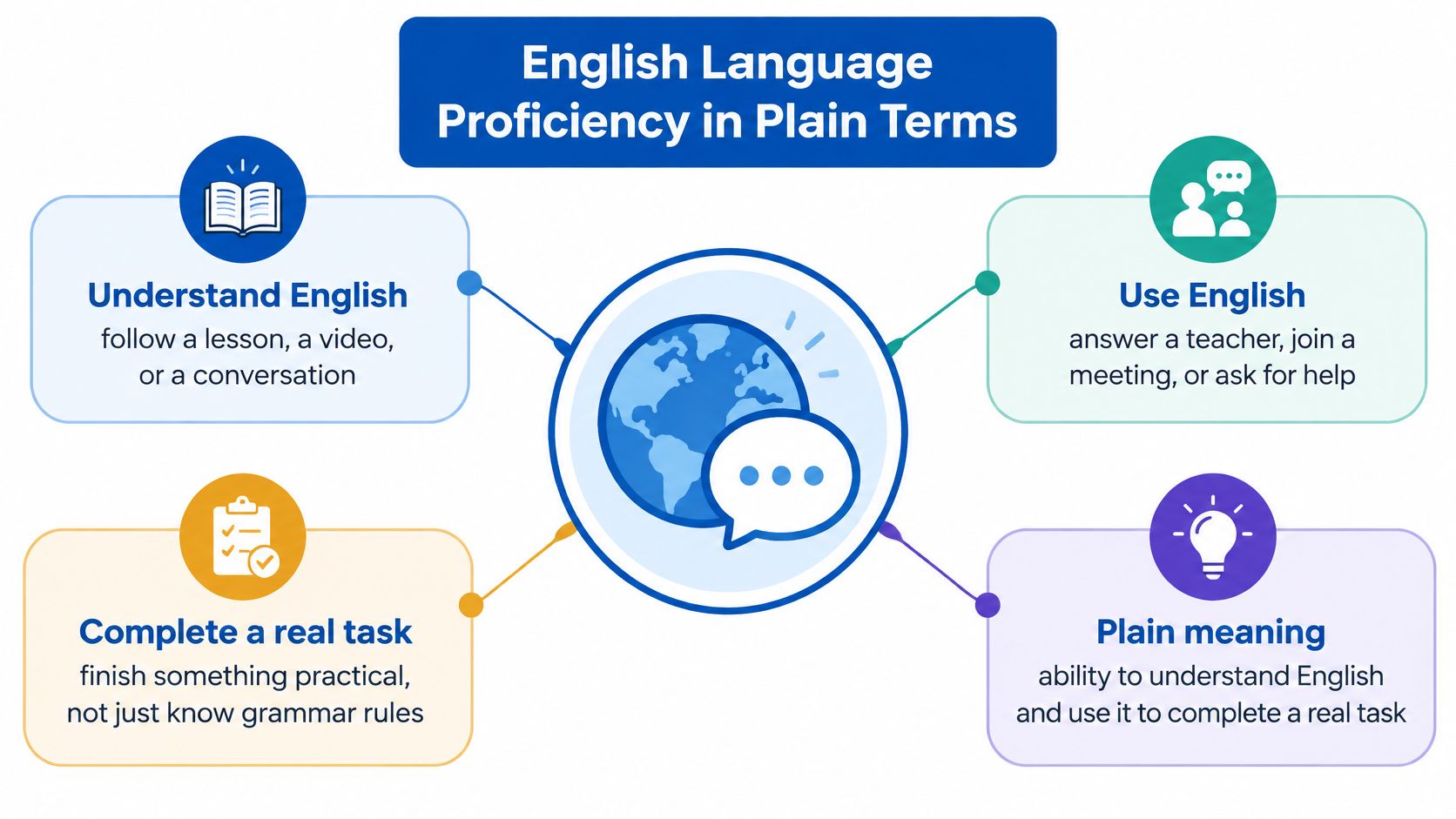
English language proficiency is the ability to understand English and use it to complete a real task, such as following a lesson, answering a teacher, joining a meeting, writing an email or sorting out a problem at a station. The definition is deliberately practical, because it separates what you can do from what you have studied.
Take a familiar case. A 15-year-old in Casablanca can label every tense on a worksheet and score well on a school grammar test, then go silent when someone asks her what she did at the weekend. Her memory is fine. Her reading and rule knowledge sit at one level while her speaking and listening sit at another, and a single school mark flattens the difference between them.
The idea is easier to hold as a picture.
Scale explains why the phrase carries so much weight. A British Council report on the English effect estimated that approximately 1.75 billion people spoke English at a useful level, about one quarter of the world's population, and projected that the number could reach 2 billion by 2020. The same report estimated that non-native speakers outnumbered native speakers by roughly four to one.
That balance changes what "good English" means in practice. Most real communication in English happens between two people who each learned it as an additional language: a hotel desk in Marrakech, a support line in Dubai, an interview over Google Meet. Intelligible pronunciation, flexibility across accents and vocabulary that travels matter more than sounding like a Londoner.
The practical test: can the other person understand you, and can you understand them well enough to finish the task?
Shared frameworks exist because that question needs a common answer across schools, employers and borders. In Morocco and the UAE, English usually sits beside Arabic, and in Morocco often French as well, so the goal is communication across three languages rather than imitation of one accent.
CEFR Levels and What Each One Lets You Do
The Common European Framework of Reference for Languages is a descriptor system, not an exam. It sorts ability into six bands, A1 to C2, and defines each one through can-do statements about what a learner can accomplish in real communication, not through grammar topics or hours attended (Council of Europe level descriptions). That design choice is what makes it useful for placement and progress tracking: you can watch a learner understand information, hold a conversation, write a message or present an idea, and judge the band from the evidence.
Because the statements are written skill by skill, the same learner can sit at different bands in reading, listening, speaking and writing on the same afternoon. Any single label, "B1" on a certificate or "intermediate" on an enrolment form, is a summary of a profile, not the profile itself.
What each band lets you do
| Level | Plain label | What you can typically do | A useful next target |
|---|---|---|---|
| A1 | Beginner | Use familiar everyday expressions and very simple sentences about yourself | Give a short personal introduction |
| A2 | Elementary | Handle simple routine tasks and short social exchanges | Manage a simple service or phone conversation |
| B1 | Intermediate | Deal with most travel situations and describe experiences, plans and opinions | Join a straightforward class or team discussion |
| B2 | Upper intermediate | Interact with some fluency on familiar and some abstract topics and write clear detailed text | Present an update and answer questions |
| C1 | Advanced | Express ideas fluently and precisely in complex professional or academic situations | Lead a meeting or write a structured report |
| C2 | Mastery | Understand virtually everything heard or read and express fine shades of meaning | Refine style rather than chase a new band |
Read the table twice, and read it carefully the second time. Pick the row that matches what you can already do in speech, not the row you hope to reach and not the row your last school report implies. Then treat the next column as the outcome you're buying lessons for: joining a team discussion, presenting an update, writing a report someone else has to act on. A target written as "become advanced" gives a teacher nothing to plan, while "answer five follow-up questions after a two-minute update" gives a teacher a task, a measure and a finish line.
C2 deserves a warning. Understanding almost everything and catching fine shades of meaning is a reasonable goal for a translator, an academic or a lawyer working in English. For a teenager preparing for a school oral, a nurse, an engineer or a small business owner, it's usually the wrong target, because the hours it demands buy very little extra usefulness compared with a strong B2 or a working C1.
Some courses, including ours at Englify, add an A0 starting point for a complete beginner who isn't at A1 yet. A0 is a teaching label that gives a true beginner a first rung, not an official seventh CEFR band.
When Reading Is Stronger Than Speaking
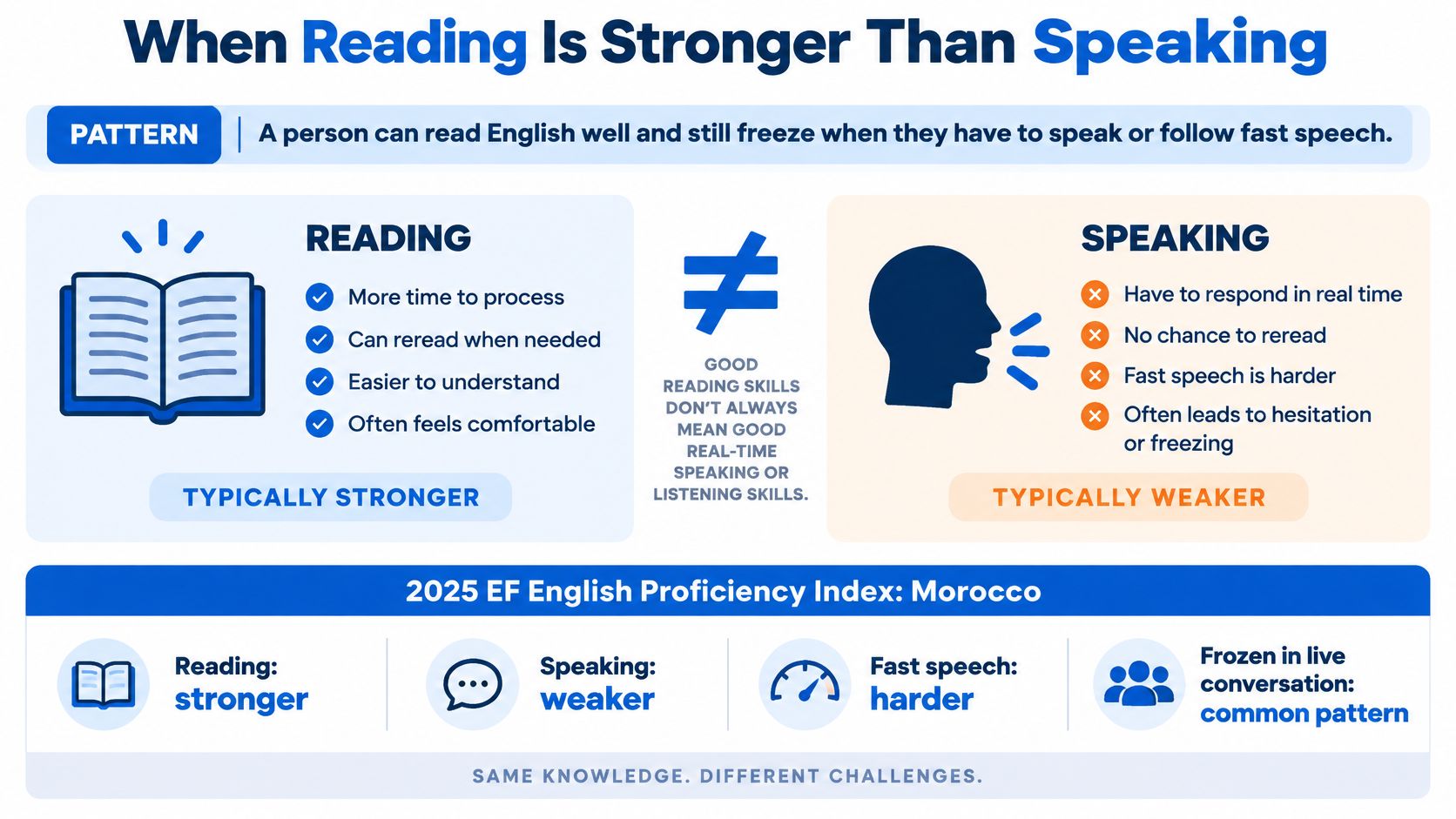
One number in the Moroccan data carries more weight than the headline score: the 72-point gap between reading at 532 and listening at 460 in the 2025 index.
Morocco's overall score of 492 came in slightly above the global average of 488 and ranked 68th among the countries and regions included, and EF classifies the result as low proficiency. The skill split carries the teaching information: reading 532, writing 491, speaking 491, listening 460 (EF English Proficiency Index 2025 report). Adults here understood written English noticeably better than spoken English.
If that describes you or your child, the pattern is common enough that we keep a separate guide on building listening and speaking confidence for learners who read well and speak rarely.
Location matters too. Fès-Meknès scored 502 and Tangier-Tétouan-Al Hoceima 500, while listed areas such as Kénitra and Sidi Bennour at 478 and Khenifra at 450 sat further down. Between the highest and lowest listed areas runs a spread of more than fifty points, so a single national average can hide where a learner lives.
Here's the caveat that keeps the data honest. The people behind these scores chose to sit the EF SET, so the index describes a self-selected group. It shows where a motivated, connected group landed. A Moroccan child, university student or worker may sit anywhere on the scale, and the average can't place them.
What a national score cannot do: it can show a pattern worth acting on. It can't hand you a personal level or tell you which skill to train on Tuesday.
Why does reading run ahead of speech in the first place? Reading gives you time, allows a second pass at a hard clause and lets you look things up. Live English gives you none of that. It arrives at natural speed, with connected speech, dropped sounds, fillers, interruptions and turn-taking, and you have to answer before you've finished planning the answer.
For Arabic-speaking learners there's an extra layer that has nothing to do with intelligence: sound and rhythm. The th sounds, consonant clusters at the ends of words, and the stress patterns that carry meaning in English never get trained by written study. They're trained by saying them out loud, being corrected, and saying them again.
The Moroccan shape is also the normal shape. The latest EF index findings report reading as the strongest skill in four out of five countries and speaking as the weakest in roughly 40% of countries, with the global average speaking score trailing reading by 57 points (EF index findings). A reading-strong, speaking-shy profile is what written-first English education produces almost everywhere.
How Placement and Exams Measure Proficiency
Five kinds of evidence get used to judge English ability, and they aren't interchangeable. Each one captures something real and misses something else, which matters when a parent, a student or an employer treats any of them as a final verdict.
| Check | What it shows | What it misses |
|---|---|---|
| Can-do self-check | A rough band from what you believe you can do | Often overrates speaking and listening |
| Skill-by-skill placement | A current profile across reading, listening, speaking and writing | Only a snapshot of one sitting |
| Live speaking sample | Fluency, pronunciation and interaction under light pressure | Reading and extended writing |
| IELTS or TOEFL | Performance on that exam format and day | An exact CEFR label |
| Repeated classroom task | Whether a real goal such as a meeting update got easier | A score comparable across different schools |
The CEFR organizes ability into six levels across separate skills, which is exactly why placement and progress tracking should report a skill profile rather than one overall label (IELTS guide for teachers). The same guide is blunt about exam scores: IELTS uses a nine-band continuum and wasn't designed as a level-based CEFR test, so any mapping between a band and a CEFR level is approximate and shifts with test purpose, format, population and measurement scale. A 6.5 tells an admissions office how someone performed on that exam. It doesn't certify a CEFR band.
External benchmarks carry their own limit. EF's own methodology note on the proficiency index explains that participants are self-selected rather than a probability sample, so people who choose to test may differ in motivation, internet access, education or prior exposure. National numbers are best used to spot broad patterns and decide where to invest training time.
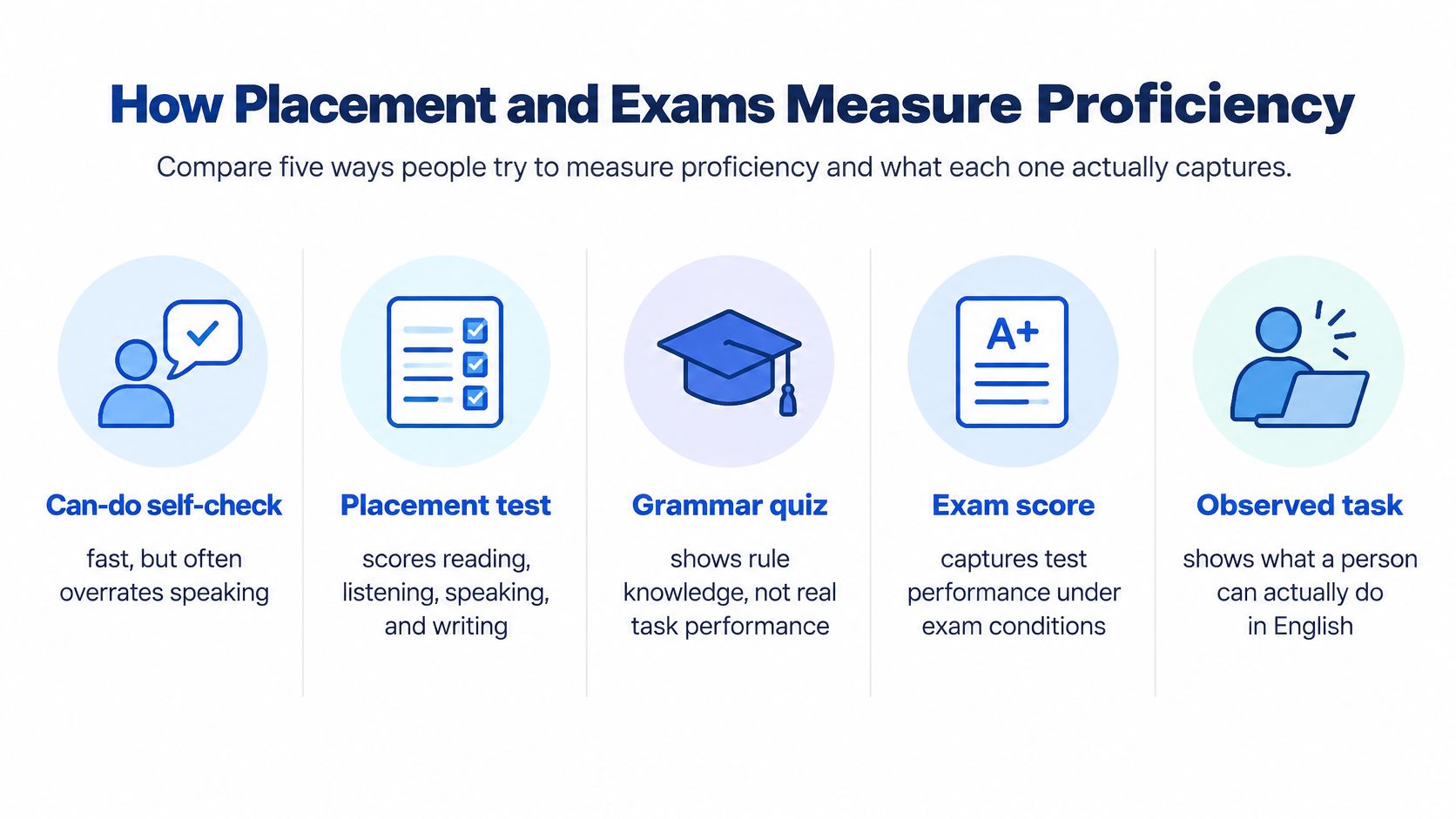
A sound placement does three things. It scores the four skills separately, it names the task and the conditions so a later test is comparable, and it ends with observable outcomes on the course plan, such as taking part in meetings, producing a coherent presentation or understanding workplace documents.
Two things are not evidence of level at all. Attendance doesn't certify proficiency: sitting in a room for ninety hours proves nothing about what you can do in the room next week. And no course should promise an official exam score or a recording of it. We don't, and any provider who does is describing something they can't control.
What Level Fits School Work and Exams
A level only becomes useful once it is attached to a situation. A parent does not need to hear that their daughter is "B1-ish"; they need to know whether she can hold her end of a school oral exam. A professional does not need a band, they need to get through Monday's meeting.
A school oral answer usually takes several connected sentences with a clear point, plus the written accuracy the subject demands, and B1 is the working level. A university student following lectures and writing a short structured essay is working toward B2, where abstract vocabulary and reading load both climb. For call and support work, most English-speaking support jobs in Morocco expect B1 to B2: a typical call means understanding a problem, clarifying it and confirming the next step before the caller hangs up.
Business use at B2 looks like giving a short update, writing a clear email and answering one follow-up question in a meeting or an interview. Travel and daily life can be comfortable at A2 to B1 as long as the tasks stay routine: booking, ordering, asking for directions, requesting a repeat.
| Goal | Useful working level | Good enough looks like |
|---|---|---|
| School oral answer | Around B1 | Several connected sentences with a clear point |
| University lecture and short essay | Around B2 | Follow the main argument and write a structured response |
| Call and support work | B1 to B2 | Handle a problem, clarify it and confirm the next step |
| Meetings, email and interviews | Around B2 | Give an update, write a clear email and answer a follow-up |
| Everyday travel and services | A2 to B1 | Complete routine transactions and ask for repetition |
| IELTS Speaking | Exam band, not a CEFR label | Balanced fluency, vocabulary, grammar and pronunciation in 11-14 minutes |
IELTS Speaking deserves its own look, because it is the exam most students here ask about. It is assessed on four equally weighted criteria: fluency and coherence, lexical resource, grammatical range and accuracy, and pronunciation. The test lasts about 11 to 14 minutes, and the band is not a grammar score (IELTS scoring in detail). At Band 5 a speaker may pause frequently while hunting for words; at Band 7 the same speaker can talk at length without noticeable effort and uses complex structures often.
What that means for preparation: timed speaking practice, vocabulary work, pronunciation drills and immediate feedback move a band more reliably than another grammar workbook.
If the goal is study abroad, the test choice and the score requirement need checking before the course starts, and our guide to the English test for studying abroad from Morocco covers how those requirements differ by destination and program.
Treat every match above as a practical guide rather than a fixed entry rule, because a single goal can demand more in one skill than the overall level suggests. A nurse needs listening under pressure, a developer needs reading and writing, and an interview candidate needs speech that holds up for forty minutes. The overall level is the label; the skill profile underneath it is what the situation tests.
How to Improve the Skill That Is Holding You Back
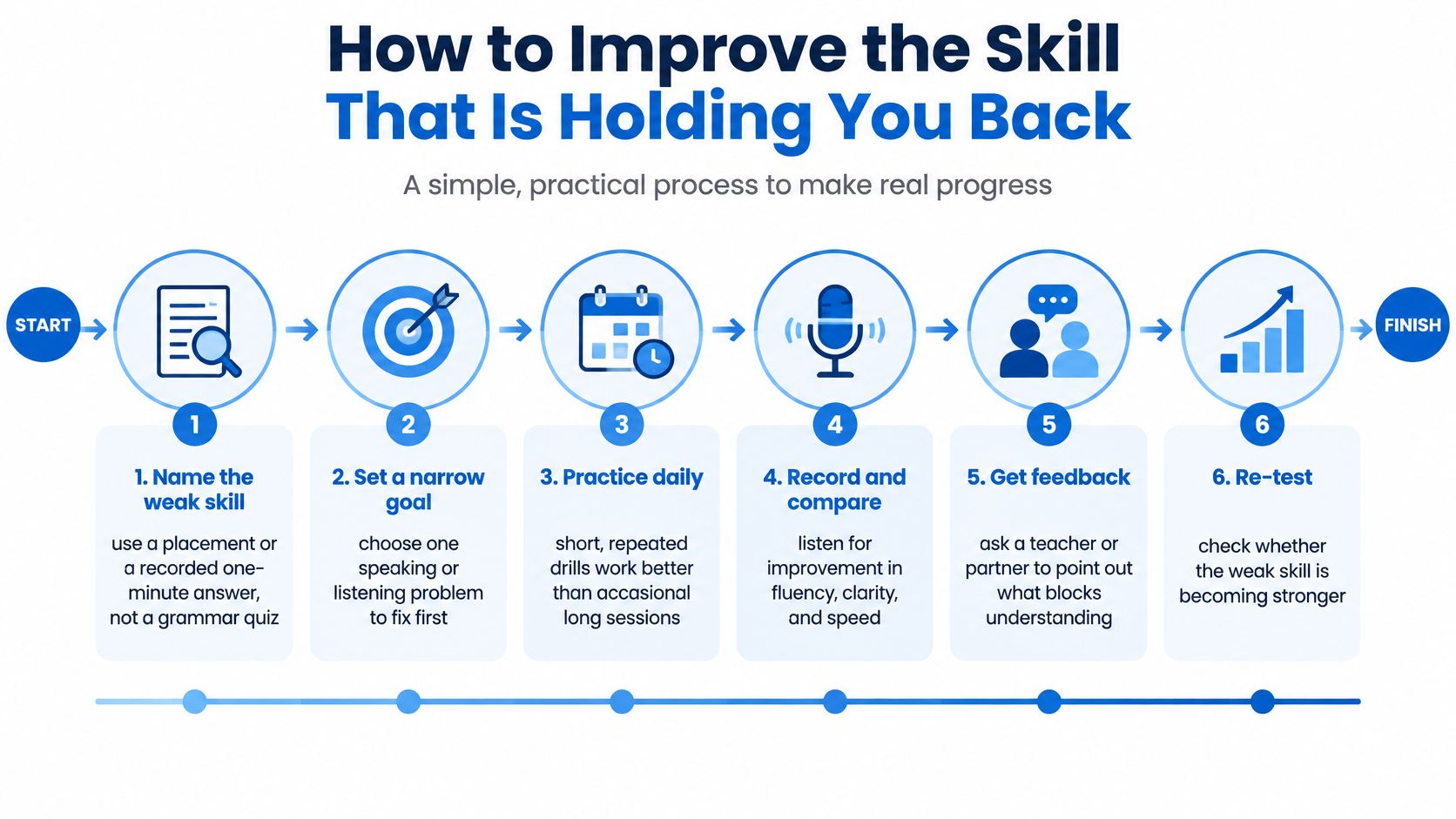
A four-skill profile works like a chair with uneven legs: the longest leg is easy to lean on, but the short one decides whether the seat stays level. Many learners read more strongly than they listen or speak, so another reading course mostly polishes a strength. The gain comes from naming the weak leg and training it deliberately.
- Name the weak skill from evidence, not mood. Use a placement that scores skills separately, or record a one-minute answer and listen back. A grammar quiz cannot tell you whether you can follow fast speech, and a good reading score cannot prove you can hold a meeting turn.
- Set a narrow, four-week can-do target. “Answer a familiar question in five connected sentences” or “follow a two-minute workplace update and summarise it” beats “improve speaking.” One target, one skill, four weeks.
- Practise in short timed turns. Sixty to ninety seconds on a single prompt, then feedback on one issue only, then the same prompt again. Redoing the prompt is where the improvement happens; a new prompt every time just repeats the same mistake.
- Train listening across accents with short clips. Play a thirty-second clip, pause, note the message, then replay only the line you missed. Two or three accents beat one perfect accent, because the world doesn't send you subtitles.
- Recycle ten phrases inside a real task. Use them in a class answer, an interview reply or a meeting update. Word lists you never say aloud stay inert.
- Repeat a comparable task after several weeks and keep the recording. Progress you can hear is what convinces a nervous speaker to keep going. It also tells a teacher whether the plan is working.
For Arabic-speaking learners, add focused work on the sounds written study skips: th, final consonant clusters, word stress, and the reduced forms people say (“wanna,” “gonna,” “cuppa” patterns) even though textbooks print the full version. These are trained habits, not a fixed trait and not a sign of weak ability.
A familiar language still has a place when used deliberately. A teacher can clarify one hard concept in Arabic or Darija, then return the learner to English for the interaction, listening and task. The clarification removes a blockage; the practice still has to happen in English.
What usually leaves a speaking gap untouched is quiet input: passive reading, highlighting, and another round of grammar drills. Three short live sessions a week beat one long silent study block, because correction has to arrive while the sentence is still fresh in your mouth. Between sessions, review methods that help you study faster without rereading notes can protect time for the part that matters: saying the answer out loud again.
Take a Placement Test Before You Set a Target
Don't choose a class from a country ranking, and don't choose one from a school grade. A national position like 68th, or a regional score like 502 in Fès-Meknès, describes a group of volunteers, and EF's own Morocco fact sheet is clear that the testing population isn't a representative sample of every age, region or learning pathway. Your needs also differ by goal: a school exam, an interview, a workplace meeting, a migration file and a holiday conversation each punish a different skill.
A personal placement answers the question the ranking can't. Englify's free placement test places learners on the CEFR scale from A0 to C1 and includes a spoken part, so the result reflects what you can do now rather than a guess; you can read how the free online placement test works before you sit it. From there, the route is simple: a free trial class on Google Meet, then 60-minute live sessions in a small group or as private classes, with a written report after every session tracking strengths, mistakes, vocabulary and the next CEFR target.
After you book the free trial, you take the level test, a teacher evaluates your speaking, and you receive group options with exact times and prices, or private lesson prices based on monthly hours, with no obligation to enrol. Lesson materials and quizzes are available in the student portal, so you can revisit what you covered after each session instead of reconstructing it from memory.
One last instruction before you start: write down the situation you need English for, whether that's a school oral, a job interview, a support desk or a team meeting. Use the placement result to pick the weakest skill that situation punishes, and make that your first four-week target. The placement shows where you are now. What happens next depends on the practice you put in.
If your profile is lopsided, with reading well ahead of listening and speaking, that's the most useful thing to know before you book anything. Englify runs live online English classes from A0 to C1 in small groups of six or fewer, or as one-to-one sessions on Google Meet, and the free placement test with its spoken part shows exactly which skill to train first. Take the free placement test or book a free trial session at Englify and start with the skill that's holding you back.