Knowledge hub
English Tenses Chart: Forms, Uses and Examples
Use this english tenses chart to compare all 12 tense forms, see when to use each one, and copy clear example sentences for speaking and writing.
The advice you'll hear first is to memorise twelve English tenses. It's the most common starting point, and it's half wrong. English has two grammatical tenses, present and past, plus a set of aspect and future constructions that a teaching chart arranges into twelve familiar rows. Learning those twelve rows is still worth your time. Believing they are twelve separate tenses is what sends learners hunting for a future-tense ending that doesn't exist, then guessing mid-sentence.
A useful tenses chart has to do two jobs at once: show you the forms quickly, and show you how to choose between them. Most charts finish the first job and skip the second, which is why plenty of learners can recite the table and still hesitate between "I have sent it" and "I sent it."
Table of Contents
- English Tenses Chart at a Glance
- How Tense and Aspect Build the Chart
- Affirmative, Negative and Question Patterns
- Time Words That Point to a Form
- Present and Past Choices in Real Situations
- Future Time Without a Future Tense
- Why Perfect Forms Get Avoided
- Keeping Tenses Consistent in Writing
English Tenses Chart at a Glance
The chart below sets out twelve forms. It crosses three time references (present, past, future) with four aspects (simple, continuous, perfect, perfect continuous), and it's the framework most coursebooks and exam syllabuses follow. English was the most popular language studied globally on Duolingo in 2024 and ranked first in 135 countries, according to the 2024 Duolingo Language Report, so a shared map like this one is practical: a teacher in Casablanca and a learner in Dubai can point at the same row and mean the same thing.
One caution before you read it. The "twelve tenses" label is a teaching convenience rather than a full description of English. BBC Learning English explains that English technically has only two grammatical tenses, present and past, and that future meaning is carried by present forms, modal verbs and other constructions. Hold both ideas at once: twelve rows to learn, two tenses the verb inflects.
| Tense | Form | Example | Typical use |
|---|---|---|---|
| Present simple | base form (he/she/it + s) | I walk; she walks | habits, routines and facts |
| Present continuous | am/is/are + -ing | I am walking | actions happening now or temporary situations |
| Present perfect | have/has + past participle | I have walked | experience and unfinished periods |
| Present perfect continuous | have/has been + -ing | I have been walking | duration up to now |
| Past simple | past form (-ed or irregular) | I walked | finished events at a known or understood past time |
| Past continuous | was/were + -ing | I was walking | background action in the past |
| Past perfect | had + past participle | I had walked | the earlier of two past events |
| Past perfect continuous | had been + -ing | I had been walking | duration before another past point |
| Future simple | will + base form | I will walk | predictions, promises and spontaneous decisions |
| Future continuous | will be + -ing | I will be walking | action in progress at a future time |
| Future perfect | will have + past participle | I will have walked | completion before a future point |
| Future perfect continuous | will have been + -ing | I will have been walking | duration up to a future point |
Reading the chart in three passes
Learners who try to absorb all twelve rows at once usually memorise the labels and lose the system. Read the table in this order instead.
- Find the time reference. Present, past or future. In "she has been working", the time is present, because the auxiliary is has.
- Name the aspect. Simple states a fact or habit, continuous shows something in progress, perfect links an earlier point to a later one, perfect continuous adds duration to that link.
- Check the auxiliary. That's the only part you should ever have to look up: have/has plus past participle, be plus -ing, or both for the perfect continuous.
When you produce a sentence rather than read one, run the passes backwards. Decide what you mean, choose the aspect that carries that meaning, then write the form.
If you'd rather keep the whole thing on one page, the method in this guide to building a cheat sheet that sticks helps you compress the twelve rows into a review sheet you'll reread instead of a photocopy you file and forget.
How Tense and Aspect Build the Chart
Tense answers when. Aspect answers how. English inflects verbs for the first only in the present and the past, which is why Cambridge Dictionary's grammar reference on tense treats the future rows on a chart as future-time constructions (will, be going to, present forms) rather than a third inflected tense. Aspect then tells you how the event unfolds, and the same four patterns repeat under each time reference.
- Simple presents a state, a habit or a finished event: I work here.
- Continuous frames an action as ongoing or temporary: I am working today.
- Perfect connects an earlier event to a later reference point: I have worked here since 2020.
- Perfect continuous adds duration to that link: I have been working since morning.
The habit that fixes most errors: label a sentence twice before you assign it a cell. Time reference first, then aspect. "I have worked" is present + perfect. "I worked" is past + simple. No amount of formula drilling makes those two interchangeable.
Build the chart as a matrix, not a list. Three time references across the top, the same four aspects down the side, and one example in each cell. One aspect pattern gets reused nine times instead of nine unrelated labels being memorised separately.
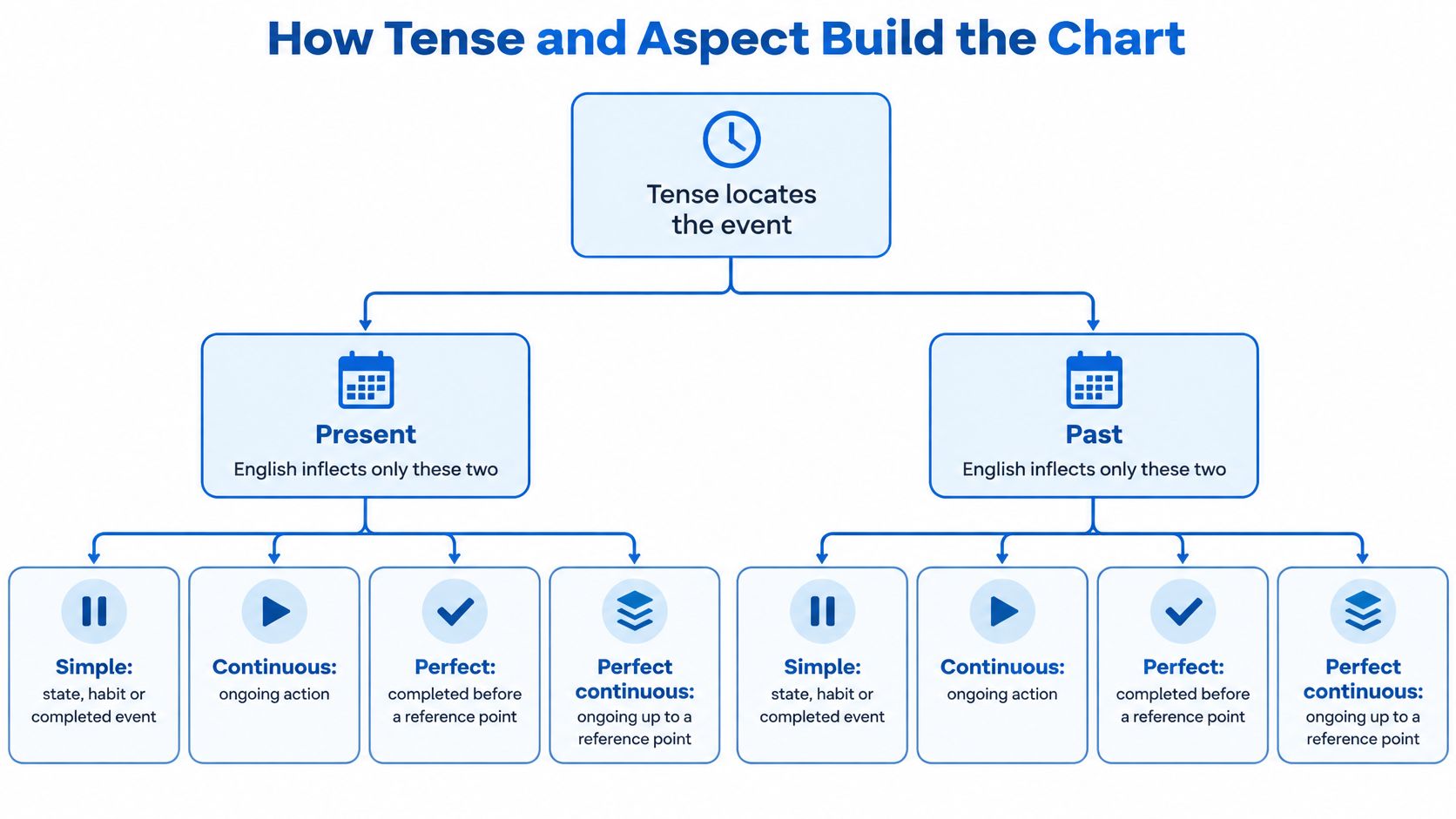
Add a third piece of information to each cell and the chart starts working in speech: the job the sentence is doing. Habit, temporary activity, experience, duration, prediction, arrangement, completed sequence. If you want to see how the -ing and participle forms feed these patterns, our guide to present and past participles shows where each one plugs in.
Affirmative, Negative and Question Patterns
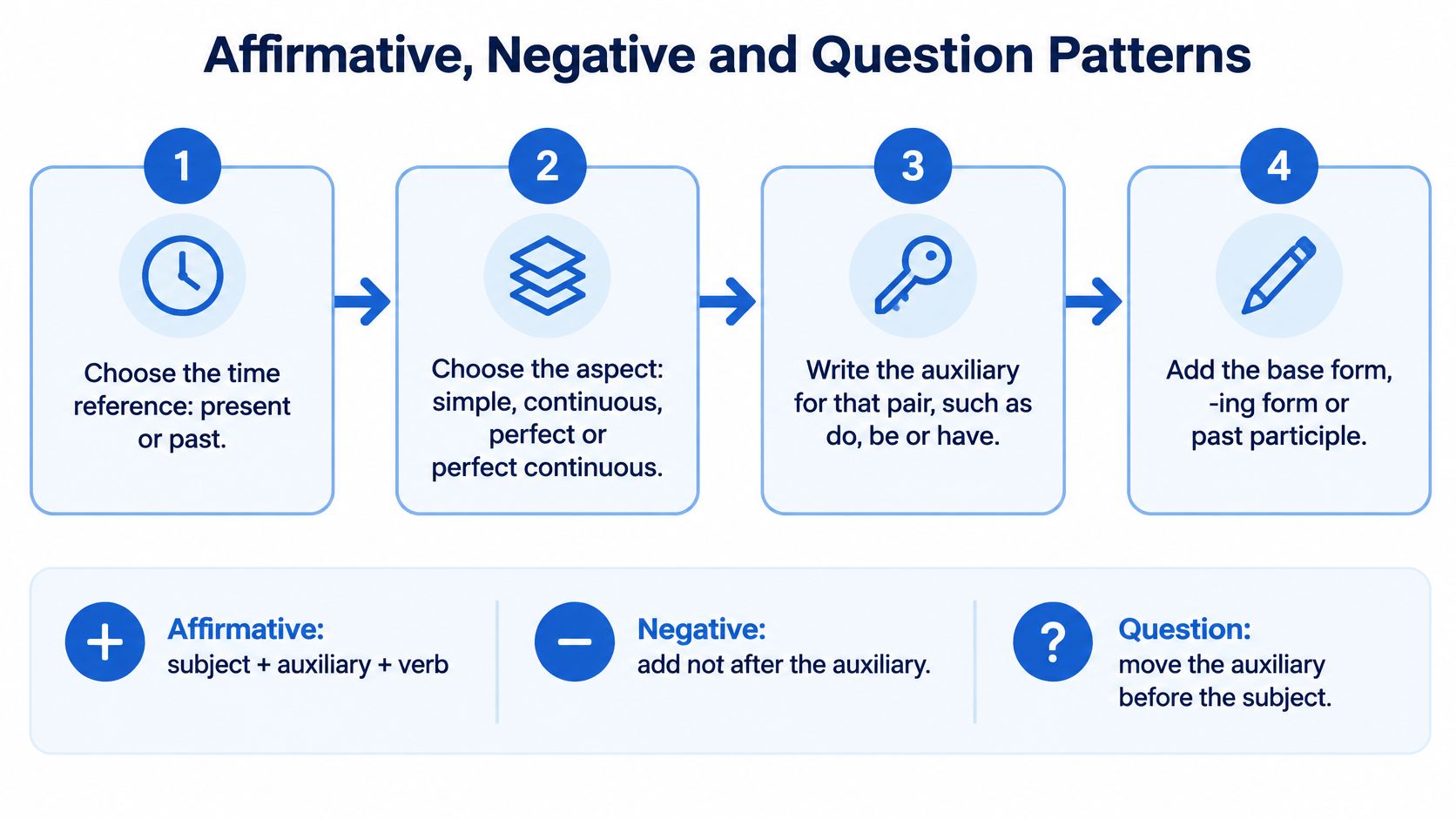
Every cell in the chart can be generated with the same five moves. Once you can generate a form, you can also negate it, question it, and diagnose your own errors by component.
Building any cell in five steps
- Choose the time reference. Present or past for the verb form itself. If the meaning is future, decide which future structure you're using.
- Choose the aspect. Simple, continuous, perfect or perfect continuous.
- Write the auxiliary. Do, be or have, in the shape the pair demands: am/is/are, was/were, have/has, had, will, will be, will have.
- Add the main verb. Base form after do or a modal, -ing after be, past participle after have.
- Check agreement. Third-person singular present takes -s: he walks, she has, the shop opens.
The British Council Foundation's guide to verb phrases describes this as an auxiliary-first design: base form, past form and past participle are the lexical pieces, while the auxiliaries encode aspect and clause structure. That's the difference between a chart you read and a chart you operate.
Negatives and questions in one line each
Put not after the first auxiliary: She has not been studying. They were not waiting. I don't work here. Move the first auxiliary in front of the subject for a question: Has she been studying? Were they waiting? Do you work here?
The flow below shows the same sequence with the negative and question transforms underneath.
Where learners slip
Three errors account for most broken tense sentences, and each one has a named cause. I have went is a participle problem: the third column of the verb table, not the second. She don't is an agreement problem: third-person singular present. I was study is an auxiliary-plus-form problem: after be, the verb needs -ing.
Irregular verbs worth automating
| Base form | Past simple | Past participle | Example with perfect |
|---|---|---|---|
| go | went | gone | They have gone home |
| see | saw | seen | They have seen that film |
| write | wrote | written | She has written the email |
| begin | began | begun | The class has begun |
| take | took | taken | He had taken the bus |
| eat | ate | eaten | We have eaten lunch |
| buy | bought | bought | I had bought the tickets |
| do | did | done | You have done well |
Run a five-minute drill: take one verb through affirmative, negative and question in the present perfect (I have finished / I haven't finished / Have you finished?), then repeat it in the past perfect. Two minutes per form is enough once the auxiliary choice becomes automatic, and repeating the pattern aloud is what moves it from recognition into speech.
Time Words That Point to a Form
Most tense errors are signal errors. The sentence usually tells you which row it wants, and the work is spotting the clue before you reach for a formula.
- Circle the time expression. Since, yesterday, by June, at the moment.
- Decide what kind of time it is. Open and unfinished, finished and closed, or tied to a second reference point.
- Copy the form from the matching row.
| Signal | Form to use | Example |
|---|---|---|
| always, usually, every day | Present simple | I start work at eight |
| now, at the moment, this week | Present continuous | I am working from home this week |
| since, for, already, yet, ever | Present perfect | I have lived in Rabat since 2019 |
| for plus an activity still in view | Present perfect continuous | I have been reading since Monday |
| yesterday, ago, in 2023, last week | Past simple | I visited Fes in 2023 |
| while, when for background | Past continuous | I was driving when the call came |
| before, after, by the time | Past perfect | The lesson had started before I arrived |
| for plus duration before a past point | Past perfect continuous | She had been studying for two hours |
| decision at the moment of speaking | will plus base form | I will call you tonight |
| present evidence | be going to | It is going to rain |
| arrangement already made | Present continuous | He is meeting Peter this afternoon |
| timetable or schedule | Present simple | The train leaves at 17.00 |
| by June, by then | Future perfect | By June I will have finished the course |
A signal narrows the choice. It never makes it alone. "For" in I have lived here for six years points at an unfinished period. "For" in she had been studying for two hours points backwards from a past moment.
Two signals cause the most hesitation. "For" plus a duration can sit with the present perfect (a period still open) or the present perfect continuous (the activity itself is in view), and only the speaker's focus decides. "When" and "while" don't automatically mean past continuous; they mark a background action only when a second, shorter action interrupts it.
Present and Past Choices in Real Situations
Charts can lose people. The formula is correct, the sentence is still wrong, because the choice depends on meaning rather than on the auxiliary. Learners routinely need to separate present simple from present continuous, past simple from present perfect, and will from be going to, and those decisions rest on time, completion, evidence and context. Research on how learners recognise and use tense finds that students can often identify basic structures while still struggling to locate the relevant time and event in a real situation. Knowing the table and using the table are two different skills.
| Pair | Choose when | Example |
|---|---|---|
| Present simple vs present continuous | routine vs action now or temporary | I work from home on Mondays / I am working from home this week |
| Past simple vs present perfect | finished past time vs past event with present result or unfinished time | I sent the file yesterday / I have sent the file |
| Present perfect vs present perfect continuous | completed experience or result vs duration or activity | I have read this book / I have been reading this book since Monday |
| Past simple vs past perfect | one past event after another vs the earlier of two past events | I left, then I called / I had left before she called |
The four questions that settle most choices
Ask them in order and stop at the first honest answer.
- Is this a routine or a fact? Then present simple: The school opens at seven.
- Is it happening now, or temporary? Then present continuous: I'm covering for a colleague this month.
- Is it finished, and does the result still matter now? Finished with a closed time word, past simple. Result relevant now, present perfect: Have you finished the report? asks about now; Did you finish the report? asks about a closed moment.
- Is there a second reference point? Then a perfect form. By the time we reached the classroom, the exam had already begun sets two past moments in order.
Present perfect continuous answers a fifth, quieter question: how long. I've been reading this book since Monday reports duration. I've read this book reports a finished result.
A working test: if you can add a finished time word like yesterday or in 2023 without the sentence sounding strange, the past simple is safe. If adding it makes the sentence wobble, you probably need a perfect form.
The British Council's explanation of perfect tenses and aspect puts the mechanic plainly: the perfect is a relationship between two time points, not an action that happened in the past. Had pushes the reference point back (she felt full because she had eaten), and will have pushes it forward. That's why "I have worked here since 2020" survives while "I have worked there in 2020" collapses.
When you're stuck mid-sentence
Say the simple version, then upgrade. I sent the email is not wrong; I've sent the email, so you can check it now is sharper when the listener needs the result. They had been waiting since noon when the bus came only earns its perfect continuous because the story already has a past reference point. Adding a harder form without a second time point doesn't make you sound advanced. It makes the listener ask which moment you mean.
Future Time Without a Future Tense
English has no dedicated future tense the way it has distinct present and past verb forms, and the British Council's grammar reference on the present tense confirms the split: two tenses, past and present, with future meaning created through several structures instead of one inflectional ending. The future rows in your chart are therefore future-time constructions, and each one has a job.
- Will plus base verb for predictions with no evidence in front of you, offers, promises, and decisions made as you speak: I'll help you carry those boxes.
- Be going to for intentions and for predictions based on what you can see: She's going to start her master's in September.
- Present continuous for arrangements already made with another person: We're flying to Istanbul on Friday.
- Present simple for timetables and schedules: The bank opens at nine.
- Present forms inside time clauses: I'll phone you when I get home, never "when I will get home."
The two less common future rows sit beside those choices rather than above them. Future continuous frames an action in progress at a later moment: This time next week I will be teaching. Future perfect marks completion before a later point: By the end of term I will have completed all six modules. Neither one needs a new rule, only the same aspect logic applied to a future reference point.
One decision rule for all five structures
Before you speak, ask a single question: is this decided now, already arranged, timetabled, or predicted from evidence? Decided now, use will. Arranged with someone else, present continuous. Timetabled, present simple. Predicted from something visible or known, be going to. The contrast that teaches the difference fastest is I'll call him now (a decision forming as you speak) against a look out of the window and it's going to rain (evidence you can both see).
Why Perfect Forms Get Avoided
A complete chart can still fail. Confidence drops sharply on perfect and perfect continuous forms, on voice changes and on temporal prepositions, even when learners handle negatives, questions and basic word order comfortably. One study of learner tense use reports that 64.6% of learners overuse the simple present to avoid more complex tenses, leaning on simpler structures or translation tools instead. The result is speech that never leaves I work and I worked, no matter how well the table is memorised.
For many Arabic-speaking learners the formula is familiar from class; the live choice is not. Treat it as a decision problem, not a knowledge gap.
- Say the fact in the simple form. I marked the papers. I worked in sales.
- Add a perfect only when a second time point is real. I've marked the papers when the listener needs the result now. She has worked in sales for three years when the period is unfinished.
- Say the negative and the question of that same form. I haven't marked them yet. Have you marked them?
- Put the upgraded line into a sentence you'd say. School, work, family. Have you sent the registration form? beats a perfect tense recited from a table.
The past perfect continuous earns its place only when the story already has a past moment: They had been waiting since noon when the bus finally came. If no such moment exists, the form has nothing to attach to.
For a slower walk through the pair that causes the most hesitation, our guide on when to use the present perfect tense covers the time markers, the contrast with past simple, and the comparison table in one place.
Keeping Tenses Consistent in Writing
Tense consistency is a paragraph-level mechanic. Purdue University's Online Writing Lab guidance on verb tense consistency recommends establishing a primary tense for the main discourse and changing tense only when the time frame changes. A shift is fine when the narrative moves to an earlier or later moment. It's an accident when both events sit in the same period and the verb drifts anyway.
Compare these two paragraphs a reader would judge differently.
The manager arrived at nine. The meeting started after the manager had arrived.
The past perfect marks the arrival as earlier than the meeting, both inside a past narrative. Now a present-tense report: Last month's workshop has changed how we plan. The present perfect ties an earlier event to now. Neither sentence is more advanced than the other. Each one points at a clear reference time.

A four-step revision method for any draft
- Identify the primary tense of the paragraph. Usually past simple for a narrative, present for analysis.
- Mark each earlier event with the perfect form relative to that reference point.
- Return to the primary tense after the shift. Don't let a perfect form take over the paragraph.
- Scan for accidental shifts. I went to the bank and I am waiting there breaks because both halves belong to one trip.
Emails and reports are where this shows up most often, since a single paragraph usually mixes what happened, what is now true, and what happens next. Our breakdown of the English grammar mistakes Moroccan learners make covers the tense shifts that recur most in written work.
Finish a paragraph by asking three questions. Is there one primary tense? Does each shift mark a new time frame? Does every perfect form point at a visible reference point, signalled by since, before or by June? If a perfect form has no anchor, drop it to the simple form.
Readers who want spoken correction on their own sentences can take our free CEFR placement test on the A0 to C1 scale and try a free trial in a live Google Meet class, with a written report afterwards. The test is the starting point, not a promised score.
The twelve rows on an English tenses chart are a map, and maps only help when you practise the route. At Englify we teach live English classes on Google Meet from A0 to C1, in small groups of no more than six learners or one to one, with the teacher correcting your tense choices as you speak rather than after the lesson. Start with the free placement test, which includes a spoken part, then book a free trial class and bring three sentences you weren't sure how to say.