Knowledge hub
Listening and Speaking: How They Reinforce Each Other
Learn how listening and speaking reinforce each other, what to expect at each CEFR level, and routines that practise both skills together.
The call ends and you're not sure what just happened. You followed most of it, laughed in the right places, said "yes, exactly" twice. Then the person asked you a direct question, and the sentence you needed didn't arrive in time.
That gap is common, and it isn't a vocabulary problem. You've studied the grammar. You know the words on the page. What breaks is the connection between what comes in and what goes out.
This article is about that connection. It explains why listening and speaking only improve when they're trained together, where the link usually fails, and the exact weekly routine that trains both in one cycle. You'll also get the level targets to aim at and the habits that undo the work.
Table of Contents
- How Listening and Speaking Feed Each Other
- Listening and Speaking Targets by CEFR Level
- A Practice Loop That Trains Both Skills at Once
- Where Listening Breaks Down and How to Fix It
- Speaking Feedback and the Question of Accent
- Mistakes That Stop the Two Skills Working Together
- Confirm Your Level Before You Choose Practice
- Questions Learners Ask About Practising Both Skills
How Listening and Speaking Feed Each Other
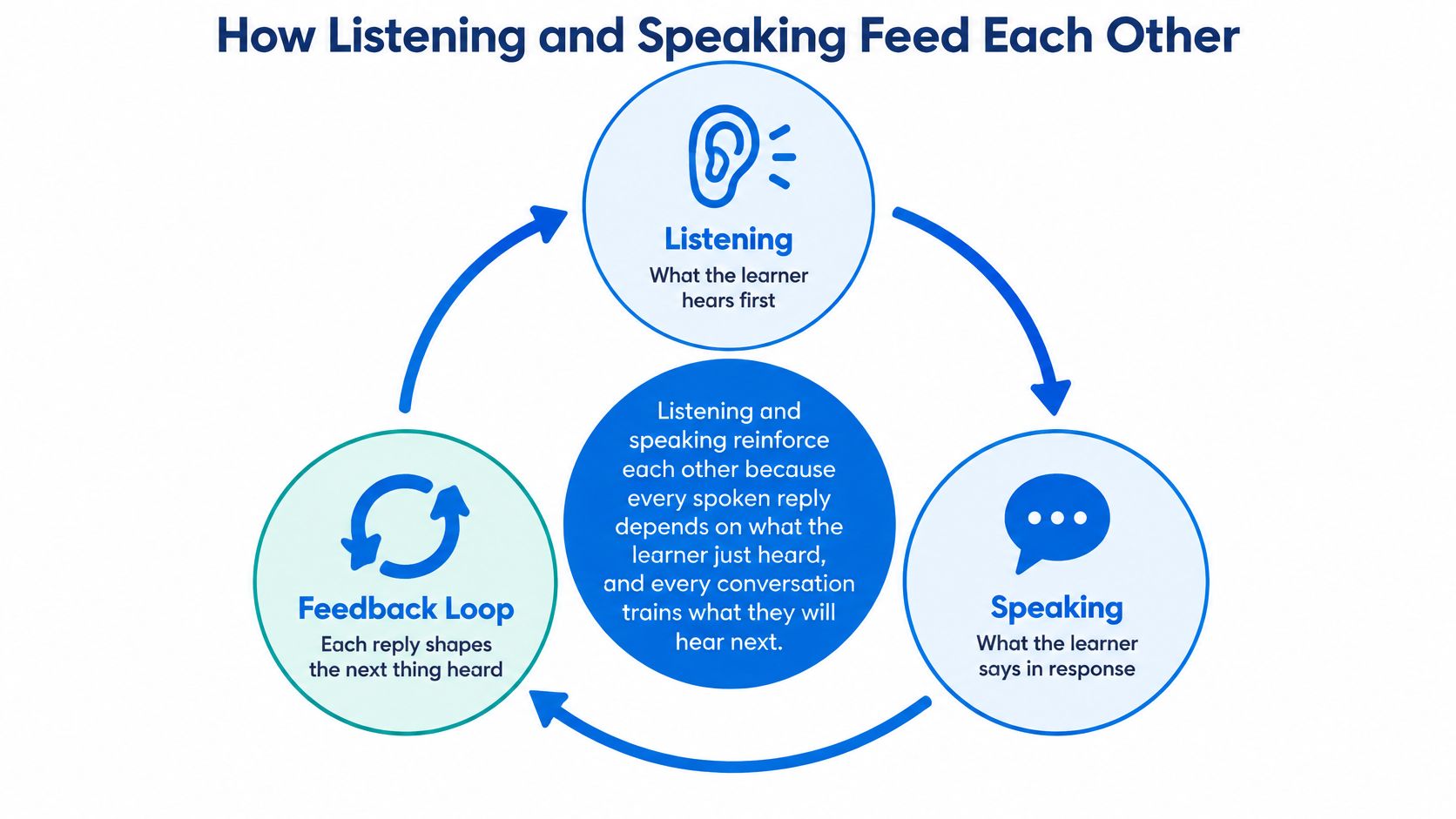
Listening and speaking reinforce each other because every spoken reply depends on what you just heard, and every conversation you hold trains what you'll hear next. Split them apart and neither moves much. Listening with no spoken answer is recognition practice. Speaking with no attention to the reply is performance, not communication.
The Council of Europe's history of the CEFR shows why this distinction got taken seriously. Work on the framework began at a symposium in Rüschlikon, Switzerland, in 1991, and the framework was published in 2001, during the European Year of Languages, with six proficiency levels from A1 to C2. For oral language it separates three abilities: oral comprehension (following speech, live or recorded), oral production (a sustained spoken message such as a presentation or an explanation) and oral interaction (turn-taking, clarifying, negotiating meaning).
That separation answers a question learners ask constantly. "I understand everything my teacher says, so why can't I speak?" Because understanding speech, delivering a message and managing a conversation are three different abilities. Treating "speaking" as one general skill hides which one is weak.
The cycle runs in one direction and then back again.
Three learners, three different weak points:
- The student who follows instructions but can't ask a follow-up. Comprehension is solid. What fails is interaction, the moment she has to take a turn and shape a question of her own.
- The professional who catches every point in a meeting but answers the wrong question. He was building his reply while the client was still talking, so production worked and interaction didn't.
- The traveller who gives directions perfectly but misses the reply. Production is strong. Listening at natural speed, with an unfamiliar accent, is the gap.
Before you choose any practice, name which of the three is weakest. The table below gives you the targets to measure against.
Listening and Speaking Targets by CEFR Level
You can follow a short clip and still fail to retell it in two sentences. The CEFR scores that gap as two abilities, not one label such as "good listener." Listening is what you can follow. Speaking is what you can say back. A clip only shifts the speaking column when you answer it aloud.
Read both columns. A learner often sits higher on one side than the other.
| CEFR level | Listening target | Speaking target |
|---|---|---|
| A1 | Recognises familiar words and basic phrases about identity, family and surroundings when speech is slow and clear | Introduces themselves and answers basic personal questions |
| A2 | Understands short, simple messages on familiar topics and routine exchanges | Describes daily routines and handles simple, predictable exchanges |
| B1 | Follows the main points of clear speech on work, school and familiar topics | Deals with most travel situations and gives reasons and short descriptions |
| B2 | Follows extended speech and technical discussion in their own field | Speaks fluently with little strain and interacts with native speakers |
| C1 | Understands extended speech even when it is not clearly structured or ideas are implied | Speaks spontaneously and flexibly for social, academic and professional purposes |
The two ends show how far the target moves. At A1, recognition is limited to slow, clear speech about identity, family and immediate surroundings, and the spoken job is a short introduction or a basic personal answer. At C1, the listener follows extended speech that is not clearly structured, with links between ideas implied rather than signalled, including films and television without too much effort, then speaks spontaneously for social, academic and professional purposes. Hearing the harder input is not the same as producing a reply at that band.
How to read your two columns honestly
The columns work like left and right shoe sizes. They are measured separately, and one number forced onto both makes the fit worse.
Match yourself on both sides before you plan practice. A learner who reads at B2 and freezes on the phone is not "B2 at speaking." One course number will either bore her on the stronger skill or lose her on the weaker one.
Match the input to the column you want to raise, then answer out loud on that same material. Beginners need controlled speed, familiar topics and clear speech, followed by a short spoken reply. Advanced learners need natural, extended speech and indirect meaning, followed by a reply that handles the implied point. Easier audio will not train the level they are aiming for.
For what each band means for courses and exams, see English levels and the CEFR explained.
A two-minute self-check
Record yourself answering a familiar question for two minutes: your last holiday, your job, or a decision you made recently. Do not script it. Listen back once for content, then once for whether you could follow your own speech comfortably at the speed you produced it. The recording is often harder to follow than the speaker expected. That gap is the point. Your speaking speed and your listening comfort are not yet the same target. Say the answer again, aloud, one sentence cleaner. That second pass is what ties the two columns together.
A Practice Loop That Trains Both Skills at Once
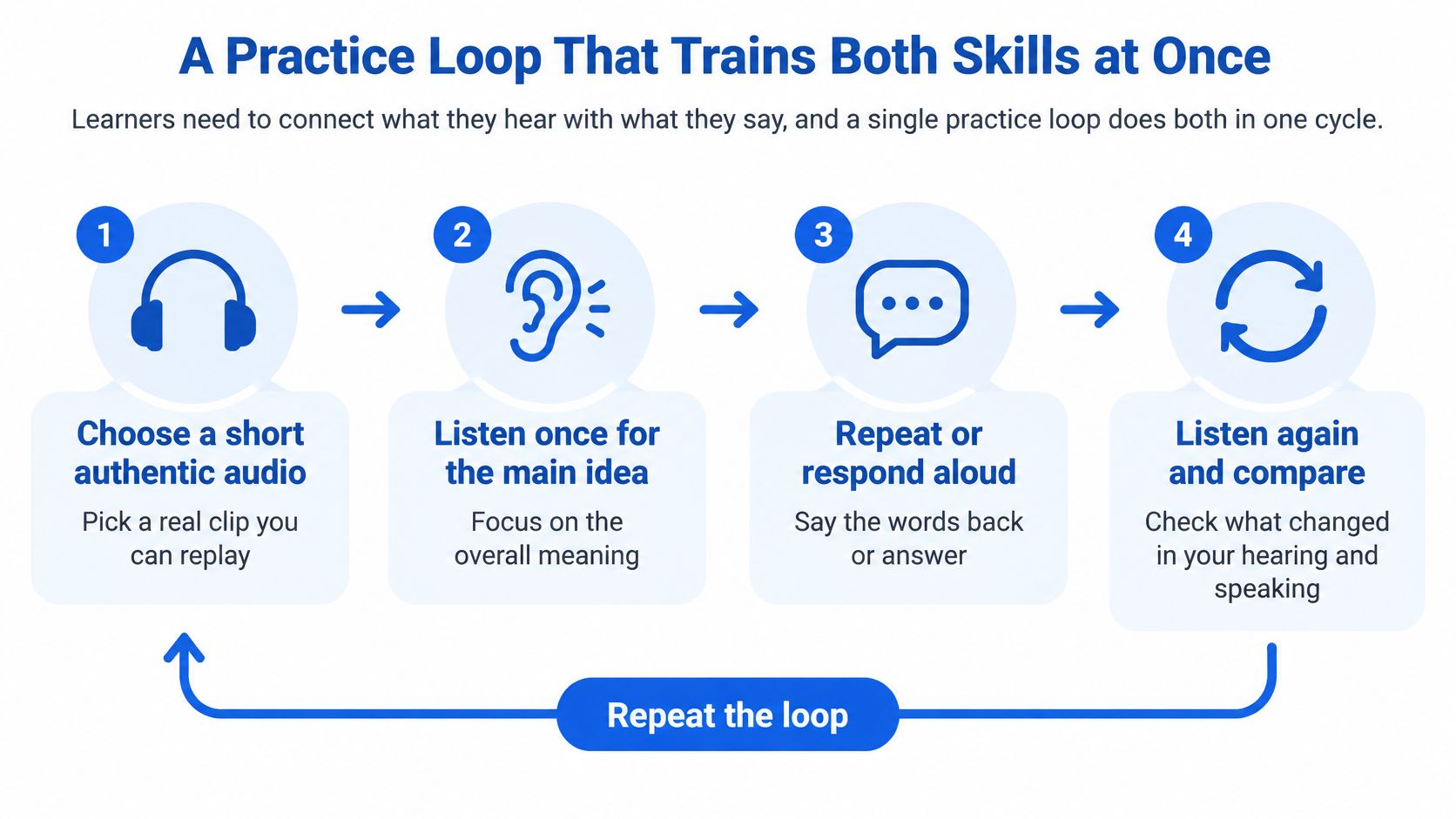
Replay a short clip five times and you may still freeze when someone asks what it was about. Hearing the story is not the same job as being asked to retell it. A loop beats two separate study habits because you have to connect what you heard to what you say, in the same minute, with a listener reacting. That spoken answer is what moves both skills. The cycle has six steps, and each one exists to close a specific gap.
- Pick a 30 to 90 second clip at your level. Short, authentic audio (a news item, a podcast opening, a scene from a series) keeps the loop fast enough to repeat on a busy day.
- Listen once for the main idea, then again for detail. Two passes train two different jobs: grasping the point, then catching the specifics that carry it.
- Answer a spoken question about it, aloud, without reading. This is the step everyone skips and the only one that turns recognition into production.
- Ask for clarification or a reformulation when your message is unclear. A partner, a teacher or a classmate can say "what do you mean by that?" and force you to rebuild the sentence.
- Repeat your answer with the better wording within a few minutes. Speed matters here. The correction has to land while the original attempt is still fresh.
- Note one thing that worked and one thing to fix. One line each, so next week's loop starts with a target instead of a blank page.
What the evidence says to expect
In a longitudinal study of Japanese university learners, the experimental group held weekly video conversations with trained native-speaker partners and received roughly 10 feedback events per 30-minute session across one academic semester. The partners used recasts and negotiation whenever an utterance blocked understanding. Those learners made significant gains in spontaneous comprehensibility, fluency and lexicogrammatical accuracy. Their pronunciation accent ratings did not improve significantly.
Meaning-focused talk produces repeated chances to notice a gap, test a guess, get clarification and adjust immediately.
What to expect in month one: intelligibility and fluency move first. Accent moves slowly, if at all, and it isn't the thing that decides whether you're understood.
If you want richer material for step one, the routine in our guide to learning English with films and series gives you clip-length scenes that fit the loop.
Score four things, not one
Once a week, rate your recorded answers separately: intelligibility (did the listener understand without asking?), fluency (how often did you stall?), grammar and vocabulary (what did you have to repair?) and accent (did anything sound unclear?). Four short scores show which part of the loop is working. A single overall impression hides the weak step.
Where Listening Breaks Down and How to Fix It
A classmate finishes a sentence and you are left holding two nouns. The verbs disappeared. You nod, then freeze when it is your turn to answer. That freeze is the useful signal. Catching a few words is not the same skill as speaking back, and listening only moves you forward when the next step is an answer out loud.
Research with Moroccan high-school students found the recurring barriers were fast speech, unfamiliar vocabulary, pronunciation variation, connected speech, and difficulty retaining information while listening. Each one fails for a different reason, so another hour of silent audio rarely repairs the barrier that is blocking you. A spoken reply shows which piece you held and which piece you only thought you heard.
| Breakdown point | What the learner notices | Speaking-based fix |
|---|---|---|
| Fast speech | Only key nouns are caught; words blur together | Shadow a 30-second clip at reduced speed, then at full speed |
| Reduced forms | Phrases such as "gonna" or "d'ya" sound unfamiliar | Say the reduced form aloud and match it to its full version |
| Unfamiliar vocabulary | A word stops the whole sentence from making sense | Use each new word in a spoken sentence within one day |
| Accent variation | British, American or international speakers sound unlike the classroom model | Listen to the same clip in two accents and retell it in your own voice |
| Connected speech | Word boundaries disappear and phrases sound like one word | Read a short passage aloud with linked words, then listen and check |
| Memory load | The start of a sentence is forgotten by the time the end arrives | Retell the clip in your own words and count the details you kept |
Two rows show how the loop works. For fast speech, take a 30-second clip, play it slowed down until you can repeat each phrase back, then play it at normal speed and notice which words disappeared. Your mouth already knows the shape of the sentence, so the fast version lands differently. For reduced forms, say "going to" and "gonna" aloud, then "do you" and "d'ya," and listen for them in the clip. Production comes before recognition here, not after it. The same order fits the other rows: say the new word, retell the clip, or read the linked phrase before you judge whether you understood it.
Accent variety is a listening job, not a speaking target. Learners in Morocco meet British, American, international and workplace accents, often in the same week. Your task is to decode that variety. One clip in two accents, followed by a retell in your own voice, trains that decoding more than an hour of a single classroom voice.
Replay only helps if you can hear your own answer. A noisy phone recording smears the words you are trying to check. The Isolate Audio guide to clearer speech covers speech-enhancement processing that cleans a recording so those words are easier to hear on the second pass.
Staged listening keeps the loop in order. Identify the topic and the speaker's intention first, notice reduced forms and key words second, and reconstruct the missing meaning from context third. Then answer aloud. Count how many replays you needed and whether you could summarise the clip afterwards without notes. The barrier that still forces a replay, or that drops out of the summary, is the row to practise tomorrow.
Speaking Feedback and the Question of Accent
Most learners need to be understood clearly, not to sound native. Clarity comes from word stress, sentence rhythm, final consonants and repair strategies. Accent differences often sit far lower on the list of things that cause misunderstanding.
Cambridge English's listening and speaking assessment criteria show how far assessment goes beyond grammar. Speaking is judged on intelligibility, prosody, fluency and the ability to sustain interaction. At higher levels, pronunciation is expected to stay highly intelligible, with stress, rhythm and intonation carrying meaning, and speech flowing with only natural hesitation. At lower levels, a listener may understand you overall while still working hard because of first-language features, false starts, repetition or unnatural pauses.
Sort every error by its effect on the listener
This is the diagnostic habit that changes how you practise. Record a short answer, then classify what went wrong:
- Segmental pronunciation that causes an actual misunderstanding, such as a vowel contrast that changes the word.
- Prosody that hides emphasis or attitude, so the listener hears a flat statement where you meant a request.
- Pauses that fall in the wrong place and break turn-taking, so someone else starts talking before you finish.
- Grammar or vocabulary gaps that stop the message from being completed at all.
Two worked examples. Say "I want the bill" with the stress on the wrong word and a waiter may hear a complaint instead of a request, because the words are identical and the emphasis does the work. Lose a word in a meeting and use "Sorry, could you say that again?" and the conversation survives. That second move is a repair strategy, and it's worth practising aloud until it arrives without thinking.
Feedback works best in a short sequence: a recast or a clarification request, then an immediate reattempt. Learners improve when they identify the problem and reformulate the sentence themselves. Hearing an explanation does much less.
Automated pronunciation tools have a real place in repetition and individual practice, and a real limit: they can flag a difference, but a teacher judges whether that difference harms understanding. For consistent scoring of recorded exchanges, Capstone Workforce's five-dimension communication rubric shows how to separate dimensions and keep the scoring defensible.
For targeted drills on the features that matter most, our guide to improving pronunciation in English covers word stress, rhythm and final consonants in order.
A useful self-check after any real conversation: note every moment someone asked you to repeat, or answered a slightly different question than the one you asked. Those moments mark your actual clarity problems.
Mistakes That Stop the Two Skills Working Together
Seven habits look productive and break the link between hearing and saying. Each one is easy to fix once you see it.
- Podcasts all week, no speaking. Comprehension climbs while production stalls. Add one spoken answer to every listening session, even thirty seconds.
- Shadowing material far above your level. You end up copying sounds without understanding them. Shadow only clips you can mostly follow.
- Speaking daily with no feedback. Errors settle in and become habits. Ask for one recast or clarification request per answer.
- Chasing accent while ignoring content. The listener understood the sounds and missed the point. Check whether the message landed first, then the sound.
- Memorising full scripts. The script collapses the moment a question changes. Rehearse key ideas and a handful of useful phrases instead.
- Treating a listening score as proof of speaking progress. Record a spoken answer and score it on its own terms.
- Avoiding clarification phrases. "Could you repeat that?" and "Do you mean...?" stay clumsy until you've said them aloud twenty times. Practise them until they arrive by reflex.
Each habit is harmless on its own. Together they remove the three things the loop needs: a spoken answer, feedback on it, and a second attempt. Remove any one of those and practice becomes rehearsal.
Confirm Your Level Before You Choose Practice
Use the level table to place yourself on both columns, then start with the weaker skill. Guessing wastes weeks, because a learner who needs interaction practice will spend a month on listening apps that never ask her to speak.
Englify runs live classes on Google Meet at CEFR levels A0 to C1, in small groups or private lessons, and the free placement test includes a spoken part, so the level you get reflects how you speak, not just what you can tick on a grammar quiz. The first step is a free trial: you take the placement test, a teacher assesses your speaking, and you get plan options at your level. In lessons, you speak for most of the hour, which is the loop applied to a real conversation.
Three next steps, in order:
- Take the free placement test and note your level for listening and for speaking separately.
- Join the free trial session and speak in a live class, so a teacher can hear the gap you can't.
- Choose the format, small group or private, that fits your week, then run the practice loop at home between lessons.
Written session reports keep a record of what was corrected in each class, so you can see which errors repeat. Keep your own recordings beside them: save a spoken answer from your first week, repeat the same task a few weeks later, and play the two side by side. You don't need to enrol to start. The loop works with a phone, a short clip and one honest listening partner.
Questions Learners Ask About Practising Both Skills
A classmate asks one question about a podcast you just finished, and the words stall. You understood the episode. You still couldn't answer. Listening only moves you forward when you have to answer aloud.
Can I improve listening and speaking without a partner? Yes, for most of the loop. Choose a clip of 30 to 90 seconds at your level, listen twice, answer a spoken question aloud, record it, then compare it with the clip and retell it without notes. The clip works like a practice partner who never gets tired: it sends a line, and your voice has to send one back. Only the clarification step needs another person. Replace it with a self-check. Write down the one phrase you couldn't produce and practise it the next day.
Is watching films enough? Films and series give useful exposure, but without a spoken response they mainly train recognition. Pause after a scene, answer a question about it aloud, and retell it in your own words before moving on.
How long before I notice progress? No single timeline fits everyone. Put a week-one recording beside one from several weeks later and score intelligibility, fluency, grammar and vocabulary, and accent separately. Familiar replies usually loosen first. Difficult ones take longer.
What if I understand every word and still freeze? Shrink the task. Listen for the question only, answer in one sentence, then add a second sentence the next day. Recognition and reply are different skills, and the reply is the one that has to be trained out loud.
If you'd like a teacher to hear where your listening and speaking break down, Englify's live classes on Google Meet include a free placement test with a spoken part, a free trial session, and level options from A0 to C1 in small groups or one to one. Visit Englify to book the free placement test and trial session.