Knowledge hub
How to Improve Pronunciation in English: A Practical Guide
How to Improve Pronunciation in English. Learn practical techniques to improve pronunciation in English. Master phonemes, stress, and intonation
You answer a question in English at work, at university, or during a job interview. The other person understands you, but you still feel uncomfortable because your accent sounds different from the speaker in the video you studied. That feeling is common, especially when you're speaking a language that has sounds, stress patterns, and rhythm unlike those of Arabic.
The good news is that how to improve pronunciation in English isn't mainly about removing your identity from your voice. It's about making your message easier to understand, strengthening the sounds that cause confusion, and speaking with enough confidence to keep the conversation moving.
Table of Contents
- Setting the Right Goal for Your Pronunciation
- Understanding the Three Pillars of Pronunciation
- Mastering Problematic Sounds for Arabic Speakers
- The Shadowing Technique for Rhythm and Fluency
- Using Technology and Feedback Wisely
- Building a Consistent Practice Routine
Setting the Right Goal for Your Pronunciation
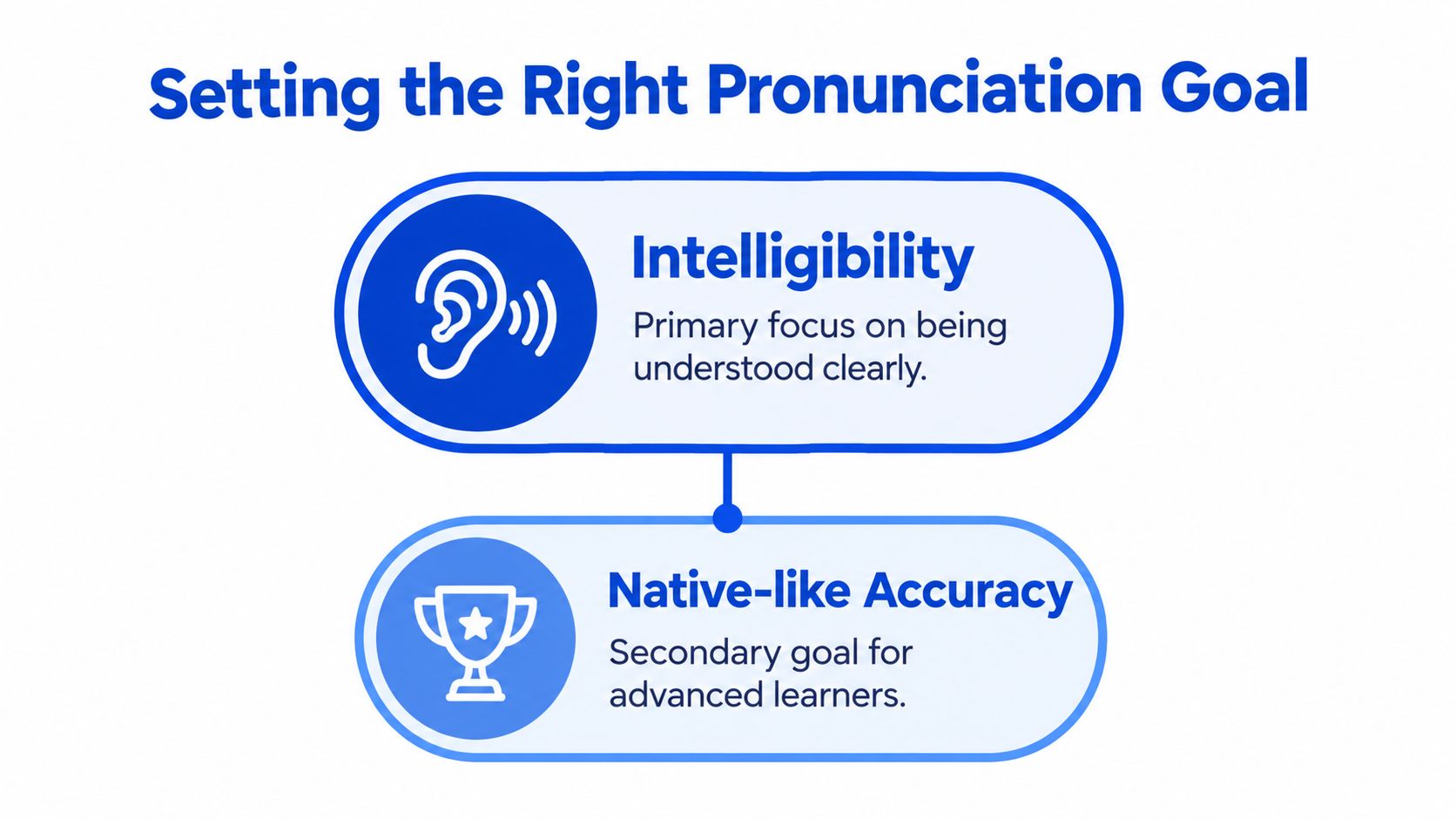
If a listener understands your message without asking you to repeat yourself several times, you're already working toward the most useful pronunciation goal: intelligibility. Intelligibility means that people can understand what you intend to say. Comprehensibility is closely related, and describes how much effort a listener needs to make while understanding you.
An accent, by contrast, is a noticeable way of speaking that may reflect your first language, region, or personal experience. Having an accent isn't a pronunciation failure. A learner from Morocco, the UAE, or another Arabic-speaking community doesn't need to erase every trace of Arabic influence to communicate effectively in English.
Practical rule: Improve the pronunciation features that create misunderstandings first. Don't spend all your energy chasing a voice that sounds exactly like someone else's.
What clear speech actually requires
A clear speaker can retain a regional or first-language accent while still making important contrasts easy to hear. These contrasts might include the difference between ship and sheep, the final consonants in asked or worked, or the stress pattern in a longer word. Clear speech also depends on pauses, rhythm, and the way words connect in a sentence.
Native-like accuracy can remain a personal ambition, especially for actors, teachers, interpreters, or advanced learners. It shouldn't become the minimum standard for participating in a meeting, answering an exam question, speaking to a customer, or introducing yourself.
A major 2015 meta-analysis examined 86 unique reports and found that learners who received systematic pronunciation instruction improved by approximately 0.89 standard deviations compared with their own pre-instruction performance. The same research supports sustained instruction, feedback, and objective progress checks rather than occasional correction, as described in the meta-analysis of pronunciation instruction.
A simple way to measure progress
Don't ask only, “Do I sound native?” Use questions that give you useful evidence:
- Listener understanding: Can someone unfamiliar with your practice understand the short message?
- Message accuracy: Do listeners hear the word you intended?
- Repeat requests: Do people regularly ask you to repeat a particular sound, word, or sentence?
- Speaking confidence: Can you continue talking instead of stopping after every uncertain word?
Record a short workplace update, university answer, travel request, or presentation opening. Ask a teacher or classmate to identify the one or two features that most affect understanding. This approach turns pronunciation from a vague worry into a skill you can observe and improve.
Understanding the Three Pillars of Pronunciation
Pronunciation has more than one layer. You can produce an individual sound accurately and still be difficult to understand if your word stress or sentence rhythm sends the listener in the wrong direction. A useful framework includes sounds, stress and rhythm, and intonation.

Sounds and phonemes
Phonemes are the individual sound categories that distinguish meaning. For example, changing the first sound in pat to bat creates a different word. Vowels also matter. The vowel contrast in live and leave, or full and fool, can cause confusion if both words sound too similar.
To improve a sound, work through three stages:
- Hear it. Listen to the target sound in several words and decide what makes it different.
- Produce it alone. Check your lips, tongue, airflow, and voicing.
- Use it in meaning. Practise the sound in a phrase, sentence, and short conversation.
Isolated repetition helps you notice the movement, but real communication tests whether the listener receives the intended meaning.
Stress and rhythm
English gives more prominence to some syllables and words than others. In PREsent, the first syllable is prominent when the word is a noun, while preSENT uses a different stress pattern when the word is a verb. In a sentence, changing the prominent word can also change the speaker's intended contrast.
Try saying:
- I didn't say he sent the email.
- I didn't say he sent the email.
- I didn't say he sent the email.
The words stay the same, but the focus changes. For Arabic-speaking learners who are used to a different rhythm pattern, stressing every syllable equally can make English sound slow or make the main idea harder to identify.
Intonation and connected speech
Intonation is the rise and fall of the voice across a phrase. It can signal completion, uncertainty, surprise, politeness, or a question. A flat delivery may not make a sentence grammatically incorrect, but it can make the speaker's intention less obvious.
Connected speech adds another layer. In natural conversation, speakers link sounds, weaken small words, and pause between groups of meaning rather than between every individual word. Practise full phrases such as Could you send it to me? instead of treating each word as a separate pronunciation exercise.
A large research synthesis reviewed 27 individual studies and aggregated 406 effect sizes related to comprehensible and native-like pronunciation. It found that pronunciation training produced a statistically significant improvement in comprehensibility, with an effect size of d = 0.610, while perceived accentedness showed a smaller effect of d = 0.278. The reported confidence intervals did not include zero, as documented in the research synthesis on comprehensibility and pronunciation training.
The practical conclusion is clear: practise sounds, but don't stop there. Stress, rhythm, and intonation often determine whether carefully produced words arrive as an understandable message.
Mastering Problematic Sounds for Arabic Speakers
Arabic-speaking learners may find certain English contrasts unfamiliar because the two languages organise sounds differently. The exact difficulty depends on the learner's variety of Arabic, previous language experience, and exposure to English. That's why a useful pronunciation plan starts with a short recording and identifies the features that most affect understanding.
Start with a contrast, not a long sound list
The /p/ and /b/ contrast is a useful example. Put your hand in front of your mouth and say pat, then bat. The /p/ begins with a stronger burst of air, while /b/ uses voice from the beginning. Practise these pairs slowly:
- pack / back
- park / bark
- cap / cab
- rip / rib
First, listen and point to the word you hear. Then say one word while a partner identifies it. Finally, place the words in short messages, such as I packed the bag and I backed the plan. If you only repeat the sounds without testing meaning, you may not notice whether the contrast works in conversation.
The /θ/ and /f/ contrast can also deserve focused practice for some Arabic-speaking learners. For /θ/ in think, place the tongue lightly between or close to the teeth and let air pass. For /f/ in fin, touch the lower lip to the upper teeth and push air through. Move from think, thin, three to phrases such as three free tickets. Record the phrase and check whether the two sounds remain distinct.
Watch final consonants and clusters
English often places several consonants together, as in texts, asked, or next week. Learners may add a vowel between consonants or leave out a final sound, especially when speaking quickly. Don't attack a long cluster at full speed. Build it gradually:
- ask
- asked
- asked me
- I asked me? Replace this with a meaningful phrase such as I asked my teacher.
For a word such as next, hold the final /t/ briefly, then add the next word: next Monday. The objective isn't to exaggerate every consonant forever. It's to make the word boundaries clear enough for a listener to recognise the message.
Give the schwa a place in your routine
The British Council describes the schwa /ə/ as the most common sound in English, especially in unstressed syllables. In connected speech, stressed syllables generally keep a full vowel, while unstressed syllables are weakened and often reduced to /ə/, as explained in its guidance on teaching the schwa in English.
Learners sometimes pronounce every written vowel with equal strength. In a phrase such as I want to go to the office, the small words to may become weak rather than receiving the same emphasis as want, go, or office. Mark the prominent words, circle the weak syllables, and repeat the phrase while making the contrast noticeable.
For targeted practice designed around common issues for Arabic-speaking learners, use this English pronunciation resource for Arabic speakers. Choose one sound or rhythm feature at a time, then test it in a sentence you might use at school, at work, or while travelling.
The Shadowing Technique for Rhythm and Fluency
A learner may know how to pronounce every word in a sentence and still speak with long pauses between words. Shadowing helps connect the parts. You listen to spoken English and repeat it immediately, with little or no delay, while copying pronunciation, intonation, rhythm, and fluency.
Choose a short recording that matches your level. A news excerpt, a course dialogue, a presentation sample, or a workplace conversation can work well, provided you understand most of the meaning. Avoid material so difficult that you're only chasing sounds without knowing what you're saying.
A routine you can follow
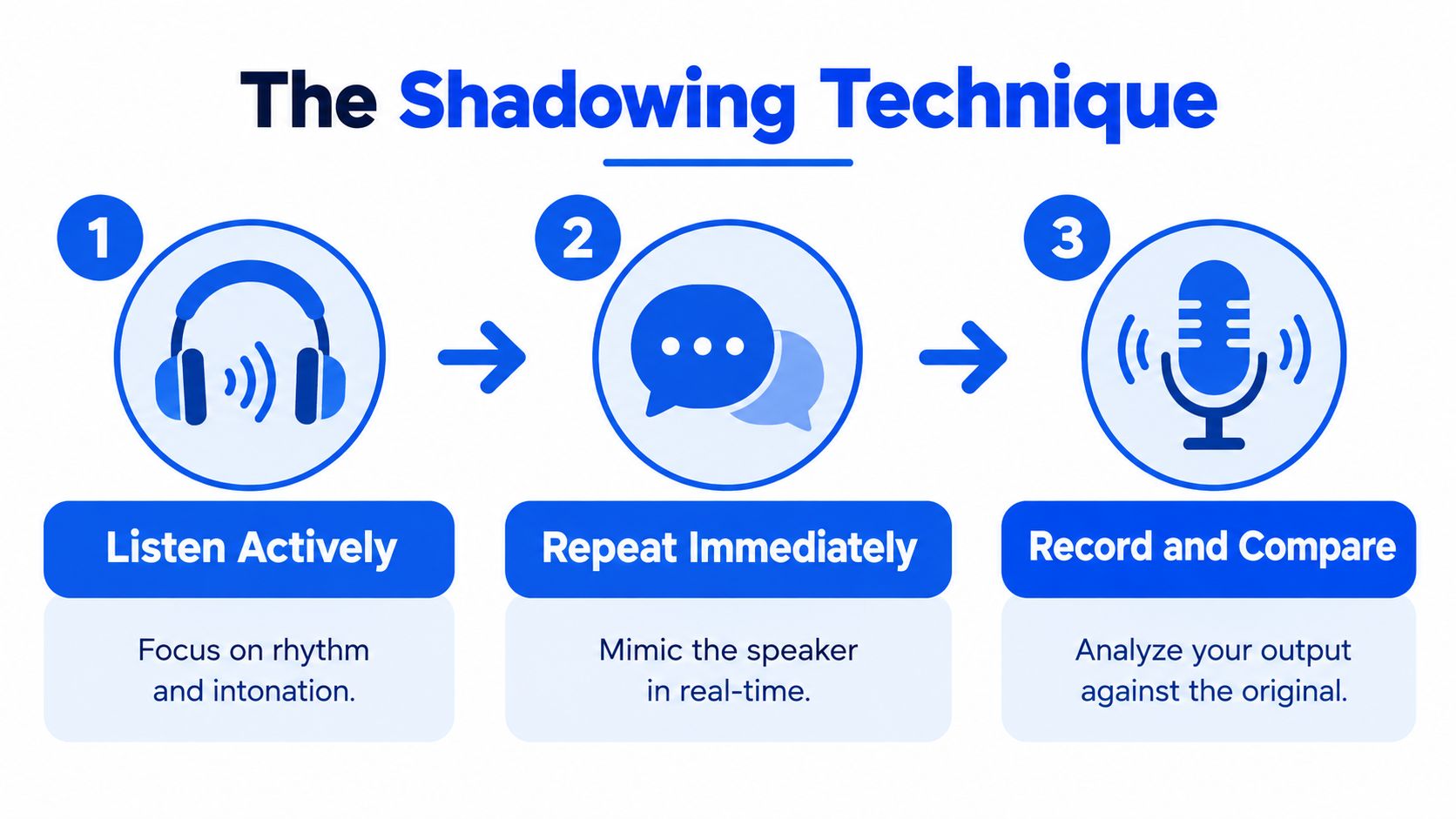
Listen actively. Play the clip once for meaning. On the next listen, notice which syllables sound prominent, where the speaker pauses, and how words connect. Mark a phrase such as Thanks for joining us today by underlining the words that carry the main message.
Repeat immediately. Play a short portion and speak along with it. Don't wait until the speaker finishes the entire sentence. Your aim is to follow the speaker's timing, not to create a perfect translation in your head first.
Record and compare. Use your phone to record your attempt. Listen to the original and your version separately, then compare one feature at a time. You might notice that your sounds are accurate but your pauses are too frequent, or that you stress every word instead of highlighting the key information.
Repeat with a smaller target. Choose one adjustment, such as reducing to, stressing joining, or connecting thanks for. Record the phrase again and ask whether the new version sounds easier to follow.
A reported six-week study used shadowing sessions three times per week after a baseline speaking assessment. The routine is described in the study of shadowing for English pronunciation practice. You don't need to shadow a long speech. Short, repeated extracts are easier to understand, imitate, and review.
Move from imitation to communication
Shadowing shouldn't become an exercise in copying a speaker's identity. Use it to develop control over timing, stress, linking, and intonation, then remove the recording and express your own idea. After practising I'd like to discuss the next step, say a new sentence such as I'd like to clarify the deadline using a similar rhythm.
For a learner preparing for an interview, shadow the opening of a professional answer, record it, and then adapt the structure to personal experience. For a university student, practise a presentation transition and use it in a real explanation. The transfer from model speech to original speech is where the technique becomes useful beyond repetition.
Using Technology and Feedback Wisely
Pronunciation apps can provide frequent practice, but an automated score isn't the same as a complete diagnosis. Digital tools are often useful for checking targeted phonemes, comparing recordings, and encouraging repetition. They may be less reliable when the issue involves meaning groups, natural pausing, conversational timing, or whether an unfamiliar listener understands the message.
A 2025 classroom study of 71 Saudi university EFL learners found that integrating ChatGPT and SpeechAce significantly improved phoneme accuracy at word and sentence levels, but produced limited gains in word-stress patterns. The finding is reported in the classroom study of ChatGPT and SpeechAce for pronunciation learning.
Use automated feedback as a starting point
When an app flags a sound, don't accept the correction blindly. Say the word again, check a reliable dictionary recording, and place the sound in a sentence. If the tool marks price as incorrect, compare price with prize, listen for the voicing difference, and ask whether a human listener hears the word you intended.
Technology works best when you give it a narrow task:
- Sound checking: Use a recording tool to practise /p/ and /b/, /θ/ and /f/, or a difficult vowel contrast.
- Self-review: Save recordings so you can notice repeated patterns instead of reacting to one score.
- Repetition: Use short prompts to practise the same phrase in several contexts.
- Error verification: Check questionable feedback with a teacher, peer, dictionary audio, or trusted learning resource.
Automated systems can misrecognise speech, suggest questionable corrections, or raise privacy concerns. A human listener can explain why a phrase sounds unclear, ask what you meant, and decide whether a difference affects communication.
Combine digital repetition with human interpretation
Ask a teacher or speaking partner to listen without seeing the script. Give them one task: write the word they hear, identify the main stressed word, or explain whether the sentence sounds complete. This tests communication rather than resemblance to a model recording.
Live correction is particularly valuable for presentations, interviews, meetings, and spontaneous conversation. A teacher can notice that your consonants are accurate but your sentence stress hides the important information. They can also choose the next exercise instead of giving you a long list of unrelated errors.
You can combine independent recording with online English speaking practice that includes real-time interaction. The aim is a balanced cycle: practise often with technology, then use human feedback to interpret what the technology can't reliably judge.
Building a Consistent Practice Routine
Pronunciation improves through repeated attention, not through one intense session followed by a long break. Build a routine around a small target:
- Listen: Choose a short phrase and mark its stress and pauses.
- Practise: Work on one sound or rhythm feature.
- Record: Compare your version with the model.
- Communicate: Use the feature in an original answer about work, study, travel, or daily life.
- Review: Keep the next target specific.
A structured course can make this process easier to maintain because a teacher selects priorities, gives immediate feedback, and checks progress through real speaking. Englify offers live English classes through Google Meet, including small groups and private lessons, CEFR-based levels from A0 to C1, session recordings, learner reports, personalized content, a free placement test, and a free trial session. The guide to practising English speaking alone can also help you continue between lessons.
Start with one recording today. Choose a sentence you need for an interview, meeting, class, or everyday conversation, make one pronunciation change, and record it again. Visit Englify to take the free placement test or book a free trial session, then use live feedback and a consistent practice plan to make your English easier to understand.