Knowledge hub
How to Get Rid of Accent: Clarity Drills That Work
Learn how to get rid of accent the practical way: improve clarity with listening drills, speaking practice and realistic goals.

Copying a native speaker isn't a complete pronunciation plan. If you're searching for how to get rid of an accent, a more useful starting point is to find out exactly where listeners lose your meaning, then practise those features in real conversation.
Table of Contents
- Why Clarity Beats Sounding Native
- Find the Sounds and Stress That Hurt Understanding
- Listening Drills That Train Your Ear First
- Speaking Drills for Stress, Rhythm and Sounds
- Using Apps and AI Feedback Without Chasing Scores
- A Realistic Timeline and How to Measure Progress
- Record Your Baseline and Book a Free Placement Test
Why Clarity Beats Sounding Native
You don't need to remove your accent to communicate effectively in English. For most learners, complete accent removal is neither a realistic target nor a requirement for clear speech.
Intelligibility means listeners recognise the words you say. Comprehensibility means they can follow your message without excessive effort. Accentedness, how different your pronunciation sounds from a listener's expected variety, is a separate measure. You can sound recognisably Moroccan and still be easy to understand.
The American Speech-Language-Hearing Association's accent modification guidance summarises a review of 86 studies reporting average gains of 0.89 standard-deviation units against learners' pre-instruction performance, and a newer analysis of 18 independent studies reporting an intelligibility effect size of 0.62. These are research measures, not percentages or promises about an individual learner.

Useful pronunciation goals describe something you can do:
- On a call, give information without repeatedly restating key words.
- In a meeting, make your main point clear through emphasis and sensible pauses.
- During clarification, repeat or rephrase calmly instead of apologising for your accent.
For Moroccan learners, a French- or Darija-influenced accent isn't an employment problem. Moroccan employers hire agents with these accents every day. Focus your effort on the words and speaking habits that interrupt communication, rather than treating your linguistic background as something to hide.
Practical rule: Keep your accent. Change the features that break understanding.
Find the Sounds and Stress That Hurt Understanding
Start with a 60 to 90 second spontaneous recording, answering a question about your work or studies. Don't read a polished script. Explain a project, describe your course or talk through a familiar task.
Play it to someone who hasn't heard the topic in advance. Ask them to write down what they understood and mark where they needed another listen. A listener's uncertainty is more useful than your own impression that you sound different.
Speech features that affect understanding
| Feature | Effect on listeners | Quick self-check |
|---|---|---|
| Word stress | Listeners hear a different word or miss the key term | Say a sentence with different syllables stressed and ask whether the word remains recognisable |
| Final consonants | Plurals, past tenses and endings disappear | Record work, worked and works, then check whether each ending is audible |
| Vowel pairs | Words such as ship and sheep, or bad and bed, merge | Ask a listener to sort a random list of the pair and count the errors |
| Consonant contrasts | P and B, or V and W, blur in names and numbers | Read a list of names and phone numbers and check what a listener confirms |
| Rhythm and linking | Speech sounds flat or choppy, so key words get lost | Compare your sentence timing with a model recording of the same sentence |
| Speed and volume | Sentence endings fade or the pace is too fast for listeners | Count words per minute and check whether each sentence's final word is audible |
Word stress isn't the same as sentence emphasis. Word stress concerns the stronger syllable inside a word. Sentence emphasis highlights the information you want someone to notice. Moving stress doesn't always create another word, but it can make a familiar word difficult to recognise.
For Arabic-speaking learners, certain contrasts deserve checking without assuming everyone has the same difficulty. Standard Arabic doesn't have /p/, so park and bark may need attention for some speakers. English vowels in ship and bit may also require unfamiliar distinctions. Your other languages and previous English exposure matter too.
Use commonly mispronounced English words as a diagnostic word list, not a list you must master before speaking. Choose a small number of priorities from actual misunderstandings. If listeners understand your vowels but miss verb endings, start with endings.
Listening Drills That Train Your Ear First
Before correcting a sound, check whether you can reliably hear it. Otherwise, you may repeat the same pronunciation while believing you've changed it.
A practical perception routine uses 20 to 30 randomised identification items, aims for 85 to 90 percent accuracy before intensive production, and keeps daily practice to 5 to 10 minutes, consistent with the approach discussed in the TESOL Quarterly review of pronunciation training. Treat that accuracy range as a working practice target, not a universal pass mark.
A focused listening routine
Choose your target contrast. Use a distinction that caused confusion in your recording, such as ship and sheep, so the exercise addresses a real need.
Build a shuffled listening test using clear recordings of both words. Select the word you hear before checking the answer, because seeing the transcript first removes the identification challenge.
Check against the transcript. Replay mistakes and notice the difference in vowel quality, length or consonant voicing rather than memorising the answer order.
Dictate a short connected sentence from a podcast or news clip with a reliable transcript. Compare your text with the original and decide whether you missed a sound, a reduced word or a word boundary.
Change the speaker. Include at least three voices with different accents as a practice choice, so success doesn't depend on becoming familiar with a single recording.
Don't limit listening to isolated words. In a meeting sentence such as We need the revised figures by Friday, notice which words receive prominence and where the speaker pauses. Those cues help you identify what matters.
Listen for the difference you need to make, not for every difference between your voice and someone else's.
The connection between listening and speaking practice is practical: hearing a contrast gives you something specific to judge when you produce it. Perception training can support later production, but recognising a word doesn't automatically mean you can pronounce it consistently. You still need speaking practice.
Speaking Drills for Stress, Rhythm and Sounds
Use a short routine that moves from deliberate mouth movements to a meaningful message. A sound you can produce alone isn't yet a sound you can use comfortably while explaining a problem.
The sequence begins with a visible check of how you make the sound.
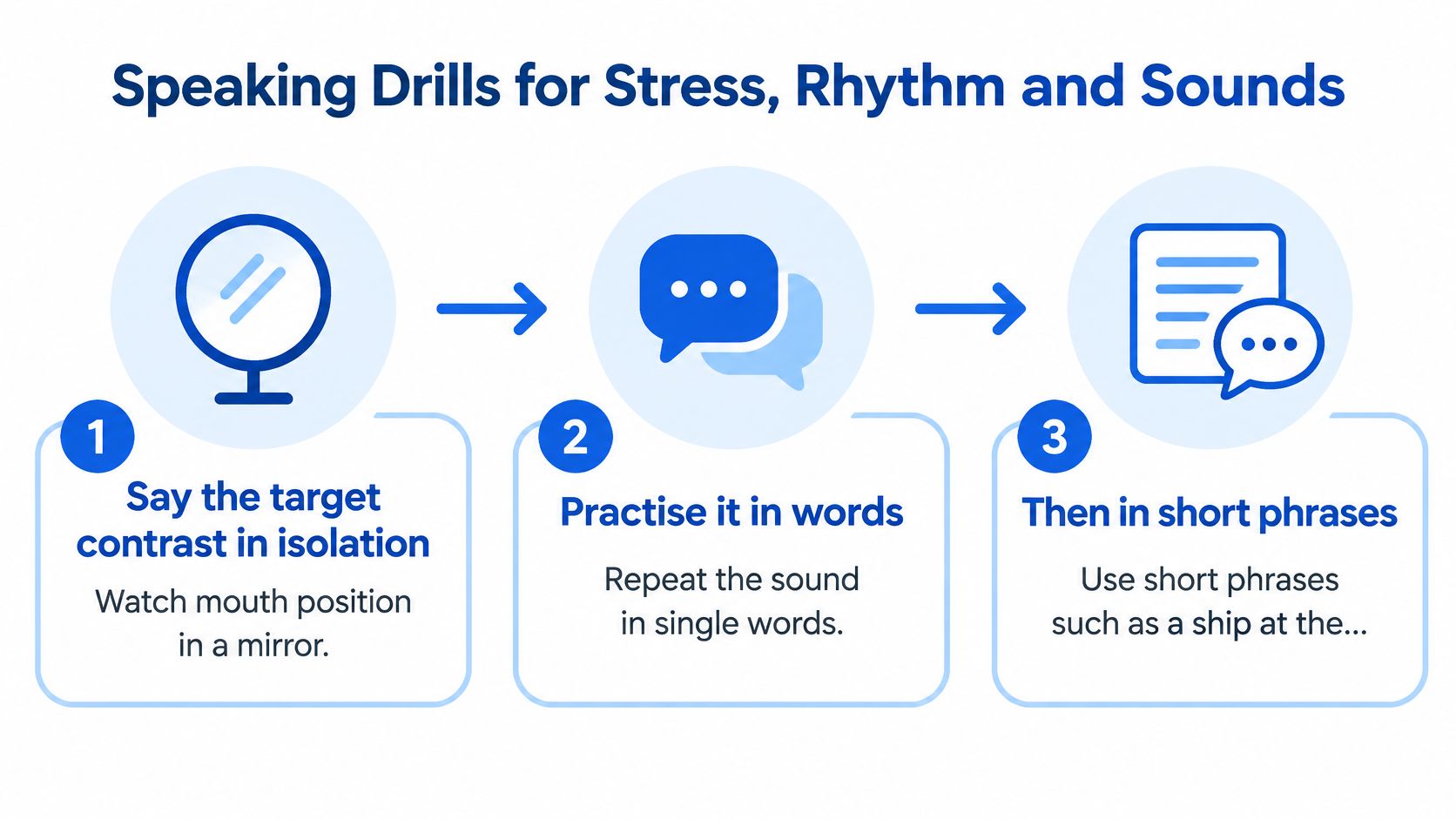
Move from sounds to conversation
Say the target contrast in isolation while watching a mirror. Check lip shape, tongue placement and voicing with a teacher's explanation, because repeating an unclear movement won't necessarily correct it.
Practise the contrast in words, then short phrases such as a ship at the port and the sheep in the field. This lets you carry the distinction into neighbouring sounds without immediately managing a whole conversation.
Shadow a clear speaker using a short clip, for example a ten-second extract. Repeat at the speaker's pace and match the important stresses and pauses, rather than copying pitch or voice quality.
Try delayed repetition by listening to a sentence, pausing briefly, then saying it from memory. The delay makes you reconstruct the sentence instead of merely following the recording.
Record an attempt and compare it with the model. Listen for a specific difference in stress, sound length or pausing, so the next attempt has a clear purpose.
Finish with a role-play such as explaining a delivery delay or confirming a meeting time. Ask a listener to respond to the message, because successful communication requires more than accurate repetition.
Include rhythm from the beginning
For Please send the revised contract today, emphasise the information the listener needs and let less important words remain lighter. Don't pronounce every word with equal force or insert a pause after each one. Linking should help a phrase flow, not hide its endings.
A pilot study involving four Burmese refugees found that all four improved on trained and untrained articulation and prosody items, while three improved on broader oral-English communication and intelligibility measures. The sample was small, so it supports a combined training approach, not a universal success rate.
Keep home practice brief and correct a single feature at a time. Stop when you're too tired to monitor your target accurately. If you're practising without a partner, these ways to practise English speaking alone can help you organise recordings and role-plays, but arrange occasional listener feedback too.
Using Apps and AI Feedback Without Chasing Scores
A higher app score doesn't guarantee a better conversation. Speech recognition can indicate whether a tool recognised your words, but it can't reliably predict how someone will interpret your message in a busy meeting or on a poor phone connection.
The Cambridge review of automatic speech recognition and pronunciation learning describes useful applications alongside continuing concerns about accuracy and variation across accents. A transcription error is a clue to investigate, not proof that your pronunciation is wrong.
Use a human-plus-tool routine
- Record spontaneous speech about a familiar, non-confidential topic.
- Run the audio through a speech-to-text tool such as Google Voice Typing and mark missing or substituted key words.
- Practise the suspected feature in meaningful sentences, rather than repeating the entire recording until the score rises.
- Ask a teacher or peer to transcribe the same passage and compare their interpretation with the tool's output.
If you're comparing tools, FruitPunch's independently scored language app rankings can provide a starting point. Choose according to the practice features you need, such as recording, playback and understandable feedback, rather than assuming a ranking establishes pronunciation accuracy.
Privacy check: Before uploading your voice, review how the service stores recordings and whether you can delete them.
Avoid clips containing customer details, employer information or personal identifiers. For Arabic-, French- and English-speaking learners, a tool's unfamiliarity with an accent may affect its response. Use technology to identify possible problems and people to confirm progress.
A Realistic Timeline and How to Measure Progress
Six to twelve week practice cycle
| Weeks | Focus | Practice | Check |
|---|---|---|---|
| Weeks 1-2 | Baseline and perception | Record 60 to 90 seconds; run identification tests for 5 to 10 minutes daily | Baseline recording and identification accuracy |
| Weeks 3-6 | Controlled production | Words, phrases and shadowing for 5 to 10 minutes daily | Target error per 100 words |
| Weeks 7-9 | Communicative transfer | Role-plays, mock calls and information-gap tasks | Key words understood by an unfamiliar listener |
| Weeks 10-12 | Re-testing | Same scripted passage plus a new information-gap task | Comprehensibility on a 1 to 9 scale compared with baseline |
Treat this as an adjustable six to twelve week practice plan, not a promise of completion; the pronunciation-instruction synthesis indexed by ERIC supports structured instruction with feedback and reports stronger improvement in comprehensibility than in perceived accentedness. The table shows an extended cycle. Move forward when the target carries into fresh speech, not just because a calendar phase has ended.
Most learners in our routine-call training see a clear difference in fluency within a few weeks, while difficult conversations take longer. Handling an unexpected complaint places different demands on attention than confirming familiar details.
Measure understanding rather than resemblance
Retest at the start, every two weeks and at the end. Use the same scripted passage alongside a new information-gap task, where your listener needs information only you have. For example, explain a changed appointment and ask the listener to confirm the new arrangements.
Keep a simple record of these measures:
- Key words understood. Decide which details matter before the task, then calculate the percentage your unfamiliar listener understood correctly.
- Listener effort. Use a consistent 1 to 9 comprehensibility scale, with clearly labelled endpoints for very difficult and very easy to follow.
- Target-error frequency. Count occurrences of the feature you're working on per 100 words, using the same scoring rule each time.
Keep the microphone, room and recording distance consistent. Otherwise, a quieter room or better microphone may account for an apparent improvement. Where possible, ask listeners to assess recordings without knowing which came first, and don't rely solely on a teacher who already knows your speech patterns.
A lower error count isn't enough on its own. If you pronounce endings more accurately but slow down so much that your message becomes hard to follow, adjust the practice. The useful outcome is clearer speech that you can sustain while thinking about meaning.
Outside formal checks, notice fewer requests to repeat, quicker confirmations on calls and less need to restate points in meetings. Those are observable communication changes, even if your accent remains recognisable.
Record Your Baseline and Book a Free Placement Test
Make a baseline recording this week about something you need to discuss: your studies, a work responsibility or an upcoming interview. Ask an unfamiliar listener where they lost the message, and save both the recording and their comments.
Bring that sample to a structured speaking assessment. It gives the teacher something more useful than a general wish to sound native: a real task, identifiable difficulties and a starting point for comparison.
Turn the recording into a learning plan
At Englify, the first step is a free trial, including a free CEFR placement test with a spoken part. A teacher assesses your speaking and then provides plan options at your level, within our A0 to C1 learning pathway.
Our live sessions run through Google Meet, with small-group and private-class options. Your recording can help identify priorities for personalised practice. Placement establishes where you're starting; it doesn't promise a particular pronunciation result.
Before your assessment, answer one question for yourself: which situation matters most right now, a meeting, a phone call, an interview or daily conversation?
Englify offers live online English and French learning with speaking practice and corrective feedback. Visit Englify to book your free trial and placement test, and bring your baseline recording so your pronunciation priorities start with what listeners need.