Knowledge hub
10 Words People Mispronounce in English: Say Them Right
Learn 10 words people mispronounce in English, with phonetic guides, stress tips, and example sentences you can practise in your next conversation.
You're halfway through ordering coffee, the meeting starts in ten minutes, and the word that comes out is not quite the word you meant. Most English words people mispronounce fall into three habits: silent letters, stress on the wrong syllable, and extra or missing syllables. Ask for an espresso and start it with an "ex" sound, and the barista will usually still get the order. The small mismatch is what slows the conversation down.
A 2025 report on accented English found that more than 60% of English speakers say they regularly mispronounce at least one common word. The problem isn't limited to learners. Spelling, borrowed words, and fast speech trip up confident speakers too.
This list covers ten everyday words. Each one includes a phonetic spelling, the habit behind the slip, and a sentence you can use at school, at work, or on a trip. The goal is clarity, not a new accent. Our teachers work on speaking speed, word stress, and the specific words listeners ask you to repeat.
Learn the habit, not only the word. The same silent letter, stress shift, or extra syllable shows up in dozens of words that never make a viral list.
Table of Contents
- 1. Almond, AH-mund (/ˈɑːmənd/)
- 2. Choir, KWY-er (/ˈkwaɪər/) or KWY-uh (/ˈkwaɪə/)
- 3. Colonel, KER-nul (/ˈkɜːrnl/ or /ˈkɜːnl/)
- 4. Comfortable, KUMF-tuh-bul (/ˈkʌmftəbl/)
- 5. Epitome, ih-PIT-uh-mee (/ɪˈpɪtəmi/)
- 6. Espresso, eh-SPRESS-oh (/ɛˈspresoʊ/)
- 7. Library, LY-brer-ee or LY-bruh-ree
- 8. Mischievous, MIS-chih-vus (/ˈmɪstʃɪvəs/)
- 9. Nuclear, NYOO-klee-ur or NOO-klee-ur
- 10. Often, OF-n or OFF-en (/ˈɒfn/, /ˈɔːfn/, /ˈɔːftən/)
- Syllables, stress, and the main learner error for each word
- Practise These Words Until They Feel Automatic
1. Almond, AH-mund (/ˈɑːmənd/)
You see the l and your mouth wants to say it. In the safer standard form, that l is silent, and almond has two syllables: AH-mund.
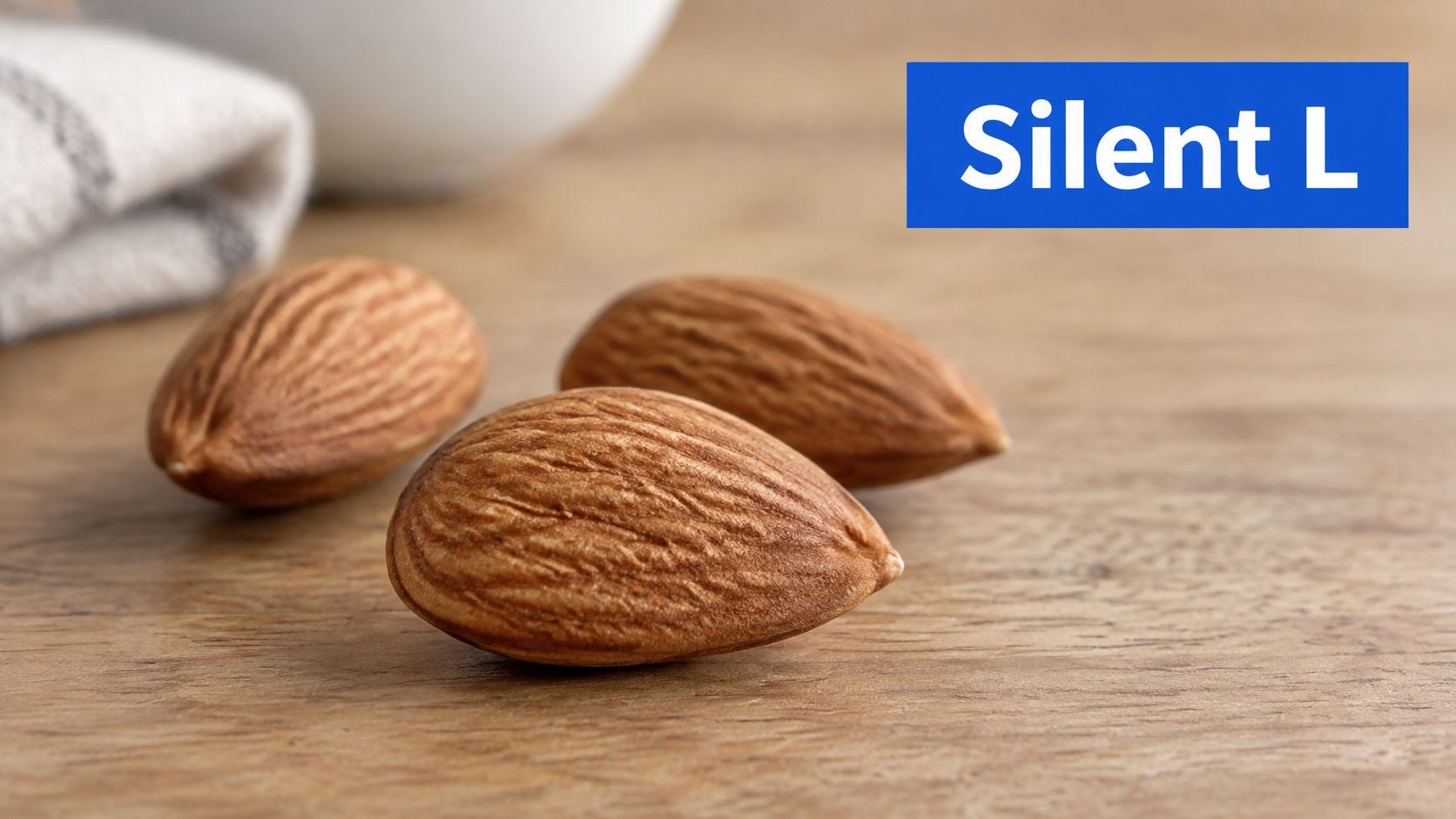
Many speakers in the US also accept a form with the l sounded, roughly /ˈæmlənd/. Both exist. If you want one version that travels well in class, interviews, and cafés, drop the l.
The silent-L habit
English keeps the letter and throws away the sound in a small family of words. Calm, palm, talk, and walk work the same way. Your eye reads a consonant your ear should ignore.
Practical rule: Say AH-mund and let the l disappear, the same way it disappears in calm and palm.
Try these out loud, then again a little faster.
- Allergy line: "I'm allergic to almonds, so I avoid marzipan."
- Everyday choice: "Almond milk is a popular dairy alternative."
If you cook or shop with family, use the word once while holding the ingredient. A real object beats a flashcard. Next time you meet a silent l, check whether the word belongs with calm before you sound every letter.
2. Choir, KWY-er (/ˈkwaɪər/) or KWY-uh (/ˈkwaɪə/)
Choir does not start like chair or church. The ch is a hard /k/, so the word sounds like quire. US speech is often KWY-er (/ˈkwaɪər/). UK speech is often KWY-uh (/ˈkwaɪə/).
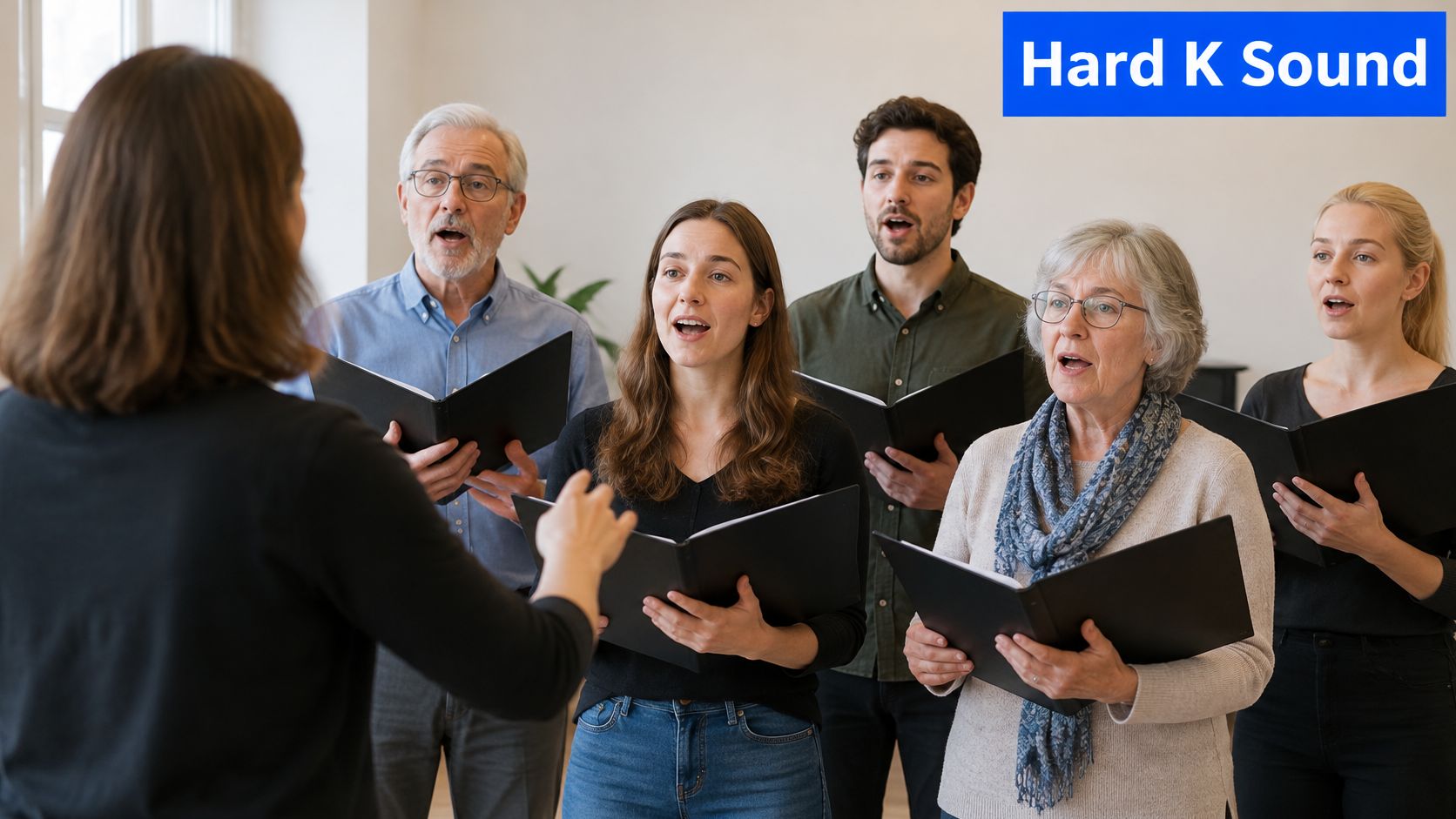
The spelling comes through French, where ch can be /k/ rather than the English "ch" in cheese. Your first language may not use that spelling trap, but English keeps it in chorus, chemistry, and character too.
Why a common word can still be hard
Difficulty isn't spread evenly across familiar vocabulary. In a 2026 study of 22 English-as-a-foreign-language learners, only 6 of 22 produced colleagues correctly, an error rate of 72.7%. That sample is small, so it isn't a worldwide rate. It does show why a word you can read easily can still fall apart in speech. Choir is the same kind of mismatch: ordinary meaning, surprising sound.
Start with a hard k, then glide into wire. The related adjective choral (/ˈkɔːrəl/) keeps the same k.
Say "She sings in the church choir every Sunday." Then try "The school choir performs at the end-of-year concert." If you have a child in a school show, this is the word you'll need at the door, not in a drill. Record one sentence. If you hear "ch" as in chair, stop and restart from k.
3. Colonel, KER-nul (/ˈkɜːrnl/ or /ˈkɜːnl/)
Read the letters and you get three chunks, co-lo-nel. Spoken English throws that reading out. Colonel sounds like kernel. The opening is /kɜːr/, and the lo is silent. US dictionaries usually show /ˈkɜːrnl/. UK forms are close, /ˈkɜːnl/.
This is one of the clearest cases of spelling that does not match pronunciation. The word travelled through French and Italian military titles, and English kept an older spelling while the sound simplified. You can't recover it by sounding every syllable.
Near-misses, not random guesses
When a word looks nothing like it sounds, people don't invent chaos. They build a nearby word from sounds they already trust. A 2013 study of 192 young adults with normal hearing tested 1,428 American English words in background noise. Across 67,952 analyzable trials, listeners were correct 55.6% of the time. Wrong answers were usually near-misses, with a mean phonological edit distance of 3, and they tended to be more frequent words than the targets. That is the colonel error in miniature. Co-lo-nel feels logical. Kernel is what listeners expect.
Use kernel as the model. Don't stress a lo that isn't there.
- Story sentence: "Colonel Mustard was the main suspect."
- Work sentence: "He was promoted to colonel after ten years in the army."
In a film, a novel, or a news clip about rank, pause and match the spoken form to kernel before you copy the spelling.
4. Comfortable, KUMF-tuh-bul (/ˈkʌmftəbl/)
Count the letters and you'll invent four or five beats: com-for-ta-ble. Standard English uses three. The middle or shrinks to a weak vowel, and many speakers almost drop it. What you hear is KUMF-tuh-bul.
That weak vowel is the schwa, written /ə/. Cambridge Dictionary defines schwa as the weak vowel in an unstressed syllable, as in the first syllable of about and the second of given. A written vowel is not a promise of a full sound.
Say it at meeting speed
If you only practise the slow four-syllable version, you'll sound careful in drills and unclear in a real meeting.
Say the word quickly, with the middle beat barely there. Then put it in a line you might need: "Please make yourself comfortable while we set up the meeting." Or, before a presentation, "Are you comfortable presenting in English?"
A short speaking drill locks the rhythm better than a single repetition. Try "I feel comfortable speaking about my experience" three times, a little faster each time. The same squeeze shows up in vegetable, interesting, and family. If you want a wider practice routine, this guide on how to improve pronunciation in English walks through stress, weak vowels, and recording yourself.
Parents can use the meeting line at home too. Ask a child, "Are you comfortable reading this aloud?" The word stops being a test item and becomes part of the evening.
5. Epitome, ih-PIT-uh-mee (/ɪˈpɪtəmi/)
Epitome means a perfect example of something. You'll meet it in essays, performance reviews, and restaurant reviews. The trap is rhythm. Stress sits on the second syllable, PIT, and the final e is a short ee, not a silent ending.
Learners often hit the first syllable, or they add extra vowel beats, and the word stops sounding like one unit. Mark the stress when you practise. In the International Phonetic Alphabet, primary stress is shown with ˈ before the stressed syllable.
Cambridge's pronunciation guide uses that mark the same way in surprise, /səˈpraɪz/, where the beat is on the second syllable. Epitome works like that: /ɪˈpɪtəmi/, not a heavy start.
Check the beat in a full sentence
Isolated words hide the problem. A sentence shows whether the stress survives.
"She is the epitome of professionalism."
"That restaurant is the epitome of simple, elegant dining."
Record one of those lines on your phone. Play it back and listen only for PIT. If the loudest beat is somewhere else, say it again and tap the table on that syllable.
Stress is the part listeners use to find the word. Get the beat right and small vowel differences matter less.
University students can drop the word into a presentation: "This case is the epitome of a weak conclusion." One precise use in a real talk is worth twenty silent readings.
6. Espresso, eh-SPRESS-oh (/ɛˈspresoʊ/)
Back to that café counter. Espresso does not start with ex. There is no /ks/ at the beginning. The standard English form starts with eh, and the stress is on SPRESS: eh-SPRESS-oh.
The word comes from Italian, and English keeps something close to that stress. Express is a different word, which is why the mouth reaches for it. You're not hearing an x. You're importing a more familiar English pattern.

Order it, don't just recite it
Role-play is the fix. Stand in your kitchen and say, "Could I get a double espresso, please?" Then, "The café near the office serves excellent espresso." Start with eh, hit SPRESS, and finish with oh. If a friend hears ex, you've still got the old habit.
Arabic-speaking learners often do better when the practice word sits inside a short request, not a word list. Travel, office coffee, and hotel breakfasts all use the same line. For sound patterns that show up across many words, not only this one, see English pronunciation for Arabic speakers.
The habit to steal is simple. When a borrowed word looks like an English word you already know, check the first sound before you trust the spelling. Espresso is not express with an o glued on.
7. Library, LY-brer-ee or LY-bruh-ree
Library often shrinks to liberry. The first r disappears, or the word collapses toward two syllables. Careful speech keeps three syllables and a clear middle r. US dictionaries commonly give /ˈlaɪbreri/. UK speech is often /ˈlaɪbrəri/, with a weaker middle vowel. In fast talk that middle r can lighten, but it shouldn't vanish while you're still learning the word.

UK and US are both real
A different standard pronunciation is not automatically a mistake. Cambridge's pronunciation resource gives audio and transcriptions for both UK and US English. Its couch potato pair shows the point in miniature: UK /ˈkaʊtʃ pəˌteɪ.təʊ/ and US /ˈkaʊtʃ pəˌteɪ.t̬oʊ/. The final vowel changes, and the US form shows a flap in the middle of potato. Pick one model, British or American, and stay with it. Then apply that choice to library.
- Campus line: "I'm studying at the university library this afternoon."
- Family line: "The public library runs free English reading groups."
Practise the three beats slowly: LY-brer-ee. Then listen to a news report or a podcast and notice how the middle softens at speed. Copy the careful form first. Reduction comes later, on purpose.
First-language sound patterns change how heavy this kind of error feels. The ISLE corpus of Italian and German learners found 0.54 phone errors per word for Italian learners and 0.16 for German learners, including stress mistakes. A generic "hard words" list is weaker than a log of your own slips: clusters, middle consonants, and endings you drop.
8. Mischievous, MIS-chih-vus (/ˈmɪstʃɪvəs/)
Mischievous has three syllables. The extra one is the mistake. People insert a beat after the ch and land on mis-chee-vee-us. The standard form is MIS-chih-vus. There is no vee syllable.
The word describes playful, slightly naughty behaviour. You'll use it for children, for a friend's humour, and in school writing about characters. Adding a syllable doesn't just sound "off." It changes the rhythm so the listener has to rebuild the word.
Three beats, then a real person
Say MIS-chiv-us quickly, almost as one gesture. Stress stays on MIS. Don't let chee grow into its own word.
Use it on someone you know, so the sentence has a face.
"The children had a mischievous look on their faces."
"He has a mischievous sense of humour."
Parents of kids aged 4 to 15 can fold this into a bedtime story or a school anecdote. Teenagers can use it in an oral exam when they describe a character. The content is easy. The pronunciation is the work.
The same extra-syllable habit hits business (two syllables, BIZ-niss, not biz-ee-ness) and, as you saw with comfortable, any word whose spelling looks longer than the spoken form. When you learn mischievous, write "3" next to it in your notebook. That number is the correction.
9. Nuclear, NYOO-klee-ur or NOO-klee-ur
Nuclear is three syllables with stress on the first: NYOO-klee-ur in many UK accents (/ˈnjuːkliər/) and NOO-klee-ur in US accents (/ˈnuːkliər/). The middle vowel is a clear ee. What you want to avoid is nu-cu-lar or nook-yu-ler, which swaps the sounds and builds a different shape.
You'll hear this word in science class, in the news, and in policy talk about energy. Advanced learners need it to be boringly clear. A swapped syllable in a presentation makes the audience listen to the sound instead of the point.
Build it, then join it
Split the word, then zip it back together.
- First beat: NYOO or NOO, depending on the accent you follow.
- Middle beat: klee, with a clean ee.
- Last beat: ur, unstressed.
"The conference discussed nuclear energy policy."
"Nuclear physics is a complex field of study."
Play a recent news clip and mark where the presenter's voice is loudest. It should be the first syllable. If your version puts the punch in the middle, you're still on the swapped pattern.
For a university seminar or a company briefing, one clean use is enough. Don't decorate the sentence. Let the stress do the work.
10. Often, OF-n or OFF-en (/ˈɒfn/, /ˈɔːfn/, /ˈɔːftən/)
The t is written. In the most common careful speech, you don't say it. UK pronunciation is often OF-n (/ˈɒfn/). US speech commonly uses OFF-en (/ˈɔːfn/) or, for some speakers, OFF-ten (/ˈɔːftən/). Both a silent t and a sounded t are accepted in many contexts. The confusion is normal, because English silent t usually shows up in other patterns, not right after f.
A safe default
If you want one conversational choice, use OF-en and don't force the t. You won't be wrong if a teacher or a colleague sounds the t. You will sound inconsistent if you switch inside the same story.
Put the word inside a question so the rhythm is real. "How often do you have speaking classes?" Then answer yourself: "I often practise English on my commute."
Questions are better practice than statements here, because often usually sits in the unstressed middle of the line. That's where learners either shout the t or swallow the whole word.
An online English pronunciation course helps when the same silent letter keeps returning in your own recordings. Bring three clips, not a list of fifty words. Often, almond, and comfortable already cover silent consonants and a squeezed syllable.
Syllables, stress, and the main learner error for each word
| Item | Syllables | Stressed Syllable | Main Learner Error |
|---|---|---|---|
| Almond | 2 | 1st | Pronouncing the silent “l” |
| Choir | 1 | 1st | Pronouncing “ch” as /tʃ/ instead of /k/ |
| Colonel | 2 | 1st | Pronouncing it as spelled instead of like “kernel” |
| Comfortable | 3 | 1st | Adding extra syllables |
| Epitome | 4 | 2nd | Stressing the wrong syllable |
| Espresso | 3 | 2nd | Adding an “x” sound at the start |
| Library | 3 | 1st | Dropping the middle “r” or a syllable |
| Mischievous | 3 | 1st | Adding an extra syllable |
| Nuclear | 3 | 1st | Mispronouncing the middle syllable |
| Often | 2 | 1st | Pronouncing the “t” when it is usually silent |
Practise These Words Until They Feel Automatic
Pick three words from this list and write a sentence you might say this week. Use one at work, one in class, and one in an interview answer or a family conversation. Record yourself. Listen once for the stressed syllable and once for any extra beat. Repeat the same sentence until the rhythm feels ordinary, not performed.
Not every accent difference is a problem. A corpus study of 143 non-native speakers and 14,718 words found that obvious word-level mispronunciations explained only 16% of the variation in intelligibility, and words judged as mispronounced stayed intelligible in about half of cases. Chase the errors that create another word, hide an ending, or move the stress. Leave the rest of your accent alone.
Viral lists are a weak guide to what you should drill. A 2025 US analysis of Google searches ranked gyro first with 312,000 searches, then Worcestershire sauce with 300,000, acai with 192,000, and Qatar with 180,000. Those numbers show curiosity. They don't show which slip will cost you in a meeting. A person's name, a job title, and a word like comfortable or nuclear carry more risk than an unfamiliar food.
If you want a clear picture of where your speaking stands, our free CEFR placement test includes a spoken part. After each session, you get a written report with phrases to reuse and mistakes to drop. The learner speaks for most of the hour, which is where these ten words either stick or slip. Self-study apps can support that practice between classes. This language speaking app pricing breakdown is one place to compare what a speaking app costs before you decide how much live correction you still want.
Englify runs live online English and French classes on Google Meet for children from age 4, teenagers, adults, and company teams, with pronunciation corrected in the flow of real speaking rather than as a separate accent drill. Small groups and private lessons work through the same habits on this list, silent letters, stress, and syllable count, and you can start with a free placement test and a free trial session. Visit Englify to book that trial and bring three words you want to stop repeating.