Knowledge hub
English Pronunciation Course Online: What to Expect
An English pronunciation course online should improve clarity, not erase your accent. Compare curriculum, class size, tutors, pricing in MAD and trials.
What if your pronunciation is already close to clear, and people still ask you to repeat yourself because the stress lands in the wrong place? That's the gap most learners miss. They practise single sounds for weeks, yet in a meeting, interview, or exam answer, listeners still work hard to follow them.
An English pronunciation course online should be judged by a simple test. After it, can unfamiliar listeners understand you more easily when you're speaking normally, on new topics, without rehearsing first? If the answer's yes, the course did its job. Sounding like a native speaker from one city isn't the measure.
Table of Contents
- What an Online Pronunciation Course Should Cover
- Pronunciation Targets at Each CEFR Level
- Self-Study, Group Classes and Private Lessons Compared
- What to Check Before You Enrol
- Measuring Progress Beyond Accent
- A Sample 60-Minute Lesson Structure
- Morocco Checks and Your Next Step
What an Online Pronunciation Course Should Cover
An online English pronunciation course trains the sounds, stress, rhythm, and intonation you use when you speak, through live sessions where a teacher hears you and corrects you while you talk. Its goal is clear, confident communication, not erasing your accent.
Sounds alone aren't enough. You can say every vowel well and still be hard to follow if stress lands on the wrong syllable or every word gets equal weight. English listeners use stressed syllables to find words quickly. If those cues are missing, they have to reconstruct what you said, and they'll often ask you to repeat it even though your grammar was fine.
The six parts that work together
A strong course builds from small units to full speech. It starts with individual sounds, adds stress and rhythm, then connects words into natural phrases you can use under pressure.
| Component | What It Trains | Practice Example |
|---|---|---|
| Individual sounds | Articulating vowels and consonants clearly | Contrasting /θ/ and /s/ in 'think' and 'sink' |
| Word stress | Placing the strong syllable in the right place | PREsent (noun) versus preSENT (verb) |
| Rhythm and weak forms | Reducing unstressed words such as to, a and for | 'I went to England for a holiday' in natural speed |
| Intonation | Pitch movement that signals questions, statements and emphasis | Rising pitch in 'Really?' versus falling pitch in 'Really.' |
| Linking | Joining a final consonant to a following vowel | 'turn it off' said as one connected phrase |
| Speech rate and chunking | Grouping words into meaningful phrases with pauses in the right places | A presentation opening split into three thought groups |
Try one example before your next lesson. Say PREsent for a gift and preSENT for giving a talk. Then put each one in a sentence. If you keep the stress wrong, listeners may hear the wrong word type first and need a second to recover.
The table also shows why weak forms matter. In "I went to England for a holiday," the words to, for, and a aren't said with full, careful vowels in natural speech. If you give every word equal force, you sound slower and your main content words get buried. Content words carry the message. Small grammar words usually step back.
That principle applies at work, too. For example, pronouncing names correctly at work depends on hearing which syllable is stressed, not just spelling the name correctly. A course that only drills /θ/ or /r/ and never reaches linking, chunking, and intonation is missing the part that most affects being understood in real conversations.
Pronunciation Targets at Each CEFR Level
The Common European Framework of Reference for Languages, or CEFR, has treated pronunciation as part of communicative language competence since its original publication in 2001, according to the Council of Europe phonological competence framework. Its revised framework measures pronunciation in three areas. Those are overall phonological control, sound articulation, and prosodic features such as intonation, rhythm, word stress, and sentence stress.
Think of those three areas as a map. Sound articulation asks whether your vowels and consonants are clear. Prosodic features ask how you organise speech across words and sentences. Overall phonological control asks whether the whole thing holds together when you're talking, not just repeating.
What changes as you move up
| CEFR Level | Pronunciation Expectation | What Changes for the Learner |
|---|---|---|
| B1 | Generally intelligible, with approximate control of intonation and stress | Listeners can follow the message with reasonable effort |
| B2 | Appropriate intonation, correct word stress and clear articulation of individual sounds | An accent may remain, but the speech stays clear |
| C1 | Full range of English phonological features, intelligible throughout | Clarity holds across long and spontaneous speech |
At B1, you don't need perfect stress. You need speech that listeners can generally follow, with approximate control of intonation and stress. That's enough for many everyday conversations, though faster or noisier situations may still expose gaps.
At B2, the expectation tightens. You should generally use appropriate intonation, place stress correctly, and articulate individual sounds clearly, even if your accent remains influenced by other languages. That's a useful target for job interviews and university presentations, where listeners shouldn't have to guess key words.
At C1, you control the full range of features well enough to stay intelligible throughout longer, spontaneous speech. The test isn't one rehearsed sentence. It's a full answer, a discussion, and a follow up question you didn't expect.
Use this map when you compare providers. Ask which level the course targets and whether reports list sound, stress, and intonation separately. Our guide to English levels and the CEFR scale explains the wider A0 to C1 scale. If a provider can't name the level it's aiming for, you can't check whether you've reached it.
Self-Study, Group Classes and Private Lessons Compared
This kind of course suits adults who use English at work but get asked to repeat themselves, university students preparing for oral exams, professionals facing interviews, and teenagers who need structured speaking practice. The right format depends on what kind of feedback you need.
| Option | Feedback While You Speak | Best Fit | Main Limit |
|---|---|---|---|
| Self-study apps and videos | Automated or none | Learners drilling one sound between classes | Rarely catches stress and rhythm errors in your own speech |
| Online group class | Teacher corrects in class, and peers practise together | Learners who want structure and shared practice | Less speaking time per learner |
| Private one-to-one lessons | Continuous, personalised correction | Professionals and adults with specific goals such as interviews | Scheduling depends on one teacher and your availability |
Self-study is flexible and low cost, and it's useful for narrow jobs. Use an app or video to drill /θ/ versus /s/ for ten minutes between lessons, or to shadow a short recording. Don't expect it to diagnose why your presentation sounds flat. Most tools react to a single word you read aloud. They don't hear how your stress changes when you're thinking and speaking at the same time.
Matching the format to your situation
A group class adds a teacher and peers. You hear other learners make similar mistakes, which sharpens your ear, and you practise in front of listeners who don't already know what you meant to say. That's valuable. The limit is arithmetic. Your speaking minutes are shared, so correction comes in bursts rather than continuously. Our comparison of group or private English classes covers that trade off in more detail.
Private lessons give you the most continuous correction. The teacher can stop mid answer, fix one stress pattern, and have you repeat the full sentence immediately. Content follows your goal, whether that's a nursing interview, a thesis defence, or client calls. The cost is flexibility. You're coordinating with one teacher's calendar.
Many learners do best with a combination. Short daily drills keep a target sound fresh. A live lesson handles stress, rhythm, and connected speech, where you can't reliably hear your own errors.
If you can't tell when your own stress is wrong, you don't need more videos. You need someone listening while you speak.
What to Check Before You Enrol
Use this checklist with any provider, and ask for the answers in writing before you pay. Each row is a test. A clear answer takes a sentence. A vague one usually means the thing doesn't exist.
| Criterion | What to Check | Red Flag |
|---|---|---|
| Methodology | Most of each session is spent speaking, with correction during speech | Mostly watching videos or reading rules |
| Class size | A stated maximum and the speaking minutes each learner gets | No maximum given |
| Tutor credentials | Named teacher training such as TEFL or TESOL, and experience with your learner profile | No stated qualifications |
| Delivery platform | Live sessions on a video platform, with materials in a student portal | Pre-recorded lessons only |
| Progress tracking | Written reports naming your CEFR level, strengths and next step | A certificate with no feedback |
| Pricing | Published prices showing monthly hours and whether the course is group or one-to-one | Prices only given after you commit |
Methodology matters most because pronunciation is a physical skill. Reading about tongue position doesn't change how you say a word under pressure. Most of the session should be you speaking, with correction arriving while the sentence is still fresh, not in a summary at the end.
Class size decides how much of that speaking you get. Ask for a stated maximum and roughly how many minutes each learner talks. In a large group, you can sit through a full hour and produce only a few sentences, which isn't enough for a teacher to hear your patterns.
Setup, evidence, and price
Ask about credentials in specific terms. Look for named training such as TEFL or TESOL and experience with learners who share your goals and language background. A teacher who's worked with Arabic speaking learners will usually anticipate certain sound contrasts faster, without assuming every learner has the same difficulties.
Delivery should be live on a video platform such as Google Meet, with materials you can reopen afterwards. Your own setup counts here, too, since a teacher can't judge a final consonant they can't hear. Working through a clearer home office calling experience before your first session helps you fix microphone placement and background noise in advance.
For progress tracking, you want written reports that name your CEFR level, your strengths, and one next step. A certificate alone tells you that time passed. It doesn't tell you what changed.
On pricing, check that monthly hours, group or one to one format, and included materials are stated plainly. With us, after you book a free trial lesson, you take a level test, the teacher evaluates your speaking, and you then receive suitable group options with exact times and prices, or private lesson prices based on monthly hours, with no obligation to enrol. Our page on what happens in a free trial English class walks through that sequence.
Measuring Progress Beyond Accent
How do you know the course is working if you still sound like yourself?
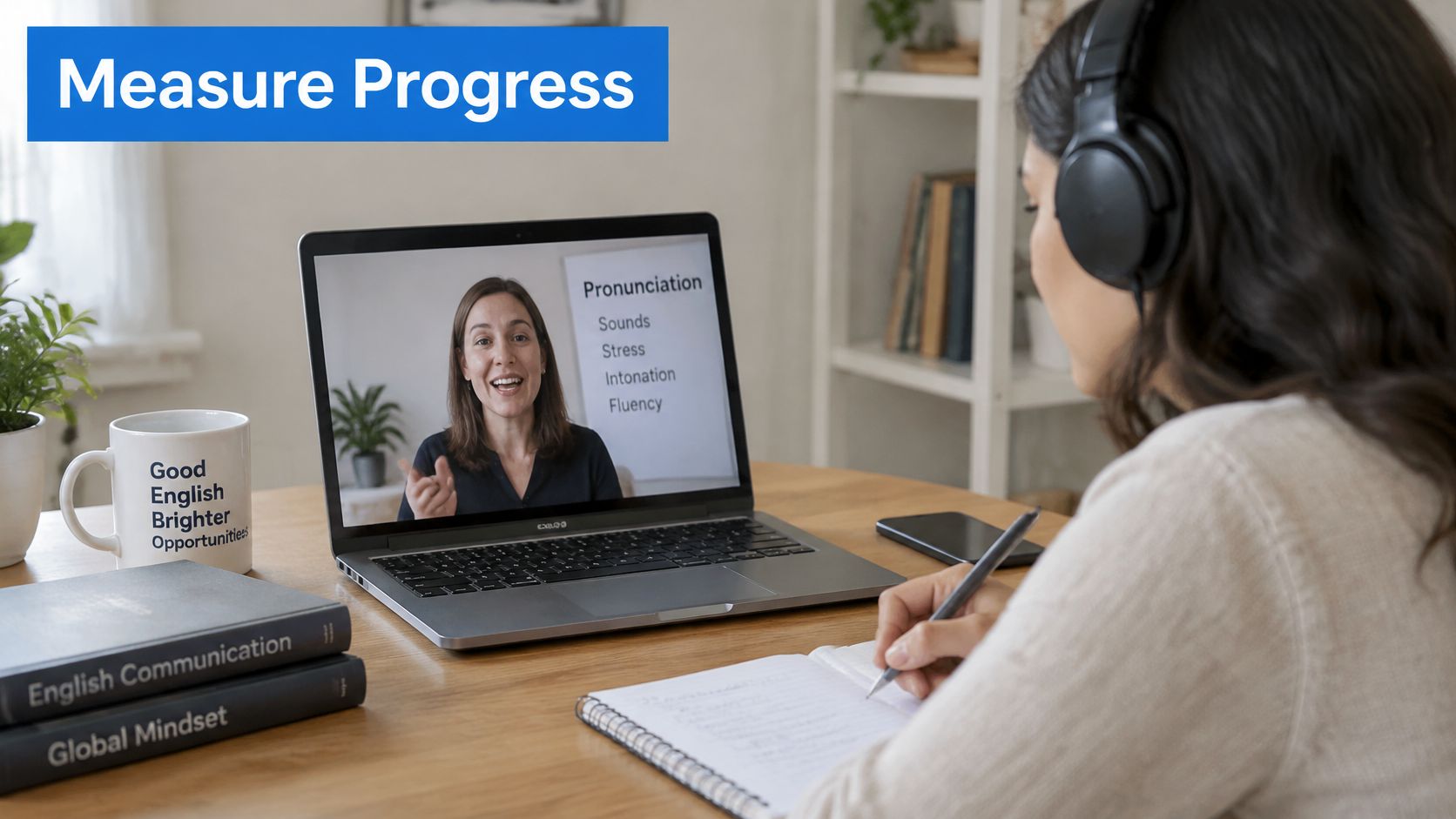
A throw can look unusual and still land in the catcher's hands. Accent is the path of the throw. What you measure is the landing: whether a listener gets the words, and how hard they work to do it.
Research connecting the CEFR phonological scale with speech measures found a highly significant relationship between intelligibility, the proportion of words listeners correctly understand, and comprehensibility, the perceived effort required to understand speech, but no significant relationship between those measures and phonological control ratings, as reported in Revista de Estudos da Linguagem. Progress can keep a noticeable accent, as long as people understand you with less effort. A more native-like sound rating can rise while a colleague still asks for the same word again.
Three tasks that show real change
- Controlled production. Say target sounds in set words, such as ship and sheep, so the teacher can check one contrast at a time.
- Sentence or paragraph repetition. Repeat longer material so stress, rhythm, and linking show up under mild pressure.
- Spontaneous speech. Answer a meeting question or give a short presentation without a script. Old habits appear here.
Score each recording three ways. Count the words a listener got right. Rate the effort that listener needed. Note CEFR aligned descriptors for sound, stress, and intonation. One end-of-course impression hides the middle. Short checks at set points show the slope. Training teams assess understanding during training sessions with brief checks rather than a single finale. Borrow that timing for speech: the same prompt, repeated, scored for words caught and for effort.
Fix high impact errors first. Unclear word endings, stress on the wrong syllable, a pause in the middle of a phrase, and a sound contrast that changes meaning cause most breakdowns. A rolled /r/ that never confuses anyone can wait.
The real test: can a listener who doesn't know you understand new vocabulary from you, first time, without asking you to repeat it?
Englify's free CEFR placement test includes a spoken part. Keep that short answer and repeat the same task later. Play both clips for someone who was not in the lesson. Their word count, and whether they asked you to repeat, is clearer evidence than asking whether you sound native.
A Sample 60-Minute Lesson Structure
A good session has a shape you can recognise and repeat. Sounds and stress come before free speech, so you've got the tools ready when correction arrives in real time.
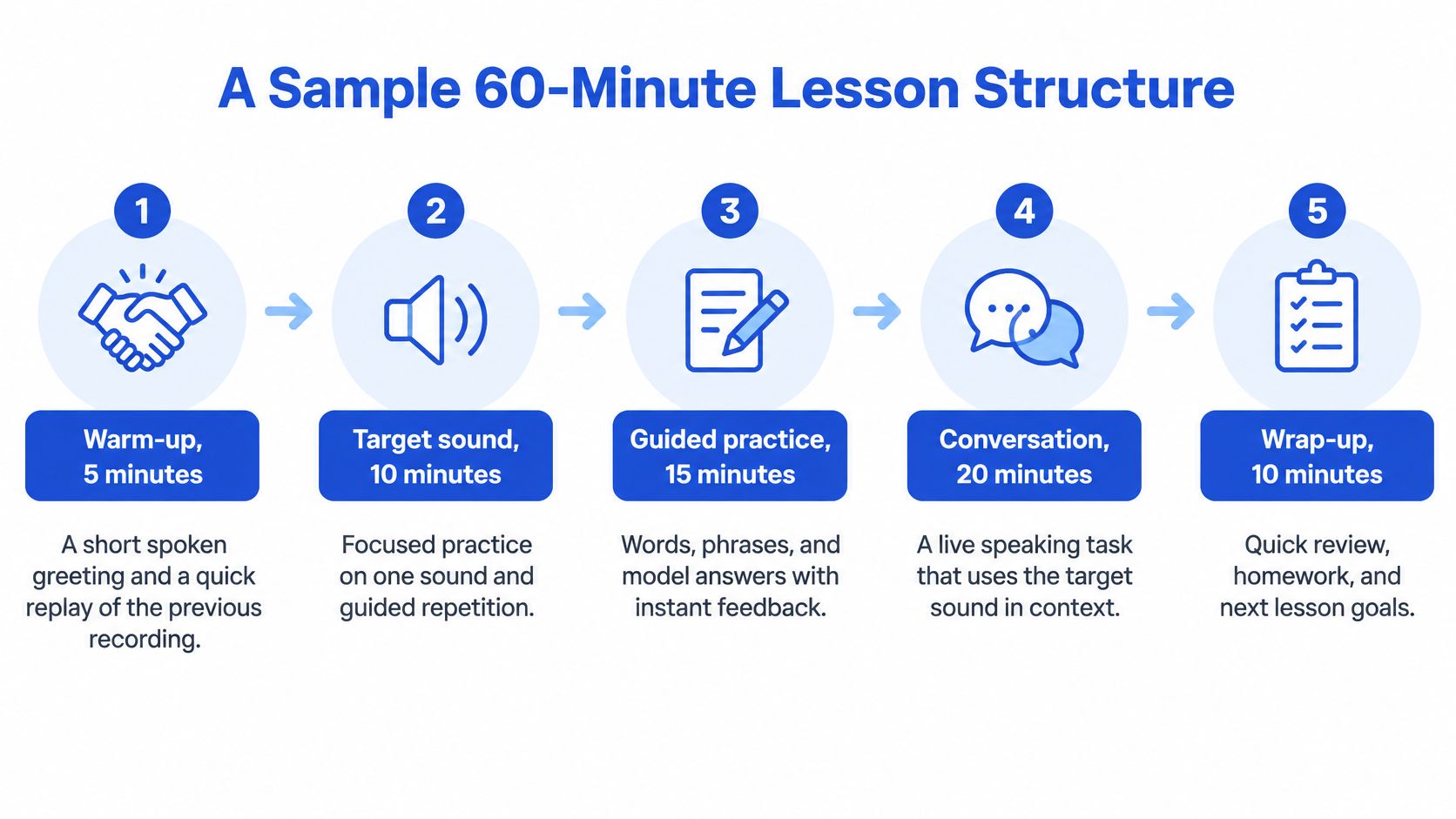
- Warm-up, 5 minutes. A short spoken greeting and a quick replay of your previous recording. You hear exactly what you're trying to change today, in your own voice.
- Target sound, 10 minutes. One contrast only, such as /θ/ versus /s/ in think and sink. The teacher models, you repeat each pair, and you learn to hear the difference before you're asked to produce it in a sentence.
- Word stress, 10 minutes. Mark the stressed syllable in five new words, then say each one inside a sentence. PREsent and preSENT are a useful pair because the meaning and grammar both shift.
- Weak forms and rhythm, 10 minutes. Reduce to, for, and a in "I went to England for a holiday." Then listen to a natural recording and pick out the reduced vowels you used to miss.
- Linking and intonation, 10 minutes. Join a final consonant to the next vowel, as in "turn it off," and contrast rising pitch in yes or no questions with falling pitch in statements.
- Free speaking, 12 minutes. A role play, such as answering a question in a meeting or explaining a delay to a client. The teacher corrects during your reply rather than after it, so you rebuild the sentence while you still remember choosing it.
- Recording review, 3 minutes. Compare a new recording with the first one from this session. Set one target for next time. One, not five.
Why stress gets its own step
English is a free stress language, so stress can fall on different syllables in different words and you can't predict it from spelling alone. Cambridge University Press research on word stress and intelligibility explains that misplaced stress can make listeners search for an unrelated word, increasing processing effort and, in severe cases, stopping communication.
That's why marking a syllable and then using the word in a sentence beats memorising phonemic symbols on their own. If your first language gives syllables fairly equal weight, transferring that pattern into English hides the cues listeners rely on for word recognition.
Beginners may spend longer on the target sound step and less on free speaking. That's fine. Keep the order, adjust the minutes, and always end by listening to yourself.
Morocco Checks and Your Next Step
If you're learning from Morocco, check the practical details alongside the course content. Your internet access may be available, but a stable connection and clear audio determine whether a teacher can hear the sounds you're working on.
Connection and support language
Before booking, test the video and audio on the device you plan to use, at the time you expect to study. Ask what happens if your connection drops during a lesson. Pronunciation teaching depends on hearing the details of your speech, not just seeing you on screen.
A connection that works for watching videos may still cut off the ends of your words. Those final sounds can change what a listener understands. Use headphones, find a quiet place, and keep the microphone at a steady distance.
Ask what language is available for support. A beginner who is stuck on a mouth position or a stress pattern may benefit from a short explanation in Arabic, French, or Darija. Most practice should still happen in English, so you have time to listen, speak, and adjust with the teacher's guidance.
Scheduling, pricing, and how we start
Check whether lessons fit your routine, and ask about missed sessions and rescheduling before you enrol. School, work, and family commitments can change. A timetable that seems manageable at first may become difficult to keep if the available times do not suit you.
Compare prices in dirhams, and check what each option includes. Make sure you understand the lesson length, whether classes are individual or in a group, and what materials or support come with the course. Clear details make it easier to compare options fairly.
Englify is a Morocco-based online academy offering live English and French classes on Google Meet. English lessons run for 60 minutes, in small groups or one to one. To get started, contact the academy on WhatsApp with your level, goal, and country of residence. A teacher can suggest a time for a free trial lesson.
Your concrete next step
Start with the free online placement test. It includes a spoken part and helps establish your level from A0 to C1. Keep a copy of any recording you make. That gives you a starting point to compare with later speech, rather than relying on memory.
Then book the free trial class on Google Meet. Speak about a real situation from your work, studies, or exam preparation instead of reading a prepared paragraph. At the end, ask the teacher which pronunciation issues most affect whether listeners understand you.
A useful answer names a specific target, such as final consonants that disappear or stress that makes a word harder to recognise. General encouragement can be pleasant, but it does not tell you what to practise next.
Review the teacher's feedback and look for a clear next step. Does it distinguish sounds, stress, and intonation? Does it explain what to work on and how to notice improvement? If anything is unclear, ask before enrolling. Progress means that listeners understand you more readily, not that your accent must sound like someone else's.
If you want to check your English level and try a class, contact Englify for the free placement test and trial lesson. After the trial, you can consider the teacher's feedback and decide whether the class suits your goals.