Knowledge hub
7 Small Group Lesson Plans for Speaking Confidence
Seven adaptable small group lesson plans for speaking, listening and reading, with tips on grouping learners, setting objectives and adjusting difficulty.
You've prepared a speaking activity, but the same confident learner answers first while everyone else waits. One child needs a phrase to get started. A teenager knows the grammar but can't find the words quickly. An adult wants something closer to a real conversation.
Small group lesson plans need more than an interesting topic. For the activities here, a small group lesson plan is a structured activity for four to six learners, where everyone has a role, a goal, and a reason to speak. The class can split into pairs or smaller teams so learners don't spend the lesson waiting for the teacher.
Before choosing a plan, make three decisions:
- Who is learning? Match the situation to learners' ages, interests, and confidence, not just their grammar level.
- What should they do? Choose an observable outcome, such as requesting information, explaining a choice, or summarizing a partner's idea.
- How hard should it be? Adjust vocabulary support, preparation time, and unexpected questions.
The seven plans below include grouping suggestions, practical steps, and A1 to B2 adjustments. They work for English or French, with situations adapted for children, teenagers, university students, adults, and professionals.
Table of Contents
- 1. Role-Play Circles for Everyday Situations
- 2. Information-Gap Pair and Group Tasks
- 3. Total Physical Response Circles for Young Learners
- 4. Jigsaw Reading and Listening Groups
- 5. Business Meeting Simulations for Professionals
- 6. Structured Discussion and Think-Pair-Share Practice
- 7. Dogme-Style Conversation Lessons Built on Learner Topics
- How the seven small group lesson plans compare
- Choose One Plan and Run It with Your Next Group
1. Role-Play Circles for Everyday Situations
A learner can complete a worksheet on polite requests and still freeze when ordering lunch. Role-play gives them a manageable situation in which they have to use that language to get something done.

Grouping: Use rotating pairs within the class. Objective: Complete an everyday exchange, including a request and a response.
Prepare role cards with different goals. A customer wants a meal without a particular ingredient; the server must explain what's available. Give learners two minutes to prepare useful phrases, then let them attempt the exchange without reading a complete script.
Run the exchange, then change it
- Model the opening: Demonstrate how to greet someone, make the request, and ask for clarification.
- Rotate responsibility: Swap customer and service-provider roles so nobody stays in the easier position.
- Repeat with a complication: Make an item unavailable or introduce a misunderstanding.
- Review selectively: Address the top two recurring errors, then ask which phrase helped learners most.
For A1, practise ordering coffee and asking for the bill with picture prompts. At A2, add preferences and prices. At B1, simulate calling a university office about registration deadlines. At B2, require learners to negotiate an alternative or explain a complaint.
Children can run a pretend snack shop; teenagers can arrange a school event. University students can contact an admissions office, adults can explain a delayed flight, and professionals can welcome a visitor.
The EEF collaborative learning guidance emphasizes structured tasks, shared outcomes, and explicitly taught cooperation. Apply that principle here: assess whether the pair resolved the situation, not whether they performed a flawless script.
2. Information-Gap Pair and Group Tasks
Give partners identical worksheets and they can finish without speaking. Give them different, necessary information and they have a reason to ask questions.
Grouping: Start in pairs, then regroup learners to compare answers. Objective: Exchange missing information and produce an accurate shared result.

Say teenagers need to arrange a study session. Each receives a different partial timetable, including unavailable periods and subject preferences. They must agree on a workable schedule without showing each other their sheets.
Prepare equally important information for everyone. If a confident learner holds everything needed to solve the task, the others can become spectators.
Build a task that requires listening
- Prepare language: Practise questions about availability and phrases for checking understanding.
- Keep information separate: Use private documents or individual cards rather than displaying every answer.
- Set a finish point: Require a completed schedule, matching drawing, or agreed summary.
- Check the result: Ask learners to explain how they resolved conflicting information.
At A1, use objects, colours, and locations. At A2, introduce timetables and routine questions. At B1, add competing preferences. At B2, require learners to explain trade-offs and justify their final decision.
Children can describe a hidden picture for a partner to draw. University students can combine course requirements; adults can plan a journey. Professionals can assemble separate sales updates into a summary slide.
Practical rule: Make every learner's information necessary, not merely different.
The CEFR guidance on mediation supports asking questions, clarifying reasoning, and reformulating meaning. Teach those actions explicitly instead of assuming learners will know how to keep the exchange going.
3. Total Physical Response Circles for Young Learners
Start with an action, not a demand to perform. In Total Physical Response, or TPR, learners respond physically to spoken language before taking responsibility for giving instructions themselves.
Grouping: Keep children together for teacher modeling, then rotate the instruction-giver. Objective: Understand familiar commands and progress toward saying them independently.

For children aged 4–7, use colours, body parts, and familiar objects. Children aged 8–11 can act out a short story and retell the sequence. Begin with commands such as standing up, touching something blue, or pointing to the window, supported by clear gestures.
Move from understanding to speaking
- Demonstrate safely: Use movements children can perform beside their seats, with a seated alternative.
- Repeat with variation: Change the object or action while keeping the sentence pattern familiar.
- Hand over the lead: Let children select a picture prompt and give the group a command.
- Connect actions to meaning: Finish by describing what happened rather than repeating commands indefinitely.
For A1, use short instructions and visible objects. At A2, combine actions in a sequence. At B1, have learners narrate an acted story. At B2, shift toward precise procedural explanations, including conditions and exceptions.
TPR itself is primarily useful here for younger children. For teenagers, university students, adults, and professionals, retain the listen-do-explain sequence but use age-appropriate tasks, such as navigating a map or explaining a workplace procedure.
A days-of-the-week action song can lead into naming today's day. Share the key phrases with parents and map vocabulary across a three-month term so children revisit language with new purposes.
For age-appropriate learning considerations, see this guide to English classes for kids. Don't mistake successful imitation for independent understanding; change the command before checking progress.
4. Jigsaw Reading and Listening Groups
A group reads different sections of an article, then answers a question nobody can solve alone. Each learner must understand their part well enough to explain it without reading it aloud.
Grouping: Assign separate sections within the class, with an expert-check stage where practical. Objective: Explain essential information and combine it into a shared answer.
This task connects directly to the Council of Europe's guidance on mediation in language classrooms: learners receive information, discuss meaning, and convey it to others.
Make each contribution necessary
Choose passages or recordings of similar length and difficulty. Give learners vocabulary to check before sharing, and let those handling the same section compare understanding when the grouping allows it. Otherwise, offer a brief teacher check.
- Prepare notes: Ask for keywords and a main point, not copied sentences.
- Limit the report: Allow no more than one minute for each initial explanation.
- Require clarification: Listeners ask about anything they need for the final task.
- Combine the content: Finish with a question requiring information from every section.
At A1, use illustrated descriptions and simple factual questions. At A2, use short event accounts. At B1, ask learners to compare explanations. At B2, require evaluation of arguments or conflicting evidence.
Children can reconstruct a picture story. Teenagers can combine texts on climate, transport, food, and education. University students can summarize sections of an academic article; adults can combine podcast segments; professionals can pool departmental updates.
The Typist listening comprehension guide offers a related resource for listening preparation.
Don't let the strongest reader become the group's permanent translator. Give everyone a manageable section and responsibility for explaining it.
Assess the individual explanation as well as the final answer. A polished group summary can hide a learner who hasn't understood their own section.
5. Business Meeting Simulations for Professionals
End with a decision, not just a conversation. A meeting simulation needs an agenda, competing priorities, and a record of what the group agreed to do.
Grouping: Assign a project lead, team members, and a client or stakeholder. Objective: Clarify a problem, discuss options, and state agreed actions.
For example, a marketing team must choose a launch date. The client wants an earlier release, while a team member needs more preparation time. Share the agenda beforehand so learners can prepare language without scripting the entire meeting.
Give the meeting a useful outcome
- Open clearly: The chair states the purpose and invites initial updates.
- Introduce disagreement: Assign a stakeholder who must challenge a proposal politely.
- Require clarification: Participants check responsibilities, constraints, and assumptions.
- Close aloud: Finish with three clear action points, each with an owner.
The CEFR background reading on collaborative interaction distinguishes collaborating with peers from managing interaction as a leader. Rotate the chair so learners practise both, rather than repeatedly rewarding the most confident speaker.
At A1, reduce the task to introductions, availability, and choosing a meeting time. At A2, assign familiar tasks. At B1, add a customer complaint or delayed project. At B2, introduce objections, competing priorities, and negotiated commitments.
For children, adapt the format into a class council. Teenagers can organize a school event, university students can allocate project work, and adults can plan a community activity. Professionals can rehearse real meeting situations or mock interview panels.
Use the guide to Business English for meetings for related preparation. Record the simulation only with permission, then ask learners to review a specific moment of clarification or disagreement.
Don't correct every sentence during the meeting. Note recurring language problems, address them afterward, and have learners write a short follow-up email.
6. Structured Discussion and Think-Pair-Share Practice
Quiet learners often need preparation, not another instruction to speak louder. Think-pair-share lets them form an idea privately, test it with a partner, and then contribute to a wider discussion.
Grouping: Begin individually, move into pairs, then reunite the class. Objective: Express a position, respond to another view, and summarize what someone else said.
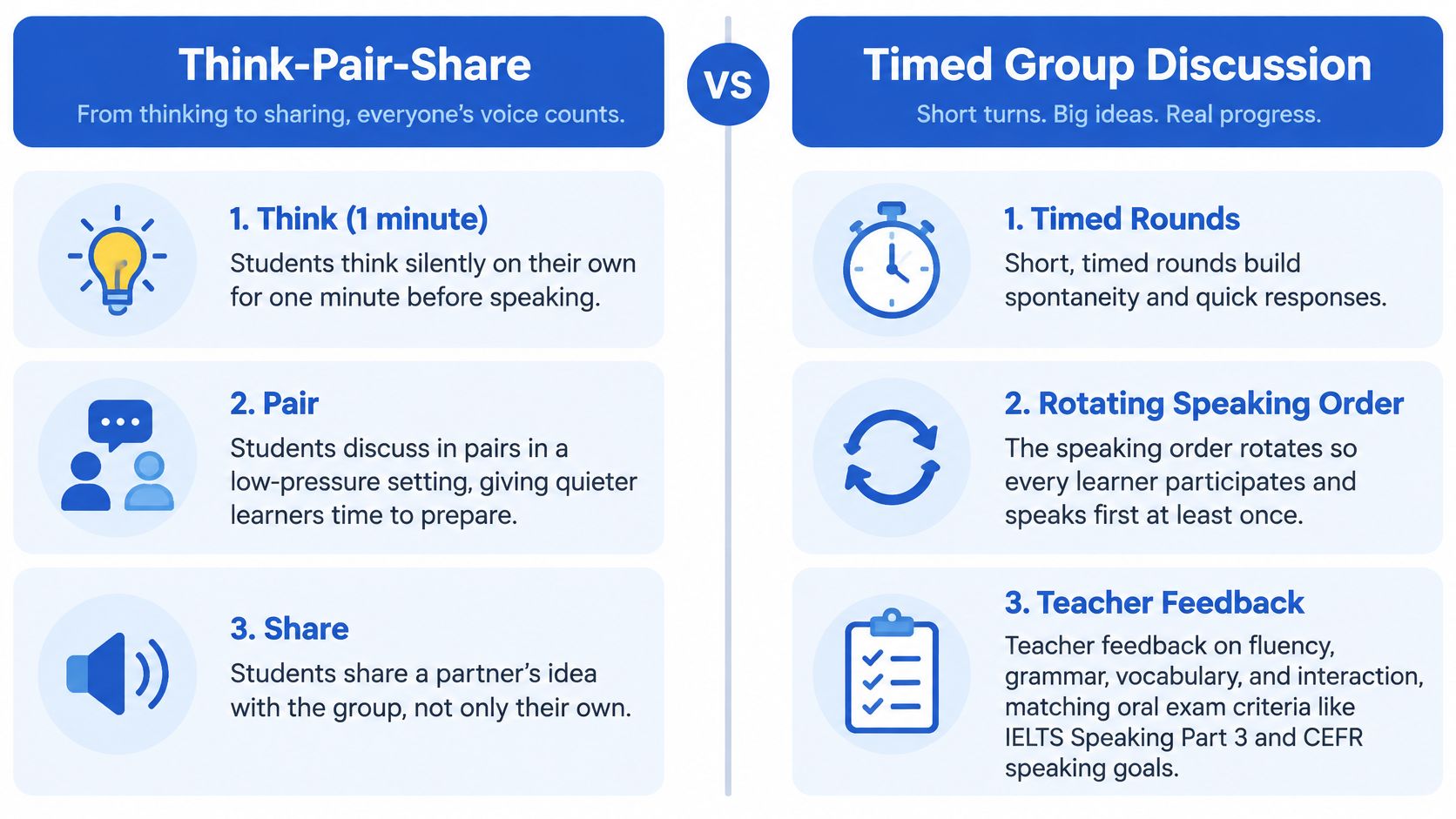
Give learners one minute to think independently. Then have partners exchange ideas before joining a timed group discussion. Ask them to report a partner's view, not only defend their own.
Separate preparation from spontaneous response
- Supply functional language: Include ways to agree, disagree, enter the discussion, and ask follow-up questions.
- Rotate the order: Change partners and who speaks first.
- Share assessment criteria: Observe fluency, accuracy, vocabulary, and interaction.
- Change prompts: Reuse the discussion process without encouraging memorized answers.
At A1, compare familiar preferences using sentence starters. At A2, add reasons and follow-up questions. At B1, compare advantages and disadvantages. At B2, evaluate counterarguments and qualify a conclusion.
Children can choose a class activity. Teenagers can debate school uniforms; university students can discuss remote work. Adults can compare morning and evening learning or practise IELTS Speaking Part 3-style questions about technology and family life. Professionals can discuss a project challenge.
A language-learning study hosted by the Open University found that learners with mental-health conditions were less likely to speak spontaneously or complete spoken assessments. Provide vocabulary previews, predictable turns, and private rehearsal without treating silence as poor motivation.
Assessment caution: A prepared contribution and an unprepared response reveal different skills. Record which support the learner used.
Keep the speaking objective, but offer a gradual route from notes or chat to paired speech and group participation.
7. Dogme-Style Conversation Lessons Built on Learner Topics
A learner mentions an awkward meeting or an upcoming trip. Instead of setting the topic aside, use it as the starting point for a focused conversation lesson.
Dogme-style teaching minimizes published materials and works with language that emerges from learners' communication. It isn't permission to chat without teaching.
Grouping: Start with brief contributions from everyone, then choose a shared topic and rotate follow-up partners. Objective: Discuss a relevant experience and reuse improved language in a fresh response.
Turn conversation into visible learning
Ask a question everyone can answer at their level, such as describing something they need to arrange. Listen for useful expressions and recurring difficulties, then select two or three language points for review.
- Follow the meaning: Ask genuine questions rather than converting every contribution into a grammar exercise.
- Pause selectively: Explain a recurring error or missing expression after learners finish their thought.
- Require reuse: Ask learners to retell, clarify, or respond again using the improved language.
- Record the next step: Connect the task to an observable CEFR-related target.
At A1, use familiar topics with picture support and question frames. At A2, explore routines and recent experiences. At B1, require connected explanations. At B2, explore implications, nuance, and alternative interpretations.
Children can discuss a favourite object; teenagers can talk about school life. University students can discuss a news event, adults can plan European travel, and professionals can revisit a meeting that didn't go well.
For related preparation, use this guide to English conversation practice online.
The ReCALL article on online foreign-language speaking anxiety highlights anxiety around online group speaking. Don't assume an open conversation feels comfortable to everyone. Offer preparation and a clear turn-taking process, while keeping personal disclosure optional.
How the seven small group lesson plans compare
Use this table to match the kit to the room: the “Best for” column is the objective, the size column is the grouping, and each plan can be adjusted from A1 to B2 by changing prompts, input, and expected output.
| Item | Best for | Suggested group size | Typical CEFR range | Main skill focus |
|---|---|---|---|---|
| Role-Play Circles for Everyday Situations | Practising everyday exchanges and building speaking confidence | 4-6 learners | A1-B2 | Spoken interaction, pronunciation, grammar, and vocabulary |
| Information-Gap Pair and Group Tasks | Completing shared tasks through exchanging information | 4-6 learners; give each learner a distinct role | A1-B2 | Asking questions, listening, and meaningful communication |
| Total Physical Response Circles for Young Learners | Teaching English through movement, commands, and play | Up to 6 children | A1-B2 | Listening comprehension, vocabulary, and gradual speaking practice |
| Jigsaw Reading and Listening Groups | Sharing and combining information from texts or audio | 4-6 learners | A1-B2 | Reading or listening comprehension, summarizing, and speaking |
| Business Meeting Simulations for Professionals | Practising workplace meetings and professional communication | 4-6 learners; assign workplace roles | A1-B2 | Spoken interaction, turn-taking, clarification, and summarizing |
| Structured Discussion and Think-Pair-Share Practice | Preparing for oral assessments and developing group discussion skills | 4-6 learners; rotate pairs and speakers | A1-B2 | Fluency, accuracy, vocabulary, and spoken interaction |
| Dogme-Style Conversation Lessons Built on Learner Topics | Building spontaneous conversation around learners' real interests | 4-6 learners | A1-B2 | Spontaneous speaking and flexible language use |
The main trade-off is control against spontaneity. Role-play, information-gap tasks, TPR and jigsaw give clearer turns and easier support. Meeting simulations need sharper role cards. Discussion and Dogme produce freer talk, so they need tighter note-taking and gentler guardrails at lower levels.
Choose One Plan and Run It with Your Next Group
Choose a plan that matches your learners' age, level, and immediate communication goal. Run it for a full week before changing the format, unless learners clearly need more support. Keep the overall group between four and six learners, but use pairs and smaller teams whenever the task requires more speaking time.
State an observable objective at the start. Completing an information request or explaining a decision is easier to assess than improving confidence in general. Keep the objective stable while adjusting vocabulary support, preparation time, topic familiarity, or unexpected questions.
- Before the task: Prepare role cards, useful phrases, and the shared outcome.
- During the task: Note who contributes, asks for clarification, and needs prompting.
- After the task: Collect an individual response rather than judging everyone from the group's performance.
- For the next lesson: Record a specific language target and a suitable support.
Use a brief learner report to distinguish what someone completed independently from what they managed with help. For children, tell parents what their child could say and what to practise next. For adults and professionals, connect feedback to an upcoming conversation, meeting, or interview.
Online delivery needs the same preparation as classroom teaching, plus a clear way to distribute different information privately. Test audio, explain where learners will find their materials, and provide an alternative if a connection fails. The AONMeetings guide for e-learning providers is a related resource for planning the video-conferencing side.
Don't change the whole lesson because a task felt difficult. First check whether learners lacked the language, misunderstood the instructions, or had too little preparation. Each problem calls for a different adjustment.
At Englify, we offer live small-group English classes of up to six learners on Google Meet, with placement by level after a free placement test. Groups follow a fixed timetable of three 60-minute sessions each week, and a free trial session is available before deciding. That structure gives learners repeated opportunities to practise, receive feedback, and work toward clear communication goals.
Englify offers live online English and French learning, with small-group and private options for different goals. Visit Englify to take the free placement test and book a free trial session where you can try structured speaking practice at your level.