Knowledge hub
First Conditional Examples: 8 Patterns for Real Life
First conditional examples for everyday, school, and work: 8 clear sentence patterns with meaning, form, and common mistakes to avoid.
A Monday morning, and you tell a colleague, "If the bus is late, I will call you." That sentence is a first conditional. It sets a realistic future situation beside its likely result, and it costs you nothing to say. The shape is plain: if plus present simple in the condition, will plus the base verb in the result.
Most learners stop there. They memorise one formula and reuse it for everything, which is why so many first conditional examples in textbooks sound identical. The friendlier truth is that the if-clause stays put, and the main clause is where English hands you choices. Swap will for an imperative and you're giving instructions. Swap it for might and you're admitting doubt. Swap it for going to and you're describing a plan that already exists.
The eight patterns below each do one job. They cover what you'll meet in speaking, in school exams, in interviews, and in workplace messages. Take them one at a time. Write three sentences with a pattern, say them aloud, then move to the next.
Table of Contents
- 1. Basic First Conditional With If, Present Simple and Will
- 2. First Conditional With an Imperative in the Main Clause
- 3. First Conditional With a Modal Verb in the Main Clause
- 4. First Conditional With Going To for Planned Future Results
- 5. First Conditional With Present Continuous in the Main Clause
- 6. Negative First Conditional With Don't and Won't
- 7. First Conditional With Unless
- 8. First Conditional in Workplace, Study and Exam Contexts
- How Each First Conditional Pattern Changes the Main Clause
- Practise One Pattern a Day, Then Test Yourself
1. Basic First Conditional With If, Present Simple and Will
The most common first conditional examples all share one shape. The condition sits in the present simple. The result sits in will plus the base verb.
"If it rains tomorrow, we will stay at home." You aren't promising rain. You're describing a possible tomorrow and your response to it.
Two more in the same shape. "She will call you if she has time." "If you study every day, you will improve quickly." Nothing dramatic happens in either sentence, and that's the point. This is the workhorse you'll use for plans, promises and straightforward predictions.
Rain and buses show up in every coursebook for a reason. They're the plainest way to see a condition and a result sitting side by side, with no extra meaning layered on top.

One rule fixes most errors
Never put will in the if-clause. Say "If it rains," not "If it will rain." The BBC Learning English session on the first conditional gives the standard pattern as if + present simple, will + infinitive, and puts the condition in the present tense even though the whole sentence points to the future. That same session explains the comma rule: use one when the condition comes first, drop it when the result comes first.
It also draws the line between conditionals. "If it rains tomorrow, we'll stay inside" presents a realistic future possibility, while "If I won the lottery, I would travel" is hypothetical and belongs to the second conditional. Same word, different tense, different meaning.
- Check the if-clause first. Before anything else, look for a stray will hiding after if. That single scan catches most errors.
- Keep the verb bare. It's will go, not will to go and not will going.
- Write about your own week. "If I finish work early, I will..." makes the pattern stick faster than copying a textbook sentence.
If you want to know where this pattern sits in a syllabus, Englify's guide to English levels and CEFR explains what each level covers and which structures appear at each stage.
2. First Conditional With an Imperative in the Main Clause
A colleague sends you a file at four in the afternoon and adds one line underneath. If the file won't open, tell me. That line is a first conditional with an imperative, and you'll meet it constantly in messages, notices and classroom instructions.
When the result clause is an instruction, a request or a piece of advice, the verb goes into the imperative and the subject disappears. "If you finish early, call me." "If the meeting starts late, send me a message." "If you have any questions, please ask during the session."
The BBC Learning English intermediate grammar session notes that the result clause can carry an imperative or a modal when the meaning is advice, permission, ability or reduced certainty, and gives "If the file arrives, send it to finance" alongside "If you finish early, you can leave."
Why it sounds direct, and when that's fine
The understood "you" makes this pattern short and firm. In a team chat or a classroom, that's exactly what you want. With a stranger or a senior colleague, one small word softens it.
- Add please for people you don't know well. "If you need another copy, please ask at reception" reads as polite; the bare version can read as an order.
- Signpost the condition clearly. "If you're late, let the teacher know" works because the condition is specific. Vague conditions produce vague instructions.
- Split double instructions. "If you miss the deadline, email me and send the file" is better as two sentences. One condition, one action.
- Use it in writing more than in speech. Instructions in emails, forms and shared documents are where this pattern earns its keep.
In class, keep it whole: say the condition and the instruction in one breath, then pause. Learners who hear the two halves together stop separating them when they write.
3. First Conditional With a Modal Verb in the Main Clause
Will isn't your only option, and treating it as the only option flattens your meaning. Replace will with a modal and the sentence keeps its shape while the speaker's attitude changes.
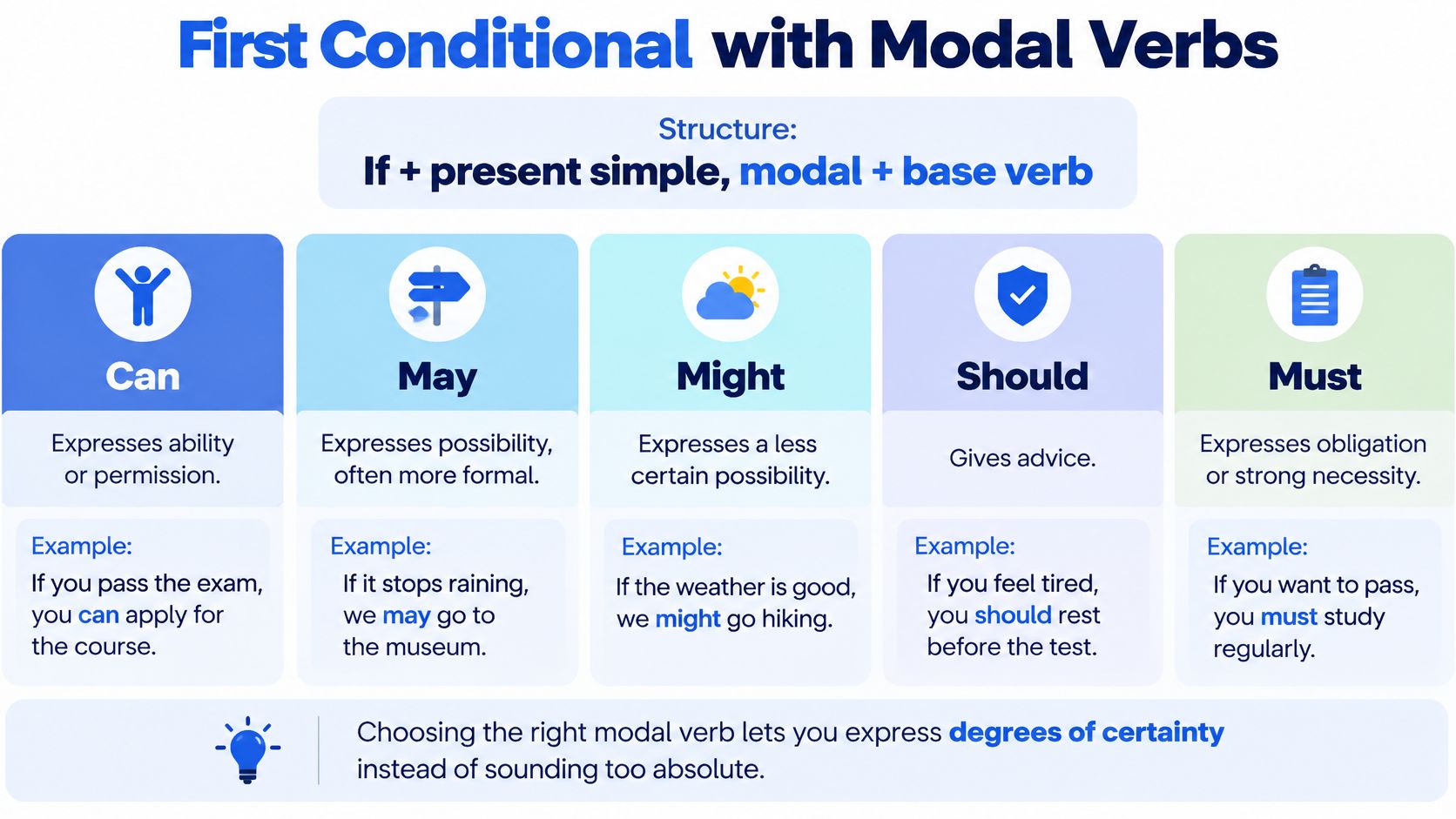
"Can" handles ability and permission. If you pass the exam, you can apply for the course. "May" and "might" handle possibility. If the weather is good, we might go hiking. "Should" gives advice. If you feel tired, you should rest before the test. "Must" marks a requirement. If you attend the workshop, you must bring your registration.
The BBC Learning English reference on future conditions and modals spells out the difference: may or might signal reduced certainty, should expresses advice, and can or could express ability or possibility, as in "If the train is late, we might take a taxi."
Choose the modal by meaning, not by habit
Start from what you want to say, then pick the verb.
- Certain result or firm promise: will. "If she calls, I'll ask her to email you."
- Possible but unsettled: may or might. "If demand increases, prices might rise."
- Permission or opportunity: can. "If the room is free, you can use it."
- Advice: should. If the instructions are unclear, you should ask for an example.
- Requirement: must. Use it when there's no choice involved.
Read the sentence aloud afterwards. If it sounds harsher than you intended, step the modal down from must to should, or from will to might. For more on the advice modal in particular, these should sentences in everyday English show how the tone shifts across contexts.
4. First Conditional With Going To for Planned Future Results
Some results aren't predictions. They're plans you already made, or conclusions drawn from what you can see right now. Going to handles both.
If I get the job, I am going to move to Casablanca. The job isn't confirmed, but the move is already decided in your head. If we finish the project on time, we are going to celebrate. Again, the celebration is a plan, not a forecast.
The evidence version works the same way. If the sky looks this dark, it is going to rain soon. You aren't reading a weather app. You're looking up and drawing the obvious conclusion about what's coming.
Will and going to aren't interchangeable
The difference is timing. Use going to when the plan or the evidence exists before you open your mouth. Use will when you're deciding as you speak.
The test: if you could have told someone about the plan yesterday, use going to. If the decision is happening in this conversation, use will.
- Plans you already hold: "If I pass the test, I am going to enrol in an advanced course." You chose the course before the result.
- Offers made on the spot: "If you need help, I will assist you." You're volunteering now, so will fits.
- Visible evidence: "If that traffic doesn't move, we are going to be late." The jam is in front of you.
- Comparisons help. Write the same sentence twice, once with each form, and read both to a partner. Hearing the gap is faster than reading about it.
5. First Conditional With Present Continuous in the Main Clause
Timetables and arrangements need a different main clause. When the result is a fixed commitment at a set time, the present continuous fits better than will.
If the train is on time, we are meeting at 9. The meeting exists in a diary. If you need a ride, I am driving to the office at 8. The drive is arranged. If the class is cancelled, we are having a meeting instead. Everyone already knows the alternative slot.
This pattern sounds natural in speech because it mirrors how people describe their calendars. The condition is a variable; the arrangement is not.
Always include the time
The present continuous in this pattern points to a specific future moment, so the sentence usually needs a time or a date attached.
- Timetables and transport: "If the flight lands early, we are taking the first bus." Without "first bus" or a clock time, the sentence floats.
- Shared arrangements: "If you're free on Friday, we are meeting for lunch." The arrangement belongs to both people.
- Fixed slots at work: "If the client confirms, we are presenting on Thursday at ten."
- One risk to watch. Don't leave the reader guessing between an arrangement and a habit. "We are meeting" is an arrangement. "We meet" is a routine. Add the time and the meaning locks.
6. Negative First Conditional With Don't and Won't
Half of real warnings are negative. You don't hurry, and the bus leaves without you. This pattern puts the negative in one clause, the other, or both, and each version says something slightly different.
If you don't hurry, you will miss the bus. If you don't prepare, you will struggle in the interview. If we don't book early, we won't get a seat. Notice that the negative in the if-clause uses don't or doesn't plus the base verb, and the negative in the result uses won't.
The error that keeps coming back
Learners write "If you won't study, you will fail" when they mean "If you don't study." For a plain future condition, the if-clause takes the present simple negative, never won't.
There's a narrow exception. "Will" can appear after if when the meaning is willingness or refusal: "If you won't listen, I can't help you." That sentence means if you refuse to listen. It isn't describing a future condition at all, which is why it survives. If you're unsure, use don't. It's correct far more often.
- Warnings in exams: "If you don't submit the report, you will lose marks." Clear condition, clear consequence.
- Third-person agreement: "If she doesn't finish early, she will stay late." After doesn't, the verb returns to its base form.
- Double negatives: both clauses can go negative when the logic calls for it. "If we don't book early, we won't get a seat" is correct and natural.
- Professional reminders: put the consequence second and keep it factual. Readers accept a warning when it's specific.
7. First Conditional With Unless
Unless means "if not," and it turns a negative condition into a cleaner sentence. The structure is unless plus the present simple, followed by will and the base verb.
Unless you hurry, you will miss the train. We will not start the session unless everyone is present. Unless the weather improves, the event will be postponed. Each sentence names the one condition that would prevent the result.

The rushing platform scene is the classic unless situation. Everything goes to plan except for one thing you can't control, and the sentence exists to flag it.
Test it by swapping back to if not
The fastest check is to replace unless with "if not" and read the sentence again. If the meaning holds, your unless is right.
Practical rule: unless already carries the negative. Never write "unless you don't" or "unless you won't." The not is built in.
- Formal writing: "Unless we receive the documents, we will not proceed" fits emails, notices and reports.
- News and announcements: unless constructions suit headlines about deadlines, weather and schedules.
- The conversion is mechanical. "If you don't register by Friday, you won't receive a pass" becomes "Unless you register by Friday, you won't receive a pass." Drop the don't, keep everything else.
- Watch the scope. Unless works best when it introduces a genuine exception. If you're describing a known fact rather than a future condition, plain if not often reads more accurately.
8. First Conditional in Workplace, Study and Exam Contexts
The pattern earns its keep. Interviews, proposals, study plans and speaking exams all ask you to connect a realistic condition to an outcome, and first conditional sentences do that in one line.
In an interview: "If I am offered the position, I will start as soon as possible." In a client email: "If the client agrees, we will send the proposal by Friday." In a courteous close: "If you need more details, I will be happy to send them."
Study goals follow the same logic. If I practise speaking every day, my confidence will grow. If I improve my vocabulary, I will get a higher score in the writing test. Both sentences link effort to a result you can reasonably expect.

Vary the modal so your writing doesn't flatten
Cambridge Grammar points out that while the conditional clause normally takes the present simple, the main clause can use several future-oriented modals, including will, may, might, can, could, should and would, as explained in the Cambridge Grammar entry on the first conditional. Grouping your examples by meaning, certainty with will, possibility with may or might, permission with can, advice with should, gives you range without extra grammar.
- Keep interview answers short. "If I get the role, I will start within two weeks" beats a long explanation of your flexibility.
- Record yourself. Reading your answers aloud exposes sentences that sound over-committed or too vague.
- Be realistic about study claims. "If I practise for 30 minutes daily, I will notice improvement in my speaking within a few months" is credible. Overnight fluency isn't.
- Know your starting point. Most of these sentences sit around B1, where you're expected to link conditions to outcomes in both speech and writing. What B1 English actually requires shows the speaking and writing targets at that level.
If you're unsure where you stand, our free placement test includes a spoken part, so the level you get reflects how you speak rather than how well you answer a grammar quiz.
How Each First Conditional Pattern Changes the Main Clause
| Item | Main Clause Form | Typical Use | Common Error to Avoid |
|---|---|---|---|
| Basic First Conditional: If + Present Simple, Will + Base Verb | Will + base verb | Realistic future plans, promises, warnings, and predictions | Using will in the if-clause |
| First Conditional with an Imperative in the Main Clause | Imperative (base verb) | Instructions, advice, and requests | Sounding abrupt without polite wording |
| First Conditional with a Modal Verb in the Main Clause | Modal + base verb | Expressing ability, possibility, advice, or obligation | Choosing a modal that gives the wrong tone or meaning |
| First Conditional with Going To for Planned Future Results | Am/is/are going to + base verb | Existing plans, intentions, or predictions based on evidence | Using going to and will without considering the difference |
| First Conditional with Present Continuous in the Main Clause | Am/is/are + verb-ing | Fixed future arrangements and schedules | Confusing a future arrangement with an ongoing action |
| Negative First Conditional with Don't or Won't | Will not (won't) + base verb | Warnings, consequences, and reminders | Using won't in the if-clause or creating a double negative |
| First Conditional with Unless | Will + base verb | Concise conditions, especially in formal writing | Adding not after unless |
| First Conditional in Workplace, Study, and Exam Contexts | Usually will + base verb; may also use modals or going to | Professional commitments, study goals, and realistic outcomes | Making overly certain promises or repeating will too often |
Practise One Pattern a Day, Then Test Yourself
Pick two patterns from this list. Write three sentences for each: one about school or work, one about daily life, one about a plan you already have. Read all six aloud. Then go back and check every if-clause for a stray will.
That last step matters more than it sounds. The will-in-the-if-clause error survives for years because it sounds logical to learners who are thinking about the future. Your ear only learns to reject it after you've heard your own voice say the correct version several times.
Here's a routine that works over a week:
- Day one: basic pattern, three sentences about your week.
- Day two: imperatives, written as instructions you'd send.
- Day three: modals, one sentence each with can, might and should.
- Day four: going to and present continuous, both about arrangements you already have.
- Day five: negatives and unless, written as warnings.
- Day six: a full interview answer or short email using three of the patterns.
- Day seven: read everything aloud and mark the sentences that still feel shaky.
What to fix first: if you only correct one thing this month, correct the if-clause. Get the present simple right there, and the main clause will follow with practice.
Two smaller habits speed this up. Keep a running list of conditions that apply to your life, such as exam dates, work deadlines and travel plans, and reuse them across patterns. And when you read English news or work emails, circle every if-clause you find. You'll start noticing modals in the result clause far more often than textbooks suggest.
If your level is uncertain, our free placement test includes a spoken part and shows where you stand on the CEFR scale before you commit to anything. Every learner also starts with a free trial class, no card required, so you can try these patterns with a teacher and get corrections in real time.
Ready to turn these patterns into speech you don't have to think about? At Englify, live classes run on Google Meet in small groups of no more than six, from complete beginner A0 up to C1, with private one-to-one options for interview preparation and workplace communication. You'll start with a free placement test and a free trial class, so you and your teacher can see exactly which conditional patterns need work before you choose a course. Book the trial, bring three sentences of your own, and spend the hour saying them out loud.