Knowledge hub
English B1 Level: Skills, Tasks, and the Path to B2
What the english B1 level really means for speaking, listening, reading, and writing, with sample tasks, performance indicators, and clear next steps to B2.
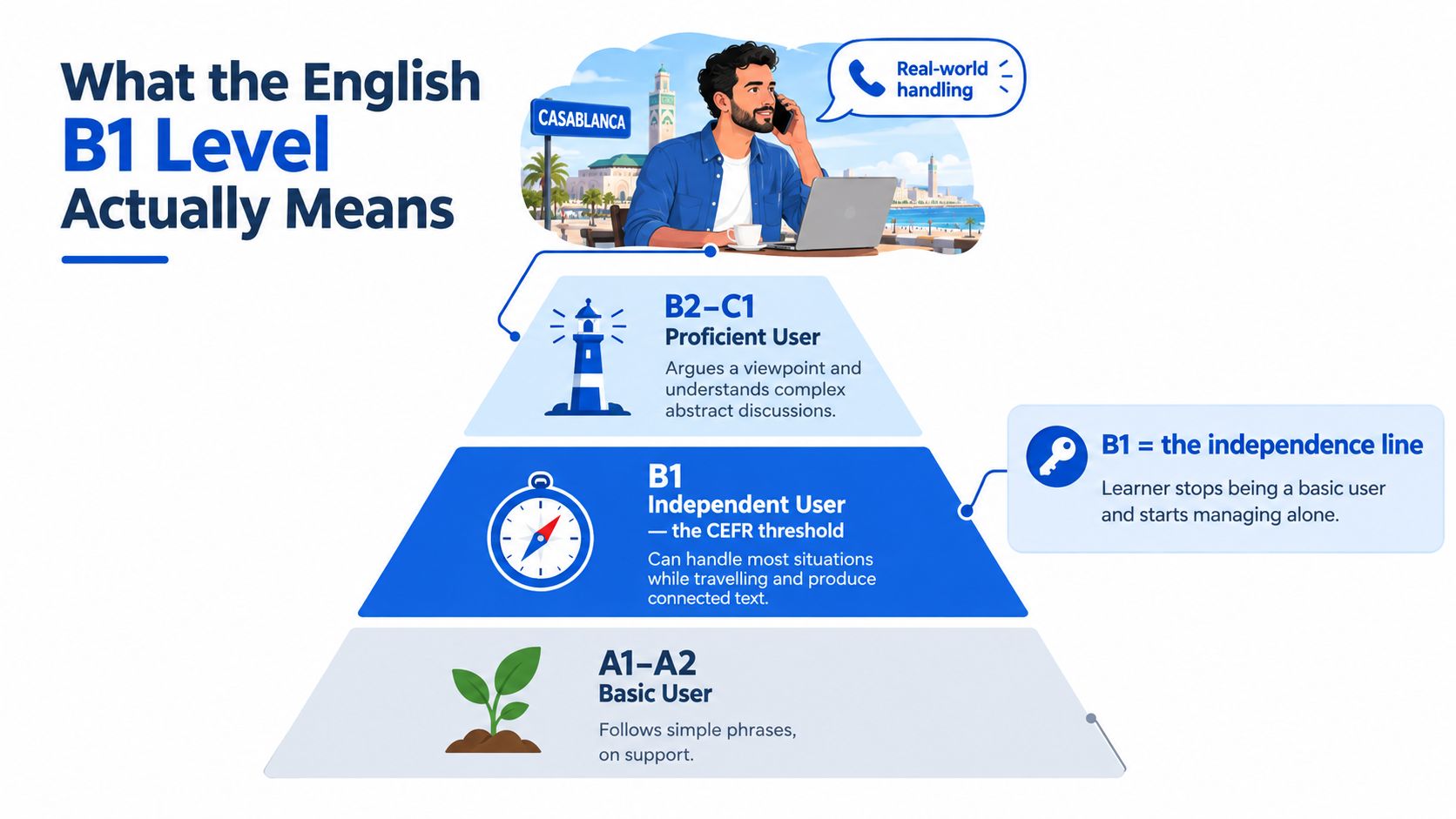
You're on a phone call in Casablanca, and a customer is asking why a shipment hasn't arrived. You understand the problem, explain that the delivery is delayed, ask for the order number, and promise to check the status. You pause, search for a word, and perhaps correct a sentence, but you keep the conversation moving.
That situation is a useful picture of the English B1 level. You're no longer dependent on memorized phrases, but you're not yet comfortable expressing complex ideas quickly and precisely. B1 is about becoming an independent English user in familiar situations, not about speaking perfectly.
Table of Contents
- What the English B1 Level Actually Means
- Listening and Reading at B1
- Speaking at B1 and What Real Conversation Looks Like
- Writing at B1 With Sample Tasks and Examples
- B1 Performance Indicators and Exam Equivalents
- Why Many B1 Learners Still Cannot Speak Fluently
- A Practical Path From B1 to B2
What the English B1 Level Actually Means
The Common European Framework of Reference for Languages, or CEFR, places B1 among six levels, from A1 to C2. The Council of Europe's B1 descriptors describe a learner who can understand the main points of clear, standard English on familiar matters, produce simple connected text, and talk about experiences, hopes, plans, and events.
That makes B1 an important threshold. At A2, you can manage short exchanges about immediate needs, but you may still need support. At B1, you can usually handle routine interactions independently. At B2, you can go further by defending an opinion, following more complex discussions, and adapting your language to professional or academic situations.
Practical rule: B1 means you can usually manage the situation, even when your English isn't perfect.
A B1 learner can deal with a delayed delivery, ask for help at an airport, explain a problem to a hotel receptionist, or discuss familiar work responsibilities. You can follow much of an everyday conversation and understand straightforward factual information about common personal or job-related topics. However, fast speech, several speakers talking together, unfamiliar subjects, irony, and abstract arguments can still create difficulty. The CEFR companion volume also shows how B1 performance can be described through more detailed sub-levels in some educational systems.
B1 in practical situations
At work, you might understand the main point of a meeting about a familiar project and give a short update. At university, you can read a straightforward article related to your subject and write a connected response. While travelling, you can resolve a routine problem without relying entirely on translation tools.
B1 still doesn't mean you can study or work exclusively in English without difficulty. You may need extra time to formulate an answer, ask someone to repeat information, or use simpler language when discussing technical and abstract subjects. A useful first step is to check your current level with an English placement test guide, then compare the result with your performance in real conversations.
Listening and Reading at B1
B1 receptive skills are about finding meaning in clear, familiar input. You don't need to understand every word. You need to identify the main idea, locate important facts, and use context to work out meaning when a word or phrase is unfamiliar.
For listening, imagine receiving a voicemail from a delivery company. The speaker explains that the package will arrive later, gives a reason, and asks you to confirm an address. A B1 listener can usually catch the central message and the practical details if the speaker uses standard pronunciation and a familiar topic.
Other realistic listening tasks include:
- A workplace interview: Following questions about previous experience and understanding the main points of the answers.
- A school or university announcement: Identifying a changed room, deadline, or meeting time.
- A short news report: Understanding the general topic and a few clear facts when the subject is familiar.
- A personal message: Following a friend's explanation of travel plans, a family event, or a change of schedule.
Reading follows the same principle. You might scan a job advertisement for required skills, read a colleague's email about a meeting, or follow a short magazine article about education, technology, health, or travel. A B1 reader can usually understand straightforward factual texts and infer the meaning of some vocabulary from nearby sentences.
| Skill | Sample Task | Expected Input | B1 Performance Signal |
|---|---|---|---|
| Listening | Follow a voicemail about a delayed delivery | Clear, familiar spoken English with practical details | Identifies the reason, action, and relevant information |
| Listening | Understand a job interview about past experience | Structured questions and answers on a familiar role | Follows the main points without translating every word |
| Listening | Catch the topic of a short news report | Standard speech about a known subject | Understands the general message and selected facts |
| Reading | Scan a job advert | Short, factual professional text | Finds requirements, duties, and application details |
| Reading | Follow an email about a plan | Personal or workplace correspondence | Understands the purpose, sequence, and requested action |
| Reading | Read a short article | Clearly organised text on a familiar topic | Understands the main idea and uses context to interpret words |
What B1 comprehension doesn't guarantee
A learner may understand a clear podcast about work but struggle with an unscripted discussion between several native speakers. You may follow the plot of a straightforward story but miss cultural references or implied criticism. These gaps don't cancel your B1 level. They show that comprehension depends on speed, topic, pronunciation, vocabulary, and context.
Use a simple performance check. After listening or reading, ask yourself: What is the main point? Which facts matter? What action or opinion does the speaker or writer communicate? If you can answer those questions in familiar contexts, you're demonstrating the core of B1 comprehension.
Speaking at B1 and What Real Conversation Looks Like
A B1 conversation often contains pauses and repairs. Those features aren't automatically signs of failure. A learner becomes more independent when they can keep communicating instead of stopping every time a sentence isn't perfect.
Consider this exchange in a shop:
Learner: Excuse me, I bought this jacket yesterday, but I'd like to return it.
Shop assistant: Is there a problem with it?
Learner: The size is not right. It's too... I mean, the sleeves are too long for me. I have the receipt, but I didn't bring the original bag.
Shop assistant: We can exchange it, but refunds require the original packaging.
Learner: I see. So, can I choose another size today? If not, what do I need to do?
The learner hesitates, rephrases “too big” as “the sleeves are too long,” and asks a follow-up question. The grammar isn't especially advanced, but the interaction works. That is a stronger sign of B1 speaking than reciting a memorized answer without responding to the other person.
Signals of solid B1 speaking
A B1 speaker can usually:
- Connect ideas: Tell a short story about a trip, explain a work task, or describe a personal experience in a sequence.
- Give reasons: Say what they prefer and support the opinion with a simple explanation.
- Ask for clarification: Use phrases such as “Could you say that again?” or “Do you mean the morning meeting?”
- Repair communication: Say “Sorry, can I say that again?” or “What I mean is that the delivery was sent to the wrong address.”
- Manage familiar pressure: Explain a problem at a hotel, discuss symptoms during a doctor visit, or answer questions in an interview for a familiar role.
The Europass CEFR skill descriptions connect B1 with routine interactions, unprepared conversation on familiar topics, connected phrases, brief explanations, and simple writing about experiences and impressions.
A2, B1, and B2 in conversation
An A2 learner may depend on memorized phrases and need the other person to guide the exchange. A B1 learner can respond, ask questions, and continue when the conversation changes slightly. A B2 speaker can contribute more spontaneously, explain an abstract viewpoint, and respond to counterarguments with greater control.
The difference is not just speed. It includes turn-taking, vocabulary range, accuracy, and flexibility. A B1 speaker can give a short presentation about a known subject at work or school, but the question-and-answer part may require more preparation than the presentation itself.
Writing at B1 With Sample Tasks and Examples
B1 writing is connected, understandable, and practical. You can write to a landlord about a repair, email a colleague about a schedule, describe a personal experience, or give a short opinion about a familiar subject.
A useful model is a message about a delayed package:
Hello Mr Karim, I'm writing because my package was supposed to arrive on Monday, but I still haven't received it. I checked the tracking information, and it says that the address needs confirmation. Could you please check the address and tell me when the delivery will arrive?
Thank you for your help.
Best regards, Samira
The message has a clear purpose, relevant details, and a request. A B1 writer may still omit an article, confuse a verb tense, or choose a slightly unnatural phrase. Those errors matter, but they don't necessarily prevent the reader from understanding the message.
A short opinion text
A B1 learner can also write a connected opinion about a familiar issue:
Remote work can be useful for employees because they don't need to travel every day. It also gives people more time with their families. However, some workers feel isolated when they work alone. In my opinion, a combination of home and office work is a good solution because people can communicate with colleagues and still have flexibility.
Words such as because, however, although, and in my opinion help the writer connect ideas. At B2, the writer would usually develop the argument more fully, organise paragraphs with stronger cohesion, and use a wider range of precise expressions.
Before submitting a B1 draft, ask:
- Is my purpose clear in the first part of the text?
- Have I included the important facts or reasons?
- Can the reader follow the order of my ideas?
- Have I checked verb tense, articles, prepositions, and punctuation?
These questions turn writing practice into measurable work. Don't only count grammar mistakes. Check whether the reader can understand your message and respond appropriately.
B1 Performance Indicators and Exam Equivalents
CEFR B1 describes performance, not just a list of grammar topics. A learner at this level should be able to understand the main points of clear standard input on familiar matters, maintain a conversation about personal interests, describe experiences and plans, give simple reasons, and produce connected text.
Exam results can provide evidence, but different tests measure skills in different ways. The British Council's B1 overview presents commonly used mappings of B1 with IELTS 4.0–5.0, TOEIC 550–780, and TOEFL iBT 42–71. These ranges are broad, so a score should be read alongside the learner's separate listening, reading, speaking, and writing performance.
| Exam | Overall B1 Range | Listening | Reading | Speaking | Writing |
|---|---|---|---|---|---|
| IELTS | 4.0–5.0 | Follows the main points of clear familiar speech | Understands straightforward factual texts | Communicates about familiar topics with pauses and repairs | Produces simple connected responses |
| TOEIC | 550–780 | Understands practical workplace messages on familiar subjects | Extracts information from everyday and job-related texts | Handles routine professional interaction | Writes clear, straightforward messages |
| TOEFL iBT | 42–71 | Understands the main point of accessible spoken input | Understands central ideas in familiar or straightforward texts | Explains familiar experiences and opinions | Produces connected writing on known topics |
| Cambridge B1 Preliminary | A pass is evidence to interpret with the CEFR skill profile | Demonstrates functional comprehension in the test tasks | Handles practical and familiar written input | Completes familiar communication tasks | Produces an understandable connected text |
| PTE Academic | Use the result with the test's current CEFR conversion guidance | Review the separate communicative skills | Review the separate communicative skills | Review fluency, pronunciation, and response content | Review form, coherence, and written development |
A B1 result doesn't automatically mean that you can work or study entirely in English. An exam may show that you can complete defined tasks under test conditions, while a demanding workplace may require faster responses, specialised vocabulary, longer reports, or confident participation in meetings.
The free English level test can help you estimate your current CEFR position before choosing a course. For formal applications, always check the exact requirement of the employer, university, immigration authority, or examination body. B1 may be a useful foundation or threshold in some contexts, but requirements vary by institution and purpose.
Why Many B1 Learners Still Cannot Speak Fluently
A learner can know B1 grammar and still sound hesitant in conversation. This happens because grammar knowledge is not the same as automatic access to language. Speaking requires you to choose words, organise ideas, pronounce them, listen to the reply, and adjust your message in real time.
A common textbook answer might be:
I went to Rabat last weekend. I visited a museum. It was interesting. I liked it because I learned about history.
It is clear and accurate enough, but it may stop there. A more conversational answer could be:
I went to Rabat last weekend, and I really enjoyed it. I wasn't planning to visit the museum at first, but my friend recommended it. It was interesting because I learned things I didn't know about the city. I'd definitely go again, although next time I'd like to visit another area too.
The second answer still contains simple language. Its strength comes from connected ideas, added detail, self-expression, and a willingness to continue.
Common reasons for the plateau
- Limited verb patterns: Learners rely heavily on the present simple and past simple, even when other forms would express the meaning more clearly.
- Fossilised small errors: Third-person -s, articles, prepositions, and word order may remain inaccurate because nobody has helped the learner notice and repair the pattern.
- Passive vocabulary: A learner may recognise many words while reading but fail to retrieve them during a live conversation.
- Short turns: Speaking practice often consists of answering questions briefly rather than telling a story, explaining a choice, or responding to an unexpected follow-up.
- No repair strategy: Without phrases such as “Let me explain that another way,” a small vocabulary gap can stop the whole conversation.
B1 isn't a promise of effortless fluency. It gives you the foundation for independent communication. Moving toward B2 requires more extended speaking, more flexible vocabulary, and feedback on recurring errors. Focused practice, such as the activities in this guide to improving English speaking, should make you speak more often, not just study more rules.
A Practical Path From B1 to B2
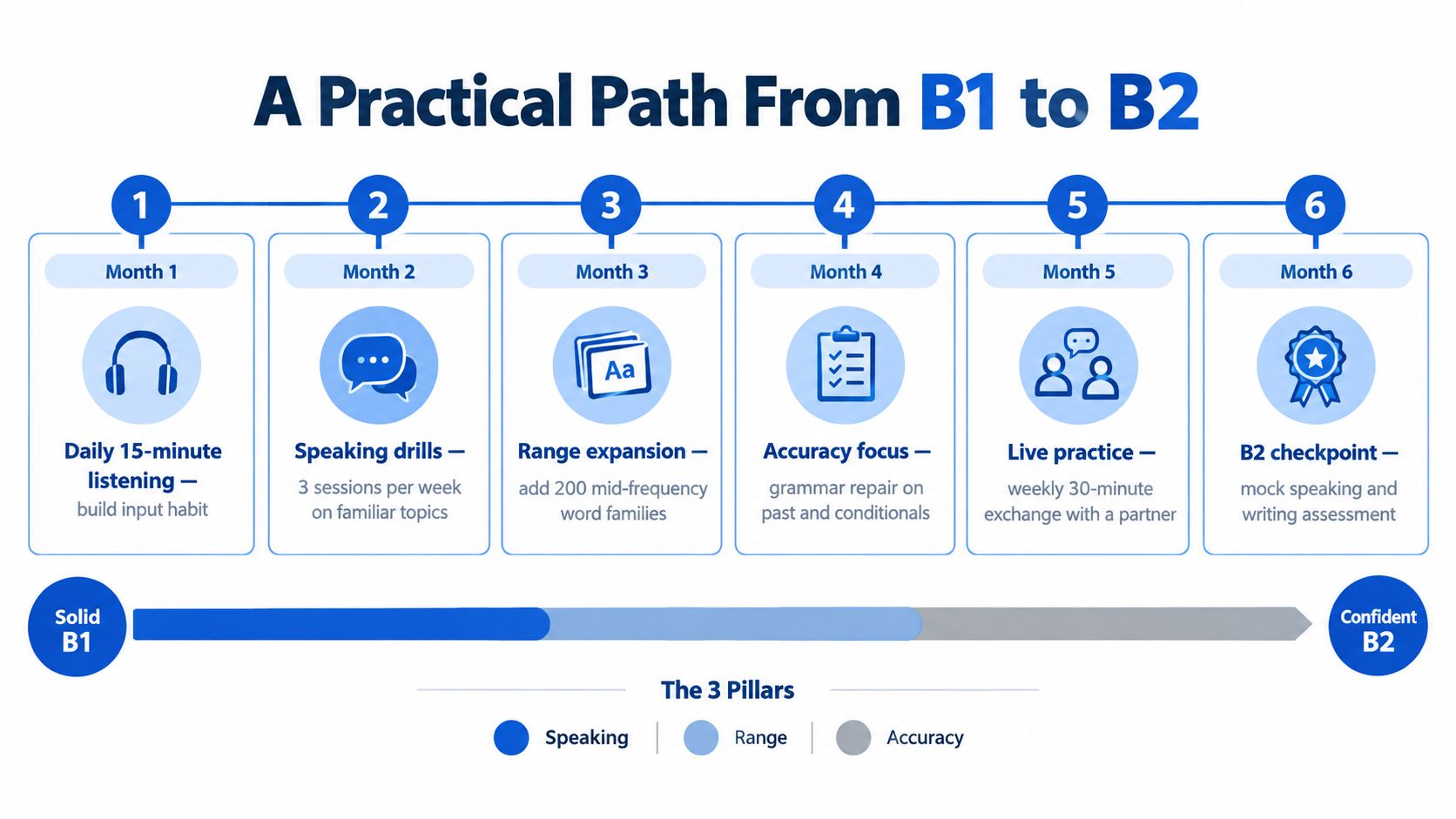
The move from B1 to B2 is a shift from handling familiar communication to performing with greater flexibility. Your plan should develop three areas together: speaking, language range, and accuracy.
Start with input. Listen to a short, clear English recording each day, then repeat selected phrases aloud. This shadowing practice helps you notice linking, stress, pronunciation, and useful chunks such as “What I'm trying to say is…” or “The main reason is…”
Build a purposeful weekly routine
Use regular activities with a clear output:
- Speaking: Practise opinions, personal stories, problem-solving, and follow-up questions in live sessions or with a reliable partner.
- Writing: Produce connected arguments about familiar topics, then revise organisation, linking, grammar, and word choice.
- Vocabulary: Replace repeated general words with more precise alternatives. For example, move beyond get, make, and big when obtain, generate, and considerable express the idea more accurately.
- Grammar: Review third conditionals, passive reporting verbs, relative clauses, and cleft sentences when they solve a communication problem, not as isolated exercises.
- Self-assessment: Use past B2-style speaking and writing prompts. Record yourself, review the transcript, and mark hesitation, repetition, unclear pronunciation, and incomplete explanations.
Your milestones should be observable. You might aim to hold a sustained debate, write a developed argumentative essay, follow a lecture on a familiar academic subject, or speak for several minutes without preparing every sentence. The point isn't to eliminate every pause. The point is to keep your message organised while choosing more accurate and varied language.
How to know you're approaching B2
Look for changes in behaviour:
- You can explain why you hold an opinion, then respond to a different opinion.
- You can tell a story with a beginning, development, and conclusion.
- You can use discourse markers such as although, whereas, on the other hand, and as a result.
- You can continue an unplanned conversation instead of returning to memorised sentences.
- You can revise a text for cohesion and tone, not only correct individual grammar mistakes.
A short speaking diagnostic or trial class can show whether your main barrier is vocabulary retrieval, pronunciation, grammar accuracy, listening speed, or confidence. Englify offers CEFR-aligned online English classes through Google Meet, including small-group and private options, personalised content, session recordings, learner reports, and a free placement test and trial session. Visit Englify to identify your current level and choose a practical next step toward B2.