Knowledge hub
What Is English Placement Test: Complete Guide
Learn what is english placement test, how it works, and why accurate CEFR level assignment matters for your English learning journey.

An English placement test is a diagnostic assessment used to place you in the correct proficiency level, typically mapped to CEFR bands from A1 to C2. It measures your current English ability so a school or academy can recommend a suitable course, rather than judging whether you're intelligent or hardworking.
But what happens after you finish the test? A level label alone doesn't tell you whether you need more speaking practice, stronger grammar foundations, academic writing support, or confidence for interviews. The important step is connecting the result to a practical learning path, especially if you're an Arabic-speaking learner who may understand English rules but still hesitate during real conversations.
Table of Contents
- What Is an English Placement Test
- How Placement Tests Determine Your Level
- Skills Measured in Modern Placement Tests
- What to Expect During the Test
- How to Prepare for Your Placement Test
- Next Steps After Your Results
What Is an English Placement Test
An English placement test is a diagnostic assessment taken before a course begins. Its purpose is to identify your current level and place you in a class that matches your ability. It isn't the same as a certification exam, where you're trying to prove proficiency for admission, work, or immigration.
A placement test asks, “Where should this learner start?” It doesn't ask, “Has this learner succeeded or failed?” That distinction matters. If your level is too high for the class, you may feel bored and stop progressing. If it's too low, lessons may feel overwhelming and you may lose confidence.
For Arabic-speaking learners, anxiety often comes from comparing English with Arabic or from remembering a difficult school exam. You might worry about pronunciation, verb tenses, or answering quickly enough. A placement test isn't designed to reject you. It gives a teacher useful information about what you can do now, including the areas that need attention.
Practical rule: Don't try to appear more advanced than you are. An honest result creates a more comfortable starting point.
The result will usually be connected to a CEFR level, which guides the curriculum you follow. A beginner may need everyday vocabulary, sentence structure, and basic listening. A more advanced learner may need presentation skills, precise writing, or spontaneous discussion. The test helps turn a general goal, such as “improve my English,” into a more suitable starting level.
How Placement Tests Determine Your Level
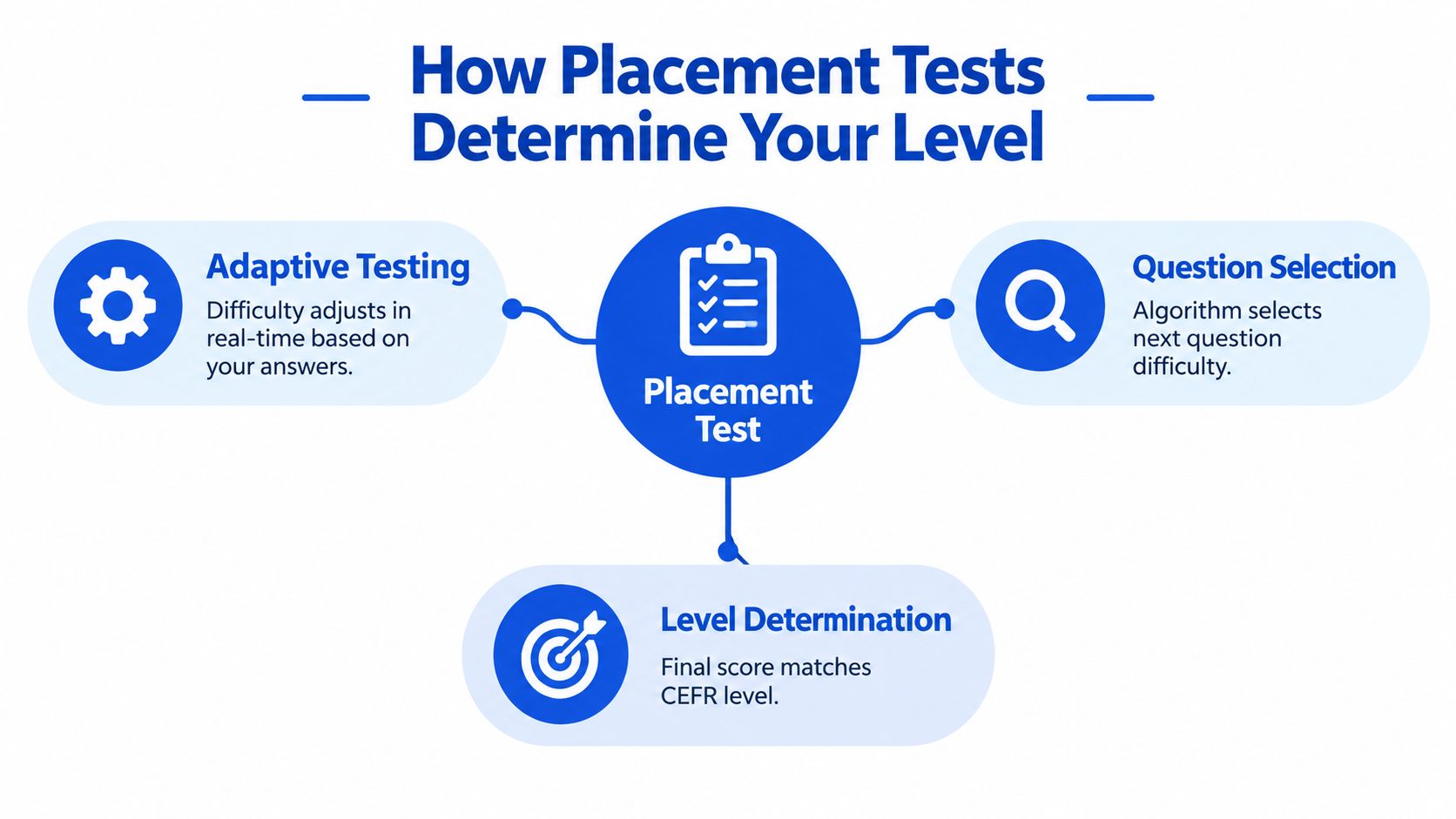
A modern placement test often uses adaptive testing. The system changes the difficulty of later questions according to your earlier answers. If you answer basic questions accurately, it may present more complex language. If a question is too difficult, the system can return to a more suitable range.
Think of this like medical triage. A nurse asks targeted questions to decide what kind of care you need. The purpose isn't to punish you for having a problem. It's to direct you to the right treatment. In the same way, an adaptive English test looks for the level at which your skills are most accurately represented.
Most widely used modern placement tests connect results to the Common European Framework of Reference for Languages, or CEFR. The framework has six broad bands, from A1 beginner to C2 proficient user, and institutions and employers use it internationally. You can explore the meaning of each band in this guide to English levels explained through CEFR.
Why placement testing became standard
Placement testing has deep roots in U.S. higher education. Harvard used informal assessments in the mid-1600s, the University of Wisconsin created the country's first in-house preparatory department in 1849, and colleges were formalizing entrance exams by the early twentieth century. In 1975, an experimental English placement test at the University of Wisconsin was administered to about 3,000 students and refined through statistical analysis to distinguish stronger and weaker language skills more effectively, as described in the history of placement testing.
This history shows that placement tests evolved as institutional tools for matching learners with appropriate instruction. A modern result is not just a teacher's guess. It combines your responses with a framework and scoring process designed to support a placement decision.
Skills Measured in Modern Placement Tests
A placement test can be much broader than a grammar quiz. Established versions may combine Reading, Use of English, Listening, Writing, and Speaking, although the exact combination varies by provider and institution. Broader coverage gives teachers a clearer picture of how you use English, not only what rules you can recognize.
| Skill | What it may show |
|---|---|
| Reading | Whether you understand written messages, instructions, and passages |
| Listening | Whether you can follow main ideas and details in spoken English |
| Writing | Whether you can express ideas clearly and logically |
| Speaking | Whether your spoken English is intelligible and organized |
| Use of English | How well you handle grammar, vocabulary, and sentence structure |
Pearson's Versant English Placement Test, for example, reports an overall score as well as separate scores for Speaking, Listening, Reading, and Writing. Its guide explains that speaking focuses on intelligible English with accurate syntax and pronunciation features, listening measures understanding of main ideas and details in everyday speech, writing evaluates clear and logical responses, and reading assesses comprehension of written English. You can review these skill descriptions in the official Versant English Placement Test guide.
This matters for Arabic-speaking learners because strengths can differ sharply across skills. You may read formal English comfortably but struggle to respond quickly in a meeting. You may understand a teacher's explanation but hesitate when you need to pronounce unfamiliar sounds. A single total score can hide these differences, while separate skill results can point to more useful priorities.
Why speaking may be missing
Not every placement test includes direct oral assessment. Research on CEFR-aligned university placement systems has noted that many tests emphasize reading, grammar, and listening, while speaking is sometimes omitted or measured only weakly. One scaled test covering reading, grammar, writing analysis, and listening involved 1,942 and 2,662 students, yet still didn't directly assess spoken performance, as discussed in this research on university placement systems.
If your test has no speaking task, don't assume the result fully represents your communication ability. Ask whether a teacher will add a short conversation, interview, or trial lesson before final placement. That extra step can be especially useful when your goal is work communication, travel, presentations, or everyday confidence.
What to Expect During the Test
You'll usually take an online placement test on a computer or mobile device. Depending on the provider, it may take about 20 to 35 minutes, with one major provider reporting a duration of about 30 to 35 minutes and another offering a CEFR-aligned assessment completed in about 20 minutes. These examples and the common coverage of vocabulary, grammar, reading comprehension, and listening comprehension are described by Berlitz's online placement test information.
The experience might begin with vocabulary or grammar questions. You may then read a short passage, listen to a conversation, or choose an answer based on what you heard. The system may adjust the difficulty, so don't be surprised if some questions suddenly feel easier or harder.
If speaking is included, you may record your answers rather than speak to a live examiner. North Carolina State University describes a placement format with grammar, listening, reading, writing, and speaking sections, where students prepare responses to spoken and written tasks and talk into a microphone for the speaking questions. This placement test format from North Carolina State University shows how oral responses can be captured digitally.

Treat the test as a low-stakes conversation with your future teacher. You're not expected to know every answer, and one difficult question doesn't define your English. Many systems provide results immediately, including a level label or score, which can support same-day enrollment and quick decisions about your next course.
How to Prepare for Your Placement Test
Preparation should make the test easier to complete, not make your result look artificially high. Because the test measures your current ability, honest effort is more useful than trying to memorize a large vocabulary list immediately beforehand.
Use this short checklist:
- Rest properly: Sleep well so you can concentrate on listening and reading tasks.
- Check your setup: Test your internet connection, microphone, headphones, and device before starting.
- Choose a quiet place: Background noise can make listening and speaking tasks harder than necessary.
- Read each instruction: Don't rush because you're nervous. Make sure you understand what the task asks.
- Practice the format: If a sample test is available, use it to become familiar with the screen and question types.
For Arabic-speaking learners who have been away from English, reviewing basic sentence patterns can be helpful. You might revise subject-verb order, question forms, common verb tenses, and words you use at work or school. However, don't spend hours trying to hide every weakness. A well-designed adaptive test will usually reveal what you can use naturally.
You can begin with a free English level test to become more comfortable with the process. Before the assessment, focus on calm attention rather than perfect performance.
Next Steps After Your Results
Your result should answer more than “What level am I?” It should help answer, “What should I learn next?” A CEFR level can guide your course choice, but your skill profile should guide the lesson priorities.
For example, a learner may be placed at an intermediate level overall but need support with speaking fluency. Another learner may communicate confidently but need structured writing practice for university. A teenager preparing for school exams may need grammar and reading support, while a professional may need meetings, interviews, and presentations.
Placement tests can also serve as a baseline for tracking progress. Pearson describes the Versant English Placement Test as a tool for placing students in the right course level and measuring learning progress, with online delivery and automated scoring. The Cambridge English Placement Test information also describes immediate reporting with an overall score and a CEFR level from Pre-A1 to C2.
If the result feels inaccurate, discuss it with a tutor or academic advisor. Explain what you can do in real situations, such as speaking with customers or writing emails, and ask whether a short conversation or trial session can provide additional evidence. A clear sample evaluation report can also help you understand the difference between a level label, individual skills, and recommended next steps.
The result isn't a final judgment. It's a starting point for choosing the right course, practicing the skills that need attention, and building confidence through regular use.
Take the free placement test with Englify and use the result to identify a suitable CEFR starting level. You can then explore live English classes through Google Meet, including small-group or private learning options with personalized content and progress reporting.