Knowledge hub
English Classes for Kids: A Parent's Guide for 2026
English classes for kids explained for parents in Morocco. Compare group vs 1-to-1, CEFR levels, online delivery, pricing, and how to evaluate programs.

Your child can name animals, count confidently, and repeat vocabulary from school. Then someone asks what they enjoyed about their day, and they look at you for help. That gap between knowing words and using them is what matters when choosing English classes for kids.
Table of Contents
- What Most Parents Actually Want from English Classes for Kids
- Age Bands and CEFR Levels Explained for Parents
- Small Group Classes vs One-to-One for Children
- What a Real Online Session Looks Like for Kids
- Teachers, Methodology, and Google Meet Delivery
- Pricing, Placement Tests, and How Trials Work in Practice
- How to Evaluate Any Kids' English Program
- FAQ and the Natural Next Step for Parents in Morocco
What Most Parents Actually Want from English Classes for Kids
You probably don't need another vocabulary workbook. You want your child to answer without rehearsing, understand a teacher's question, and recover when they forget a word.
For a family in Morocco comparing an online academy, a neighbourhood language centre, and a private tutor, two decisions matter most: which format suits the child, and which provider can demonstrate progress.
Price and convenience matter, but they aren't enough. Apply the same checklist to every option: age fit, speaking opportunities, placement, teaching quality, feedback, and the trial experience. Choose the class your child can participate in, not the programme with the most impressive syllabus.
Age Bands and CEFR Levels Explained for Parents
Age determines how a lesson should work. Level determines what the child should practise. Don't let a provider substitute one for the other.
A beginner teenager shouldn't automatically join young beginners. Equally, a younger child who understands plenty of English shouldn't be placed with teenagers because their vocabulary overlaps.
Match age and level separately
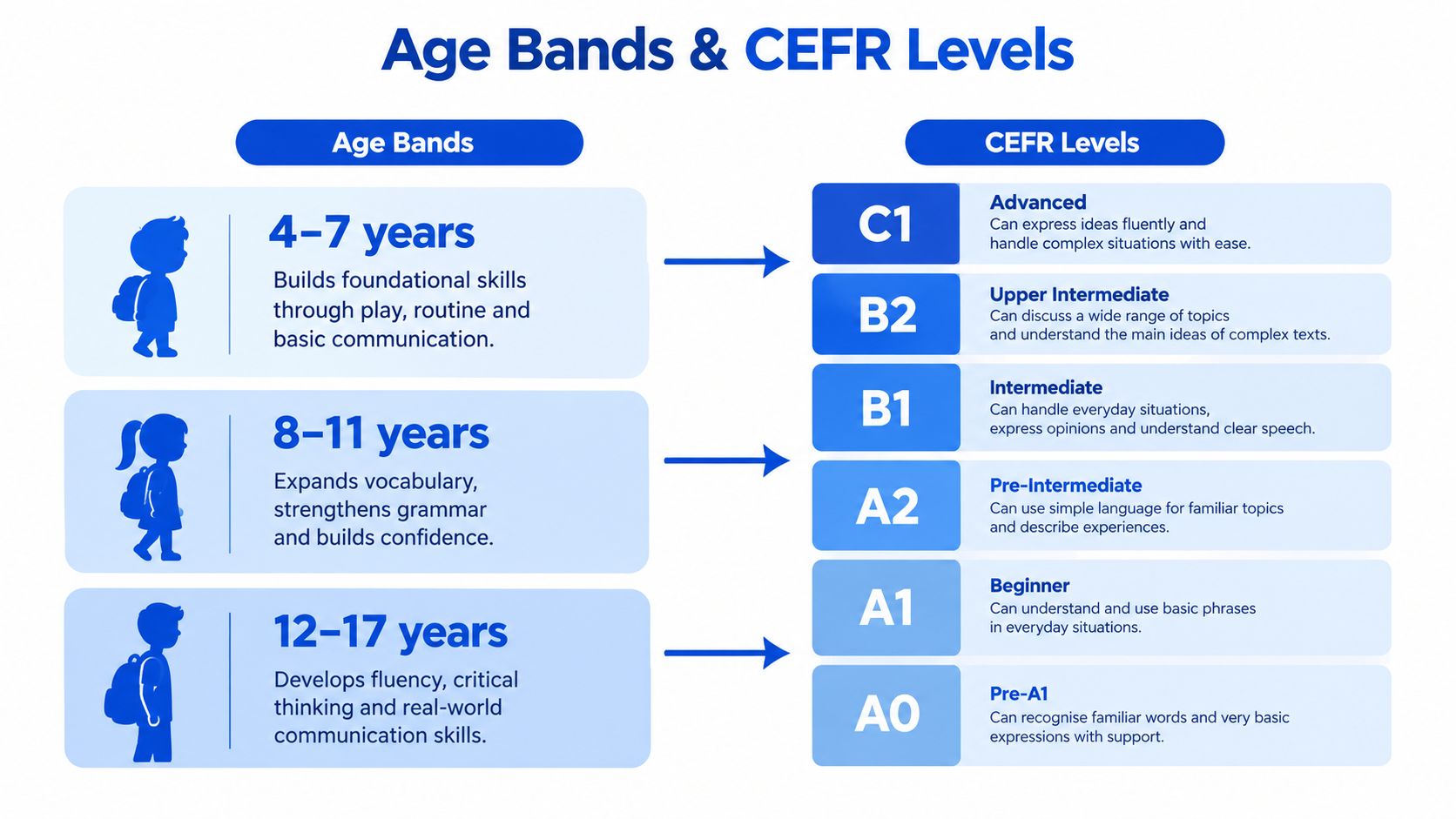
For age-grouped provision, the academy's programme bands are 4–7, 8–11, and 12–17, alongside placement across A0–C1, as outlined in its guide to English levels and placement.
Use those bands as organisational guides, not predictions of ability:
- Young children need picture-supported instructions, movement, stories, and help managing the microphone.
- Primary-age learners can work towards connected reading, guided writing, and longer exchanges.
- Teenagers need age-respectful material, room to explain opinions, and tasks connected to their interests.
Don't assume school grade tells you enough. Ask whether the child can follow the lesson's instructions, manage the digital tasks, and relate to the other learners.
Translate the level into something observable
The CEFR officially identifies six levels, A1, A2, B1, B2, C1, and C2, organised around practical language abilities rather than textbook completion, according to the Council of Europe's explanation of the framework. Treat A0 as a provider's beginner label, not an additional official CEFR level.
For parents, useful targets sound like this: responding to a familiar personal question, discussing a daily routine, retelling a story, or explaining an opinion. These are illustrative learning tasks, not substitutes for assessment.
A level label is useful only when the teacher can explain what your child can currently do, what still requires help, and what comes next.
A free placement test should start that conversation. The teacher's observation during the trial should refine it, particularly when a child reads confidently but hesitates to speak.
Small Group Classes vs One-to-One for Children
Choose the format around your child's participation, not a belief that private teaching is automatically superior. A lively group can suit one child beautifully and leave another waiting.
Small groups offer partners, different responses to listen to, and reasons to communicate beyond answering an adult. Private lessons offer concentrated attention and more freedom to change the pace. Neither format works well when the teacher does most of the talking.
Group vs 1-to-1 at a glance
| Dimension | Small group (max 6) | 1-to-1 private |
|---|---|---|
| Speaking time | Shared, so turn-taking must be deliberate | Focused on the individual learner |
| Cost | Compare the group fee with actual attendance and participation | Compare the hourly fee with the child's specific goals |
| Attention | Teacher monitors several learners | Teacher can respond immediately to individual difficulties |
| Social experience | Peer interaction and shared tasks | Direct interaction with the teacher |
| Strongest fit | Children who engage with classmates and shared activities | Children needing targeted support or a highly individual pace |
The academy's group cap is six learners, as described in its comparison of group and private English classes. A cap isn't a guarantee of speaking time. Ask how the teacher prevents confident children from answering everything.
The Education Endowment Foundation identifies groups of 3–5 pupils as the most promising arrangement within its collaborative-learning evidence review, while rating the evidence security as low. That's a reason to look for paired or smaller shared tasks within a class, not to treat a particular headcount as a formula for success.
Decide from behaviour, not labels
A shy beginner may appreciate watching a friendly classmate model an answer. Another may feel exposed and participate more readily in private. Use the trial to distinguish those situations.
Choose private support when the goal is narrow: practising a school oral presentation, addressing a recurring pronunciation difficulty, or rebuilding understanding after missed learning. Don't assume siblings should share lessons just because their schedules match. Their levels and willingness to interact must also fit, and shared-private arrangements need confirmation.
Practical rule: Try a well-matched small group first when your child enjoys peers. Choose private teaching when the group format gets in the way of participation, not merely because it sounds more exclusive.
What a Real Online Session Looks Like for Kids
Sit in on one lesson and you'll know within ten minutes whether it's working. The teacher introduces language, checks that each child understands it, then gives them a reason to use it. A child who spends the hour watching slides on Google Meet and clicking answers is attending a presentation, not a class.
The academy's lessons run for 60 minutes, three times a week. The rhythm below is an illustrative pattern worth looking for during any trial, not a promise that every class follows an identical script.
Follow the language through the lesson
A younger group might open with a familiar chant and a question about how everyone feels. The teacher brings out picture cards tied to a story, models the phrases children will need, and checks comprehension before anyone is asked to produce anything.
- Guided production: Each learner answers with support, rather than disappearing inside a chorus.
- Listening with a purpose: Children identify a character, action, or object in a short story or suitable clip.
- Meaningful reuse: A guessing game requires learners to ask questions or describe something using the target language.
- Independent check: The teacher removes some prompts to see what children can produce themselves.
Teenagers need the same architecture with different materials. Swap the chant and picture story for an opening question, a short text, or a discussion task, and the logic still holds. I tell parents to count something simple during a trial: how many times does your child speak in a full sentence? If the answer is twice in an hour, the format is failing them.
Look beyond entertainment
The Education Endowment Foundation's oral-language intervention synthesis reports an average impact equivalent to six additional months of progress, drawing on 188 studies. That is an intervention average across educational settings, not a forecast for an individual online English learner.
The practical lesson: purposeful interaction between teacher and pupil, and between pupils, deserves your attention. A colourful game isn't enough if children can complete it without speaking.
Ask for written session reports that identify what was practised, what the child managed independently, and what still needed prompting. A short example of the child's actual language clarifies the difference, but the teacher shouldn't invent a polished quotation.
End-of-level assessment should check whether the learner can reuse the language outside the familiar lesson routine. Attendance records and completed worksheets don't establish that on their own.
Teachers, Methodology, and Google Meet Delivery
A teacher biography should help you judge suitability, not just display acronyms. Ask how the teacher works with children at your child's stage, then compare the answer with what happens during the trial.
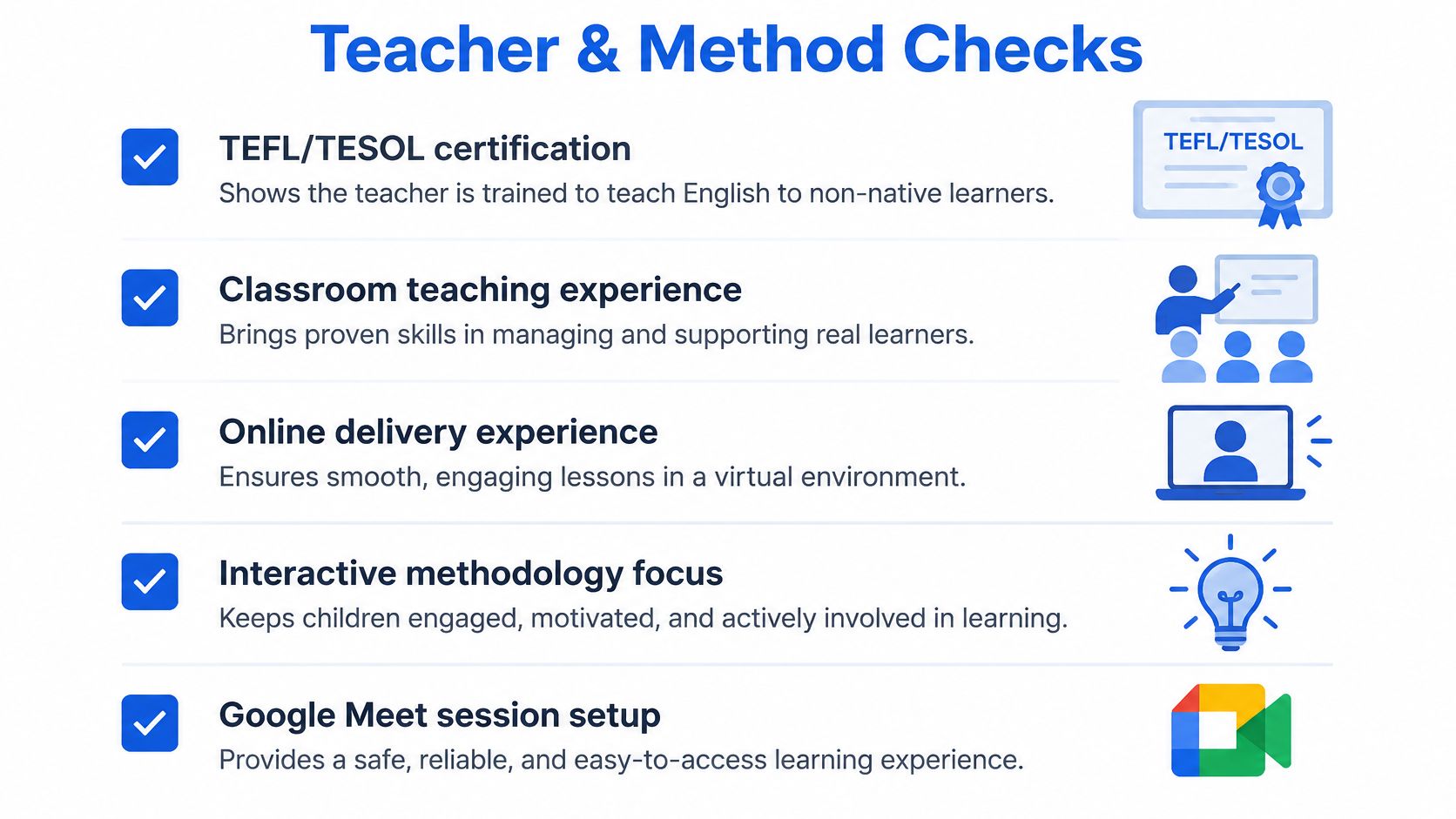
The academy describes its teaching team as TEFL/TESOL-certified, with classroom and online experience. Treat those as relevant background, not proof that every teacher will suit every learner.
Check how the teacher responds
During the trial, notice what happens when your child gives an incomplete answer. Does the teacher provide a manageable prompt? Model the phrase again? Let the child finish before choosing what to correct?
A speaking-first approach should mean supported opportunities from the beginning, not pressure to perform without preparation. Immediate feedback can be useful during focused practice, but correcting every detail in a personal answer can interrupt the conversation unnecessarily.
Ask the teacher to demonstrate how a simple response becomes a fuller one. A child might begin with “football,” then practise “I play football,” and later explain who they play with. Those are teaching examples, not promises about the speed of progress.
Check the practical setup
Prepare a quiet space, working microphone, stable connection, and access to Google Meet. A headset can help when household noise interferes, but test comfort before making it part of every lesson.
- Screen sharing: Text and pictures should be readable on the child's actual device.
- Paired activities: Ask how the teacher organises and supervises partner work within the available setup.
- Local support: Arabic- and French-language WhatsApp support can simplify communication with parents.
- Language rescue: A brief Darija explanation can help a stuck beginner, followed by another opportunity to respond in English.
Session recordings can support review when available. Confirm access and privacy arrangements before relying on them, and don't accept recordings as substitutes for the live instruction you're buying.
Red flags include vague teacher biographies, no opportunity to observe teaching, feedback limited to praise, and lessons dominated by explanations. A professional academy should be able to show you its teaching process without hiding behind methodology slogans.
Pricing, Placement Tests, and How Trials Work in Practice
Compare the offer you will really use, not just the smallest number on the price page. A monthly fee means little without the timetable, lesson duration, attendance arrangements, and included feedback.
For a Moroccan household, pricing in MAD makes budgeting straightforward. Still, ask for the complete written offer before committing to a longer plan.

Compare like with like
Published reference prices include kids' groups from 250 MAD for a month, 650 MAD for a three-month plan, and private classes from 100 MAD an hour, as presented in the guide to English course costs in Morocco. Confirm the current package and inclusions directly rather than assuming every advertised option includes the same service.
Don't calculate value from duration alone. Check whether the fee includes live teaching, ongoing reports, learning materials, and a certificate of completion. A completion certificate records course completion; it shouldn't be confused with an independently awarded language qualification.
A longer commitment is sensible only after your child has tried the format and you understand the terms. If a longer-duration price isn't clearly published or confirmed, request it in writing rather than extrapolating.
Use placement and trial for different purposes
The free placement test helps establish a starting point. The free trial session lets you inspect the learning experience. Neither replaces the other.
Ask for a written trial evaluation that names the working level, identifies strengths, and gives concrete next steps. “Needs more confidence” isn't enough unless the teacher explains what the child avoided and how lessons will address it.
Before paying, ask:
- Weekly commitment: How often will my child attend, and which timetable am I accepting?
- Missed lessons: What happens if my child is ill, disconnected, or unavailable?
- Trial feedback: Will I receive a written evaluation, and is any payment information required beforehand?
Don't assume a no-card policy, replacement lesson, or refund arrangement unless the academy confirms it. Transparent terms are part of teaching quality, because families need a workable routine, not surprises after enrolment.
How to Evaluate Any Kids' English Program
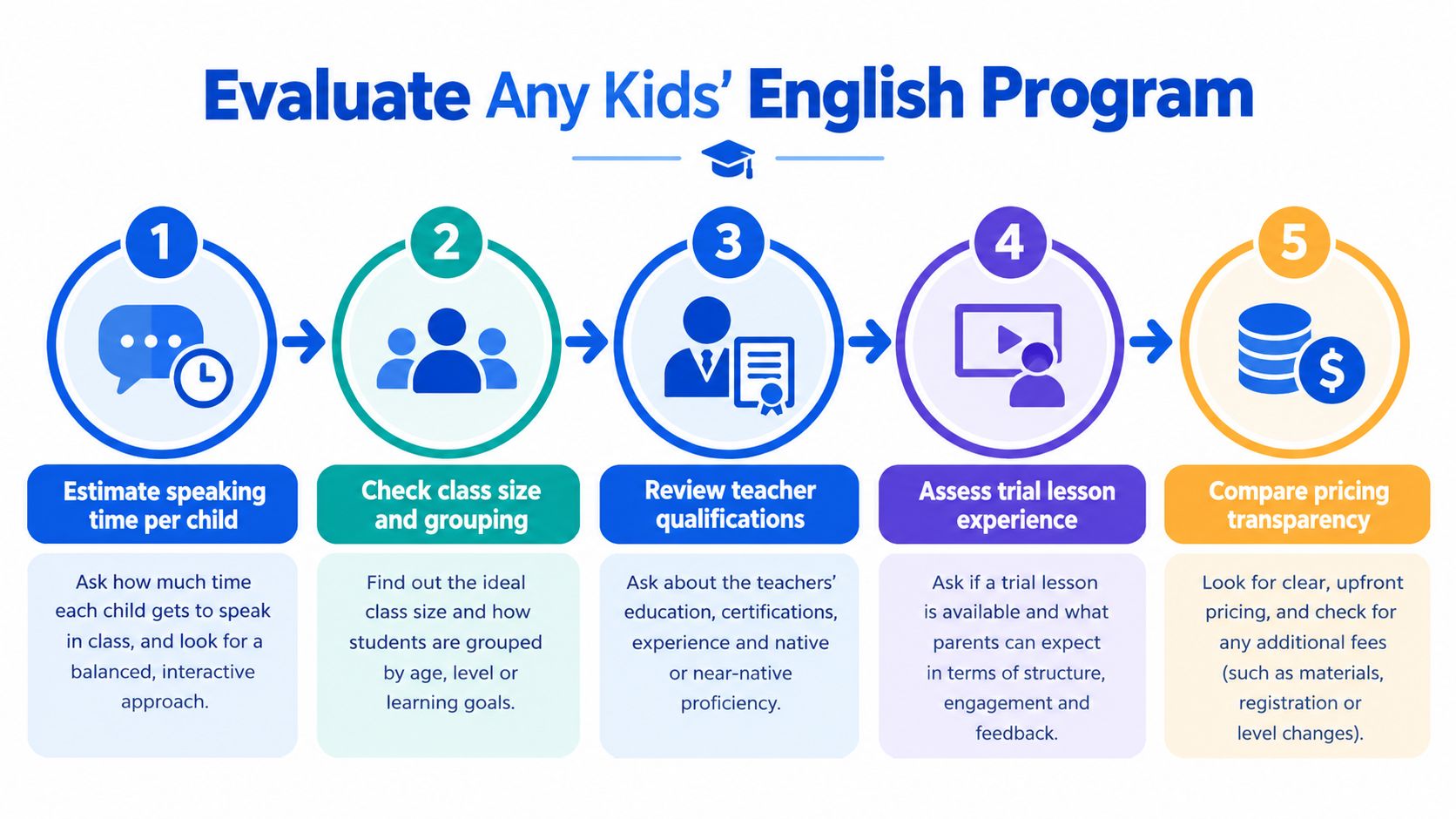
Ask every provider the same practical questions. That makes an online academy, a centre-based course, and a private tutor easier to compare without being distracted by their different presentations.
Your strongest evidence will come from the trial, the proposed timetable, and the teacher's explanation of your child's needs. A brochure can introduce the programme, but it can't show how your child responds.
Keep a parent decision sheet
| Criterion | What to ask for | What should make you pause |
|---|---|---|
| Individual participation | An explanation of how each child gets turns | Participation described only as joining games |
| Grouping | A reason for the proposed age and level match | Placement based solely on availability |
| Reporting | An anonymised report example | Attendance and praise without learning evidence |
| Curriculum | Clear targets, assessment arrangements, and completion criteria | A textbook title presented as the whole plan |
| Entry process | Placement, a trial, and written terms | Pressure to purchase before observing teaching |
You don't need to inspect every teaching resource. You do need answers you can understand.
Choose the provider that can explain its decisions about your child, including why a particular group, target, or activity is appropriate.
Turn the offer into an ordinary week
For an illustrative primary-school learner, place live lessons on Monday, Wednesday, and Friday after school. Between lessons, add a brief listening activity connected to the current topic, then invite the child to tell you something about it without turning home into another classroom.
Read the session feedback as it arrives. At the end of the week, check whether the same difficulty keeps appearing and ask the teacher which home activity would be most useful. This is a sample routine, not a claim about the timetable every family should follow.
Research on young learners supports looking beyond starting age: school input and the home English-media environment significantly predicted measured language outcomes in the study of early foreign-language English development. Use that finding to build a sustainable routine, not to fill every spare moment with English.
The right weekly plan leaves room for schoolwork, family life, and willingness to return.
FAQ and the Natural Next Step for Parents in Morocco
At what age should my child start?
Start when your child can join the proposed lesson and the teaching matches their developmental stage. A neighbour's earlier start is not a reason to enrol.
For very young learners, watch for three behaviours: following a playful instruction, staying with a shared activity, and recovering after distraction with adult support. The Nuffield Early Language Intervention evaluation shows why trained delivery, explicit goals, and consistent guided practice matter. Treat it as evidence about early-years teaching in England, not as a forecast for an online course in Morocco.
How long until my child speaks English?
Refuse fixed fluency deadlines. Ask which visible behaviour the teacher expects first: answering a familiar question, starting an exchange, or giving a connected description.
Judge progress by growing independence. A child who needs less prompting is moving forward even before the vocabulary looks impressive. If progress feels vague, review placement, attendance, task difficulty, and chances to use English before blaming ability.
Is online as good as in-person for young children?
Choose the format your child can attend consistently and enjoy. A lively local class can suit a child who needs physical interaction. Online can suit a family where travel makes regular attendance unrealistic.
In an online lesson, watch whether the teacher checks comprehension and manages turn-taking. The CEFR communication descriptor system separates listening, interaction, and online communication, which is a useful reminder that clicking through activities is different from communicating.
Can my child switch from a group to private lessons?
Ask before enrolling. Availability, payment adjustments, and transfer arrangements vary by provider, so never assume a mid-term switch is automatic.
If the format is failing, request a clear recommendation and written options. Observation and evaluation should come next. Buying a larger package only makes sense after the fit has improved.
What should I do after comparing providers?
Run the same sequence on every programme: age band, format, CEFR placement, delivery, evaluation, then trial. The provider that explains its choices clearly is easier to trust than the one with the glossier brochure.
Englify offers live online English classes for children through Google Meet, with age- and level-based groups and private options. Arrange the free placement test and trial session, then use the teaching experience and written evaluation to decide whether the programme suits your child.