Knowledge hub
English Course for Employees: What to Look for in 2026
Find the right english course for employees with this practical 2026 guide. Covers CEFR levels, delivery formats, ROI, and a ready-to-use checklist.
A Moroccan HR lead gets a familiar request from a department manager: the team needs an English course for employees. A search quickly turns up broad promises about fluency, confidence, and business results, but none answers the practical questions: which roles need English, what employees should be able to do, and how will the company know training helped?
Treat the purchase as a workforce decision, not a course catalog search. Start with the tasks employees perform, choose a CEFR target and delivery format that fit those tasks, then define observable workplace outcomes before training begins. This guide gives you a buyer-side framework for making those decisions, including what to ask providers and where Moroccan context matters. It won't tell you to buy a particular package or promise an automatic return.
Table of Contents
- Why English Skills Now Drive Workplace Performance
- CEFR Levels Explained for Hiring and Training Decisions
- Core Business English Modules Every Course Should Cover
- Delivery Formats Compared for Employee Cohorts
- Implementation Steps an Employer Should Expect
- Pricing, ROI, and How to Measure Real Workplace Gains
- Localizing an English Course for Moroccan Teams
- Implementation Checklist and a Sensible Next Step
Why English Skills Now Drive Workplace Performance
English is now part of operating capacity for many employers. In the 2025 ETS Global English Skills Report, researchers surveyed more than 1,300 HR decision-makers across 17 countries: 92% said English proficiency is more important to their organization than it was five years earlier, and 90% called it critical to organizational success (ETS Global English Skills Report).
The same ETS survey ties proficiency to cost and competitiveness. It found 86% of respondents believe companies without fluent English speakers face a competitive disadvantage, and 83% reported business costs linked to hiring people with insufficient English, including lower productivity and weaker retention. For a Moroccan employer working with international customers, suppliers, or colleagues, English belongs in workforce planning with a budget, an owner, and a target.
Buyer's rule: Ask where English changes output before asking which course to buy.
Needs differ sharply by role. A technician may need to follow safety instructions and explain a fault. A customer-facing employee may need to clarify requests under time pressure. A manager may need to chair a call, challenge numbers, and summarize a decision for mixed-language stakeholders.
The buying sequence stays concrete: map tasks and failure points, set CEFR targets per role, choose a format employees can attend consistently, and agree what evidence will count after training. With that sequence in mind, the next step is to translate role requirements into CEFR targets HR can specify.
CEFR Levels Explained for Hiring and Training Decisions
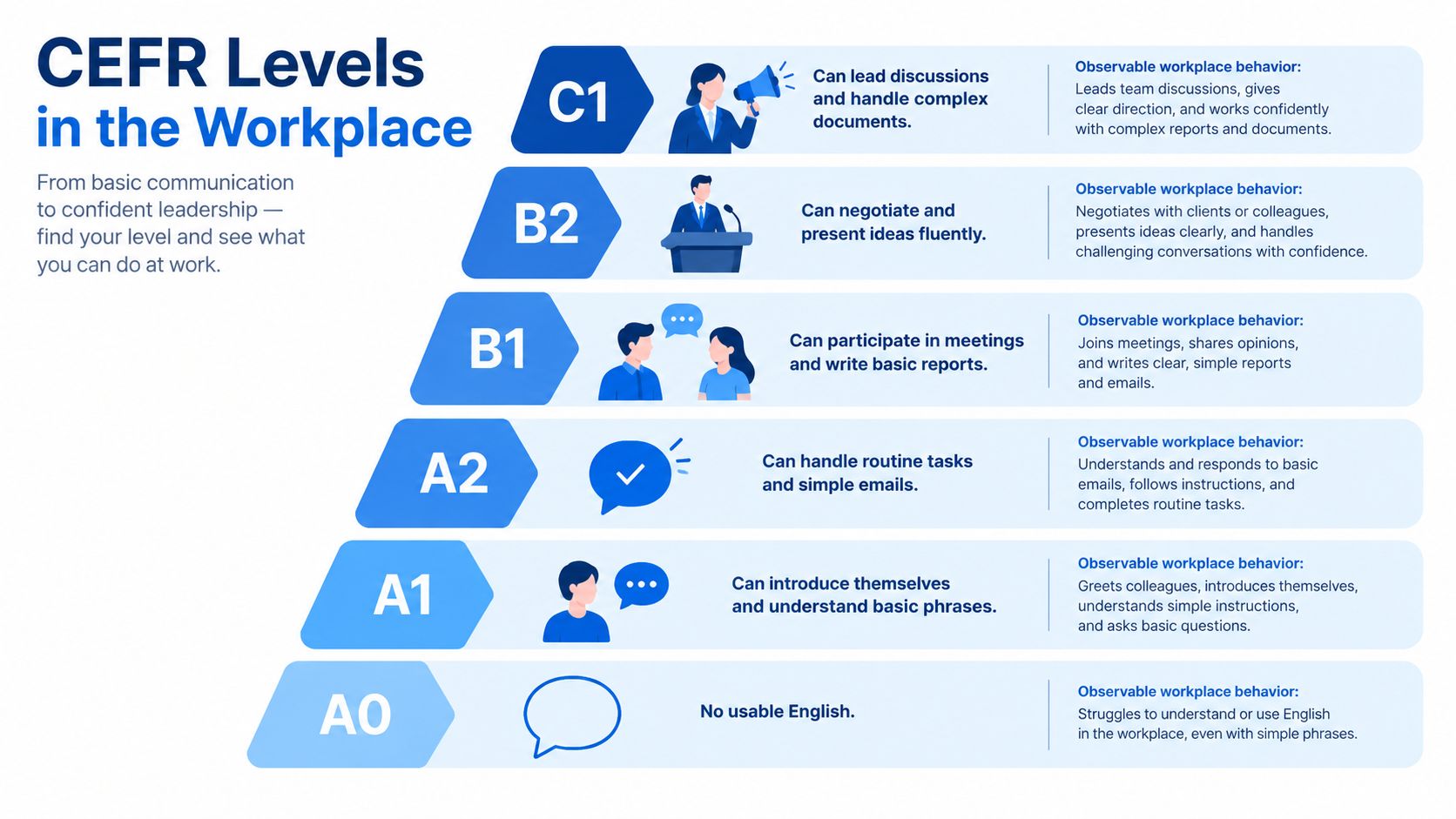
CEFR levels give HR teams a shared way to describe what employees can do in English. Treat them as a procurement specification, not a marketing label. The framework defines six levels, from A1 and A2 for basic users through B1 and B2 for independent users to C1 and C2 for proficient users (CEFR level descriptions). For workplace planning, A0 works as a practical label for an employee with no usable English yet, though it sits outside the CEFR's six official levels.
Use observable workplace tasks, not course hours or completion certificates, to fix each employee's starting point:
- A0: Cannot yet complete a routine work exchange in English without substantial support.
- A1: Can introduce themselves and understand familiar words or basic phrases.
- A2: Can handle simple routine tasks, follow short instructions, and draft a basic message.
- B1: Can understand the main points of clear language on familiar work matters and contribute to routine discussions, per the CEFR descriptions cited above.
- B2: Can communicate independently in meetings, explain ideas, and handle more complex customer exchanges.
- C1: Can express themselves fluently and flexibly for professional purposes and produce clear, well-structured writing on complex subjects, per the CEFR descriptions cited above.
Now the decision rule that turns this list into a hiring and training tool. Set the target from the hardest recurring task in the role, then test that task directly before fixing a level. Find the point where a language failure costs the most, whether that is a misunderstood delivery date, a lost customer, or a safety instruction misread, and require the level that task demands. A company-wide preference for "advanced English" wastes budget on employees who need less and underserves the ones who need more.
Two people in the same department can legitimately need different targets. That is normal, and your training contract should allow for it.
Before signing with a provider, ask what a learner at the proposed level will be able to do in your workplace. If the answer is only "speak more fluently," ask for a sample task and the criteria used to assess it. This plain-language guide to English levels and CEFR can help align internal discussions between HR and line managers. A level label earns its place in a job description or training contract when it connects to a real behavior, not when it stands in for one.
Core Business English Modules Every Course Should Cover
A provider's module list tells you what they sell. It does not tell you what your team needs. Read every curriculum the way you would read a tender response: start from the tasks your employees repeat every week and the cost of getting them wrong, then check whether the proposed modules map to those tasks. General English with corporate vocabulary added on top fails that test. For many Moroccan workplaces, the recurring tasks are listening and speaking in meetings, writing clear emails and short messages, and explaining information to customers or colleagues.
Different teams inside the same company need different weight on each module. A logistics team that exchanges routine updates gets the most from concise emails and standup practice. A client-facing group needs drilling in listening for details, checking understanding, and recovering when a request is unclear. A manager who presents proposals needs practice structuring an explanation and handling questions under pressure. Interview preparation earns its place when the training goal includes hiring, internal mobility, or promotion discussions.
| Module | Job task | Typical CEFR target |
|---|---|---|
| Meeting participation | Share an update, ask for clarification, and respond to colleagues | B1–B2 |
| Email and workplace messages | Write a clear request, instruction, or follow-up | A2–B2 |
| Presentations | Explain a proposal and answer questions | B2–C1 |
| Phone and video calls | Listen, confirm details, and manage turn-taking | B1–B2 |
| Customer and client communication | Understand a need, explain next steps, and resolve routine issues | B1–C1 |
| Interviews | Describe experience and answer role-related questions | B1–B2 |
| AI-mediated communication | Write precise prompts, evaluate responses, and explain decisions | Depends on the role and task |
AI work belongs in this list because it is now part of daily tasks. In the same ETS employer survey cited earlier, 81% of respondents said integrating AI tools increases the need for English proficiency, particularly for writing prompts, evaluating AI-generated information, and working with interfaces often presented in English. Around 60% said AI cannot compensate for weaknesses in reading, writing, listening, and speaking.
Make that concrete in the classroom. A Casablanca sales team, for example, might practise drafting English prompts for a CRM assistant, then checking the output for tone and factual accuracy before anything goes to a client. Train employees to write precise prompts, spot ambiguous responses, and communicate AI-assisted decisions responsibly, with boundaries around confidential information set by company policy.
For more task ideas, compare the proposed curriculum with these Business English communication skills. Then ask the provider to demonstrate how lessons practise your team's actual work, rather than reading module names off a brochure.
Delivery Formats Compared for Employee Cohorts
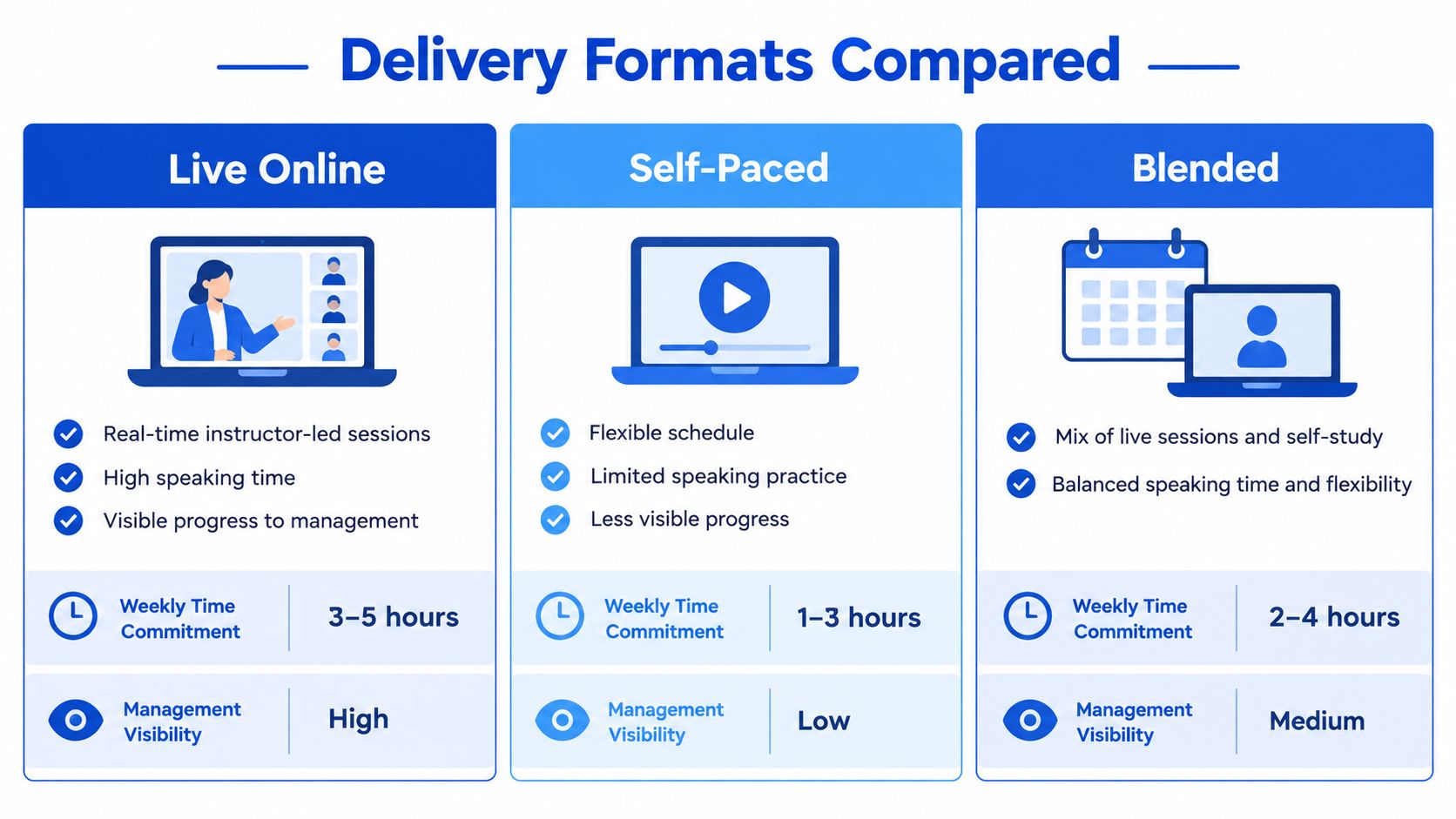
Format changes the learning experience and the employer's ability to see what employees can do. Live online classes create real-time opportunities for speaking practice and instructor feedback. Self-paced apps can fit around busy schedules, but independent exercises may not reveal whether a learner can manage a real conversation. A blended model combines live practice with individual study, but it still needs a clear schedule and accountability.
| Format | Speaking time | Scheduling flexibility | Management visibility | Cost behavior |
|---|---|---|---|---|
| Live online small group | Employees practise with an instructor and peers; individual airtime depends on group size and lesson design | Scheduled sessions require attendance planning | Can include attendance and progress reporting if agreed with the provider | Shared instruction can make it suitable for employees with similar needs |
| Private 1:1 | The lesson can focus on one employee's role-specific tasks | Scheduling can be tailored, subject to availability and company arrangements | Progress can be reviewed against individual goals | More instructor time per employee, so compare the full delivery plan |
| Self-paced app | Speaking practice may be limited or automated, depending on the product | Employees can study at varied times | Managers need agreed usage and assessment reports to track engagement | Often priced differently from instructor-led delivery; check what's included |
| Blended | Live sessions provide interaction; self-study supports preparation and review | Balances scheduled learning with independent practice | Requires a joined-up reporting plan across both components | Cost depends on the live component and included materials |
For a customer-facing team, private sessions can target high-stakes calls or presentations. Employees in an operations team with similar tasks may benefit from small-group practice, where they can rehearse instructions, handovers, and common scenarios together. Neither format is automatically better. The choice depends on whether employees share a level and role, how much individualized practice they need, and when they can attend.
Ask providers how they divide speaking time, handle missed sessions, and report progress to management. If your team works shifts or has changing client commitments, confirm what scheduling flexibility means before signing. This comparison of group and private English classes can help frame the trade-off. Don't choose an app just because it's flexible, or a live class just because it includes an instructor. Choose the format that supports the work behavior you intend to improve.
Implementation Steps an Employer Should Expect
A sound course can still disappoint if the company launches it without clear ownership. HR should coordinate the process, but line managers need to explain job demands and protect time for learning. The provider should assess needs, place employees, teach, and report against agreed outcomes.

Use a practical sequence:
- Define the business need. HR and line managers identify the roles, situations, and communication problems the course should address.
- Assess employees and tasks. The provider runs placement assessments and gathers role information. A level test alone won't show whether the employee struggles with calls, writing, or meetings.
- Set groups and targets. HR and the provider group employees by level and learning need. Avoid placing people together only because they share a department if their English starting points differ substantially.
- Agree on the operating rules. HR confirms session times, attendance expectations, make-up arrangements, and who receives reports. Managers flag shift patterns and busy periods before the timetable is fixed.
- Review progress during delivery. The provider reports attendance and learning evidence at an agreed midpoint. Managers check whether employees are trying the target communication behaviors at work.
- Assess and decide next steps. At the end, compare role-specific tasks with the baseline. HR, managers, and the provider decide whether employees need another course, a different target, or more opportunities to apply the skills.
Set timelines around readiness, not a vendor's default calendar. Assessment and grouping need to happen before sessions begin; scheduling needs manager input before employees are enrolled. Agree in advance on what a progress report contains. A useful report separates participation from language performance and identifies next steps, rather than treating attendance as proof of learning.
Keep managers involved without turning them into language teachers. They can give employees low-risk chances to practise, such as opening a meeting, summarizing an action, or drafting a short client response. The employer's role is to make those opportunities part of work, while the provider gives structured instruction and feedback.
Pricing, ROI, and How to Measure Real Workplace Gains
Don't evaluate an English course by its quoted fee alone. Price can depend on group size, lesson frequency, course duration, employee starting levels, materials, individual coaching, and the reporting included. Ask providers to itemize those elements so you can compare like with like. A lower fee may mean less live speaking practice or limited progress reporting; a higher fee is not evidence of better outcomes by itself.
Set a baseline before instruction starts. Ask employees to complete a short task tied to the role, such as explaining a process, writing a customer follow-up, answering an interview question, or responding to an ambiguous request. Use the same rubric for a comparable task later, assessing clarity, listening accuracy, task completion, intelligibility, and interaction.
Practical rule: Measure the work communication you want to improve, not the number of lessons employees attended.
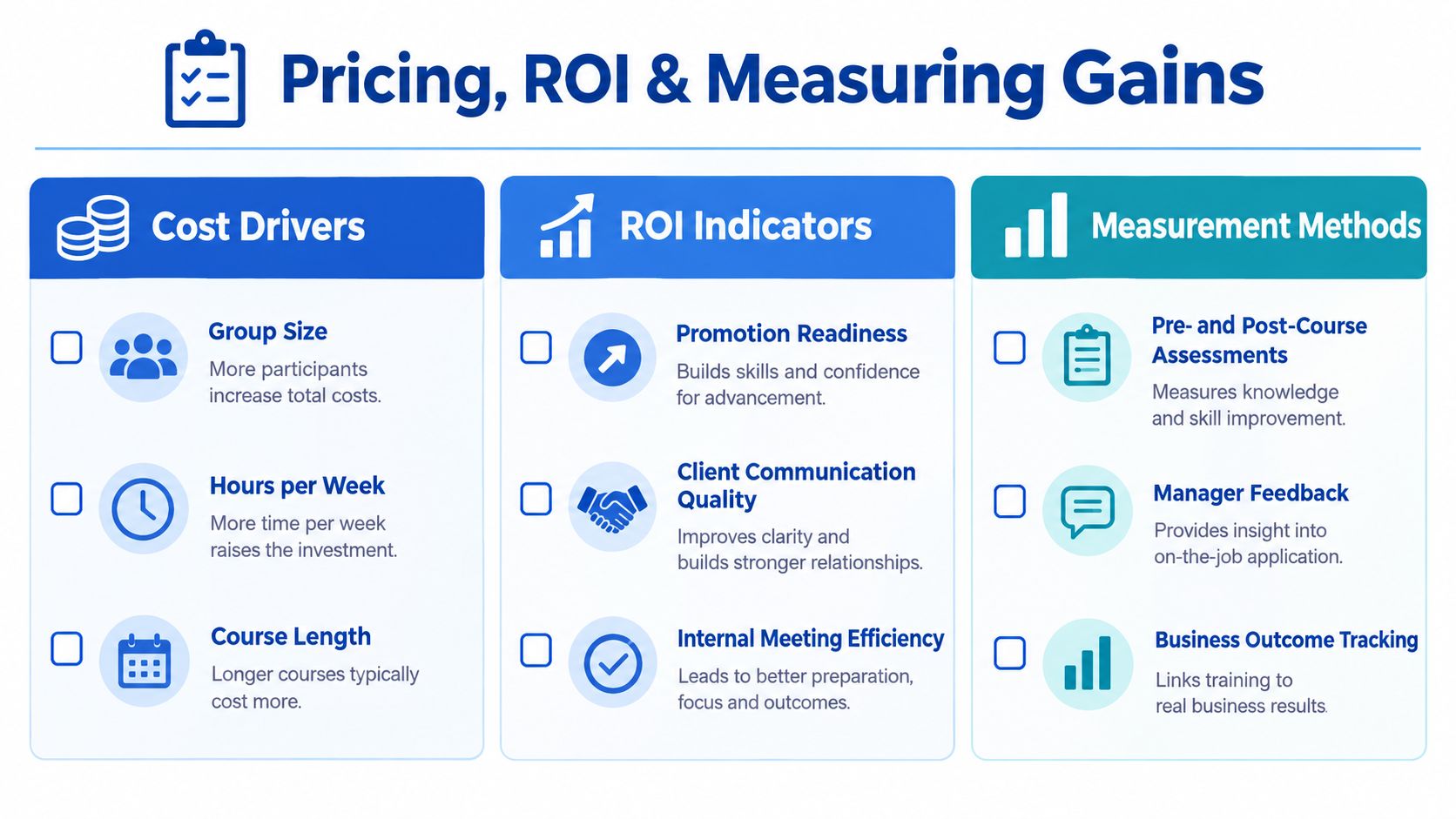
A credible evaluation combines learner performance with manager observations. Track changes that matter to the role: whether employees participate in meetings, make requests clearly, handle customer interactions, or present information with less support. These are useful indicators, but don't promise that a language course alone will cause a promotion or a company-wide productivity gain. Research reviews report associations between English proficiency and communication, collaboration, productivity, career mobility, and engagement, while cautioning that much of the evidence isn't longitudinal (systematic review of workplace English research).
Measure progress at the start, review it during the course, and compare equivalent tasks at the end. Gather manager feedback after employees have had a chance to use the skills in their role. Report language gains separately from broader business results, which can be affected by staffing, processes, and workload as well as communication. The goal is a defensible account of what employees can do now that they couldn't do as effectively before, not an inflated ROI claim.
Localizing an English Course for Moroccan Teams
A useful program for a Moroccan company should respect how employees already communicate, then build the English they need for specific work. Some teams switch between Darija, French, Arabic, and English during the day. Employees may understand English grammar from school but need more practice speaking spontaneously, taking turns in a meeting, or asking a customer to clarify a request. Treat those as training needs to diagnose, not assumptions to apply to every learner.
Check whether the provider can explain difficult language in a way employees understand, including support in Arabic or French where appropriate. Darija-aware communication can help employees ask questions and understand feedback, while the actual practice should stay focused on the English tasks they need to perform. Ask for sample content based on your sector and roles, not generic scenarios that don't resemble your team's work.
Scheduling also needs local operational context. Teams in Casablanca, Rabat, Marrakech, and Tangier may have different shift patterns, client commitments, and commuting routines. Online lessons can also support staff based elsewhere, including employees working with international teams from Morocco. Confirm session times against work schedules, and agree on how employees will access materials and raise questions between classes.
Ask what localization changes in practice: the examples, explanations, schedule, support, or reporting. If the answer is only a familiar local label, keep asking.
For budgeting, request clear terms in MAD and an itemized explanation of what the price includes. Published rates can make internal approvals easier, but compare lesson time, group arrangements, assessment, and reporting rather than the headline figure alone. WhatsApp support in Arabic or French may be convenient for coordination, but it doesn't replace clear attendance rules or a named contact for managers.
Morocco-specific delivery is not about lowering expectations or assuming all employees learn the same way. It's about making instruction accessible while keeping the target tied to English communication on the job. Ask employees what situations they find difficult, then check whether the course gives them realistic practice and useful feedback.
Implementation Checklist and a Sensible Next Step
Use this checklist to turn the buying decision into a practical plan:
- Name the roles: Identify which employees need English and what tasks they perform.
- Set targets: Choose CEFR levels based on observable workplace behavior.
- Assess needs: Combine placement results with employee and manager input.
- Choose delivery: Match small-group, private, self-paced, or blended learning to the cohort.
- Confirm operations: Agree on scheduling, attendance, and missed-session arrangements.
- Set a baseline: Record how employees currently handle relevant speaking and writing tasks.
- Agree on reporting: Decide what HR and managers will receive, and when.
- Run a midpoint review: Check participation and early signs of task performance.
- Compare endline work: Repeat equivalent tasks and discuss the results with managers.
- Plan application: Give employees opportunities to use their new skills in everyday work.
A good purchase decision doesn't depend on a promise of fluency. It depends on a clear starting point, a realistic CEFR target, delivery employees can attend, and evidence that relates to their jobs. That framework gives HR and managers a common basis for deciding what to fund and what to change after the course.
Englify offers live online English classes for company teams through Google Meet, with small-group and private options, CEFR-based levels, placement testing, and progress reports. If you're comparing providers, try the free placement test or trial session to assess fit before committing your team.
Visit Englify to explore live online Business English training for company teams, including small-group and one-to-one options through Google Meet. Use the free placement test or trial session to check whether its CEFR-based approach and workplace practice fit your employees' needs.