Knowledge hub
Private English Lessons Online: A Practical Guide
Explore private English lessons online, how they differ from group classes, what to expect in 1:1 sessions, pricing, and practical tips to get the most
A child sits through an English class and knows the answer, but the words won't come out. A professional opens a meeting in English, understands every point, then hesitates when it's time to respond. Those are the moments when private English lessons online make sense, not as a casual chat replacement, but as a format built for one learner, one goal, and one teacher watching every spoken attempt closely.
The format matters because online English teaching is now a major field of study, and most of the research in that area has focused on online English learning, with generally positive outcomes reported across the literature. Private lessons sit inside that wider shift, but they serve a narrower purpose, which is to turn speaking from a stressful event into a repeatable skill. For parents, students, and working adults, that usually means more time to speak, more direct correction, and a course that follows a clear target instead of a general syllabus.
Table of Contents
- Why Learners Turn to Private English Lessons Online
- How Private Lessons Differ From Group Classes and Self-Study
- What a Strong 60-Minute Private Lesson Looks Like
- CEFR Levels and How They Shape Private Lesson Goals
- How to Tell if a Private Lesson Is Working
- Pricing, Scheduling, and What to Ask Before You Commit
- Tips to Get the Most Out of Each Private Online Session
- Choosing the Right Private Lesson Format and Next Steps
Why Learners Turn to Private English Lessons Online
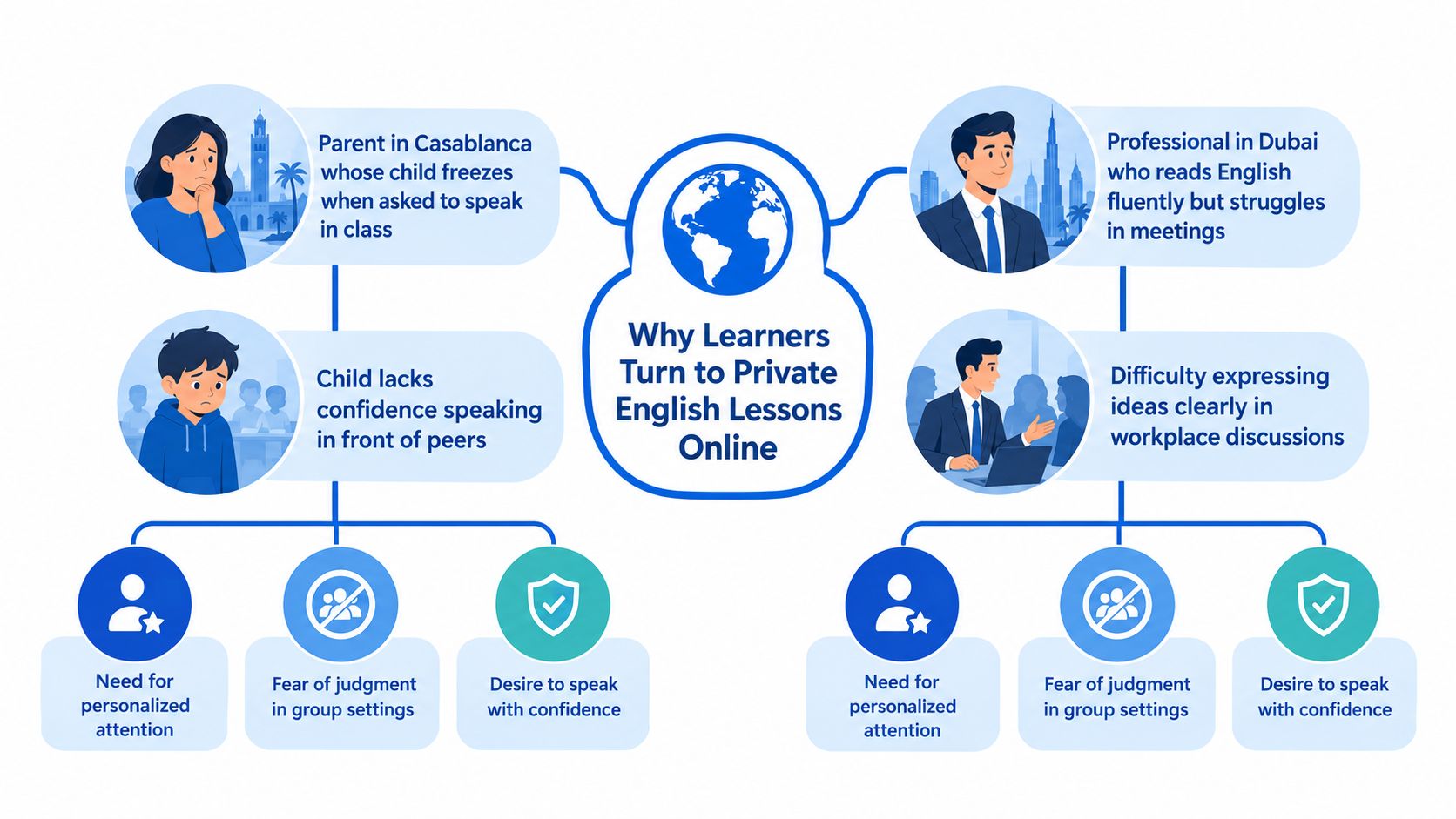
A parent in Casablanca can see the problem quickly. Their child knows the vocabulary at home, but in class the voice disappears as soon as the teacher asks for an answer. A professional in Dubai may read English emails comfortably, then struggle to join a meeting because the pressure to speak in real time changes everything.
That is where private English lessons online fit. The format gives one learner uninterrupted speaking time, and it lets the tutor respond to that learner's exact mistakes, gaps, and goals. It works for children who freeze in groups, teenagers preparing for oral exams, adults who need workplace English, and teams that need focused training for meetings or presentations.
For many families and professionals, the difference is not convenience alone. It is the structure of attention. A private lesson makes it possible to listen, pause, correct, and try again without waiting for classmates or depending on self-study apps that can't react to live speech.
Practical rule: if the problem is speaking confidence, not just general exposure, the lesson format should let the learner talk early and often.
The broader research base supports this logic. A 2022 systematic review of 103 empirical studies found that 82.52% focused on online English learning and about 86.4% reported positive learning or satisfaction outcomes, which shows that online instruction is now a serious educational format rather than a temporary workaround. The point isn't that every lesson works automatically, but that the model is now well established when it's designed properly.

How Private Lessons Differ From Group Classes and Self-Study
The easiest way to understand the format is to compare the mechanics, not the marketing. A private lesson gives all the speaking time to one learner. A small group spreads that time across several people. Self-study gives the learner control, but no live correction, no immediate pushback, and no teacher noticing the small errors that keep repeating.
| Format | Speaking time per hour | Feedback type | Best fit |
|---|---|---|---|
| Private 1:1 lesson | Highest, all focused on one learner | Immediate, personalised correction | Specific goals, confidence building, interview prep |
| Small live group | Shared across several learners | Teacher feedback plus peer interaction | Learners who benefit from discussion and turn-taking |
| Self-study or pre-recorded course | None in live form | Automated or delayed feedback | Vocabulary review, grammar practice, independent learners |
What happens when the learner makes a mistake is the difference. In a 1:1 session, the tutor can stop, rephrase, model the sentence again, and ask for a second attempt. In a group, that same moment often passes quickly because the class has to keep moving. In self-study, the learner may not even know the mistake is there.
Read Englify's comparison of group and private English classes
Small groups and private lessons aren't rivals. They solve different problems, and they reward different kinds of learners.
A private format is usually the better fit when the learner needs a specific target, such as speaking in interviews, preparing for an oral exam, or practising workplace discussions. A small group can still work well when the learner wants interaction and can tolerate shared speaking time. Self-study is useful for review, but it rarely fixes speaking hesitation on its own.
What a Strong 60-Minute Private Lesson Looks Like
A good lesson is not a long explanation with a few quick questions at the end. It is a speaking session with a purpose, where the learner uses language several times and gets corrected while the material is still fresh. One-to-one tuition has been associated with approximately +5 months of additional progress on average, compared with about +4 months for small-group tuition, and corrective feedback shows a medium effect that holds over time in the research cited by the source below. That doesn't mean every session produces visible progress, but it does show why structure matters. Evidence on one-to-one tuition and corrective feedback
A simple lesson flow
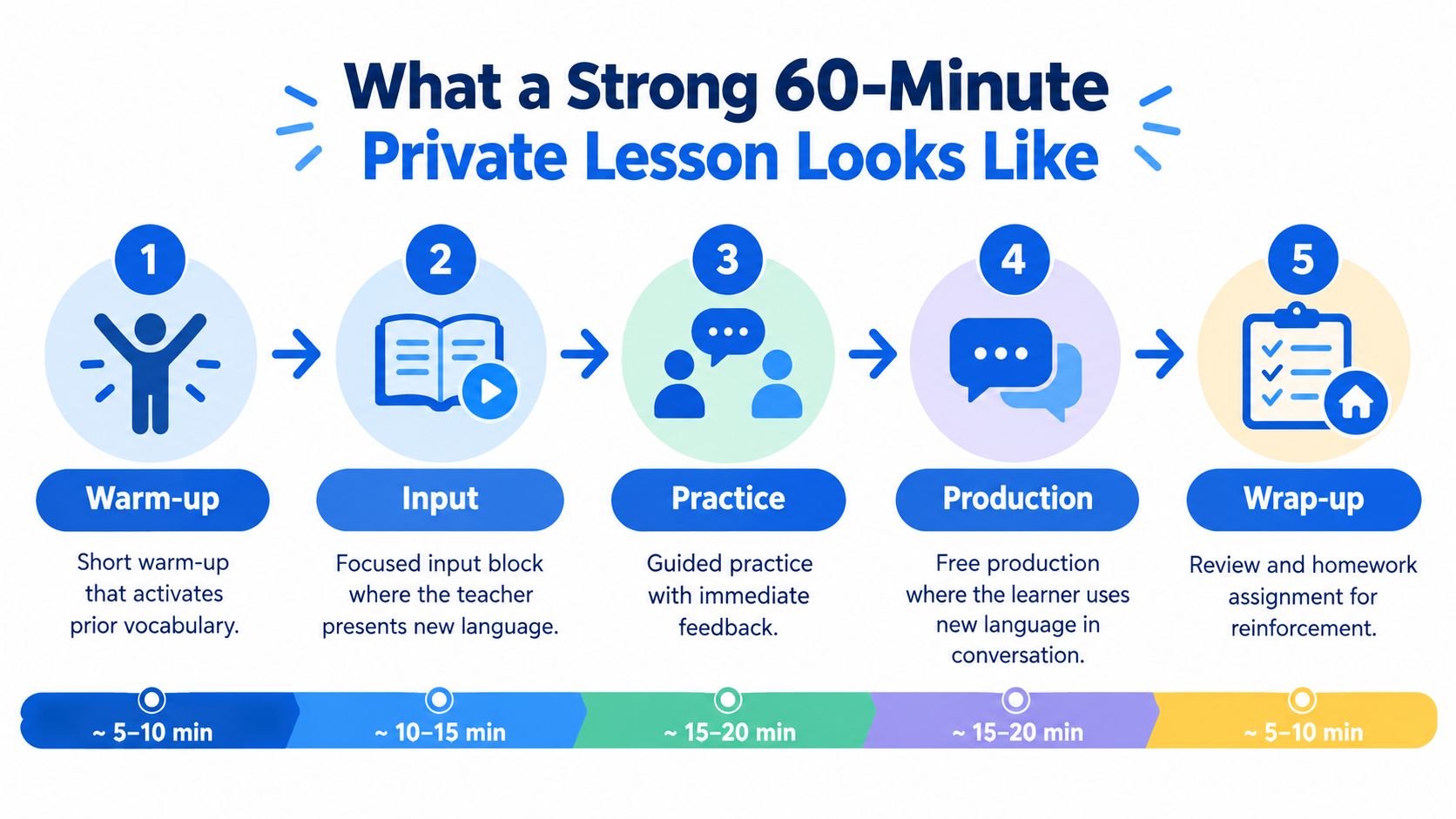
A solid 60-minute lesson usually has five parts. The learner starts with a short warm-up, then hears or notices a target structure, then uses it in guided speaking, then receives correction, then finishes with a short retrieval task that forces reuse.
For a B1 learner preparing for a job interview, the teacher might begin with a brief chat about recent work experience. Next, the tutor introduces useful phrases for describing strengths or handling a weakness question. The learner then practises two or three interview answers aloud, gets recasts and short written notes, and closes by repeating one improved answer without help.
Heavy teacher explanation is usually a warning sign. In a live video lesson, the tutor should spend more time listening than lecturing, because the value comes from repeated learner output and immediate correction.
What correction should look like
Correction works best when it is specific and usable. The tutor can pause the learner, rephrase the sentence naturally, write the corrected version in shared notes, and ask for the sentence again. That gives the learner a chance to notice the problem, hear the fix, and reuse it before the lesson ends.
A weak lesson often sounds like this, lots of talking from the tutor, a few quick yes-or-no answers, and then a vague goodbye. A strong lesson leaves the learner with a clearer sentence, a clearer task, and a clearer memory of what changed.
CEFR Levels and How They Shape Private Lesson Goals
Private lessons are easier to design when they follow the CEFR instead of vague labels like beginner or advanced. The Council of Europe's CEFR assessment guidance separates Spoken Interaction from Spoken Production, and it organizes speaking around Range, Accuracy, Fluency, Interaction, and Coherence. CEFR assessment guidance
That framework gives a tutor something concrete to build on. A learner at A0 to A1 needs short, predictable exchanges and survival phrases. At A2 to B1, the learner starts linking ideas about familiar topics. At B2, the learner should be able to support opinions and speak in longer turns. At C1, the focus moves to flexible, fluent communication for academic or professional use.
What the five CEFR speaking dimensions mean in practice
- Range means the learner can choose words and grammar that fit the task.
- Accuracy shows whether errors keep interrupting the message.
- Fluency covers hesitation, pausing, and how smoothly speech continues.
- Interaction is about turn-taking, clarification, and responsiveness.
- Coherence asks whether the learner's ideas connect clearly.
A learner preparing for a customer-service role may need polite opening lines, clear handling of complaints, and calm repair language when something goes wrong. A tutor can use those needs to set the next lesson goal instead of relying on a generic topic list.
See how CEFR levels are explained for learners and parents
The CEFR also helps parents and professionals avoid false confidence. A student who “knows grammar” may still need work on interaction. Someone who speaks fluently may still need better range or coherence. In a private course, those distinctions matter because they tell the tutor what to practise next.
How to Tell if a Private Lesson Is Working
The most common concern is simple. Is the learner improving, or just having a pleasant conversation every week? The answer becomes clearer when the lesson has a baseline, a recurring target, and a repeatable speaking task.
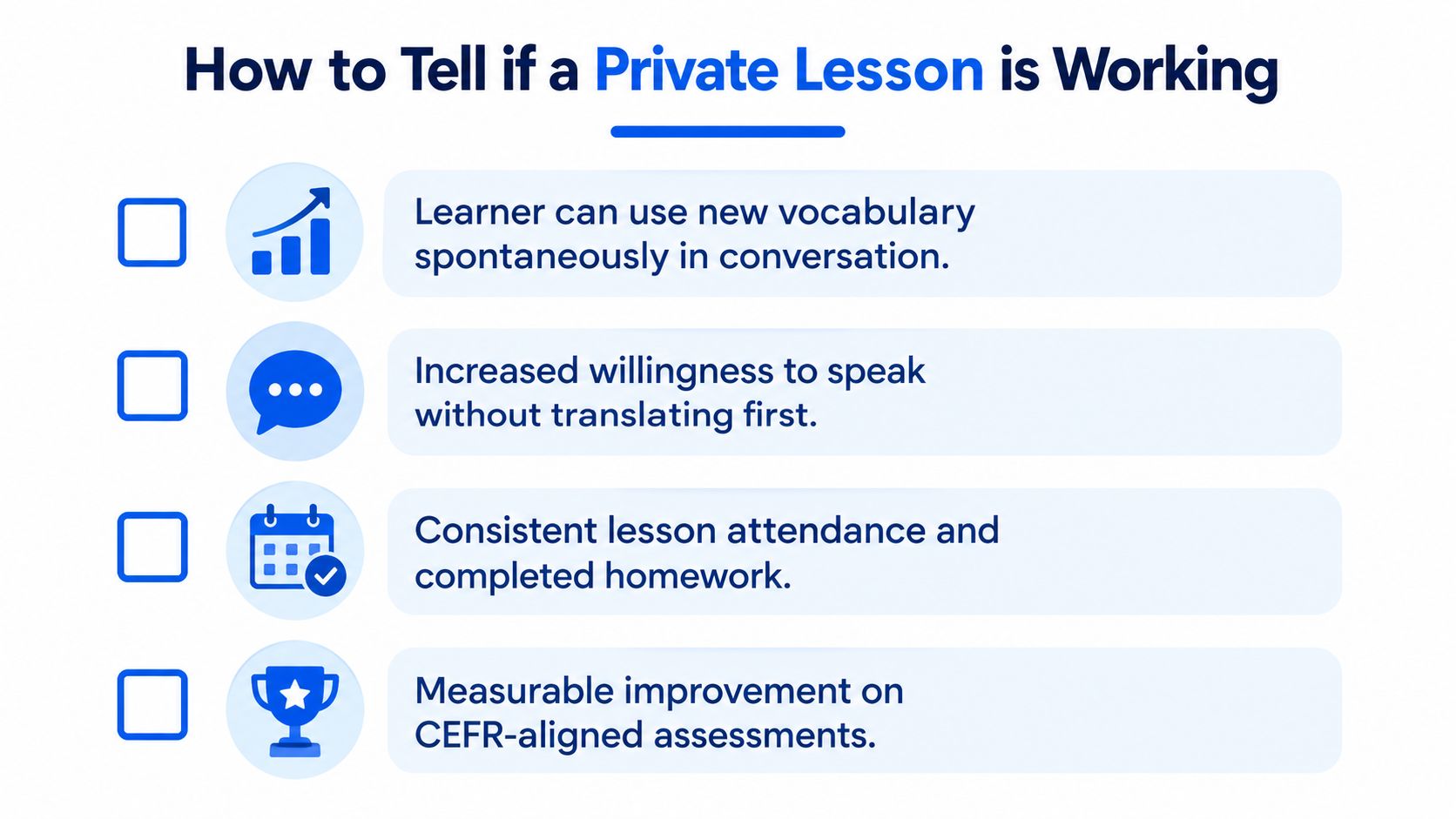
A practical way to check progress is to keep four pieces of evidence: an initial speaking sample, a note of the learner's recurring error pattern, a later speaking sample under similar conditions, and a short written report after selected lessons. That gives parents and professionals something better than memory, because memory tends to remember confidence more easily than accuracy.
A useful report should not just say “great progress”. It should name the learner's CEFR-linked strengths, the two or three next priorities, evidence from the session, and one home practice task. If the report says the child is improving in interaction but still needs help with article use and sentence endings, that is far more useful than generic praise.
If the same mistake appears three lessons in a row, it isn't a small issue anymore. It's the next teaching target.
The workplace gap matters here too. A 2025 TOEIC global test-taker survey found that more than one-third of respondents still feel English difficulty affects their ability to communicate effectively, and 28% take the test for job-application purposes, which shows how often passive knowledge fails to become spoken performance. TOEIC workforce readiness survey
A course is usually on track when the learner speaks more willingly, reuses corrected language, and handles familiar tasks with less hesitation. It may need redesign if the reports stay vague, the same errors repeat without correction, or lessons never move beyond friendly conversation.
Pricing, Scheduling, and What to Ask Before You Commit
Costs vary for private lessons because several things change the price, including tutor experience, lesson length, whether the academy includes reports and materials, and whether the course is sold as a package or a single session. The important question isn't only “how much per hour”, it's “what is included, and how does the course support speaking progress?”
For a concrete local reference, Englify publishes private classes from 100 MAD/hour, with kids group classes from 250 MAD/month and 3-month plans from 650 MAD. That gives Moroccan families and professionals a real starting point without pretending there's one universal market rate.
Questions worth asking before you book
- Trial policy: Is there a free trial class, and what happens after it?
- Placement test: How is the learner level checked before the course starts?
- Rescheduling rules: What happens if the student or teacher misses a session?
- Recordings: Are lessons recorded, and if so, under what consent rules?
- Progress reporting: Do you receive written feedback after class, or only a verbal recap?
The British Council notes that learners can access a teacher online from more than 100 countries, which shows how online delivery has widened access to qualified teaching beyond one city or academy. British Council online teaching access
Session length and frequency matter too. A 60-minute lesson can work well when it has enough output, while a shorter session may feel rushed if the goal is speaking practice. Monthly commitment can be useful, but only if the academy still gives you evidence of what changed, not just attendance.
Watch for hidden fees around placement tests, recording access, materials, or rebooking rules. If the academy won't explain those details clearly, that's usually a sign to keep looking.
Tips to Get the Most Out of Each Private Online Session
The easiest sessions to waste are the ones that start without a clear setup. Before class, the learner should test the device, headset, and connection, open any shared notes, and pick one speaking goal for the hour. That one goal could be a pronunciation target, a job-interview answer, or a short presentation.
During the lesson, the learner should do more than answer questions. They should ask the tutor to pause and recast errors, not just move on, and they should request a short summary at the end. If the tutor is using shared notes, the learner should keep them open and reuse corrected phrases immediately.
After the lesson, the best habit is simple. Complete the agreed home task within 48 hours, review the written report, and bring the same problem back into the next session if it still feels weak. That keeps the lesson connected to real progress rather than isolated practice.
A 2025 systematic review of 31 studies on K-12 online learners found recurring needs for stronger school-parent communication, clearer parental understanding of technology and teaching, and greater involvement in coursework at home. K-12 online learner review
For parents of younger learners
A quiet supervised space helps, but hovering too close can reduce independence. The parent's job is to check the teacher identity, platform settings, and post-lesson report, not to interrupt every answer. If there's a safety or behaviour concern, it should be raised directly with the academy rather than handled casually in the lesson room.
For adults and professionals
The key is transfer. If the lesson practises meetings, the learner should reuse the same phrases in real work. If it practises interviews, the learner should rehearse the answers aloud before the next application. The lesson works best when practice spills into the week, not when it stops at the video call.
Keep this checklist close, device ready, one goal chosen, notes open, correction requested, report reviewed, home task done. That routine is simple, but it changes the quality of the lesson fast.
Choosing the Right Private Lesson Format and Next Steps
Private 1:1 online lessons are a good fit when the learner needs targeted speaking support, interview or exam preparation, a flexible schedule, or a child who shuts down in group settings. They're also useful for professionals who need English for meetings, presentations, and everyday workplace communication. For learners who want broader interaction or lighter pressure, small groups or self-study can still be the better match.
The serious signs of a strong private course are consistent. It should have a structured 60-minute lesson, CEFR-aligned goals, and observable progress reporting. If one of those pieces is missing, the course may still be pleasant, but it won't be easy to verify.
Read more about choosing an online English tutor for adults
For many families and professionals, the safest next step is a free placement test and a free trial class before committing to a term. That gives you a clearer view of the level, the teaching style, and whether the lesson structure matches the learner's needs.
Englify offers live private English lessons online, along with CEFR-based placement, trial sessions, and written progress reporting that help you see whether the lessons are working. If you want a structured, low-pressure way to check fit before you commit, visit Englify and start with the free placement test.