Knowledge hub
English Lessons for Beginners: A Practical Starting Guide
English lessons for beginners that actually work, with a clear structure, sample lesson plan, and tips for fast early progress.
You can already read English on a screen. The problem starts when someone asks you a simple question in real time, and your mind goes blank. If that feels familiar, you don't need another app that gives you random words, you need english lessons for beginners that show you exactly what to do next.
Good beginner lessons share three things: a clear level target, a speaking-first routine, and a steady weekly rhythm that doesn't depend on motivation. A learner should know what counts as progress, practise it in short guided exchanges, and repeat that pattern often enough for it to stick.
That's the point of a real beginner path. It turns English from a pile of rules into a set of small, useful actions, like greeting someone, asking a question, answering about work or family, and understanding a short instruction. In practical terms, the best beginner lessons teach words in phrases, not in isolation, and they end with a task the learner can perform.
Table of Contents
- What Effective Beginner English Lessons Actually Look Like
- CEFR Levels for Beginners Explained
- The Four Building Blocks of Every Beginner Lesson
- A Sample 60-Minute Beginner Lesson Plan
- Why Speaking Feels So Hard and How to Fix It
- A Beginner Study Routine You Can Actually Keep
- Common Beginner Mistakes and What to Do Instead
- Your Next Step Toward Confident Beginner English
What Effective Beginner English Lessons Actually Look Like
A beginner lesson should feel structured, not random. If you sit through a class and leave with a page of notes but no speaking practice, that lesson probably taught content, not communication. The useful question is simple, what can the learner do after class that they could not do before?
The three things to look for
The first pillar is measurable level progress. A beginner should know whether they're working at Pre-A1, A1, or A2, because those labels point to different can-do abilities rather than vague “beginner” language. The second pillar is a speaking-first routine, where the teacher turns input into a short exchange instead of stopping at explanation. The third pillar is a predictable rhythm, so the learner knows what happens each week and can keep going even on low-energy days.
Practical rule: if a beginner lesson ends with only rule recognition, it hasn't gone far enough.
A strong course also avoids the common trap of teaching English as if grammar comes first and speech comes later. Beginners need short models, repetition, supported practice, and a chance to reuse the language in a real exchange. That's why a lesson on introductions, work, directions, or shopping works better than a lesson built only around grammar labels.
If you're looking for a useful definition, this is it, beginner English lessons are guided, task-based classes that help a learner understand, say, and reuse everyday English in a small but real situation. The lesson is successful when the learner can perform the target task, not when they can recite a rule.
CEFR Levels for Beginners Explained
The CEFR is useful because it gives beginners a map instead of a vague label. It divides basic user ability into A1 and A2, and it also recognizes Pre-A1 for learners who are just starting out. That matters because a learner who is still learning the alphabet needs a different lesson from someone who can already introduce themselves and answer basic questions.
What A1 and A2 mean in plain English
At A1, learners should be able to understand familiar everyday expressions, introduce themselves, exchange basic personal information, and interact when the other person speaks slowly and clearly. That means the lesson target can be something like greeting someone, saying where they live, or asking one simple question.
At A2, the learner moves into frequently used expressions about personal information, shopping, local geography, and work, plus simple routine exchanges. So the target might be ordering food, asking for a price, or talking about a job in a short exchange.
The CEFR becomes useful the moment it stops being a certificate term and starts becoming a lesson design tool. Instead of saying, “Today we did Unit 3,” a teacher can say, “Today you learned to ask where someone lives and answer the same question yourself.” That's easier for beginners to understand, and it makes progress visible.
For a deeper look at level placement and course structure, this guide to CEFR English levels is a helpful companion. It's much easier to stay motivated when the target is concrete.
The Four Building Blocks of Every Beginner Lesson
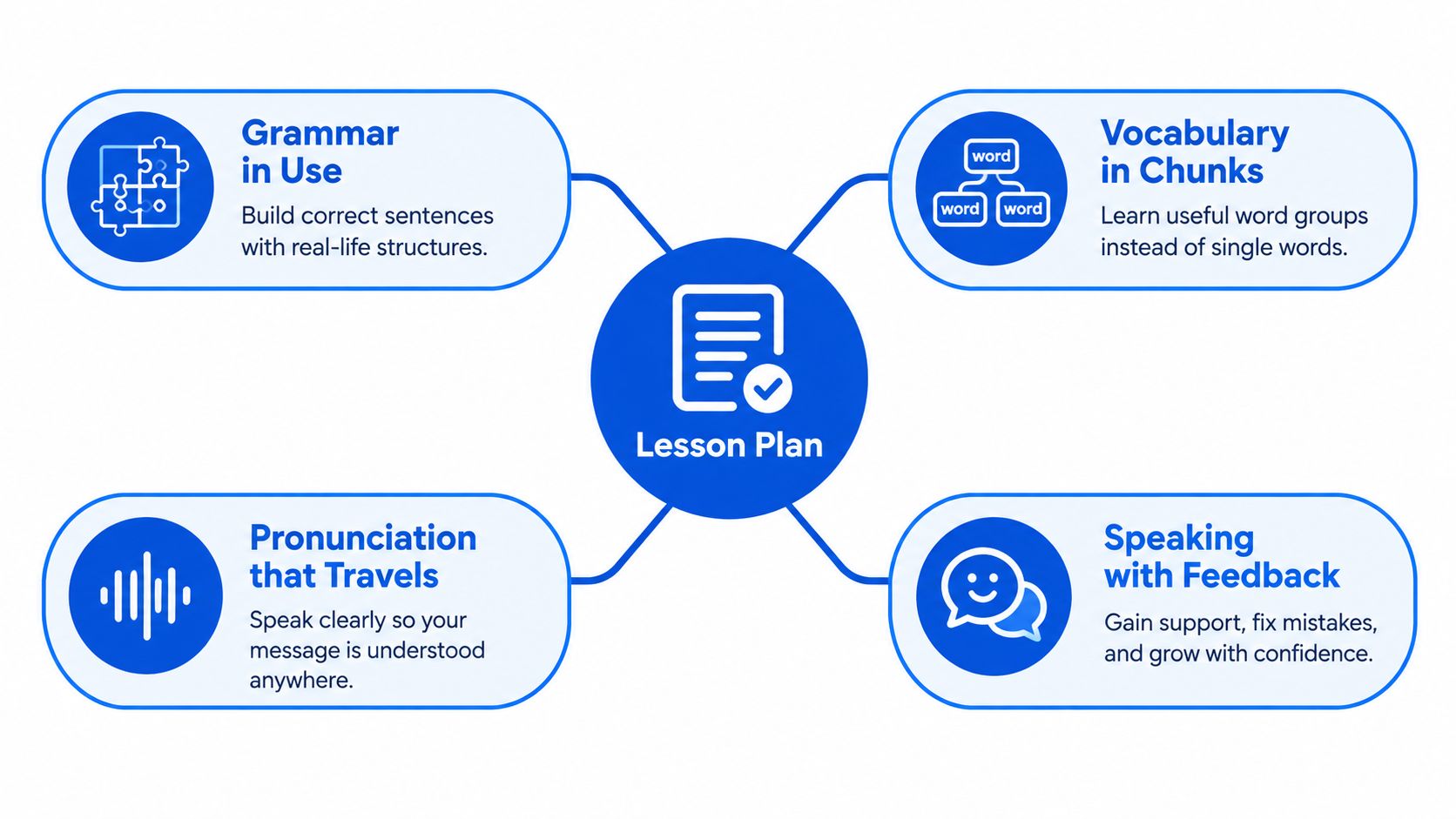
A beginner lesson works when four parts support each other. If one of them is missing, the class usually feels either too theoretical or too chaotic. The four parts are grammar in use, vocabulary in chunks, pronunciation that travels, and speaking with feedback.
Grammar in use, not grammar in isolation
Beginners don't need long explanations first. They need grammar inside a sentence they can actually say. For example, subject–verb agreement becomes easier when learners hear and use “I live in Casablanca” and “She lives in Rabat” inside a short exchange, because the form is tied to meaning.
The point is not to avoid grammar, it's to place grammar where the learner can use it. A rule on a slide may be technically correct, but a sentence in a dialogue gives the learner something to copy, change, and reuse.
Vocabulary in chunks
Cambridge materials make an important point, knowing a word means more than knowing its meaning, because a learner also needs its pronunciation, grammar, and common combinations. That's why a beginner should learn “go to work”, “What do you do?”, and “I work in…” as connected language, not as separate dictionary items.
A short chunk gives the learner a ready-made path into speaking. A single word often stays trapped in recognition only.
Pronunciation that travels
Pronunciation for beginners doesn't mean mastering every sound. It means focusing on the few patterns that most affect intelligibility, especially th endings, question intonation, and high-frequency weak forms. If those are clear, the message travels more easily, even when the learner still makes mistakes elsewhere.
Speaking with feedback
Speaking is the main event. The teacher should listen, notice what blocks meaning, and prompt the learner to fix the form and reuse it in a real exchange. That's much more useful than merely reformulating every sentence for them.
A beginner lesson should produce language the learner can say again outside the classroom, not just language they can recognise on the page.
A Sample 60-Minute Beginner Lesson Plan
A good beginner class has a shape the learner can feel. It starts with easy language, moves into guided practice, then opens into a more real exchange. If you want to know whether a class is well designed, ask whether each stage prepares the next one.
Minute by minute
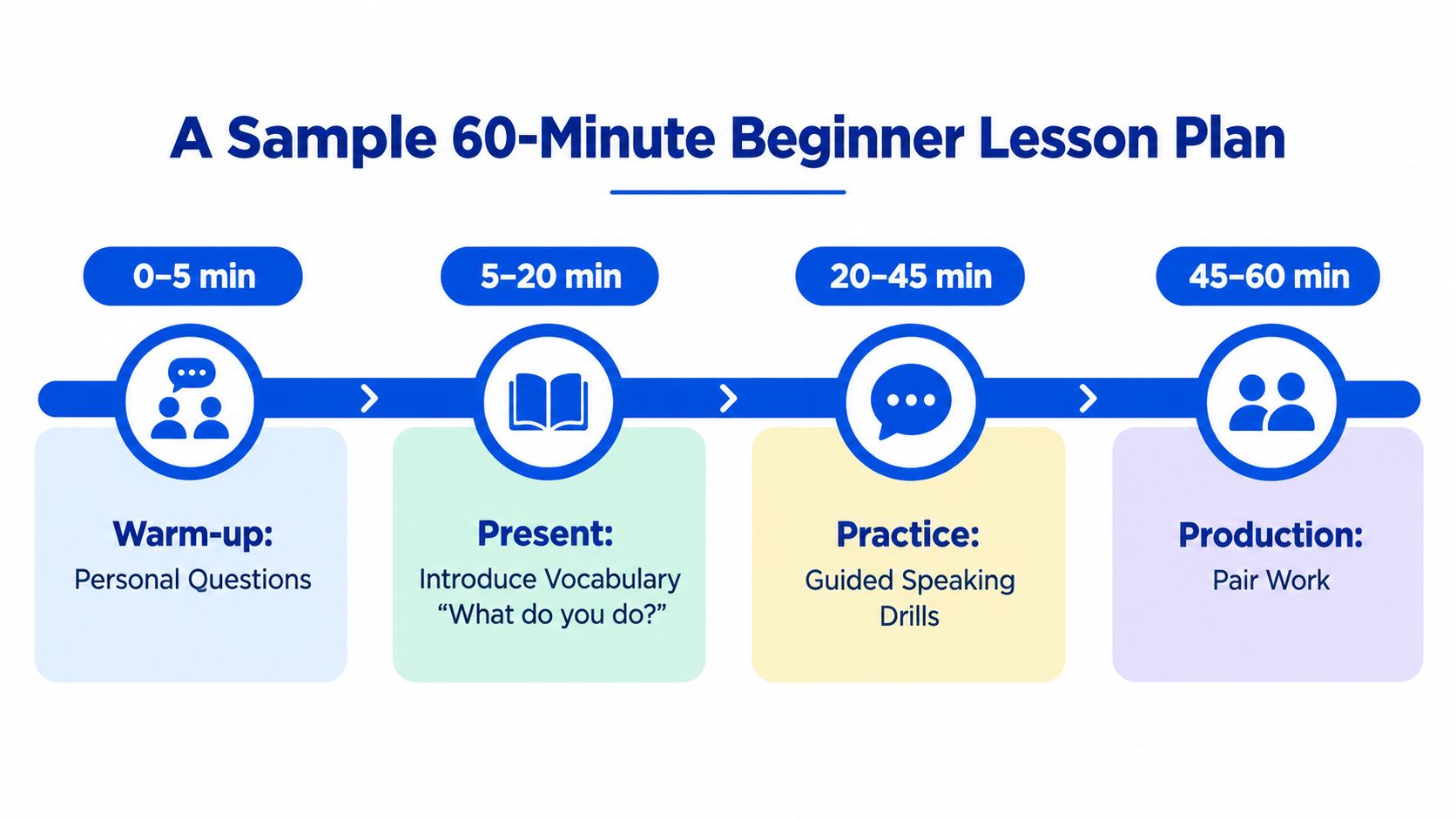
0 to 5 minutes. The teacher opens with simple personal questions, like name, country, or job, using slow speech and visual support. This lowers pressure and gets the learner speaking immediately without demanding full independence.
5 to 15 minutes. The teacher introduces a tiny set of vocabulary and one sentence pattern with pictures, a short model dialogue, and sentence frames. The learner hears the target language in context before trying it.
15 to 25 minutes. Controlled practice begins. Learners reorder words, complete gaps, and repeat a model like “What do you do?” and “I work in…” until the form starts to feel familiar.
25 to 40 minutes. Pair work takes over. One learner asks for real information, the other answers, and the teacher moves around, listening for patterns that need correction.
40 to 57 minutes. The class shifts into freer conversation. A short pronunciation focus can slot in here if a sound or ending keeps causing trouble, then learners reuse the target language in a slightly new situation.
57 to 60 minutes. The lesson closes with a quick reflection, not a grammar quiz. The learner states what they can now do, such as greeting someone, asking about a job, or answering with a full sentence.
A beginner lesson should always end with a can-do check. That tells the learner what progress actually looks like.
Teacher's rule: if the learner cannot perform the target exchange by the end, the lesson was too large.
Why Speaking Feels So Hard and How to Fix It
Beginners often think their speaking problem is vocabulary or grammar. Those things matter, but they're not the whole story. A lot of learners freeze because speaking is emotional, public, and fast, especially when they worry about mistakes or negative evaluation.
The real blocker is often confidence
Research on speaking anxiety points to fear of negative evaluation, low self-confidence, communication apprehension, fear of mistakes, and too few chances for authentic interaction as major barriers. A 2025 study of 144 high-school students also found that communication apprehension, test anxiety, and fear of negative evaluation significantly shaped speaking anxiety, which makes the confidence problem impossible to ignore. The lesson design matters because adding more grammar won't fix that alone.
A better speaking path is gradual. Start with private pronunciation practice, move to a short self-introduction, then to a paired information gap, then to timed answers, and only after that to freer conversation. That ladder lowers the emotional load while still demanding real use.
When a learner says, “She go school,” the teacher doesn't need to give a long lecture. A prompt like “She…?” can lead to “She goes to school”, and then the learner can reuse that full form in a new sentence. That short correction cycle is much stronger than hearing the teacher say the correct sentence once.
For more on building confidence in real speaking, this practical guide to improving English speaking is worth reading after class.
Mistakes should be treated as data, not as failure. The goal is to correct the errors that block meaning or recur often, then let the learner try again in a meaningful exchange.
A Beginner Study Routine You Can Actually Keep
A routine works better than bursts of motivation. If a beginner waits for the perfect mood, practice becomes irregular and the same problems keep returning. A simple rhythm is enough: a few live lessons each week, short daily review, and a small speaking task at the end of the week.
A weekly plan that fits real life
A steady routine can look like this:
| Day | Standard Beginner | Low-Bandwidth Beginner |
|---|---|---|
| Monday | Live 60-minute lesson on Google Meet | Download audio and worksheets after class |
| Tuesday | 10 to 15 minutes of sentence-frame review | Listen offline and repeat aloud from printed notes |
| Wednesday | Live 60-minute lesson with speaking practice | Send a 30-second voice note for feedback |
| Thursday | Review vocabulary in chunks and pronunciation | Practise from a phone call or offline recording |
| Friday | Live 60-minute lesson or pair work | Complete a picture-based worksheet |
| Saturday | Record a short self-introduction | Record the same intro on a shared phone |
| Sunday | Compare this week's recording with last week's | Compare voice notes and note one improvement |
This routine matches the idea behind learning English online in a structured way, because it combines live interaction with small, repeatable practice outside the class. It also works for learners who have unreliable access.
If your internet is unstable, don't wait for ideal conditions. Save the audio, keep printable tasks, and use WhatsApp voice notes for asynchronous speaking practice. A beginner in Casablanca with stable Wi-Fi and a beginner in a rural area with one shared phone can still follow the same course if the materials are designed with flexibility in mind.
The routine should survive a missed live session. If it collapses after one bad connection, it isn't resilient enough.
Common Beginner Mistakes and What to Do Instead
The biggest beginner mistakes are rarely dramatic. They're small habits that subtly slow progress. The good news is that each one has a clear replacement.
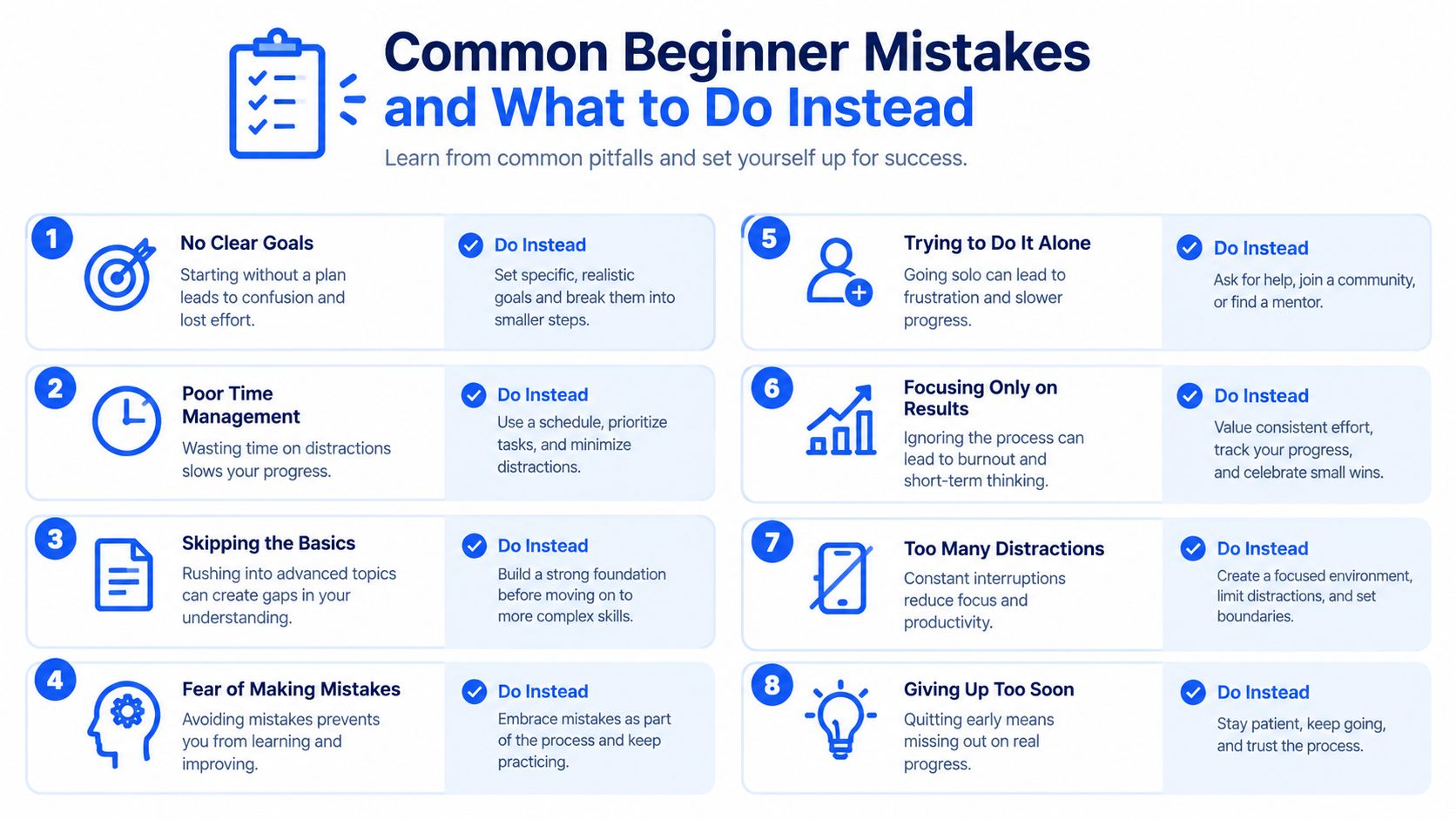
Four traps that hold learners back
- Long word lists without context: learn the word with pronunciation, one useful collocation, and one question that brings it into conversation.
- Waiting to be perfect before speaking: use sentence frames, accept a corrected version, and reuse it in the same exchange.
- Grammar studied alone: meet the grammar point inside a short dialogue, so the form is attached to a real situation.
- Skipping pronunciation: focus on the few sounds and endings that affect intelligibility most.
The pattern here is simple. Beginners don't need more passive input than they can handle, they need more guided use than feels comfortable at first. That's where real progress starts.
Pin this checklist near your study space:
- Say it out loud, not only in your head.
- Learn the phrase, not only the single word.
- Fix one priority error, not every mistake.
- Use it again, in a new sentence right away.
That's the habit set that keeps beginner English moving.
Your Next Step Toward Confident Beginner English
The next decision is simple. Choose a CEFR-based path, look for lessons built around speaking tasks and short feedback cycles, and keep a small routine you can repeat every week. If your level isn't clear yet, a placement check and one trial class are enough to start without pressure.
Englify offers live beginner English classes on Google Meet, with small groups, private lessons, and a CEFR-based structure that helps learners move from A0 to A2 with clear speaking goals. If you want a calm first step, visit Englify to check your level and see what a beginner lesson feels like before you commit.