Knowledge hub
IELTS Preparation Course Online: How to Choose and Prepare
Find the right IELTS preparation course online. Compare self-study, live classes, and tutoring with facts on pricing, formats, and choosing your path.

More than 4 million IELTS tests were taken worldwide in 2023, yet the average overall band was only above 6.0. An effective online IELTS preparation course must therefore train separate Listening, Reading, Writing, and Speaking performance, not just improve general English.
That distinction matters for learners in Morocco, the UAE, and Arabic-speaking communities abroad. A candidate can understand English well and still lose marks through weak timing, incomplete task responses, unclear paragraph structure, hesitant delivery, or pronunciation that affects intelligibility. IELTS measures performance under a specific test design, so preparation must reproduce that design and provide reliable feedback on the skills you can't judge accurately by yourself.
Table of Contents
- Why General English Is Not Enough for IELTS
- Comparing Online Pathways, Self-Study vs Live Classes vs Tutoring
- Decoding IELTS Scoring Criteria for Smarter Course Selection
- Real-World Scenarios, Which Format Fits Your Situation
- Building a Routine, Beyond Practice Tests
- Englify as a Purpose-Built Alternative
- Next Steps, Placement, Trial, and Final Decisions
Why General English Is Not Enough for IELTS
IELTS is a long-established English proficiency test with a specific scoring system. It developed from the English Language Testing Service introduced in 1980 into the redesigned IELTS used from 1989, and it scores Listening, Reading, Writing, and Speaking separately before combining them on a 9-band scale from Band 1 to Band 9 (IELTS history and scoring overview).
That structure is the point. IELTS does not reward general comfort with English in the same way a classroom discussion or everyday conversation does. It rewards performance against task types, time limits, and rating criteria. A learner can sound fluent, read widely, and still miss the band they need because their essay does not fully answer the question, their ideas are poorly sequenced, or their speaking drifts into hesitation and self-correction.
Band targets such as 5.5, 6.5, or 7.0 change what preparation must do. You are not just trying to improve your English. You are trying to meet a threshold set by a university, employer, immigration authority, or professional body.
Why the average score doesn't tell the whole story
The published 2023 figures make that clear. 85% of test takers achieved at least Band 5.5, and almost one-third reached Band 7.0 or higher (Official IELTS test statistics).
So the question is not whether you know English. It is whether you can produce the kind of English the exam rewards, consistently, under pressure, in all four papers.
This is where many online courses fail. They give you videos, model answers, and large question banks, but they do not close the feedback gap. For Listening and Reading, self-checking is often enough. For Writing and Speaking, it is not. If nobody shows you where your Task Response, Coherence and Cohesion, Lexical Resource, pronunciation, or fluency is losing marks, you are consuming content, not preparing for IELTS.
Coach's rule: If a course can't show you which skill and criterion are limiting your band, it isn't measuring preparation properly.
Comparing Online Pathways, Self-Study vs Live Classes vs Tutoring
The right online pathway depends less on how much content it contains and more on the quality of its feedback loop. Self-study, live classes, and private tutoring can all support IELTS preparation, but they solve different problems.
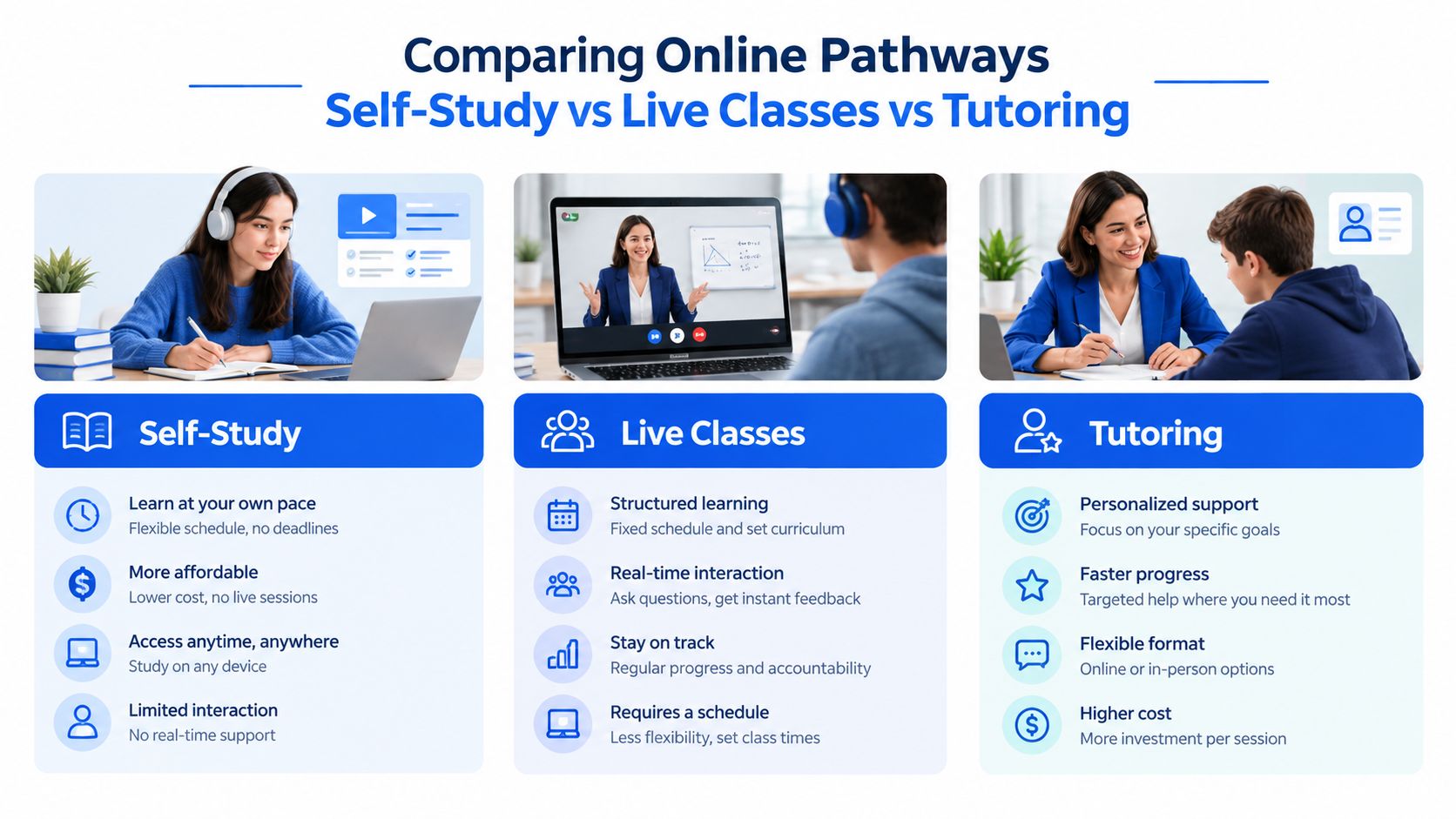
| Online pathway | What it handles well | Main feedback limitation | Best fit |
|---|---|---|---|
| Self-study | Flexible practice, repeated exposure, independent pacing | You may not know why an answer or response is weak | Disciplined learners who can diagnose errors |
| Live small-group classes | Routine, interaction, speaking drills, peer comparison | Individual weaknesses may receive limited attention | Learners who need accountability and regular practice |
| Private tutoring | Focused correction and customized tasks | Progress depends heavily on the tutor's assessment quality | Candidates with a clear bottleneck or demanding target |
Self-study is useful, but self-diagnosis is unreliable
A self-study platform can give you Listening and Reading questions, model answers, vocabulary activities, and mock tests. Those materials are useful for building familiarity, especially when you need flexible scheduling around university, work, or family responsibilities.
The weakness appears in productive skills. You can compare your essay with a model answer, but you may not identify whether the problem is Task Response, Coherence and Cohesion, Lexical Resource, or Grammatical Range and Accuracy. You may also record yourself speaking and notice hesitation without understanding whether the issue is fluency, pronunciation, vocabulary control, or grammatical accuracy.
A structured online language school should be judged by how it turns practice into correction, not by its library size.
Live classes create accountability and interaction
Small live classes make it harder to avoid Speaking practice. A teacher can interrupt a recurring error, ask a follow-up question, and require you to reformulate an answer. Peer interaction also exposes you to different accents, ideas, and response styles.
The trade-off is individual attention. If your Writing problem is paragraph cohesion while another learner needs pronunciation work, a group lesson can't devote the entire session to your issue. Choose a class that uses written submissions, recorded speaking tasks, or progress reports outside the live meeting.
Private tutoring targets the bottleneck fastest
One-to-one tutoring is most useful when you already have a specific diagnosis. For example, a learner who consistently produces relevant ideas but fails to develop them needs task-response coaching, not another general grammar lecture. A candidate who understands questions but freezes in Speaking needs repeated simulations, recording review, and controlled fluency drills.
Don't choose private lessons just because they sound more intensive. Ask what gets marked, how feedback is recorded, and what you must revise before the next lesson. Without that cycle, private tutoring can become conversation practice with an IELTS label.
Decoding IELTS Scoring Criteria for Smarter Course Selection
IELTS does not reward effort evenly. It rewards performance against specific criteria, and that is exactly why many online courses disappoint. They give you more videos, more exercises, more sample answers, and almost no criterion-based correction. If nobody shows you why your Writing stays stuck at one level or why your Speaking sounds hesitant, you are consuming content, not preparing for the test.
For Writing, IELTS uses four equally weighted criteria: Task Achievement or Task Response, Coherence and Cohesion, Lexical Resource, and Grammatical Range and Accuracy. Task 2 contributes more to the Writing score than Task 1, so any serious course must spend regular time on timed essays, paragraph development, and revision, not just model answers and grammar drills. The official breakdown is explained in the Official IELTS scoring criteria.
That matters because the feedback gap is where scores stall.
A learner can complete ten essays and still repeat the same problems: partial answers, loose topic sentences, vague vocabulary, and grammar errors that blur meaning. A course only becomes useful when a teacher names the weak criterion, shows evidence from your work, and makes you fix it in a rewrite.
Use the rubric to screen any course before you pay:
- Does a teacher mark full Writing tasks? Sentence correction alone will not reveal weak task response or poor structure.
- Is feedback tied to the exact criterion? “Work on vocabulary” is lazy feedback. You need to know which words are imprecise and what better choices fit the task.
- Are rewrites required? Feedback without revision gets forgotten fast.
- Are Speaking responses recorded and reviewed? You need proof of where you hesitate, go off point, or lose clarity in pronunciation.
- Is progress tracked by criterion instead of one overall estimate? A single band guess hides the real bottleneck.
Speaking follows the same logic. It is assessed through Fluency and Coherence, Lexical Resource, Grammatical Range and Accuracy, and Pronunciation, again as equally weighted criteria. If a course cannot explain how its speaking tasks improve those four areas, it is offering activity, not progress.
A useful dashboard separates all eight Writing and Speaking dimensions. Then you can see what is holding your score down: weak development, repetitive wording, inaccurate sentences, hesitation, or unclear pronunciation.
If Band 7 is your target, read this IELTS Band 7 guide and compare its descriptors with the course's feedback process. Convenience matters. Criterion-based human feedback matters more.
Real-World Scenarios, Which Format Fits Your Situation
A good course decision starts with the bottleneck, not the format that looks most convenient. Three learners can share the same target band and need completely different preparation.

The university student with limited study windows
A student attending lectures during the day may have enough English knowledge but no consistent routine. Self-study offers flexibility, yet the learner keeps postponing Speaking and submits essays only when motivation appears.
A live small-group class is the better starting point. Fixed meetings create accountability, while short weekly submissions keep Writing visible. The student should still complete independent Listening and Reading work, then bring error patterns to class instead of arriving with unexamined practice scores.
The professional targeting Band 7
A professional may communicate effectively in meetings but write essays with weak introductions, broad claims, and underdeveloped examples. More vocabulary lists won't solve the problem. The learner needs timed Task 2 writing, criterion-level marking, and revision until each paragraph answers the question directly.
Private tutoring is appropriate when the target is specific and the weakness is already visible. A small group can work too, but only if the teacher reviews individual writing between sessions rather than giving general advice to everyone.
The fluent learner who freezes in Speaking
Some learners have solid grammar and broad vocabulary but become hesitant in the interview. They answer Part 1 questions with memorized phrases, lose structure in Part 2, or give short opinions in Part 3.
The remedy is not passive exposure to English. Use recorded simulations, timed preparation, follow-up questions, and feedback on fluency, coherence, pronunciation, and lexical control. A live class provides useful pressure, while one-to-one practice is valuable when anxiety or a recurring pronunciation issue dominates performance.
The format should follow the weakness. Flexibility solves scheduling, but feedback solves stagnation.
Building a Routine, Beyond Practice Tests
A practice test tells you where you are. It doesn't automatically teach you how to move. A serious routine combines measurement, correction, and repetition under conditions that resemble the actual exam.
The IELTS test takes approximately 2 hours and 45 minutes. Listening lasts 30 minutes, Reading 60 minutes, Writing 60 minutes, and Speaking 11 to 14 minutes. Listening, Reading, and Writing take place on the same day without breaks, while Speaking may happen on the same day or within the seven days before or after the other sections. (British Council IELTS test format)
Measure receptive skills and productive skills differently
Listening and Reading use one mark per question, so your dashboard should preserve raw correct answers, question-type errors, and timing problems. Don't record only an estimated band. If you miss several answers because you misread instructions, that requires a different intervention from vocabulary gaps or poor concentration.
Writing and Speaking require expert-rated evaluation against descriptors. A useful cycle looks like this:
- Diagnose: complete a mini-test and submit one Writing task plus a recorded Speaking response.
- Classify: separate errors into task fulfillment, organization, vocabulary, grammar, fluency, and pronunciation.
- Correct: receive a specific explanation and a model revision, not just a score.
- Repeat: complete a comparable task and check whether the same error returns.
Train the whole exam, then target the weakest skill
Full-test practice matters because endurance and transitions affect performance. A learner who completes isolated exercises comfortably may struggle when Writing follows Listening and Reading on the same day. Include timed full tests, but don't use them as your only activity.
A weekly routine should include timed Listening and Reading sets, Writing Task 2 submissions, Speaking interview simulations, vocabulary review based on personal errors, and a short progress record. Each task needs a next action. “Band 6.0 again” isn't an action. “Develop the second main idea with an explanation and example” is.
Check retake options before changing your plan
One Skill Retake creates a strategic question, but eligibility, local availability, and institutional acceptance must be verified. IELTS Academic can be taken at a test centre or remotely online, and the format remains 2 hours and 45 minutes. (IELTS Academic test information)
Don't assume a targeted retake will solve your problem. First confirm that your university, employer, or immigration authority accepts it. Then compare a full retest with focused preparation for the weakest skill. The correct plan may be to raise every component, or it may be to repair one clearly limiting result.
Englify as a Purpose-Built Alternative
Many online English programs add IELTS exercises to a general curriculum. That can help learners build language ability, but exam preparation requires a tighter connection between task, criterion, feedback, and revision.
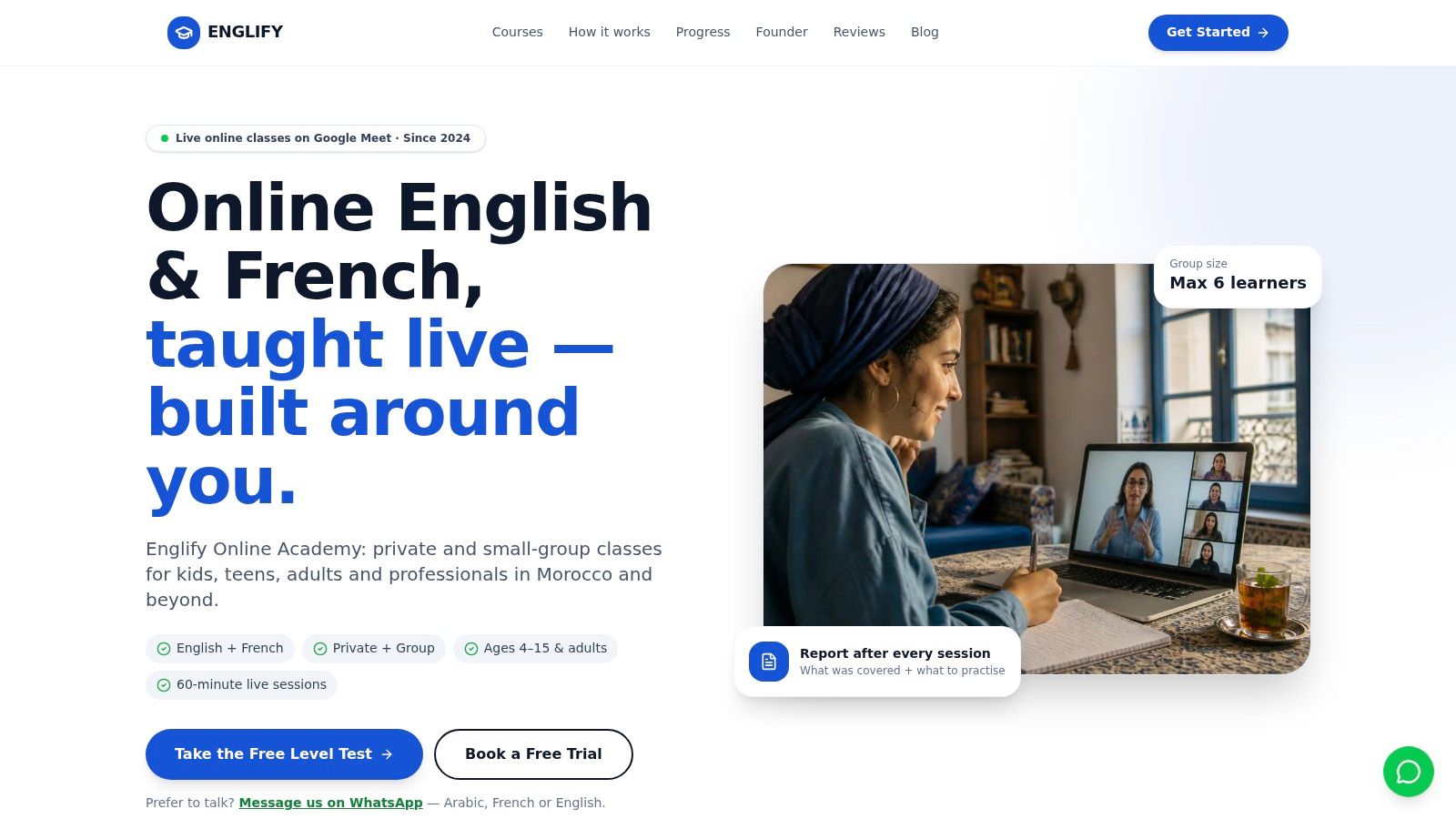
Englify offers live online English courses in small groups with a maximum of 6 learners across CEFR A0 to C1, alongside private 1-to-1 classes. Sessions run through Google Meet and use a speaking-first approach with immediate feedback, recordings, written reports for parents, flexible scheduling, and personalized content.
What to look for in the learning design
For IELTS candidates, the relevant question isn't whether a class is live. It's whether live time produces evidence of improvement. A practical course should connect activities to the exam:
- Listening and Reading: timed sets, answer analysis, and error categories.
- Writing Tasks 1 and 2: marked submissions linked to Task Achievement or Task Response, Coherence and Cohesion, Lexical Resource, and Grammatical Range and Accuracy.
- Speaking Parts 1 to 3: recorded simulations, follow-up questions, and feedback on the four speaking criteria.
- Progress reporting: current performance, recurring weaknesses, and the next practice priority.
Small groups support interaction without removing the need for individual correction. Private classes make it easier to focus on a specific target, such as paragraph cohesion, task development, pronunciation, or response speed.
Why local delivery can make the routine easier
Learners in Morocco often need schedules that fit university, work, and family commitments. Flexible morning, afternoon, and evening sessions reduce the practical friction that causes candidates to miss preparation. Google Meet also allows learners to study remotely without depending on a local classroom.
Parents can use session recordings and written reports to understand progress, while adult learners can focus content on university applications, professional communication, interviews, or migration-related goals. Englify's CEFR-based structure also helps distinguish a general level need from an IELTS-specific performance problem.
The essential test remains the same: ask how often Writing and Speaking receive human review, what criteria teachers use, and how feedback changes the next task. A course is purpose-built only when those answers are clear.
Next Steps, Placement, Trial, and Final Decisions
Don't choose an IELTS preparation course online by comparing lesson counts. Establish your current performance, identify the weakest skill, and test the provider's feedback process before committing.
Start with a diagnostic
Take a free placement test and request an estimated band assessment if available. The result should help separate general English level from IELTS readiness. A learner at a lower CEFR level may need broader language development, while a stronger learner may need targeted work on Writing, Speaking, timing, or task types.
Bring clear questions to the diagnostic:
- Which IELTS module do I need, Academic or General Training?
- What score does my university, employer, or authority require?
- Which component is currently limiting my overall result?
- How will Writing and Speaking be marked?
- Will I receive examples and a chance to revise?
Use a trial session as an audit
A free trial session shouldn't be judged only by whether the teacher is friendly. Notice whether you speak, receive correction, and leave with a specific next step. Ask to see how the academy records progress and whether feedback refers to official IELTS criteria.
Englify's free trial English class information can help you understand what to assess in a live online lesson. For learners in Morocco and abroad, flexible scheduling and local support through WhatsApp in Arabic or French can also make communication easier, but they shouldn't replace academic quality.
Confirm rules before you plan a retake
Verify the test type, delivery option, registration details, and whether your institution accepts a particular result format. If you're considering One Skill Retake, check eligibility and local availability directly before building your study schedule around it.
Then choose the format that matches your bottleneck. Self-study can support independent practice, live classes can supply routine and interaction, and one-to-one tutoring can concentrate on a stubborn weakness. The strongest plan combines timed work, human feedback, deliberate revision, and progress tracking by skill.
Englify provides live online IELTS preparation through Google Meet, with small groups and private classes designed around all four skills and feedback on Writing and Speaking. Take the free placement test or book a trial through Englify to identify your current level and choose a preparation routine based on evidence rather than content volume.