Knowledge hub
Online Language School: Find Your Perfect Course in 2026
Discover how to choose the best online language school for your needs. Compare models, quality, and find the right course to start learning in 2026.

You might be comparing two or three online English options right now, trying to figure out which one will help your child, your teen, or yourself speak better. One school promises confidence, another shows polished videos, and a third says it uses AI. The core question is simpler than the landing pages make it look: what can you verify before you pay?
An online language school is not just a tutor on a screen. It is a structured programme with placement, lesson sequencing, teacher feedback, and a way to show progress over time. That structure matters because speaking improves when learners get repeated practice, correction, and a clear next step, not just access to content. Englify works in that school model through live classes, CEFR-aligned levels, written reports, and Google Meet delivery, which is the kind of setup many parents and adult learners are trying to compare against app-only learning. You can see how that teaching model is organised in Englify's teaching approach.
Table of Contents
- What an Online Language School Actually Is
- The Three Main Models Live, Self-Study, and Blended
- Live Classes Versus AI and Self-Study Apps
- CEFR Levels and Placement Tests Explained
- Quality Markers You Can Verify Before You Pay
- A Week Inside a Live Online Class
- How to Compare Providers and Read a Trial Honestly
- Key Takeaways and Your Next Step
What an Online Language School Actually Is
A parent often reaches the same conclusion after one too many weak tutoring sessions. The problem is not that the teacher is bad, it's that the setup is loose. A real online language school gives the learner a path, not just a meeting link.
Three jobs a school should do
First, it should diagnose the starting point. A good school doesn't guess level from a short chat, it places the learner and uses that result to choose the right class. Second, it should sequence lessons toward a target outcome, such as speaking more clearly in school, handling interviews, or passing a language exam. Third, it should report progress in a way the learner or parent can check later, not just remember in the moment.
That's why schools are different from freelance tutor marketplaces. A marketplace lets you pick a person, but the burden of curriculum, level choice, and progress tracking often falls on you. A casual app subscription gives you exercises, but it usually doesn't give you a teacher who knows your history or a written account of what changed. A translation service solves text, not language growth.
Practical rule: if you can't tell what level the learner started at, what the next milestone is, and how progress will be shown, you're not looking at a school model yet.
Who these schools are for
An online language school can serve children, teens, university students, working adults, and sometimes company teams. English is the most common choice, but many schools also teach French, Spanish, German, and other languages. For Moroccan and Arabic-speaking learners, the school format is especially useful when the goal is not just “study English” but “speak with more control in class, work, travel, or interviews.”
Englify fits that school definition because it offers live English and French classes through Google Meet, with small-group and one-to-one options for different ages and goals. It's the kind of setup that moves beyond casual practice and into structured learning with visible steps.
The Three Main Models Live, Self-Study, and Blended
The easiest way to compare online language schools is to look at how the learning is delivered. Who leads the session, when it happens, how feedback arrives, and how progress is tracked all shape the experience more than the marketing does.
Live classes
Live classes are teacher-led sessions on a schedule. The learner shows up at a fixed time, speaks with real people, and gets feedback in the moment. That format suits speaking practice, accountability, and families who want attendance to be visible.
Self-study
Self-study paths rely on apps, videos, and exercises the learner completes alone. They fit busy calendars and lower budgets because the learner controls the pace. Feedback can be automated, which helps with quick correction, but it usually leaves the learner to decide what to do next.
Blended learning
Blended models combine live lessons with self-study materials and sometimes AI conversation practice between sessions. This can work well for learners who need both structure and flexibility. The live class handles speaking, correction, and direction, while the self-study side keeps vocabulary, review, and repetition moving between meetings.
| Criterion | Live Classes | Self-Study | Blended |
|---|---|---|---|
| Who leads it | Teacher | Learner, with app guidance | Teacher plus learner tools |
| When it happens | Scheduled sessions | Anytime | Scheduled live sessions plus flexible practice |
| Feedback style | Human feedback during and after class | Automated or limited feedback | Human feedback plus app-based review |
| Progress tracking | Can be documented in reports and class notes | Often depends on learner discipline | Usually stronger than self-study alone |
| Best fit | Speaking goals and accountability | Tight budgets and irregular schedules | Learners who want balance |
The key point is not that one model is universally better. A teenager who needs speaking confidence before school oral exams may need live classes. An adult revising vocabulary during a commute may prefer self-study. A parent looking for both structure and flexibility may find the blended model easiest to sustain.
Live Classes Versus AI and Self-Study Apps
AI tutors and self-study apps have changed the market, and they do some things well. They can give endless practice, instant prompts, and a low-friction way to review a lesson without booking a teacher. That's useful, but it isn't the same as learning to speak under real conversational pressure.
Where each format helps most
For speaking goals, AI conversation tools can help learners rehearse pronunciation, turn-taking, and simple dialogue. Live classes do something different, they force the learner to respond to another person, repair misunderstandings, and keep going when the answer isn't predictable. That's a better match for interviews, classroom speaking, meetings, and presentations.
For accountability, scheduled live sessions create a commitment. A learner is more likely to show up when a teacher and group are waiting. App streaks can be motivating for a while, but many learners stop using them once the novelty fades.
For feedback quality, machine feedback is strong on repeated grammar slips and some pronunciation patterns. Teacher feedback adds judgment on content, tone, task strategy, and whether the answer fits the situation. A learner might say something grammatically correct but still sound awkward in a job interview, and that's where a teacher's correction matters.
AI can help a learner practise more. It doesn't automatically help them speak better in front of people.
For cost, apps and AI tools are usually cheaper per hour. Live classes cost more because they bundle a teacher, a curriculum, and structured reporting. That difference is the trade-off. If the learner only wants exposure and repetition, apps may be enough. If the learner needs usable speaking skill, the school structure usually does more work.
Recent market reporting also shows that the broader online language learning sector has become large and fast-scaling, with mobile delivery and self-paced tools now central to how learners access education as reported in the online language learning market overview. Even with that shift, live instruction still has a role when the goal is accountability and spoken performance, not just practice volume.
CEFR Levels and Placement Tests Explained
CEFR is useful because it gives schools and families a shared language for level. Instead of vague labels like “Intermediate” or “Level 3,” it uses bands that describe what a learner can do. That makes it easier to compare schools and judge progress without relying on sales language.
What the levels mean in plain words
A1 learners can introduce themselves and ask or answer basic personal questions.
A2 learners can handle simple, routine exchanges and describe their background.
B1 learners can deal with most travel situations and produce connected text on familiar topics.
B2 learners can interact with fluency and spontaneity and explain a viewpoint on a topical issue.
C1 learners can express themselves fluently and use language flexibly for social and professional purposes.
C2 learners can understand with ease virtually everything heard or read and summarize information.
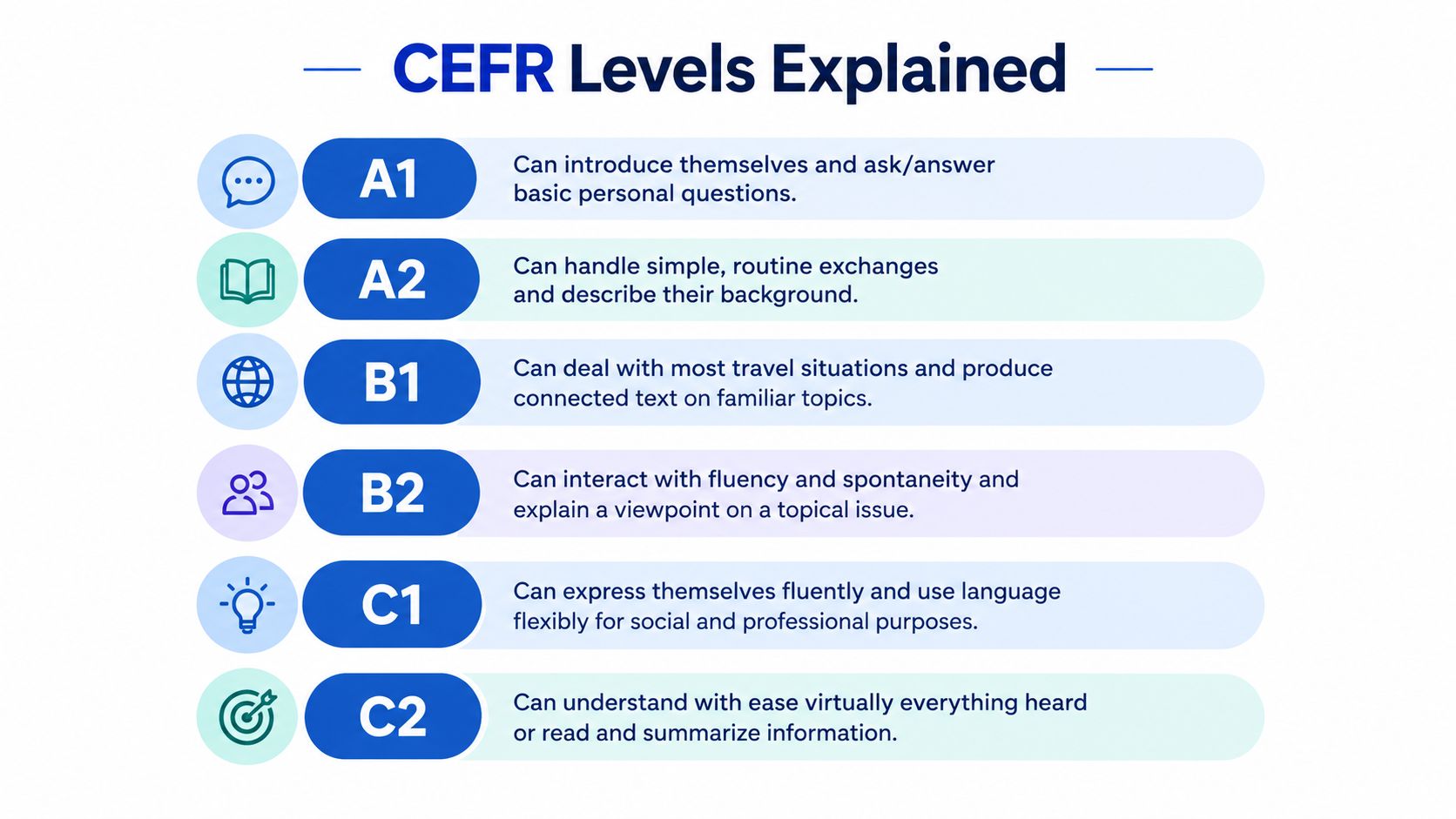
A credible placement process should feel specific, not vague. One recognized online placement test from National Geographic Learning assigns learners to 14 CEFR bands from Pre-A1 to C1 and produces separate CEFR-based scores for Overall, Listening, Reading, and Language Use in its placement report structure. That kind of report is useful because it turns level into something you can review, not just trust.
Good placement reports name a level and show why. Bad ones hand out a label without evidence.
A weak report often has red flags. The level is assigned in five minutes, there's no written justification, and there's no way to retake or discuss the result if the learner feels misplaced. A stronger report gives the learner a speaking sample, a writing task, and a clear note about gaps.
If you want a practical example of a placement tool, Englify's AI English level test is designed around that kind of level-checking approach. The important part is not the tool itself, it's whether the result helps the learner make a better class choice.
Quality Markers You Can Verify Before You Pay
A polished homepage can be tidy and still tell you very little. Before you pay, look for signals you can verify yourself. For a child or an adult learner, the useful test is simple: does the school show who teaches, how lessons run, what proof it gives, and what the price is?
People
Check the teacher profile. Look for qualifications such as TEFL, CELTA, a relevant degree, or clear experience teaching the target language. Ask whether the same teacher stays with the class or whether learners meet a different instructor every lesson. Consistency helps both children and adults build trust and keep momentum.
Process
Ask about class size, lesson length, curriculum, and how feedback is delivered. A school should tell you whether lessons follow CEFR levels, whether recordings are kept, and whether parents or learners receive written feedback. For minors, communication matters as much as the lesson itself. A school that can explain its process clearly is easier to judge than one that only uses broad promises.
Proof
Look for a free trial, a sample lesson, a sample report, and visible reviews that you can check outside the school's own site, such as Englify's reviews page. If the school offers written reports, ask to see an example with personal details removed. If they promise progress, they should be able to show what progress looks like on paper.
Price
Read the full fee structure carefully. Hidden add-ons, currency confusion, and auto-renewing subscriptions can make a course much less attractive than it first appeared. A clear school lets you understand what you are paying for before you commit.
If a provider will not show you the lesson structure, the reporting format, or the full price, treat that as useful information.
Englify, for example, publishes live classes, placement testing, trial sessions, and written reports as part of its online academy model. That is the kind of setup to compare against when you want transparency instead of vague promises.
A Week Inside a Live Online Class
A live online class becomes much easier to judge when you can picture a normal week. The schedule matters, but so do the small details around it, because that's where parents and adult learners see whether the school is organised or chaotic.
What the learner sees during the week
On Sunday, the class portal shows the week's materials, the lesson topic, and any homework from the previous session. On Monday, the learner joins a short live lesson on Google Meet with a few classmates, the teacher opens with a warm-up, and everyone speaks before the teacher shares vocabulary on screen. This is the part that makes live classes feel real, because learners don't just watch, they respond.
Tuesday might be homework day, with a short writing task submitted through the portal. Wednesday is often the feedback day, where the learner gets a written note and a short voice message that explains what was good and what needs work. Thursday brings a second live lesson focused on fluency, while Friday is for self-study review. Saturday can be a quick quiz or reassessment to see whether the learner is keeping the new material.
What parents should look for
For younger learners, the useful signal isn't just the lesson itself. It's whether attendance is tracked, whether teacher messages are visible, and whether progress updates are easy to read. A parent doesn't need a long report every time, but they do need enough information to know if the child is engaged and improving.
Google Meet is a sensible delivery tool for this model because it's built for live classes, parent-teacher communication, file sharing, and screen sharing in education settings as described by Google for Education. Schools also use Google Meet's class tools to schedule and launch lessons in a standard way for live lessons. One useful pattern in online language education is recording or transcribing meetings so the school can keep records of class activity as shown in Google Meet materials.
How to Compare Providers and Read a Trial Honestly
Most families and adult learners compare schools the wrong way. They watch one polished trial, hear one confident teacher, and decide too fast. A better method is to judge all shortlisted schools against the same checklist.
Use one checklist for every school
Put the same items in front of every provider, teacher qualifications, CEFR placement report content, live class size, recording policy, written feedback cadence, total monthly cost with all fees, cancellation terms, and communication rules for minors. If a school can't answer one of those clearly, that's useful information too.
Run trials under similar conditions
Book trial classes as close together as possible. Ask the same questions in each trial, and pay attention to whether the teacher adapts to what the learner already knows or just follows a script. A real trial should reveal how the school teaches, not just how well the teacher sells.
Read the report, not just the feeling
After the trial, ask for the written evaluation. If the report only says “Upper-Intermediate” without subskill detail, treat that as a soft warning sign. A useful trial report should tell you what the learner can do well, what is missing, and what the next class should focus on.
Best practice: give the school a full month before making a final judgement. One 25-minute class can't show the full learning curve.
A simple weighted scorecard helps here. Put more weight on teaching clarity, feedback quality, and level accuracy than on polished branding. If two schools feel similar on the surface, the one that gives clearer reports and better follow-up is usually the safer choice.
Key Takeaways and Your Next Step
An online language school is a structured programme with placement, feedback, and progression, not just a place to buy lessons. The right format depends on the learner's goal, schedule, and need for accountability. Live classes help most when speaking performance matters, while apps and AI are better as support tools than full replacements.
The biggest misconception is that more classes automatically mean faster progress. They don't if the level is wrong or the feedback is vague. Another mistake is assuming a fluent teacher in a trial session guarantees the learner will improve at the same pace. What matters is whether the school creates enough spoken practice and gives feedback the learner can act on.
If you're choosing now, keep it simple. Shortlist three schools, compare them on the same checklist, run matched trials, and read the reports carefully. Then give the chosen school one full placement cycle before deciding whether to stay or switch.
Speaking progress usually comes from consistent spoken reps with feedback. The school that makes that habit easier to keep is the one worth keeping.
Englify offers live English and French classes through Google Meet, with placement testing, trial sessions, small groups, one-to-one options, and written reports that help you track progress. If you're comparing online language schools and want a clearer path from level check to real speaking practice, visit Englify and see how its classes are organised.