Knowledge hub
Maximize Your Free Trial English Class Results
Learn how to prepare for and evaluate a free trial English class. Discover what to look for, how to test your tech, and how to use the diagnostic report.

A friendly teacher can make a trial lesson enjoyable, but friendliness isn't proof that the lesson was useful. The popular advice is to judge a free trial English class by whether you liked the tutor. Judge it first by whether the session produced reliable evidence about what you can understand, say, and improve.
A serious trial should reveal the difference between passive English knowledge and active communication. You may recognize grammar rules, follow written instructions, or understand familiar vocabulary while still struggling to answer a question spontaneously. Treat the session as a diagnostic appointment, not a casual chat or a sales presentation.
Table of Contents
- The Real Purpose of a Free Trial English Class
- Preparing Your Technology and Learning Environment
- What Happens During a Structured Trial Session
- Evaluating the Teacher and the Learning Experience
- Understanding Your Post-Trial Evaluation Report
- Making Your Enrollment Decision Based on Evidence
The Real Purpose of a Free Trial English Class
The value of a free trial English class lies in its ability to establish a practical starting point. A teacher should observe your receptive skills, ask about your objectives, and listen to how you manage real communication. The result should be more useful than a vague label such as beginner or intermediate.
English has a large and internationally distributed learner market. Duolingo's 2024 Language Report found that English was the most popular language studied in 135 countries, an increase of more than 10% compared with the previous year. The same report states that the Duolingo English Test had been taken in more than 70,000 locations across over 230 countries and territories. More than half of test takers used the certification for admission to English-language undergraduate institutions, while another 31% sought certification for graduate study.
Those figures connect English learning to concrete goals, including university admission, employment, and international mobility. They also explain why an online trial can be valuable for learners in Morocco, the UAE, and Arabic-speaking communities abroad. You don't need to travel to a language center to demonstrate your speaking ability, but you do need a session designed to measure it.
The global challenge isn't access to English content alone. The 2024 EF English Proficiency Index analyzed approximately 2.1 million non-native English speakers aged 18 and above across 116 countries and regions and reported that 60% of indexed countries scored lower than in the previous year. That doesn't mean every learner declined. It does show that exposure to English doesn't automatically create effective speaking ability.
Practical rule: Don't ask only whether the teacher was pleasant. Ask what the teacher measured, what evidence they found, and what you should do next.
A useful guide to English placement tests should help you understand this distinction. Your trial should compare what you can do now with the communication demands of your target, whether that's school performance, an interview, an IELTS routine, workplace meetings, travel, or everyday conversation.
Preparing Your Technology and Learning Environment
A live lesson can't assess your English accurately if the teacher spends the session solving microphone and connection problems. Technology readiness is part of trial preparation, especially in mobile-first households where learners may rely on a smartphone, cellular data, shared devices, or a busy home environment.
Research on online English learning found that 71.8% of participants used a smartphone, 66.7% relied on cellular internet, and 59% identified internet cost as the main access barrier, as reported in this study of technology access in ESL learning. These figures make one point clear: a free class isn't automatically frictionless. A professional provider should account for the technology you have.
Complete the setup before the lesson
Use this checklist before joining a live Google Meet class:
Test the microphone and speaker. Record a short voice message and play it back. If your voice sounds distant, move closer to the device or use a headset. Clear audio matters more than a perfect camera because pronunciation and listening are central to the assessment.
Check the camera and permissions. Open Google Meet in advance and confirm that the browser or app can use the camera and microphone. Place the device at eye level rather than holding it in your hand.
Test your connection at the same time of day. A connection that works in the morning may become unstable when other family members are online. If video fails, ask whether you can keep audio active and turn off video temporarily.
Prepare a fallback. Keep your phone charged, know how to join by phone, and ask what happens if the audio drops. A low-bandwidth option or a clear rescheduling policy prevents a technical failure from being mistaken for poor participation.
Create a speaking zone. Choose the quietest available space, close unrelated apps, silence notifications, and tell family members when you need uninterrupted attention. Parents should prepare a child with water, paper, and a stable seat without coaching answers during the class.
A useful online English tutor guide for adults should also recognize the realities of work schedules and home setups. Professionals joining after work may need a headset and a private corner, while a child may need an adult to test the connection but should complete the speaking tasks independently.
What Happens During a Structured Trial Session
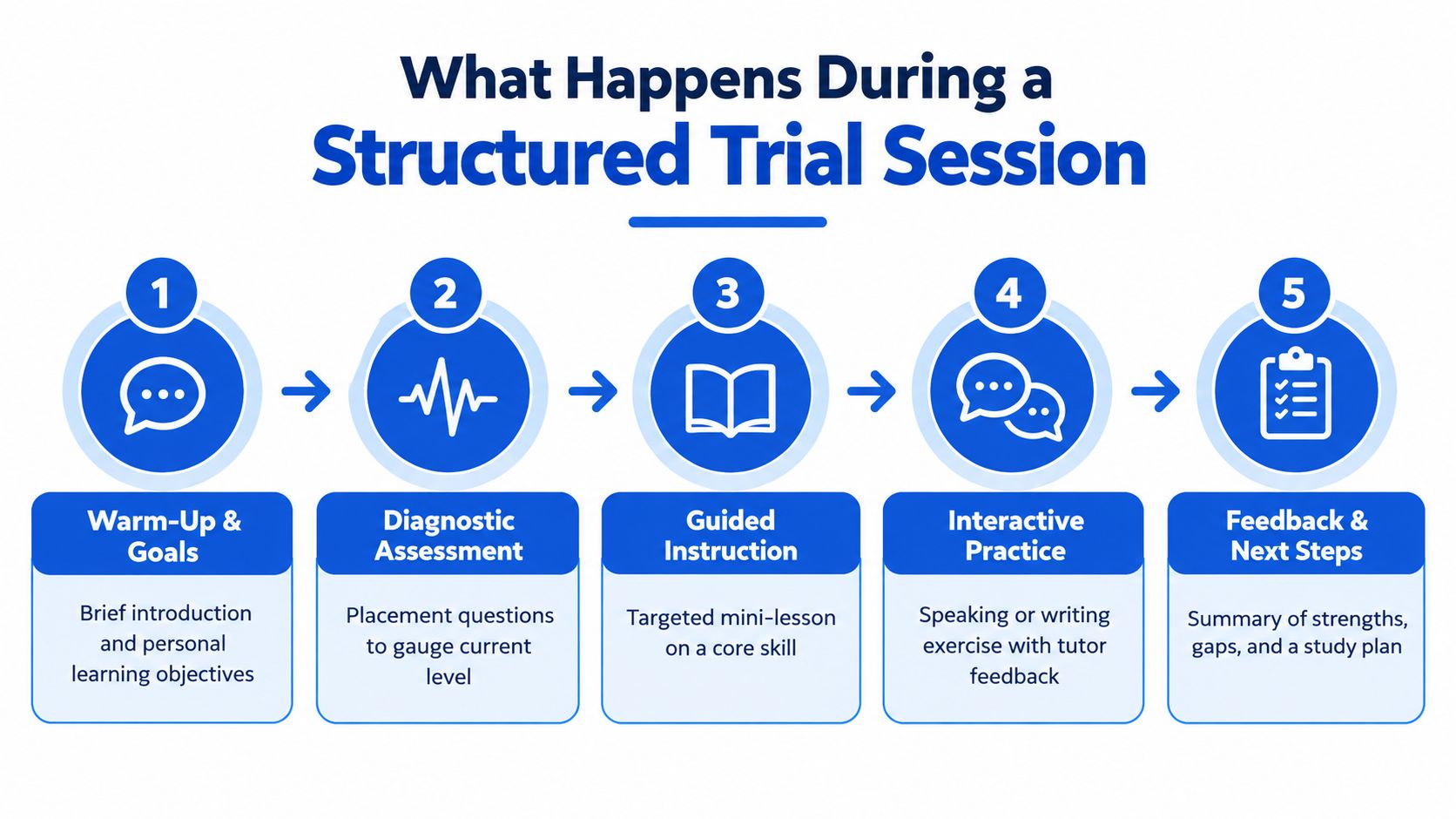
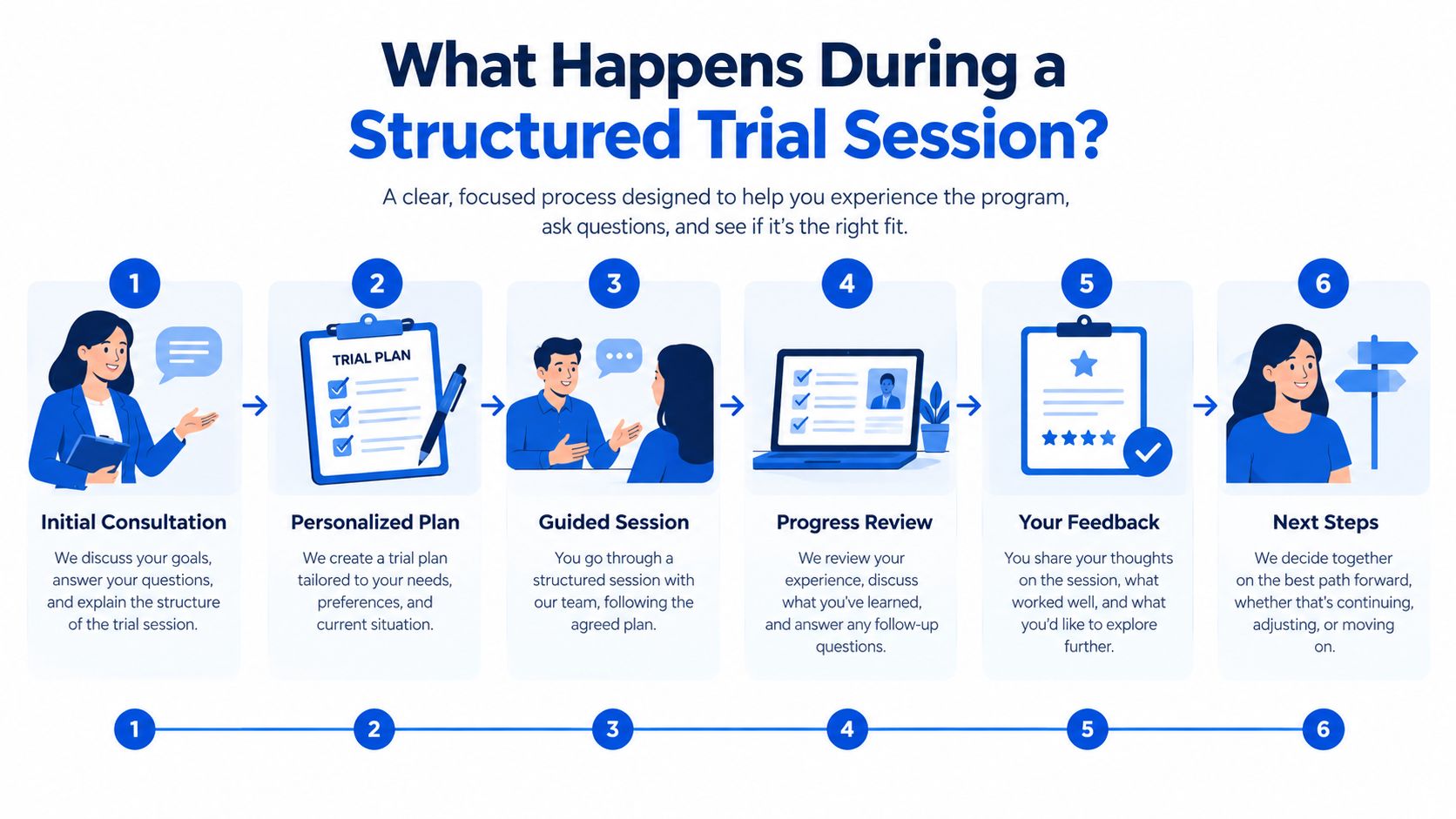
A structured trial should move from evidence gathering to guided practice and then back to evidence gathering. The teacher shouldn't spend most of the lesson explaining grammar while you listen. Your spoken performance is the central material.
The diagnostic sequence
A reliable session can follow four main stages:
Screening: A short CEFR-oriented check should cover receptive skills and include a brief speaking task. Grammar questions alone aren't enough because reading performance can sit above speaking performance.
Goal setting: The teacher should ask what you need English for. A learner preparing for university admission needs different evidence from a professional preparing for presentations or a child building classroom confidence.
Interactive task: A 10–15-minute task can require information exchange, role-play, or problem-solving, as outlined in the placement-test evidence. These activities reveal whether you can respond, clarify meaning, describe a problem, and continue after an unexpected question.
Written evaluation: The report should separate pronunciation, grammatical control, vocabulary range, fluency, interaction, and the recommended CEFR level. It should also identify observable strengths and priority gaps.
The Common European Framework of Reference for Languages uses six levels, A1, A2, B1, B2, C1, and C2, grouped into Basic User, Independent User, and Proficient User categories. The Council of Europe's CEFR level descriptions are more useful than a general label because they describe progressive ability across individual skills.
Speaking tasks reveal more than recognition
At A1, a learner should be able to understand and use familiar everyday expressions, introduce themselves, and exchange basic personal information when the other speaker communicates slowly and clearly. At C1, the learner should be able to understand demanding longer texts, recognize implicit meaning, speak fluently and spontaneously, and use English flexibly in social, academic, and professional contexts, according to the CEFR global scale.
The teacher should therefore ask you to do something meaningful, not merely repeat a vocabulary list. A learner might introduce themselves for a workplace setting, describe a past event, explain a preference, solve a simple problem with a partner, or respond to a follow-up question. The teacher can then provide delayed correction, repeat the task, and check whether the second performance is clearer.
Small-group design matters. Research on online language teaching identifies two to four learners as the most comfortable size for effective interaction, while a separate virtual-classroom study found that highly engaged learners reported approximately 15% greater language improvement than less-engaged learners, as discussed in this research on collaborative online language tasks. A group with a maximum of six learners still needs rotating roles, timed turns, and deliberate monitoring so confident speakers don't dominate.
Evaluating the Teacher and the Learning Experience
A fun lesson and a good diagnostic lesson aren't the same thing. Entertainment can create positive energy, but it doesn't show whether you can sustain a conversation, understand a question, or repair a communication problem.
Evaluate the teacher on observable behavior. During the class, ask yourself:
| What you observe | What it tells you |
|---|---|
| The teacher explains the task clearly, then gives you time to speak | The lesson prioritizes communication over lecture |
| The teacher takes notes without interrupting every sentence | Feedback is being collected without damaging fluency |
| The teacher corrects errors linked to the objective | Correction is selective and useful |
| You repeat a task after feedback | Improvement can be observed, not merely promised |
| The teacher adapts the activity to your level and goal | The session isn't a generic textbook demonstration |
A strong teacher won't correct every error while you're trying to express an idea. Constant interruption can make a learner cautious and produce less language. Delayed correction is often more appropriate during fluency work, followed by a second attempt in which you apply the feedback.
A comfortable class should make mistakes safe, not make the work easy.
For parents, the key evidence is independent behavior. A child who repeats words after the teacher may be engaged, but repetition alone doesn't show communicative readiness. Watch whether the child can answer without immediate prompting, follow instructions, take a turn, ask or respond to a question, and maintain focus during a short activity.
The lesson should also reveal whether the format suits the learner. Small groups can create peer interaction and useful turn-taking, while private classes offer more direct speaking time and closer adaptation. Neither format is automatically correct. The right choice depends on the learner's goal, confidence, availability, and performance during the trial.
Be cautious if the class includes a long sales conversation, a generic worksheet, no speaking task, or no explanation of the evaluation criteria. A teacher's warm personality is valuable, but it can't replace structured observation, targeted feedback, and a clear next step.
Understanding Your Post-Trial Evaluation Report
The written report is the most valuable product of the trial. Don't treat it as a score that closes the conversation. Treat it as a gap analysis between your current performance and the communication ability required for your goal.
Formative assessment evaluates learning during instruction rather than only at the end. A 2024 review of 40 studies on formative assessment in K–12 English as a foreign language found that 46.3%, or 19 out of 40, focused on practices such as peer assessment, self-assessment, feedback, portfolios, questioning, and specific formative tasks. That supports a trial built around questions, speaking activities, feedback, and next steps.
Read the report as a working document
Look for five elements:
Current level hypothesis: The report should state an initial CEFR estimate and explain the evidence behind it. It shouldn't just label you A2 or B1 without examples.
Strengths: These might include understandable pronunciation, effective use of familiar vocabulary, accurate basic sentence patterns, or the ability to follow the main point of a conversation.
Priority gaps: A useful report identifies specific difficulties in pronunciation, grammar, vocabulary, listening, interaction, or fluency. “Improve speaking” is too vague to guide study.
Target outcome: The report should connect your next goal to a real task, such as delivering a workplace introduction, answering interview questions, narrating a past event, or participating in a school discussion.
Recommended action: The teacher should indicate whether private instruction, a small group, exam preparation, or personalized practice is the sensible next step.
The sample evaluation report is useful because it gives families and learners a concrete idea of what written feedback should contain. Parents can use the report to distinguish between a child who recognizes classroom vocabulary and a child who can use that language independently.
Turn feedback into a measurable routine
Feedback is useful when it identifies the difference between actual performance and a reference level, then points to an action that can reduce the gap. A review of formative assessment and feedback describes feedback in these terms, as information that helps learners recognize weaknesses and choose actions connected to their goals.
Convert each priority into practice. If pronunciation affects intelligibility, choose a short introduction and record a new attempt after targeted correction. If grammar breaks past-tense narration, retell the same event using a small set of controlled prompts. If fluency collapses during follow-up questions, practice answering, extending, and clarifying rather than memorizing longer lists of words.
Making Your Enrollment Decision Based on Evidence
Don't enroll because the trial felt pleasant. Enroll when the evidence, format, and plan fit your objective.
Use this decision logic:
Choose a small group when you need regular interaction, can learn from peer responses, and want practice taking turns in conversation. Confirm that the teacher tracks individual participation rather than allowing the most confident learner to speak for everyone.
Choose private instruction when your needs are specialized, your schedule changes often, or your report identifies gaps that require concentrated correction. This can suit interview preparation, business communication, exam routines, or a learner who needs more time before speaking in front of peers.
Choose a children's format carefully when the learner is young or easily distracted. The teacher should measure independent responses, listening, focus, and interaction, not only whether the child enjoyed a game.
Choose an exam-oriented plan when the report connects current performance to the demands of IELTS or another defined assessment. Ask how speaking, listening, writing, and reading practice will be organized around the learner's target.
Choose a workplace plan when you need English for meetings, emails, presentations, interviews, or technical discussions. Bring real communication situations into the course instead of accepting a general vocabulary syllabus.
Your schedule must support repetition. A single trial can't create fluency, but it can establish the baseline needed for purposeful practice. Follow the report's priorities, keep the target task visible, and ask for progress evidence during later lessons, including updated observations and examples of stronger performance.
The right academy should offer more than a pleasant introduction. It should provide live online learning through Google Meet, small-group and private options, CEFR-based levels from A0 to C1, a free placement test, session recordings, personalized content, and written learner reports. Englify provides these elements alongside a free trial session for learners who want to evaluate the fit before enrolling.
Book a free trial with Englify and arrive ready to test your microphone, state your real English goal, and participate actively in the speaking tasks. Use the written evaluation to choose between small-group and private classes, then turn the recommended next step into a consistent learning plan.