Knowledge hub
Online English Tutor for Adults: A Practical Guide
Find the right online English tutor for adults with this practical guide. Learn what to check, what to ask, and how to plan lessons that build speaking fluency.
You can read English emails, follow work chats, and still freeze the moment someone says, “Can you answer that on the call?” That gap is exactly why many adults start looking for an online English tutor for adults, not another app, and not another generic course that never turns passive knowledge into spoken confidence.
If that sounds familiar, you probably don't need more grammar rules. You need a tutor who can turn your limited study time into clear speaking progress, tie lessons to real situations, and show you whether you're getting better.
Table of Contents
- What an Adult Learner Needs from an Online Tutor
- How a One-to-One Online English Lesson Works
- Qualifications and Teaching Approach to Look For
- Private, Small Group, or Self-Paced for Adults
- Planning Lessons Around CEFR Levels and Personal Goals
- Real Pathways for Working Professionals and Adult Learners
- How to Evaluate a Tutor Before You Commit
- Your Next Step From Reading to Booking a Trial
What an Adult Learner Needs from an Online Tutor
An adult learner usually brings two things into an online lesson, confidence in reading and writing, and hesitation in speaking. You may understand a lot of English already, but if your job, studies, or daily life requires quick spoken answers, that knowledge can disappear the moment a conversation starts.
A good tutor has to do more than teach English. They need to find the gap between what you recognize and what you can say under pressure, then shape lessons around the situations that matter to you, such as meetings, interviews, travel, or written reports. Adult learners are a major part of digital language learning. One market report estimates that learners above 18 account for 71.6% of the market, and the same category is projected to grow from $12.6 billion in 2025 to $52.2 billion by 2034. DataIntelo's digital language learning market report
Practical rule: if a tutor cannot explain how they will help you speak in a real situation, they are probably selling exposure, not progress.
What adults usually need from tutoring
- A clear starting point. You need placement, not guesswork.
- Speaking tasks with purpose. Role-plays, short presentations, interviews, or daily communication drills.
- Schedule respect. Adults rarely have unlimited study windows.
- Measured progress. You should know what improved, what did not, and what comes next.
Apps and broad group classes can give exposure, but they rarely give the correction adults need to break old habits. A good tutor listens for recurring problems, corrects them without stopping every sentence, and keeps the lesson tied to your actual life. That is the difference between “I studied English” and “I can use English when it matters.”
How a One-to-One Online English Lesson Works
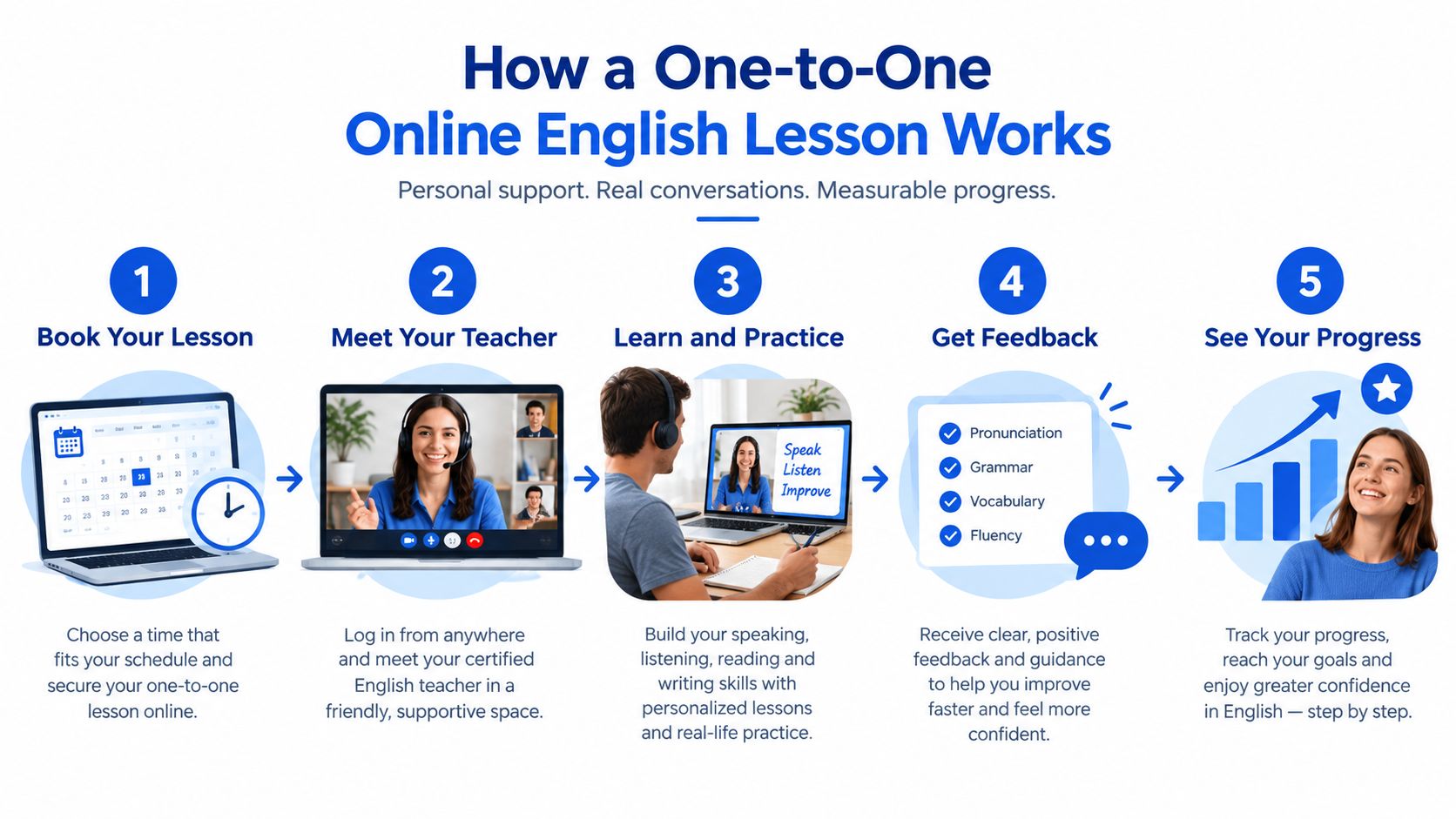
A good one-to-one lesson for an adult is structured enough to be useful and flexible enough to stay conversational. It usually doesn't feel like school, because the tutor is trying to make your speaking time count, not fill a lesson with explanations.
A typical 60-minute session
The first five minutes are usually a check-in. The tutor reviews last week's homework, listens for pronunciation carryover, and confirms what felt easy or difficult since the last class. That short opening matters because adults forget less when the lesson connects to what they already tried.
The main block is the speaking task. It might be a role-play for a meeting, a picture description, or a problem-solving discussion, and the tutor tracks errors in real time without breaking the flow every few seconds. One controlled study of 34 adult Thai learners found that six months of online hourly tutoring significantly improved oral English fluency and moved participants from beginner to independent-user levels on the CEFR Global Scale, which supports the value of sustained speaking practice in a live format. Stonebridge's adult English course article
The final ten minutes are where the lesson becomes memory. The tutor gives focused correction, previews a few useful words or phrases for next time, and sends a written summary by email. In live classes, tutors often use a shared document for notes, a video platform with screen share, and a homework submission channel so the learner can return to the same material without hunting for it later.
Adults benefit when the correction happens during the task, then gets written down after the task. That way, fluency stays alive and accuracy still improves.
This structure is very different from a classroom lesson with twenty learners. In one-to-one tutoring, almost every minute can be tied to your own speaking goal, which is why adults with limited time often progress better with shorter, focused sessions than with broad exposure.
Qualifications and Teaching Approach to Look For
A tutor's profile can look polished and still be weak where it matters. Adults should look for proof that the tutor can teach speaking, not just that they know English.
What the credentials usually tell you
| Tutor Credentials and What They Signal for Adult Learners | What It Signals | What to Ask the Tutor |
|---|---|---|
| CELTA, Trinity CertTESOL, or equivalent | Formal training in teaching English and lesson design | “How do you adapt these methods for adult speaking goals?” |
| Relevant university degree | Broad subject knowledge and academic credibility | “How do you use your degree experience in adult lessons?” |
| Experience teaching adults specifically | Familiarity with working professionals, university students, and return learners | “What adult speaking problems do you see most often?” |
| Business English or exam-prep training | Ability to target job situations or structured assessments | “How do you work on meetings, interviews, or test speaking?” |
| Needs analysis before lesson one | The tutor plans from your real goal, not a stock syllabus | “What do you need from me before starting?” |
| Written notes after class | A sign that correction and follow-up are part of the method | “Do you send lesson notes or homework summaries?” |
For a broader look at one academy's teaching approach, Englify's teaching method page shows how a structured, adult-aware model can be presented in practice.
The method matters as much as the paper
A qualified tutor still needs a teaching style that suits adults. The best signs are simple, and they're visible in the first conversation. Does the tutor keep most of the lesson in English? Do they correct the mistakes that block communication first, or do they overload you with every minor error? Do they start with a needs analysis instead of opening the same worksheet for everybody?
Adults do best with a tutor who can say, in plain language, what will improve this month and how that will be measured. If the answers stay vague, the teaching probably will too.
Private, Small Group, or Self-Paced for Adults
A working parent with one free hour on Tuesday evening does not need the same setup as a job seeker preparing for interviews. Adult learners usually choose a format based on time, speaking pressure, and how much correction they want in the room.
How the main formats compare
| Comparing Tutoring Formats for Adult Learners | Typical Lesson Length | Speaking Time Per Learner | Best For | Main Trade-Off |
|---|---|---|---|---|
| Private 1-to-1 tutoring | 45 to 60 minutes | Very high | Targeted speaking work, fast feedback, interviews, presentations | Costs more, but usually moves faster |
| Small group classes | 60 minutes | Moderate | Conversation with peers at a similar level, confidence building | Less individual correction than private lessons |
| Self-paced study with tutor check-ins | Flexible | Low to moderate, depending on check-ins | Adults whose schedule changes week to week | Demands stronger self-discipline and follow-through |
Choosing by adult goal
Private lessons fit learners who need correction on specific speaking habits and want the shortest route to usable speech. Small groups suit adults who want interaction without being the only speaker in the room. Self-paced study works when the calendar keeps changing, but it only works if the learner follows the plan.
For a deeper comparison of group versus private formats, see this guide to group or private English classes.
A market report from DataIntelo's digital English learning market report says self-paced formats led at 31.74%, which helps explain why many adults default to a format that gives them little speaking time. That choice feels convenient at first, but convenience and speaking progress are not the same thing.
The question is simple. If your goal is speaking, choose the format that gives you the most live output per hour. If your schedule is unstable, choose the format you can sustain without dropping it after two weeks.
Planning Lessons Around CEFR Levels and Personal Goals
A tutor who plans well starts with a level, then builds toward a result. That's where CEFR helps, because it gives both learner and tutor a shared map from beginner to advanced.
How the roadmap works in practice
A placement result anchors the starting band, such as A1, A2, B1, B2, or C1. From there, the tutor breaks the term into blocks, often with a foundation phase, a functional speaking phase, and a topic-based fluency phase. British Council materials organize learning by CEFR levels from A1 to C1, which makes level-based placement and progression easier to explain and track. British Council CEFR overview
A sample path for an adult moving from A2 to confident B1 speaking might look like this:
- Weeks 1 to 4, foundation. Everyday routines, simple question forms, high-frequency verbs, and short personal answers.
- Weeks 5 to 8, functional speaking. Asking for clarification, handling short phone calls, and describing plans or problems.
- Weeks 9 to 12, topic fluency. Opinions, travel, work, and study situations with longer answers and less hesitation.
At the end of each block, the tutor should set a measurable speaking task. That might be a two-minute self-introduction, a mock meeting update, or a short opinion answer recorded on video. The structure is simple, but it gives adults something concrete to notice week by week.
Personal goals fit inside the same framework
A relocation conversation, a university presentation, and a job interview all sit inside the same CEFR backbone. The level tells you how complex the language should be, while the goal tells you which situations to practise. For learners who want a plain explanation of the levels themselves, this guide to English levels and CEFR is a useful companion.
A good plan does two things at once, it respects the level and it respects the reason you're learning.
Real Pathways for Working Professionals and Adult Learners
The same tutoring framework looks different depending on the adult's life. That's the point, because a course only works when it fits the learner's actual week.
A marketing manager preparing for a promotion might start at B1 and work toward meeting leadership over a term. The weekly task could be running a short project update, using persuasive phrases, and answering follow-up questions without freezing. By week twelve, the visible result is usually less hesitation and more control when speaking in a meeting.
A university student writing a thesis in English may begin at B2 and need cleaner academic speaking more than flashy vocabulary. Their weekly work can focus on argument structure, citation language, and speaking with a supervisor about revisions. By the end of the term, the student should sound more organised and less dependent on prepared notes.
A career changer moving from design to client-facing consulting might sit around A2 or B1 and need active vocabulary rebuilt from the ground up. Their weekly speaking task could be small talk, client introductions, and simple negotiation scenarios. By week twelve, they often sound more natural in first meetings and less trapped by direct translation from their first language.
What these paths have in common
- Clear speaking target. Each learner practises a real situation.
- Regular output. Speaking happens every week, not only before an exam.
- Visible change. The tutor can point to what improved, not just what was covered.
For adults in Morocco and Arabic-speaking contexts, the most useful tutor is usually the one who can connect English to work, study, travel, or daily communication without turning the lesson into a lecture.
How to Evaluate a Tutor Before You Commit
A placement call should feel like a diagnostic conversation, not a sales pitch. If the tutor asks the right questions, you'll learn a lot before paying for a package.
What to listen for in the first call
The tutor should ask about your current level, weekly availability, prior study methods that didn't stick, and the exact speaking situations you want to handle. If they don't ask about what failed before, they may repeat the same mistake with a new worksheet.
A strong trial lesson usually shows three things. First, the corrections feel targeted rather than random. Second, your speaking time is balanced, not dominated by tutor talk. Third, the tutor can describe the next 8 to 12 weeks, not only the next lesson.
If a tutor promises fluency in a fixed number of classes, treat that as a warning sign, not a confidence boost.
Red flags to watch for
- No level check. The tutor starts teaching without understanding where you are.
- Same material for everyone. Adult needs get ignored in favor of recycled worksheets.
- Big promises. Fixed results, fixed timelines, no discussion of effort.
- No progress notes. If homework and feedback are never mentioned, measurable improvement will be hard to prove.
One common enrollment model in reputable schools is evaluation before commitment. International House Budapest, for example, describes a free online placement test of about 30 minutes and a free trial lesson before joining, which shows how practical that approach can be. International House Budapest online placement test
For adults, that kind of screening is useful because it prevents a long contract from being based on hope. Compare two or three tutors against the same checklist, then choose the one who can explain the plan in plain language.
Your Next Step From Reading to Booking a Trial
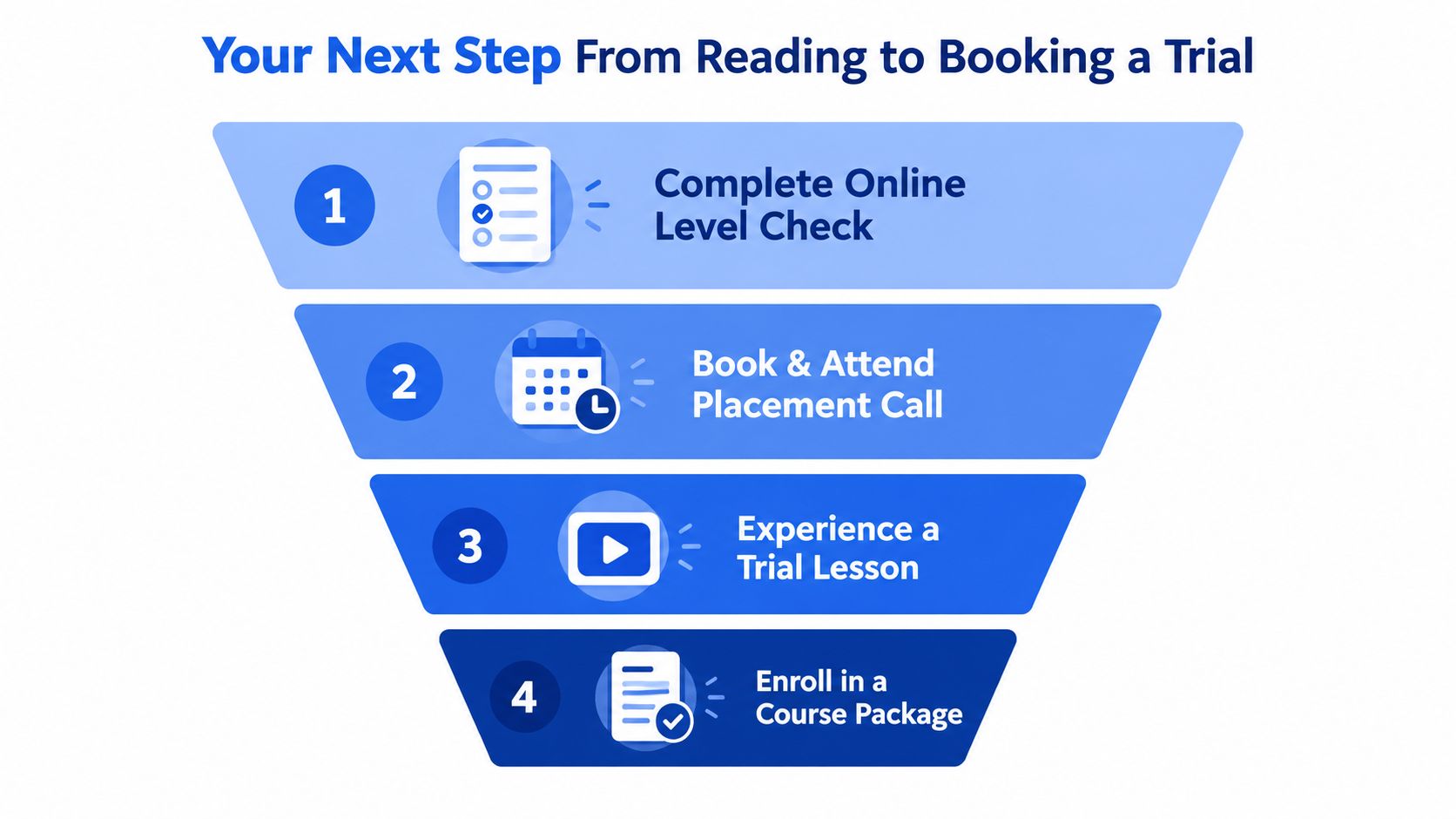
Start with a short online level check so you know your CEFR band, not just your guess. Then book a free trial session and use it to talk about goals, weak spots, and weekly availability in real terms.
After the trial, read the tutor's short plan carefully. It should name your target speaking situations, the lesson frequency, and how progress will be measured at 4, 8, and 12 weeks. If the plan is vague, ask for clarification before you commit.
Choose a starter block of 8 or 12 lessons instead of a large upfront package. That gives you a real chance to test the fit, the pace, and the way corrections are handled before you extend anything.
If you want a structured place to start, Englify offers live online English classes for adults through Google Meet, with private and small-group options, a free placement test, and a free trial session. If your goal is to speak more confidently at work, in interviews, or in daily life, that kind of setup gives you a practical way to test fit before you commit.