Knowledge hub
How to Learn English Online: A Practical Guide for 2026
Discover how to learn English online with effective strategies, real practice tips, and proven methods to speak confidently in 2026.

You're probably here because you've tried apps, watched a few videos, maybe even started and stopped a course, but speaking still feels slow, nervous, or stuck. That's a common point for learners who want to know how to learn English online in a way that changes what they can say in real life.
The short answer is simple, online learning works best when it gives you clear level goals, regular speaking practice, and feedback you can use. If you only collect vocabulary and grammar rules, progress stays invisible. If you combine guided lessons, live conversation, and review, you can move forward with much more confidence.
Table of Contents
- How to Learn English Online Without Wasting Time
- Define Your Level and Choose the Right Online Course
- Build a Weekly Routine That Sticks
- Get Real Speaking Practice Instead of Just App Study
- Track Progress and Stay Motivated Online
- Your Next Step to Start Learning English Online
How to Learn English Online Without Wasting Time
Most learners don't need more content. They need a better system.
The task is not to “study English online” in a vague way. The task is to become the kind of speaker who can answer a question, join a meeting, order food, explain an idea, or introduce themselves without freezing. That shift matters because online learning is full of tempting shortcuts, and many of them feel productive while they delay speaking.
What works better than random app use
A strong online path has three parts: input, practice, and feedback. Input gives you language to notice. Practice helps you use it. Feedback tells you what to fix before bad habits settle in.
That is especially important for Arabic-speaking learners, because many people can understand more English than they can produce. They know rules, but the sentence does not come out smoothly. Without correction from a teacher or speaking partner, pronunciation issues, word order mistakes, and hesitation often stay the same.
Practical rule: if your study plan does not include live speaking, it is probably incomplete.
A useful way to think about online English is this. Apps help you start. Guided classes help you improve. Live speaking helps you become usable in real situations.
Many learners also get stuck because they study with no destination. They do a little grammar, a little listening, a little vocabulary, then restart from zero the next week. A CEFR-based target gives structure, so instead of “I want better English,” you can aim for a specific level and skill set.
When your goal is clear, your choices get easier. You stop asking, “What should I do today?” and start asking, “What should I do this week to move one step closer to speaking more clearly?”
Define Your Level and Choose the Right Online Course
Before you pick a class, you need to know where you're starting. That sounds basic, but many learners skip it and end up choosing a course that is too easy, too hard, or focused on the wrong skill.
The CEFR gives you a practical framework. It has six levels, A1, A2, B1, B2, C1, and C2, and these fit into three bands, Basic User, Independent User, and Proficient User Council of Europe level descriptions. That makes progress easier to describe than a loose label like “intermediate.”
A simple placement test helps you avoid guessing. If you know your current level, you can match the right class format to your purpose. For example, a child who needs school support does not need the same structure as a professional preparing for meetings or an adult who wants travel confidence.
Match the course to the goal
Think about the reason you want English, not just the level. School support, university study, workplace communication, interviews, and travel all need different kinds of practice. A good course should make that difference visible.
One helpful marker is whether the course gives you live interaction. Online learning can be effective when the course design is strong and the learner gets enough guided practice, not just canned content. The distance-language evidence base also points to a common problem, learners lose feedback and speaking opportunities when they depend too much on asynchronous material Open University study.
The same principle applies when choosing between group classes and private classes. Small groups are useful if you need energy, peer interaction, and a chance to hear other learners. Private classes make more sense if you need targeted correction, a faster pace, or help with a very specific goal.
| Course Format | Best For | Interaction and Feedback |
|---|---|---|
| Small group live class | Learners who want guided conversation and peer practice | Regular speaking turns, teacher correction, shared discussion |
| Private class | Learners with a specific goal or weaker confidence | Direct feedback, personalised pacing, focused correction |
| App-only study | Quick revision and vocabulary drilling | Low interaction, limited speaking feedback |
A professional academy usually makes this choice clearer through structured levels, live classes, and progress tracking. One example is a free placement test that helps you see where you fit before you enroll, which you can access through this English level test.
Build a Weekly Routine That Sticks
A routine works only if it fits real life. If your schedule is full, the answer is not a bigger plan, it is a better one.
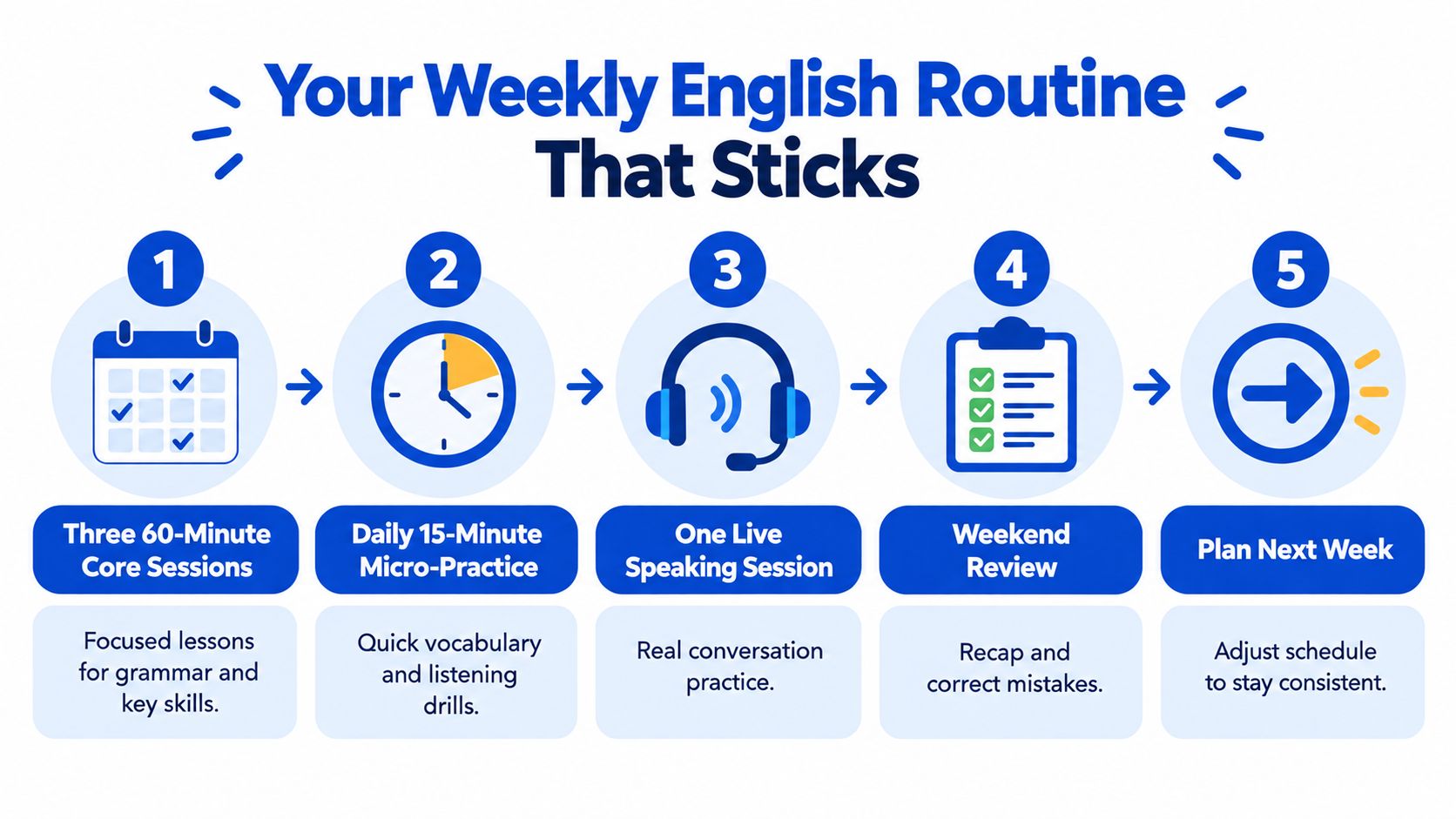
A practical online routine needs fixed anchors. For many learners, that means three live sessions, then short daily practice in between. This structure gives you enough repetition to build habits without turning English into a second job.
A schedule you can keep
Use live sessions for the parts that need a teacher, speaking, correction, role play, and guided review. Use short solo sessions for vocabulary, listening, and quick recap. That mix matters because progress usually comes from repeated contact, not from one long weekend study burst.
For a student, the week might include one lesson for school speaking tasks, one for grammar repair, and one for revision before exams. For a professional, the live sessions can focus on meetings, emails, presentations, or interviews. For a parent helping a child, the goal is consistency, not intensity, so fixed time slots matter more than long lessons.
A useful weekly pattern looks like this:
- Three core sessions: fixed live lessons for speaking, guided input, and correction.
- Daily micro-practice: 10 to 15 minutes of vocabulary review, listening, or shadowing.
- One review slot: revisit errors, useful phrases, and recording notes.
- One planning moment: decide next week's focus before the schedule gets messy.
If your classes are on Google Meet, ask whether recordings are available so you can replay the moments where your speech broke down. Google Meet's built-in recording saves sessions automatically to the organizer's Drive, and participants are notified when recording starts or stops, which makes it easier to review the lesson later Google Meet recording support.
Keep the live class for speaking, and keep the app for repetition. Do not ask one tool to do both jobs.
If you want a simple model to copy, use one lesson for new language, one lesson for speaking, and one lesson for correction and review. Then keep your daily practice small enough that you will do it, even on busy days. If you need a compact version of that habit, this 30-minute-a-day English routine guide can help you shape the daily side without overloading your week.
Get Real Speaking Practice Instead of Just App Study
Apps are useful for repetition. They are not enough for speaking confidence.
That's the main problem behind many online-English searches. People don't just want to click through lessons. They want to sound clearer, respond faster, and stop translating every sentence in their head. Self-paced formats can help with vocabulary and grammar, but they usually can't give you the live pressure and real-time correction that speaking needs.
What live practice gives you that apps cannot
A live class gives you interruption, and that is a good thing. A teacher can stop you when pronunciation breaks down, show a better sentence shape, and ask you to try again. That instant correction is what turns “I studied this” into “I can say this.”
The review evidence on online informal language learning points to a familiar weakness, many studies are not quantitative, and the outcomes are mixed. It also highlights recurring failure points such as reduced interaction, weak speaking practice, lack of personalized feedback, technical problems, low motivation, and poor readiness for online learning Taylor & Francis review. In plain language, passive study often feels safer than it is.
For Arabic-speaking learners, this usually shows up in predictable places. A learner may understand the meaning but struggle with sentence order, linking ideas smoothly, or hearing the difference between sounds they don't use often. That's not a sign of low ability. It's a sign that the learning method needs more speaking and more correction.
A practical speaking plan should include:
- Short live conversations: answer simple questions without reading from notes.
- Role-play tasks: practice meetings, interviews, travel, or customer situations.
- Correction moments: focus on grammar, pronunciation, and hesitation.
- Repeated speaking goals: use the same topic more than once, but say it better each time.
The market is also moving in this direction. Data shows that live online classes are projected to grow faster than self-paced models, which makes sense because people want more than passive content. The demand is shifting toward oral communication confidence, not just course completion global English e-learning market data.
If you're looking for a structured speaking path, online conversation practice inside an academy format can be more useful than app-only study. That's the kind of activity described in this English conversation practice resource, where the focus is on speaking, correction, and repeatable habits rather than silent completion.
Track Progress and Stay Motivated Online
Progress feels invisible when you only count hours. It becomes clearer when you measure what you can do.
A better question than “How long did I study?” is “Can I speak more clearly than I could before?” Online learning should show movement in speaking speed, confidence, and accuracy, not just time spent on a screen.
Use evidence, not guesswork
The clearest check is a before and after speaking sample. Record a short answer to the same type of prompt, then repeat it later and compare the two clips. If you have session recordings or learner reports, use them to spot whether pronunciation slips, missing words, and long pauses are shrinking.
The CEFR helps because it gives you a shared language for progress. A learner moving from one band to another should be able to handle more demanding language, understand more, and speak with more flexibility. The Council of Europe's global scale describes C1 users as people who can understand demanding longer texts, recognize implicit meaning, and express themselves fluently and spontaneously without obvious searching for expressions CEFR C1 global scale.
Motivation usually drops for a few predictable reasons. Learners feel alone, they miss correction, they hit technical issues, or they cannot tell whether the work is paying off. The fix is practical. Use a buddy system, ask for written notes, keep a backup slot, and make sure you can reschedule when life gets messy.
A simple progress checklist can keep you honest:
- Speaking fluency: do you pause less when answering familiar questions?
- Pronunciation: are common sounds and word endings clearer?
- Grammar control: do repeated mistakes keep showing up, or are they getting corrected?
- Vocabulary use: can you reuse useful phrases in a meeting, class, or conversation?
- Confidence: do you volunteer to speak more often than before?
One useful habit is to keep monthly speaking samples on the same topic. Listen for the same two or three weak points each time, then set the next practice around those points instead of adding more study hours. If two monthly samples still sound stuck in the same places, book a session that focuses only on those errors and ask for direct correction.
Your Next Step to Start Learning English Online
The cleanest path is not complicated. First, find your level. Then choose a course format that matches your goal. After that, build a weekly routine with live speaking, short daily practice, and regular review.
If you want English that helps you speak more clearly in real situations, look for a program that uses CEFR-based levels, live Google Meet classes, and feedback you can use. That kind of structure is what turns online study into measurable progress, especially when you need support for school, work, travel, or everyday communication.
Englify offers live online English classes through Google Meet, with small groups, private classes, a free placement test, a free trial session, learner reports, and CEFR-aligned levels from A0 to C1. For Arabic-speaking learners who want a more guided route, that setup makes it easier to move from passive study to real speaking practice with clear next steps.
If you want a structured way to begin, start with the free placement test and a trial session, then compare the class format with your goal and schedule. Englify gives you a practical way to do that with live lessons, speaking practice, and progress tracking in one place.