Knowledge hub
English Presentation Course: What to Expect in 2026
Looking for an English presentation course in 2026? Learn what to expect, how to choose the right program, and boost your speaking confidence.
You can read a business email, understand a meeting update, and still go blank the moment someone says, “Can you present this in English?” That gap is exactly why an english presentation course exists. It's not just about speaking more, it's about turning English into something you can use clearly, under time pressure, in front of people.
For many Moroccan learners, the hard part isn't grammar alone. It's holding your structure, finding the right words fast, sounding intelligible, and staying calm when someone looks at you and waits.
An effective course treats presentation performance as a full communication task, not a memorized speech. The right one helps you build language, delivery, structure, and confidence together, then checks progress with recordings, feedback, and repeated practice.
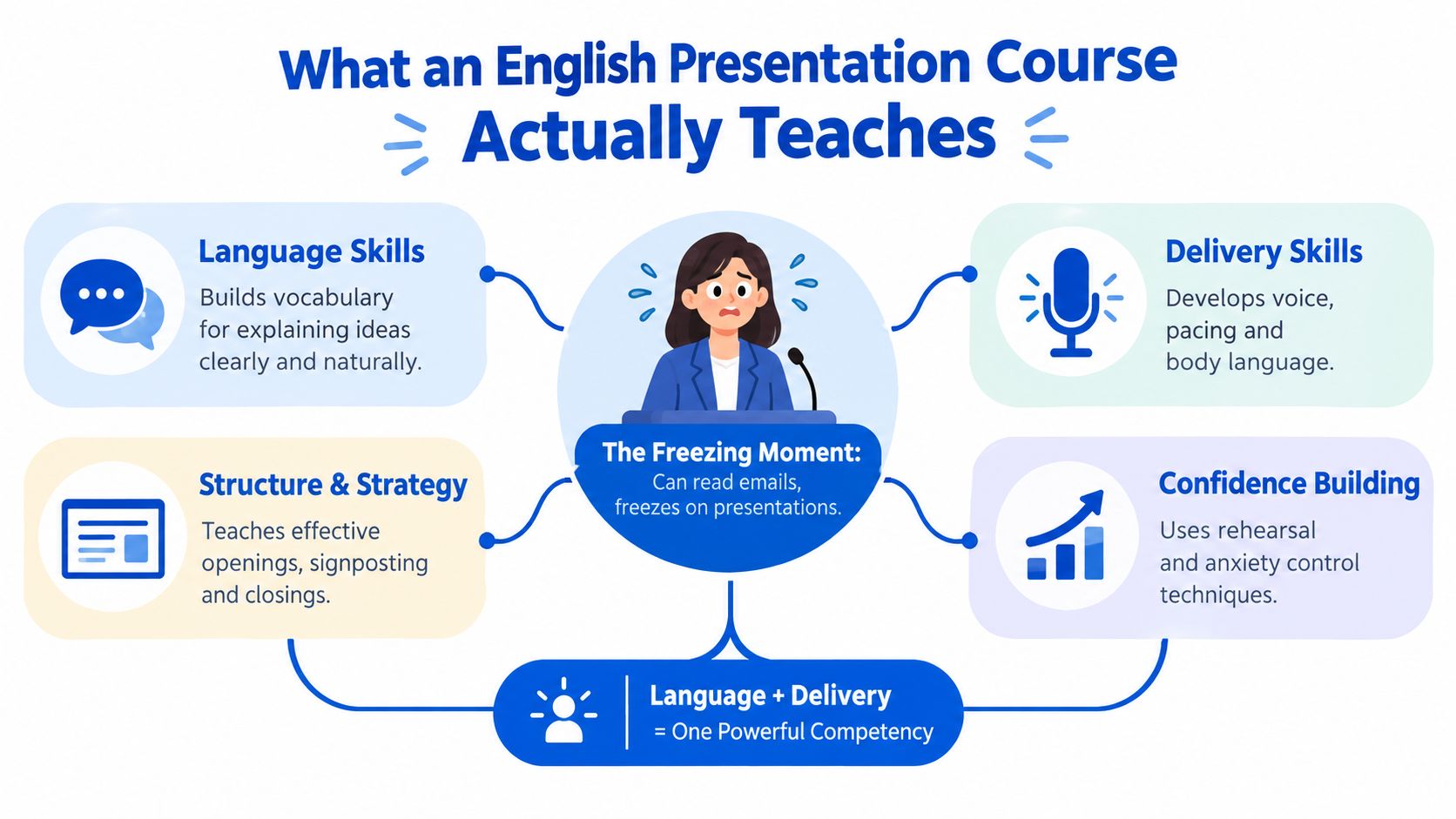
Table of Contents
- What an English Presentation Course Teaches
- The Two Skill Tracks Inside a Quality Course
- A Realistic Week-by-Week Syllabus and Lesson Template
- Group Classes, Private Sessions, and Hybrid Options
- Who an English Presentation Course Is Built For
- Performance Anxiety, the L1 Shortcut, and Other Underserved Angles
- How to Choose a Course Without Getting Sold To
- FAQs and Your Next Step
What an English Presentation Course Teaches
The learner I picture most often is someone who can handle English in private but freezes when the room turns toward them. They may manage emails, WhatsApp messages, or reading tasks, then suddenly lose their footing when asked to present a quarterly update, defend a project, or explain a chart.
A strong English presentation course sits between a language class and a performance workshop. It teaches you how to organize ideas, open clearly, signpost the flow, explain evidence, answer questions, and use your voice and body in a way that supports the message. That matches the CEFR view of communication as more than accuracy alone, because speaking in public combines interaction, production, reception, and mediation in one task. North Helsinki CEFR Companion Volume
What to expect from a real course
A useful course should cover fluency, vocabulary, pronunciation, comprehension, organization, audience adaptation, and non-verbal delivery. It should also give you a repeatable structure, not just a list of “useful phrases.” A learner should finish able to say, in one sentence, what the course trains, “It helps me plan, deliver, and handle a presentation in English.”
Practical rule: if a program only teaches slide words and opening phrases, it is too narrow.
The strongest courses also fit workplace reality. A presentation in English may be a university talk, a client update, a job interview answer, or a meeting report, and each one asks for a slightly different level of control. For a practical comparison point, see English business presentations, which shows the kind of business-facing content a presentation-focused course should cover.
The key question is whether the course treats speaking as a skill you can shape step by step. If it does, you are in the right place. If it treats presentation as a one-time speech, you will probably leave with notes, not confidence.
The Two Skill Tracks Inside a Quality Course
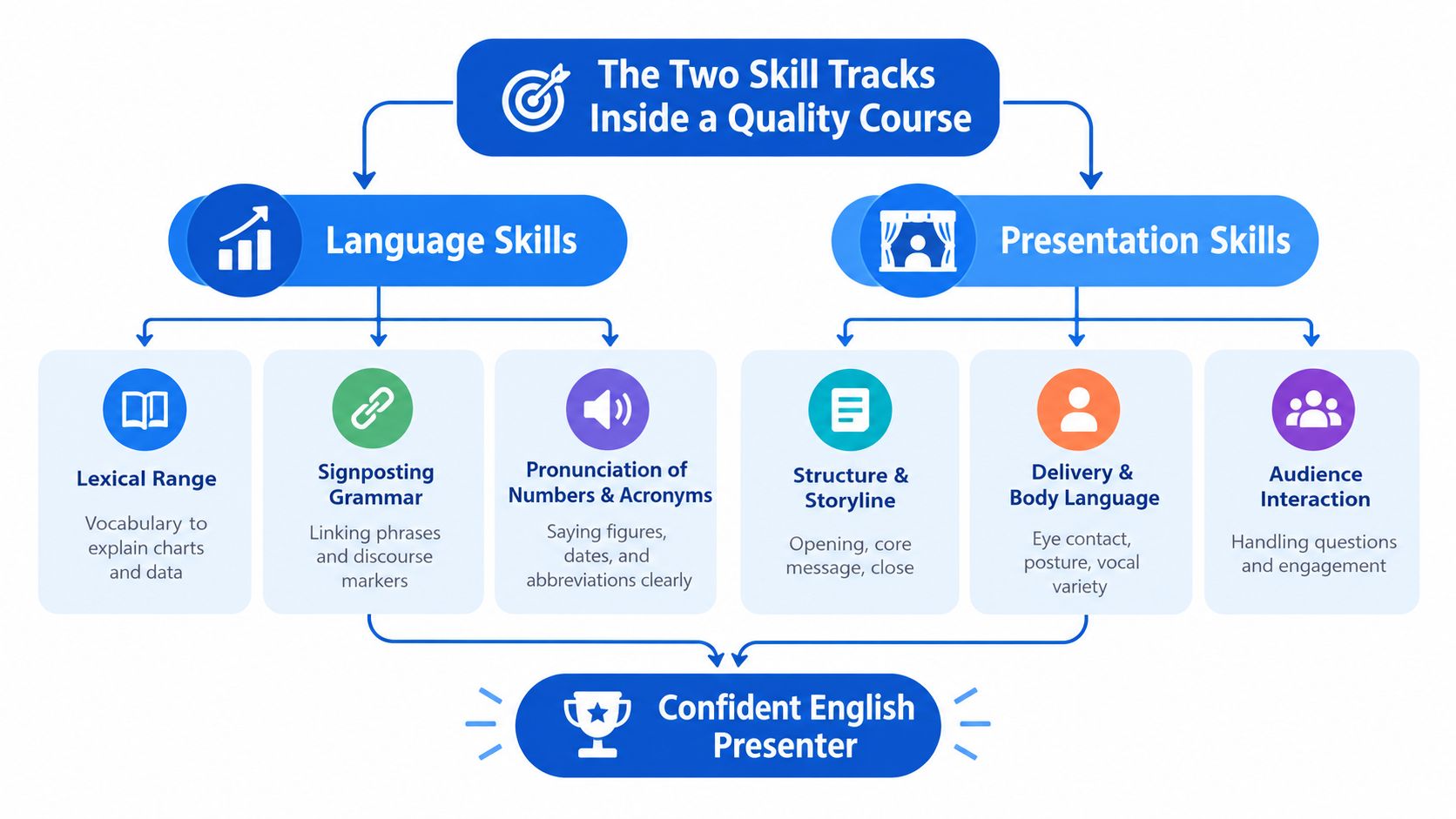
A good course works on two tracks at once. Language skills help you say what you mean. Presentation skills help people follow, trust, and remember what you said.
Language is the engine, delivery is the steering. You can have a powerful engine and still drift across the road if you can't control the car. In presentation training, you need both.
Language skills
This track builds the words and sentence patterns you need in front of people. That means vocabulary for describing trends, data, and comparisons, plus grammar for signposting, linking causes and effects, and moving from one point to the next without sounding choppy. It also includes pronunciation of numbers, dates, acronyms, and technical terms, because those are often where learners hesitate first.
Presentation skills
This track covers eye contact, gesture, pacing, voice, posture, and slide handoff. It also includes how to listen to a question, how to pause without panicking, and how to return to your structure after a distraction. The CEFR framing matters here too, because presentation performance should be assessed in several dimensions, not squeezed into “grammar right or wrong.”
A solid rubric can separate criteria like message structure, signposting, intelligibility, lexical range, grammatical control, delivery speed, eye contact, gesture, and responses to questions. That matters because a learner may have strong grammar but weak pacing, or good ideas but poor structure. If a provider can't explain what they assess, they may not be measuring progress properly.
A course that scores only accuracy is missing half the picture.
If you're comparing academies, ask them what their rubric looks like and how they give feedback. A clear answer tells you they're teaching a performance skill, not just a language topic. Englify's how we teach page is a good model of the kind of clarity learners should expect from any academy that takes presentation training seriously.
A Realistic Week-by-Week Syllabus and Lesson Template
The weakest presentation courses usually save everything for the final speech. That feels dramatic, but it's not good teaching. Learners improve faster when they rehearse, receive feedback, revise, and try again.
A sample course rhythm
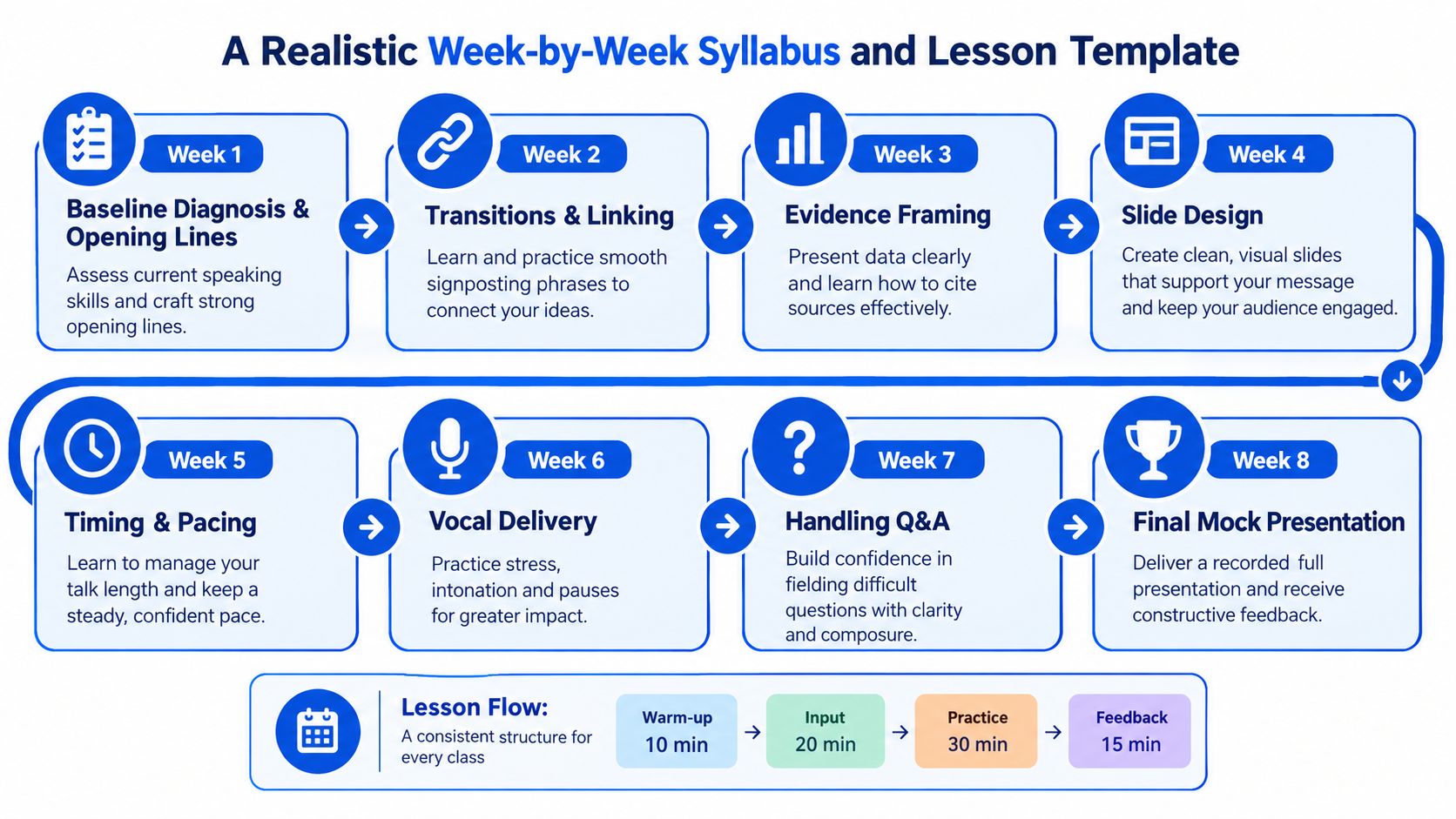
A realistic course can run as a sequence of focused stages. One practical version starts with a short baseline presentation, then moves into openings and structure, then into transitions and evidence, then into slides and timing, then into Q&A, and finally into a recorded presentation with feedback. That sequence follows the rehearsal cycle used in presentation training, where progress comes from repeated preparation, rehearsal, feedback, and revision rather than one high-stakes performance.
A simple 60-minute lesson can look like this:
- 10 minutes of modeling, where the teacher shows a short presentation segment and highlights useful language.
- 15 minutes of planning, where learners outline their own talk or adapt a topic.
- 20 minutes of small-group rehearsal, where they speak, stop, restart, and refine.
- 10 minutes of feedback, where the teacher or peers respond with specific corrections.
- 5 minutes of target setting, where each learner chooses one fix for the next round.
What each stage should produce
A good course should leave evidence behind. In week one, that might be a shaky baseline recording. Later, it becomes a stronger opening, cleaner transitions, a clearer conclusion, or a calmer response to questions. By the end, the learner should be able to compare two short recordings and see what changed.
The University of Sydney's guidance on presentation structure is useful here because it reinforces a simple planning habit, introduction, body, conclusion, with each section doing a different job. It also recommends assigning a time limit to each section and cutting examples if the talk runs long. University of Sydney presentation structure guidance
A provider who can explain the course week by week is usually thinking like a teacher, not a salesperson. That's what you want. A learner should be able to look at the syllabus and know exactly what each week is training.
Group Classes, Private Sessions, and Hybrid Options
The format matters as much as the content. Some learners need the energy of a group. Others need privacy, repetition, and personal correction. A few do best with both.
| Criterion | Small-Group Class | 1-to-1 Private Class | Hybrid / Workshop |
|---|---|---|---|
| Speaking time per session | Shared with peers, so each learner speaks less but hears more models | High, with most of the session centered on one learner | Mixed, short group input followed by focused rehearsal |
| Feedback turnaround | Useful, but often less individualized | Fast and tailored to the learner's own target presentation | Strong during the private practice part |
| Scheduling flexibility | Moderate, because the group needs a shared time | High, especially for busy professionals | Moderate to high depending on the format |
| Typical cost band | Usually lower than private lessons | Usually higher per hour | Often sits between the two |
| Best fit | Learners who want peer rehearsal and a structured environment | People preparing for a specific interview, defense, or work presentation | Learners who want both interaction and individual polishing |
In Morocco, many buyers get stuck here. They compare prices before they compare learning design. That usually leads to a bad match, because a shy learner facing an interview needs a different setup from a teenager practicing class presentations or a manager preparing a client update.
A quick decision test helps. If the learner needs repeated correction on their own material, private sessions usually make sense. If they need peer exposure and a lower-cost rhythm, a group class may be enough. If they need both, a hybrid format can work well.
Englify's group or private English classes page is a practical comparison point for learners trying to choose format before they commit.
Who an English Presentation Course Is Built For
Different learners need different parts of the same course. A student defending a thesis does not need the same rehearsal pattern as a job seeker preparing interview answers, even if both need clear English and calmer delivery.
Four common learner profiles
University students usually need structure, timing, and practice with follow-up questions. The most useful features are recorded self-review, thesis-defense simulation, and timed delivery.
Working professionals often need slides, evidence framing, and quick recovery when an audience interrupts. For them, the important features are Q&A drills, presentation rehearsal with real workplace topics, and feedback on phrasing that sounds too vague or too direct.
Job seekers need concise answers, clear self-introduction, and confidence under pressure. They benefit most from interview simulations, vocabulary for achievements, and practice handling follow-up questions.
Returning learners often understand more English than they can produce. They tend to benefit from private rehearsal, recordings they can watch back, and a slow rebuild of speaking confidence.
Helpful filter: choose the format that matches your speaking pressure, not just your current level.
A teacher who has watched hundreds of learners knows this pattern well. Strong readers can still freeze. Quiet learners can still become effective presenters if the course gives them enough safe repetition. That is why a course should be judged by the learner's goal, not by a generic promise that it “improves speaking.”
For Moroccan learners, this is especially relevant in schools, universities, and offices where English is often used for performance, not just study. The right course does not ask, “How good is your English?” It asks, “What do you need to do with your English next week?”
Performance Anxiety, the L1 Shortcut, and Other Underserved Angles
Presentation anxiety is often treated like a confidence issue. That framing is too simple. A learner can be capable in English and still freeze in a high-stakes setting because the pressure changes the task.
A recent study of 76 final-year English majors found that 71.5% experienced anxiety during English job interviews and 60.7% during in-class presentations, with limited vocabulary, low confidence, fear of mistakes, and fear of negative judgment among the strongest causes. Another study of 121 English learners found no significant relationship between overall English proficiency and public-speaking anxiety, with r = .025, p = .784. Frontiers in Education study on English presentation anxiety
Why first-language planning can help
That finding matters because it challenges the idea that grammar alone solves presentation problems. For multilingual learners, a smarter course may begin in the learner's first language, then move into English. A student might map the argument in Arabic, Darija, or French, decide the logic, and only then convert the key points into English.
Research on Japanese university students found that performance improved when learners first prepared and presented ideas in their L1 before delivering them in English, because the first stage reduced language anxiety. That kind of bridge helps learners stop translating every sentence mentally and start thinking in chunks, which is much closer to natural speech. IAFOR research on L1-supported English public speaking
Don't ignore the slide and recovery side
Slides matter too. Accessibility guidance recommends built-in slide layouts, meaningful alt text, sufficient contrast, minimal animation, descriptive titles, and avoiding colour as the only carrier of meaning. It also points to the 7x7 rule, with no more than seven lines of text per slide and about seven words per line, while some university guidance recommends a minimum content font size of 24 points and another recommends 28 points or higher. EICC accessibility guidance on PowerPoint
Recovery strategies are just as important as prevention. Learners should practise what to do if they forget a word, lose the thread, misunderstand a question, or get a critical reaction. A simple recovery move is to pause, restate the point in simpler language, and continue. That is not weakness, it's presentation control.
How to Choose a Course Without Getting Sold To
A buyer who knows what to ask is harder to mislead. Start with the trial class, because it shows how the teacher corrects, how much learners speak, and whether the class feels like practice or entertainment.
Use a short checklist before you enroll:
- Trial access: Ask whether there's a free placement test and a free trial session.
- Teacher clarity: Ask who teaches, how feedback is given, and whether the teacher can handle presentation work, not just general conversation.
- Group size or private setup: Ask how many learners are in a group and how speaking turns are managed.
- Reporting: Ask whether you'll receive written feedback, progress notes, or learner reports.
- Recordings: Ask whether sessions are recorded for review.
- Certificate terms: Ask what completion means and when the certificate is issued.
- Cancellation policy: Ask how missed sessions are handled.
Moroccan learners will also see pricing in MAD. In published offers, that usually separates kids group plans, adult multi-session plans, and private hourly rates. Compare the format first, then the price. A cheaper course that doesn't give enough speaking time can cost more in lost progress.
Englify is one option in this space, and it publishes a free placement test, a free trial session, and course information in MAD, which makes it easier to compare before committing. The important point is not to buy on price alone, or on promises of guaranteed results.
FAQs and Your Next Step
A typical presentation course can be short or extended depending on the goal. A learner preparing one interview may need a few focused sessions, while someone building long-term speaking confidence may need a full term with repeated practice.
Certificates are usually useful as proof of completion, but employers care most about what you can do in the meeting or interview. Recorded sessions are valuable because they let you compare your first attempt with your later one, and that's where progress becomes visible.
If you're starting from zero, the cleanest first step is a placement test, then a trial session, then a format choice based on your real goal. That keeps you from enrolling in the wrong class just because the schedule looked convenient.
For Moroccan learners who want an online academy with live classes, CEFR-based levels, and presentation practice built into the learning process, Englify is one place to begin with a free placement test and a free trial. If you've been delaying because speaking in public feels heavy, start there and use the trial to see what kind of feedback helps you move.
If you want a presentation course that treats speaking as a skill you can build, not a personality trait you either have or don't, Englify can help you start with a free placement test and a free trial session. Visit Englify to compare options, check the format that fits your goal, and take the first step toward speaking English with more structure and less fear.