Knowledge hub
English Classes for Parents: Top Online Options in Morocco
Discover english classes for parents in Morocco with flexible online options. Learn practical English skills to support your family and boost your confidence.

You're finishing work, your child's online English lesson is about to start, and someone needs to find the headphones. You want to help, but your own English is limited and sitting beside the screen all evening isn't realistic. Choosing a course shouldn't mean taking on another teaching job.
English classes for parents can mean lessons you're choosing for your child or training you need yourself. In either case, the right choice starts with a practical question: what should the learner be able to do, and what can your family realistically sustain?
Table of Contents
- Where Most Parents Start and Where They Get Stuck
- Class Formats That Actually Fit Different Goals
- Reading CEFR Levels Like a Parent, Not a Teacher
- Supporting Your Child Without Speaking English Yourself
- Pricing, Schedules, and What Reports Should Tell You
- Choosing a Provider With a Parent's Checklist
- A Realistic Weekly Plan for a Working Family
- Your Next Step and How to Use a Trial Wisely
Where Most Parents Start and Where They Get Stuck
A Moroccan parent might be comparing an evening group course with private weekend lessons while also managing school pickup, homework, and work commitments. The cheapest advertised package looks attractive, but it says little about whether the child will speak, receive feedback, or attend consistently.
Choose around a communication goal, not a course label. A child who needs confidence answering questions has a different priority from a teenager preparing for an oral exam. A parent preparing for a job interview needs a different lesson again.
Start with the learner's actual problem
Before contacting an academy, write down what isn't working. Perhaps your child recognises vocabulary but freezes when asked a question. Perhaps you can read a work email but struggle to explain your experience aloud.
Use these questions to narrow your options:
- Goal: What conversation or task should become easier?
- Availability: Which lesson slots survive a normal busy week, not just an unusually quiet one?
- Evidence: What will the teacher show you beyond completed worksheets?
- Budget: What's included in the quoted fee, and what commitment are you making?
Don't automatically choose a beginner class because the learner lacks confidence. Ask for an assessment that includes speaking and listening, rather than relying only on school marks or a grammar quiz.
Practical rule: Buy teaching for the learner's difficulty, not extra supervision for the parent.
Your own English level shouldn't determine whether your child can enrol. However, the provider should explain what support a young learner needs to connect, follow activities, and stay safe online.
A workable choice balances format, communication targets, total cost, and clear reporting. If an academy can't explain those plainly before payment, keep comparing.
Class Formats That Actually Fit Different Goals
Small groups, private lessons, children's programmes, and Business English aren't interchangeable. Some describe class size; others describe the audience or content. A children's programme, for example, can run in either a group or a private format.
The options described in this comparison of group and private English classes include small groups capped at 6 learners, private 1-to-1 lessons, and age bands of 4–7, 8–11, and 12–17; a 9-year-old needing conversation confidence is a useful example of someone to consider for an age-appropriate group.
Match the format to the task
Small-group live classes suit learners who need regular exchanges with classmates. For the child who hesitates to speak, answering a peer's question can be a useful target. During a trial, check whether the teacher involves quieter learners rather than accepting answers only from the most confident child.
A group isn't the right default when the learner needs concentrated help on a specific weakness or can't attend the shared timetable. Small size alone doesn't establish teaching quality.
Private lessons suit focused goals and personalised pacing. For a teenager preparing for an oral school exam, ask whether the teacher can work with the relevant question types, practise follow-up questions, and give feedback on the learner's actual answers. Don't pay for private teaching if it just reproduces a generic worksheet lesson.
Age-banded children's programmes deserve attention because content must fit the learner, not just their vocabulary level. Ask to see sample activities. A teenager shouldn't have to work through material designed for much younger children, while a younger learner shouldn't be expected to follow an adult-style lecture.
Business English is relevant when you're the learner. If you're preparing for an interview, request practice introducing your experience, explaining responsibilities, and responding to unexpected questions. A course built around workplace vocabulary alone won't address that goal.
Class formats at a glance
| Format | Best for | What to verify |
|---|---|---|
| Small-group live classes | Conversation with classmates | Speaking opportunities, turn-taking, shared timetable |
| Private lessons | Specific goals and individual pacing | Personalised content and targeted feedback |
| Age-banded kids programmes | Activities suited to children or teenagers | Age fit, level fit, and suitable materials |
| Business English | Interviews and workplace communication | Tasks connected to the parent's actual work |
My recommendation: choose a group when peer conversation fits the goal and timetable. Choose private teaching when the learner needs focused preparation or a pace the group can't accommodate. Choose the audience-specific programme only after checking how the class operates.
Reading CEFR Levels Like a Parent, Not a Teacher
A level label is useful only when the academy can explain what the learner can do. CEFR, the Common European Framework of Reference for Languages, describes communication abilities rather than counting vocabulary or completed lessons.
The official framework has six levels, A1, A2, B1, B2, C1, and C2, grouped into Basic, Independent, and Proficient User categories, as explained in the Council of Europe's CEFR level descriptions. Academies may use A0 as a practical label for complete beginners; it isn't an additional official CEFR level.
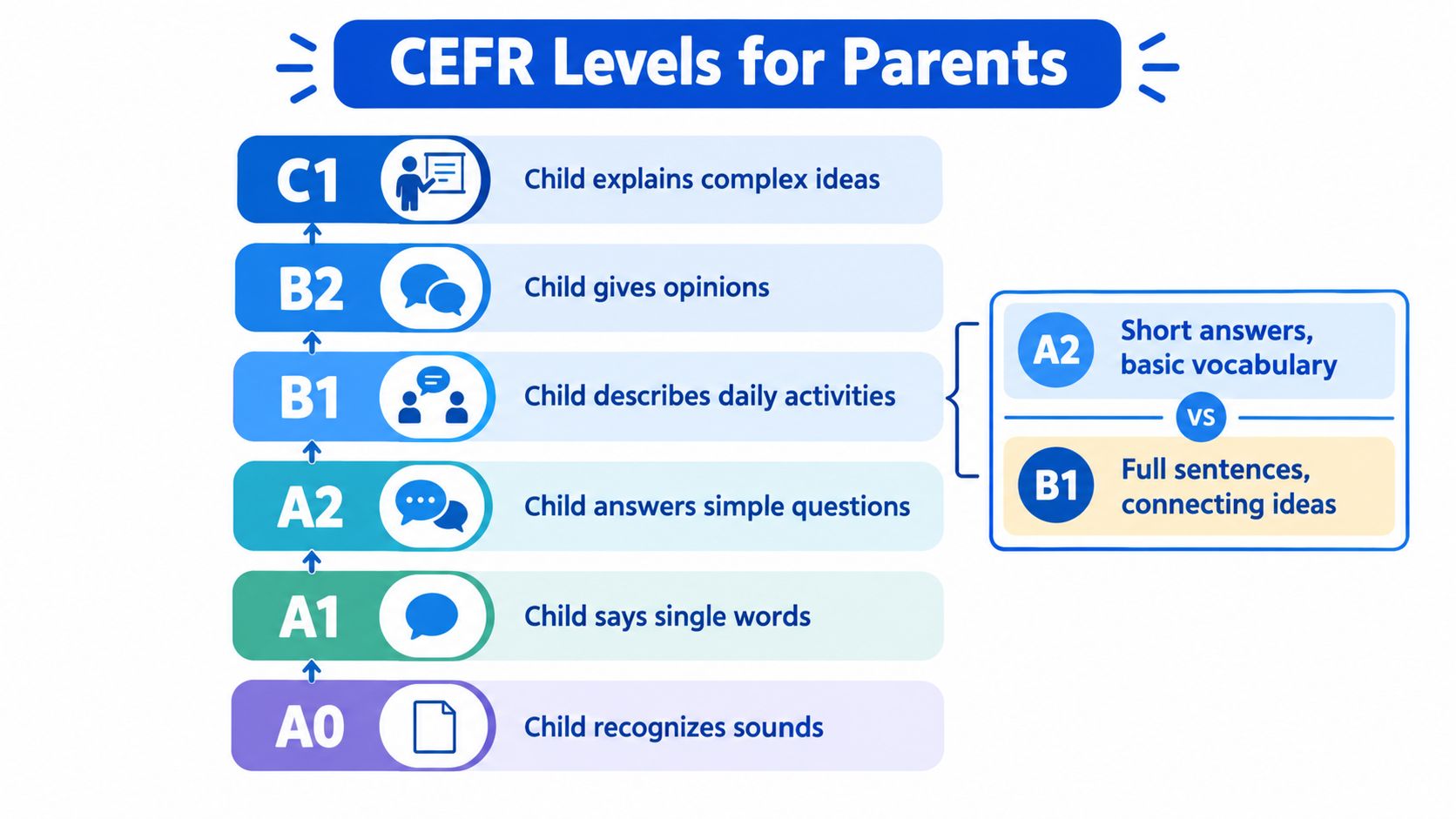
Treat the ladder as a guide, not a grading shortcut
The infographic offers quick memory prompts, not complete assessment criteria. Saying isolated words doesn't establish an entire level, and giving an opinion doesn't automatically demonstrate advanced proficiency.
Use this parent-facing interpretation:
| Level | What to ask the teacher to demonstrate |
|---|---|
| A0 | Beginning recognition and participation |
| A1 | Introductions and simple personal questions |
| A2 | Routine exchanges and familiar descriptions |
| B1 | Connected explanations and unprepared familiar conversations |
| B2 | Sustained discussion with supported opinions |
| C1 | Flexible expression of complex ideas |
The important contrast is A2 versus B1. At A2, the learner handles simple routine exchanges; at B1, they can enter an unprepared conversation on familiar topics, connect ideas, and briefly explain reasons, according to Erasmus University's CEFR comparison.
For a child, ask whether they merely answer a rehearsed question about school or can continue when the teacher asks why they enjoyed a subject. That follow-up exposes a communication demand that memorised answers can hide.
Ask for a skill profile
Listening, speaking, reading, and writing shouldn't disappear inside a single overall grade. The Council of Europe's searchable CEFR descriptors distinguish reception, production, and interaction, making separate skill reporting more informative.
A useful target might be understanding classroom instructions independently or describing an experience with connected ideas. Read this plain-language guide to English CEFR levels before discussing placement.
Reject promises of rapid level jumps without an assessment. Ask which abilities the teacher will work on during the term and how they'll demonstrate change.
Supporting Your Child Without Speaking English Yourself
You don't need to become the English teacher. Your job is encouragement, basic organisation, and communication with the academy. Explaining grammar, selecting teaching content, and correcting language belong to the instructor.
This distinction matters for busy families. A 2025 study involving 517 parents and six focus groups found that parents wanted to support online English learning but faced work pressures, digital-literacy limitations, and teaching responsibilities, alongside differences in parental English proficiency and teacher–student interaction, as reported in the study of parental involvement in young children's online English learning.

Before and during class
Before class, focus on access rather than teaching:
- Attendance: Make sure your child knows when the lesson starts.
- Equipment: Check sound, the meeting invitation, and any requested materials.
- Independence: Ask the academy to show your child how to join and request help.
- Communication: Tell the teacher if the child is tired, anxious, or struggling with the platform.
During class, stay available when the child needs help with technology or supervision. Don't answer questions for them, translate every instruction, or interrupt to correct mistakes.
If your child keeps looking to you before answering, discuss it with the teacher. The solution should be a teaching adjustment, not an expectation that you deliver the lesson alongside them.
After class without a second lesson
Ask your child to show you a phrase they practised. They can explain its meaning in Darija, Arabic, or French, then demonstrate how they'd use it.
You can also listen to a short recording together, notice an effort to speak, or invite the child to describe a familiar activity. The British Council's guidance for families supporting English learning emphasises encouragement, praise, and bringing English into family life without requiring advanced parental English.
Your child needs an interested parent, not a second examiner.
Keep these moments brief enough to survive your working week. Don't turn dinner into a vocabulary test or punish a child for forgetting a phrase.
If reading English reports is difficult, ask for an explanation in Arabic or French. If joining the platform is difficult, request a demonstration before the course begins. Support should fit your capacity, rather than depend on skills or time you don't have.
Pricing, Schedules, and What Reports Should Tell You
An advertised starting price isn't a complete offer. You need to know which programme it covers, what's included, and whether the schedule fits your child before comparing it with another academy.
Published entry points include kids classes from 250 MAD/month, 3-month plans from 650 MAD, and private classes from 100 MAD/hour, as outlined in this guide to English course costs in Morocco. Treat these as starting figures, not personalised quotes or a national market average.
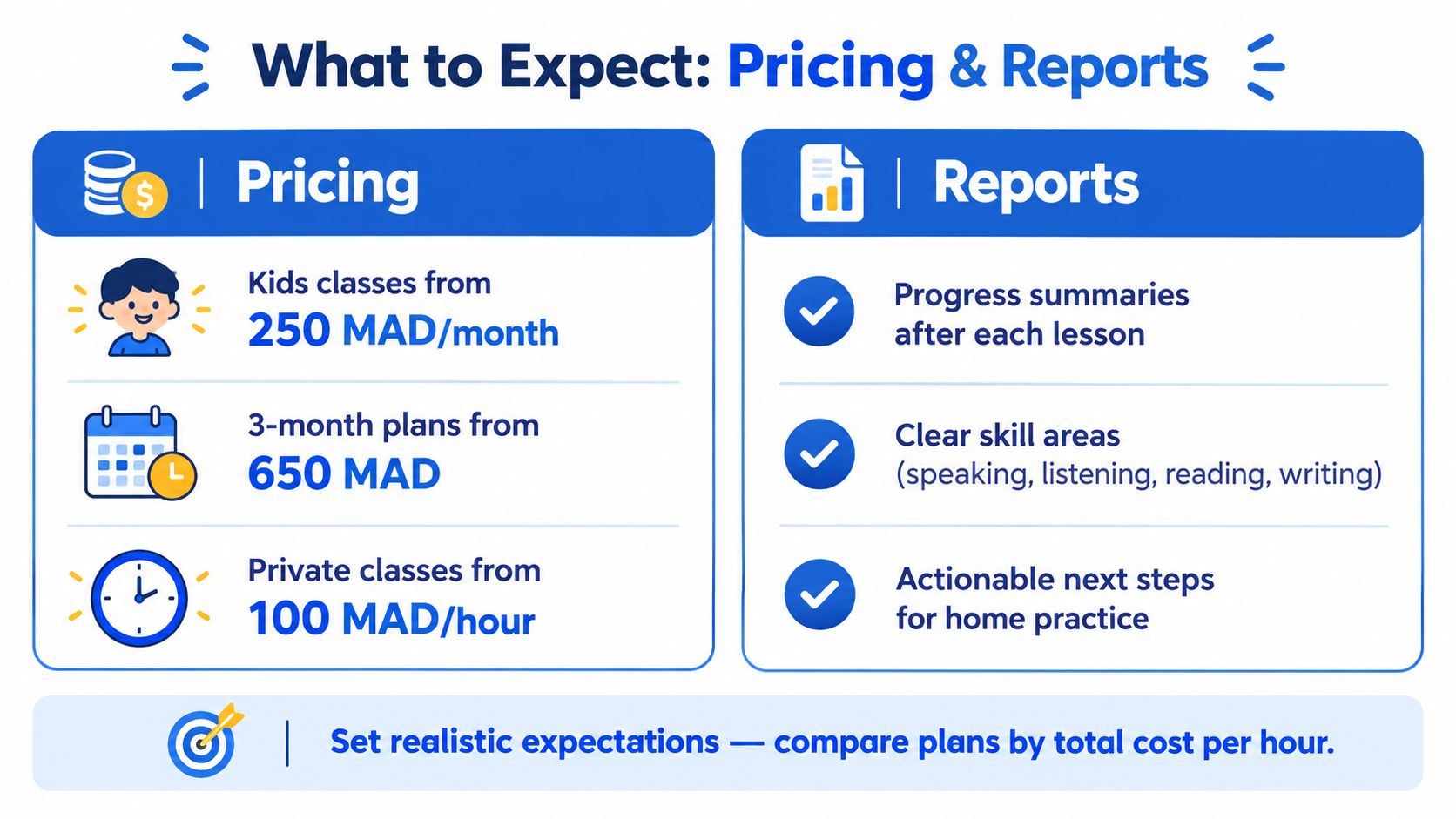
Compare the whole commitment
Request a written offer showing the programme, lesson allocation, payment arrangement, and any conditions. Don't assume differently labelled packages include the same teaching time or services.
Use a consistent comparison:
- Total cost: What will you pay for the complete enrolment period?
- Included teaching: Which live lessons does that payment cover?
- Additional charges: Are materials, assessments, or certificates included?
- Missed lessons: What happens if your child can't attend?
- Practical timetable: Does the proposed slot fit school, transport, meals, and bedtime?
Compare cost per included live teaching hour when the academy provides enough information to calculate it. Don't derive it from a headline price while guessing the lesson allocation.
Judge visibility as carefully as price
For Google Meet lessons, check how invitations arrive and who handles connection problems. Ask about recording availability and access conditions rather than assuming every class can be replayed.
Written reports should tell you what the learner attempted, where they succeeded, and what the teacher will address next. A report saying only that your child participated well doesn't give you enough information.
Ask for a sample report with identifying details removed. Look for an observed task, a difficulty, and a practical next step, rather than a page of generic compliments.
The trial evaluation should explain the proposed placement and any uncertainty the teacher needs to assess further. Ongoing reports should let you see whether the learning targets remain appropriate.
Parent visibility matters more than a small price difference. A lower fee isn't good value if you can't establish what the learner is practising or why the teacher chose it.
Choosing a Provider With a Parent's Checklist
A polished website can't show you how a teacher responds when a child doesn't understand. Use the trial, sample materials, and written answers to separate an appealing presentation from a workable course.
Check qualifications and policies, but don't treat a certificate or a friendly sales conversation as proof of teaching quality.
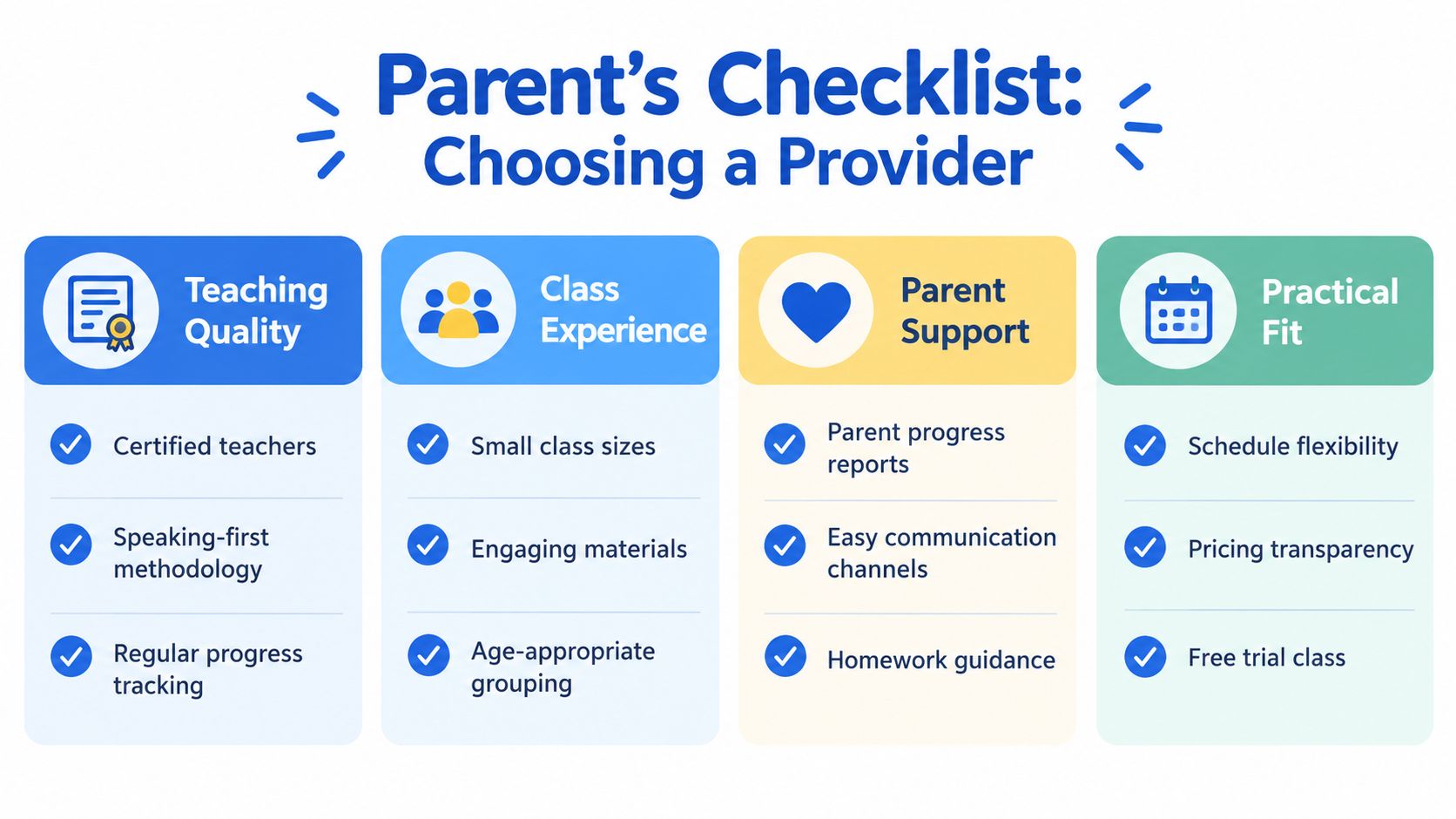
Check the commitments behind the features
- Teaching quality: Ask about relevant teaching certifications, the speaking-first approach, and how the teacher gives corrective feedback.
- Class experience: Confirm the group limit, age and level matching, and the materials your child will use.
- Parent experience: Check written reporting, WhatsApp communication in Arabic or French, homework guidance, and rescheduling rules.
- Trust signals: Request transparent pricing in MAD, clear curriculum targets, and an explanation of any completion certificate.
A certificate of completion records course completion. Don't assume it's an external qualification or independent proof of proficiency.
Likewise, distinguish a choice of available time slots from permission to reschedule a missed lesson. Those are different commitments, and you need the relevant policy in writing.
A message you can send on WhatsApp
Adapt these questions to your child and send them before paying:
- Placement: How will you assess my child's speaking and listening?
- Teacher: What qualifications and experience are relevant to this age group?
- Lesson: Can I see the kinds of activities my child will do?
- Grouping: How do you match learners by age and ability?
- Updates: Can you show me a sample parent report?
- Language support: Can you explain progress and homework in Arabic or French?
- Policies: What happens when we miss a lesson, and what does the quoted fee include?
- Completion: What exactly does the certificate confirm?
Decision test: If the answer is vague, ask for an example or written policy before enrolling.
Compare the answers with your original goal. Don't choose an academy because it offers the longest feature list. Choose the arrangement whose teaching, communication, and practical conditions address your family's needs.
A Realistic Weekly Plan for a Working Family
Build the family calendar around confirmed lesson slots, then add short follow-up moments. Don't invent an ambitious home-study programme that requires you to be available every evening.
For example, if your agreed timetable includes three 60-minute classes, you could reserve a five-minute review on class days and a 15-minute weekend recap. That's a sample family routine, not a required study dose or a promise of results.
A calendar you can adapt
| When | Child's activity | Parent's role |
|---|---|---|
| First agreed class day | Attend, then demonstrate a phrase | Listen without testing grammar |
| Between classes | Use English in a familiar situation | Offer a prompt if convenient |
| Next class day | Attend and notice the teacher's next target | Read the update when available |
| Final class day | Try the target in conversation | Recognise the attempt |
| Weekend | Revisit a favourite task | Let the child lead the recap |
A real-life prompt could involve naming groceries, greeting a relative, or describing something enjoyable about the day. Let the teacher supply suitable language if you're unsure what to ask.
When the parent is learning too
Use parallel goals rather than making your child your tutor. You might practise introducing your job while your child describes a school activity, with each learner following their own teacher's guidance.
Don't measure the week only by attendance. Watch whether the child speaks, receives feedback, recalls language later, and uses it beyond the lesson.
The National Literacy Trust's consultation response on early-years screen use highlights the importance of activity quality and social interaction rather than treating all screen exposure alike. Live teaching should therefore be judged by participation, not merely by a child sitting at a screen.
Keep the routine workable. If your child is fatigued or distracted, discuss lesson timing and activity design with the teacher instead of adding more homework.
Your Next Step and How to Use a Trial Wisely
Start with a free placement test, then use a free trial session to judge whether the teaching fits. Placement establishes a proposed starting point; the trial lets you observe how the teacher works with the learner.
Don't spend the trial judging only whether your child appears happy. Enjoyment matters, but look for purposeful participation too.
Watch the teaching, not just the presentation
- Speaking opportunity: Does your child answer and attempt language rather than mainly listen?
- Feedback: Does the teacher help them improve without taking over?
- Materials: Are the activities suitable for their age and interests?
- Evaluation: Does the academy explain placement, observed strengths, and next steps in writing?
Afterwards, ask your child what they said, what felt difficult, and whether they'd feel comfortable returning. Compare their response with the teacher's evaluation, not just the sales explanation.
Choose a course you can sustain without becoming the instructor. Your contribution is to make attendance possible, notice effort, and stay informed; the academy must take responsibility for teaching.
Englify offers live online English and French classes through Google Meet, with small-group and private options, personalised content, and learner reports. Visit Englify to take the free placement test and arrange a free trial session, then use the trial to assess the fit for your child or your own learning goals.