Knowledge hub
When to Use Present Perfect Tense: Rules and Examples
Learn when to use present perfect tense: clear rules, time words such as for, since and yet, common mistakes and practice prompts for learners.
If you name a finished time like yesterday, last year, or in 2019, use the past simple, and if the period is still open, the experience matters more than the date, or the result affects now, use the present perfect. So why do so many learners memorize lists of time words and still freeze mid-sentence? Because when to use present perfect tense forms isn't really about the word at the end of your sentence. It's about what you're focusing on right now, and that shift in thinking makes the choice much easier to feel.
Table of Contents
- The Quick Rule
- The Main Meanings of the Present Perfect
- For, Since and How Long Questions
- Already, Yet, Just and Ever in Practice
- Common Mistakes and How to Fix Them
- Practice Prompts for Moroccan Learners
- Frequently Asked Questions
The Quick Rule
Use the present perfect with have or has plus the past participle when a past action connects to now, when the time period is still open, or when the exact time doesn't matter. Use the past simple when the time is finished or stated. The British Council guide to the present perfect identifies expressions such as today, this week, this year, so far, and until now as signals for an unfinished period.
The One-Line Test
If a finished marker like yesterday, last month, last year, or in 2019 appears, choose the past simple. If the period hasn't closed, or no time is given and the experience or result matters, choose the present perfect. You're not asking when exactly it happened. You're asking how that earlier event relates to your present viewpoint.
Compare these two sentences. I have lost my keys tells the listener the keys are still missing now, so the present situation is the point. I lost my keys yesterday reports a finished event at a stated time, even if you found them later.
Practical rule: Underline the time marker first. Finished time means past simple. Open time, no time, or a result that matters now means present perfect.
| Time marker | Tense | Example |
|---|---|---|
| today | present perfect | I have answered three emails today |
| this year | present perfect | She has visited four countries this year |
| so far | present perfect | We have finished two chapters so far |
| until now | present perfect | I have never missed a class until now |
| yesterday | past simple | I answered the email yesterday |
| last year | past simple | She visited four countries last year |
| in 2019 | past simple | I moved to Rabat in 2019 |
Notice today and this year in the table. The day and the year aren't over, so more emails or more trips could still happen. That's why this tense works so well for reporting progress at work, at university, and in daily updates.
Three Questions Before You Speak
- Is there a finished time marker? If yes, use the past simple, as in I sent it yesterday.
- Is the period still open, or does the experience or present result matter? If yes, use the present perfect, as in I have sent two files today.
- Which meaning are you expressing? Pick the wording that signals experience, a recent event, a continuing situation, or a change.
If you'd like extra revision material beyond this guide, you can explore English Language revision topics for broader grammar and language practice. Learners who want guided speaking practice can take Englify's free placement test to find their CEFR level from A0 to C1, then book a free trial session on Google Meet. All our lessons are online and live on Google Meet in Morocco time, nothing is pre-recorded, and your teacher corrects you while you speak. After each session, you also receive a written report with the phrases to reuse and the mistakes to drop.
The Main Meanings of the Present Perfect
Knowing the formula doesn't guarantee you'll choose it while speaking. You also need to recognize which meaning you're expressing, because each meaning pulls you toward different natural wording.
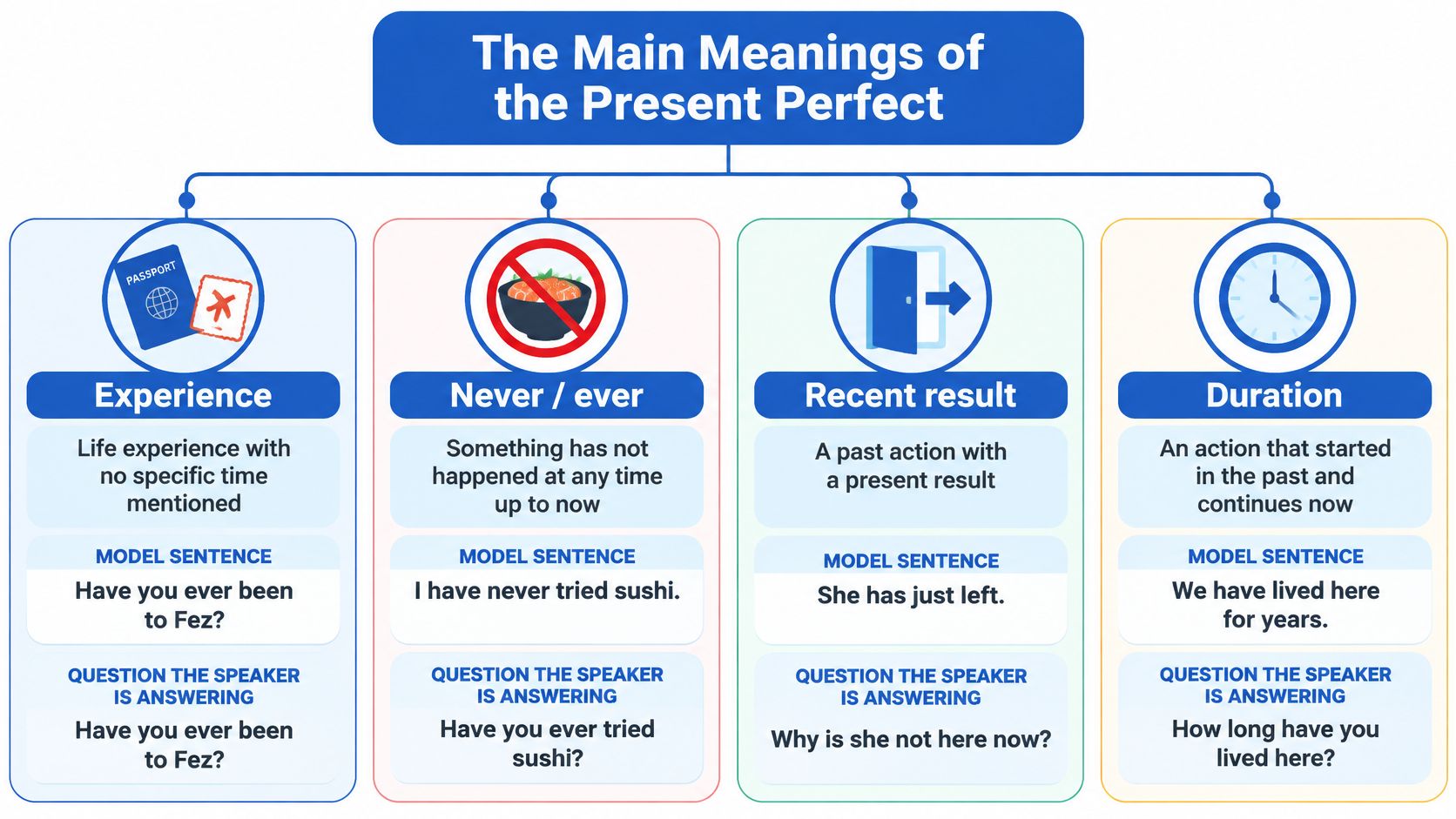
Experience With No Specific Time
Have you ever been to Fez? and I have never tried sushi both answer the question, at any point in your life up to now, has this happened? The exact date doesn't matter, so you don't give one. The pattern have you ever is your signal here. If your listener then asks when it happened, you switch to the past simple for that detail.
Recent Event With a Present Result
I have lost my keys answers a different question: why can't you open the door now? The train has just arrived works the same way, since the result is visible in the present moment. Look for patterns like has just arrived when the recency itself is the news.
Continuing Situation and Change
I have lived in Casablanca for six years means the person still lives there, answering how long this situation has continued up to now. A different use describes change, as in My English has improved a lot this year or The city has changed. Here you're comparing an earlier state with the present one, not reporting a single dated event.
A corpus-driven study of the present perfect identifies seven meanings, including present-relevant accomplishment, continuation from past to present, change of condition, experience, recency, discovery, and possession, and finds that textbooks tend to emphasize only a few familiar uses. That study also describes the form as one of the most challenging English time-reference forms for non-native speakers. Patterns like have discovered and has changed help because they tie each meaning to wording you'll say.
If the participle itself trips you up, our guide to present and past participles walks through forms like seen, done, and written. Before you speak, test your sentence with one question. Are you reporting an experience, a result, a duration, or a change? The answer usually points you straight to the right pattern.
For, Since and How Long Questions
When a state started in the past and continues now, two small words do most of the work. For introduces a length of time, and since introduces the starting point. The Oxford Learner's Dictionaries grammar practice on the present perfect gives the pair I have lived here for three years and I have lived here since 2021 to show the contrast.
Test It With a Question
Ask yourself which question your phrase answers. Since answers From when?, so it needs a moment like Monday, 2021, or the day you moved. For answers How long?, so it needs a duration like two weeks or three years.
Say for most of my life, not since most of my life, because most of my life measures a length, not a starting point.
| Word or question | Introduces | Example |
|---|---|---|
| for | a length of time | for three years, for two weeks, for most of my life |
| since | a starting point | since 2021, since Monday, since I moved here |
| How long? | asks for the duration | How long have you lived in Rabat? |
| From when? | asks for the starting point | Since when have you worked here? |
The matching question for both forms is How long have you studied English? Your answer can use either word, depending on what you emphasize. I have studied English for three years gives the length, while since 2022 gives the starting point.
You may also hear the continuous form. I have worked here for three years presents the situation as a state or total, while I have been working here for three years stresses the ongoing activity. Both are natural, and the difference is one of emphasis rather than correctness.
Watch the contrast with the past simple, though. I lived there for five years normally means that period has ended. I have lived there for five years means you're still there now.
Quick Practice Pair
- Sentence one: I have known my best friend ___ 2018. The answer is since, because 2018 is a starting point.
- Sentence two: We have waited ___ twenty minutes. The answer is for, because twenty minutes is a length of time.
Already, Yet, Just and Ever in Practice
Placement is simpler than it looks once you group these words by position. Already and just sit between have and the past participle, as in I have already sent the file and The train has just arrived. Yet goes at the end of questions and negatives, as in Have you finished yet? and I haven't finished yet.
Ever appears in questions about experience, such as Have you ever visited Essaouira? Its negative partner never goes before the participle, as in I have never flown business class. Keep that middle position in mind and most word-order slips disappear.
British and American Preference
Here's where rigid rules mislead learners. Cambridge Grammar on British and American differences reports that the present perfect is less common in American English than in British English, and American speakers often use the simple past where British speakers use the present perfect, particularly with already and yet.
So you'll hear British I've already eaten alongside American I already ate, and both convey that the eating happened before now. Neither sentence is a mistake. It's a regional preference, and listeners on both sides understand both forms without difficulty.
That matters in Morocco, where you might prepare for a British-style exam, then join a call with an American client an hour later. Accept both forms when you listen. When you speak, follow the variety your course, exam, or workplace uses, and stay consistent.
Some choices do change meaning, so don't treat every pair as interchangeable. Have you eaten yet? expects an answer tied to now and often leads to an invitation or a plan. Before you correct yourself, ask one question. Is the speaker stressing present relevance, or only placing the event in a finished past?
Common Mistakes and How to Fix Them
Most present perfect errors don't come from the auxiliary or the participle. They come from mixing up the meaning of this tense with the past simple, so the form is built correctly but chosen for the wrong job. That's fixable once you spot the pattern behind each slip.
One common source is transfer from French, where the present tense works with depuis to cover time up to now. That pattern can produce I am here since two years in English. Learners from many language backgrounds meet similar transfer patterns, so treat it as a predictable step rather than a personal fault.
| Learner sentence | Problem | Correction |
|---|---|---|
| I have met her yesterday | finished time marker with present perfect | I met her yesterday |
| I have been to Paris in 2019 | stated finished year | I went to Paris in 2019 |
| I am here since two years | present tense with a starting point | I have been here for two years |
| They know each other since January | present tense for a continuing state | They have known each other since January |
| I didn't finish yet | wrong auxiliary with yet | I haven't finished yet |
| I have seen the film when I was young | past time clause with present perfect | I saw the film when I was young |
Why Each Fix Works
The first two rows share one cause. Yesterday and in 2019 close the time period, so English asks for the past simple even though the event still feels important to you. Remove the finished marker and the present perfect becomes natural again, as in I have been to Paris.
The middle rows reverse the problem. A state that began earlier and continues now can't sit in the present simple with since or for. English needs the present perfect to carry that stretch of time, which is why They have known each other since January is the natural form.
The last two rows involve partners that expect a specific tense. Yet in a negative sentence pairs with haven't, and a when I was young clause anchors the event in a finished past. In both cases, the surrounding words are telling you which tense to choose.
Self-check routine: Write the sentence, underline the time marker, decide whether the time is finished or open, then choose the tense and read it aloud.
For each correction, ask two short questions. Is the time finished, and what is the starting point? If you want more patterns like these, our article on English grammar mistakes Moroccan learners make collects the errors that show up most often in class and shows how to repair them.
Practice Prompts for Moroccan Learners
Short, realistic prompts work better than long exercise sets because they force a meaning choice, just like real conversation does. Read each prompt, say your answer aloud, then compare it with the expected form before moving on.
Six Prompts to Say Out Loud
- Job interview in Casablanca: Tell me about a project you have worked on since you graduated. Expected answer uses the present perfect with since, such as I have managed two client projects since I graduated.
- Family WhatsApp update: Tell us what has changed in your neighbourhood this year. Expected answer uses the present perfect with this year, such as A new café has opened near our street.
- University seminar: Have you ever presented in English? Expected follow-up switches to the past simple for the finished event, such as Yes, I presented in March.
- Client meeting in Rabat: Has the team sent the report yet? Expected answer uses the present perfect with yet, such as No, we haven't sent it yet.
- Gap-fill: I ___ (live) in Tangier for four years. Expected answer is have lived, because the residence continues now.
- Compare the pair: I lost my phone yesterday reports a finished event, while I have lost my phone means it's still missing now. Explain which sentence you'd say while searching your bag.
Record yourself on your phone as you answer, then listen back and check two things. Did you include a finished time marker by accident, and did your participle sound right? Repeating one prompt three times usually beats rushing through all six once.
If you want written drills alongside speaking, the perfect tense practice from Kuraplan offers worksheet-style exercises you can pair with these prompts. Learners who also study French can compare Je suis ici depuis deux ans with I have been here for two years. Noticing that French uses the present tense where English uses the present perfect helps you catch the transfer before it reaches your sentence. Neither language is the reference for the other, but the contrast makes the English pattern easier to remember.
Frequently Asked Questions
Does I Have Been to Paris Mean I Am Still There
No. It describes an experience at some point up to now, and the exact time doesn't matter. If you were still there, you'd say I have been in Paris for a week or I am in Paris.
Can I Use the Present Perfect With Yesterday
No. Yesterday is a finished time marker, so English requires the past simple. Say I met her yesterday, not I have met her yesterday.
What Is the Difference Between For and Since
For introduces a length of time, as in for three years. Since introduces a starting point, as in since 2021. If your phrase answers how long, choose for, and if it answers from when, choose since.
Is Have You Eaten Yet Correct
Yes. It's a natural question that expects an answer tied to now, and it often leads to a practical next step, like ordering food or starting a break.
Do American Speakers Use the Present Perfect
Yes, but less often than British speakers in everyday conversation. American speakers frequently use the simple past with already and yet, as in I already ate, and both varieties are generally understood internationally. Pick the form your exam or workplace expects and don't treat the other as an error.
Do I Need to Memorize Irregular Past Participles
Yes, because forms like seen, done, written, and gone don't follow the regular pattern. Learn them inside short sentences, such as I have written the email, so the form and the meaning stick together. Once the participle feels automatic, you can give your full attention to choosing the tense.
If you can build the form but still hesitate over the choice while speaking, live practice with immediate correction is usually the missing step. At Englify, you can take a free placement test, try a free trial session on Google Meet, and practise present perfect choices in real conversation at your CEFR level. Book your trial today and turn these rules into sentences you can say without stopping to think.