Knowledge hub
Present and Past Participles: Forms and Uses Explained
Present and past participles explained: forms, perfect tenses, passives, adjectives, common mistakes and practice exercises for English learners.
The present participle is the -ing form (working, going), and the past participle is the third verb form (worked, gone, written), used in perfect and passive structures and as adjectives.
Why does working appear in both She is working and She was working if it's called a present participle? The name identifies the form, not the time. To use present and past participles confidently, ask what the sentence needs to express: an action in progress, a result, something affected by an action, or a description.
Table of Contents
- Present and Past Participles Side by Side
- Regular and Irregular Past Participle Forms
- Present Participles in Progressive Tenses and Clauses
- Past Participles in Perfect and Passive Structures
- When to Use -ing or -ed
- Common Participle Mistakes and How to Fix Them
- Practise Participles and Check Your Level
Present and Past Participles Side by Side
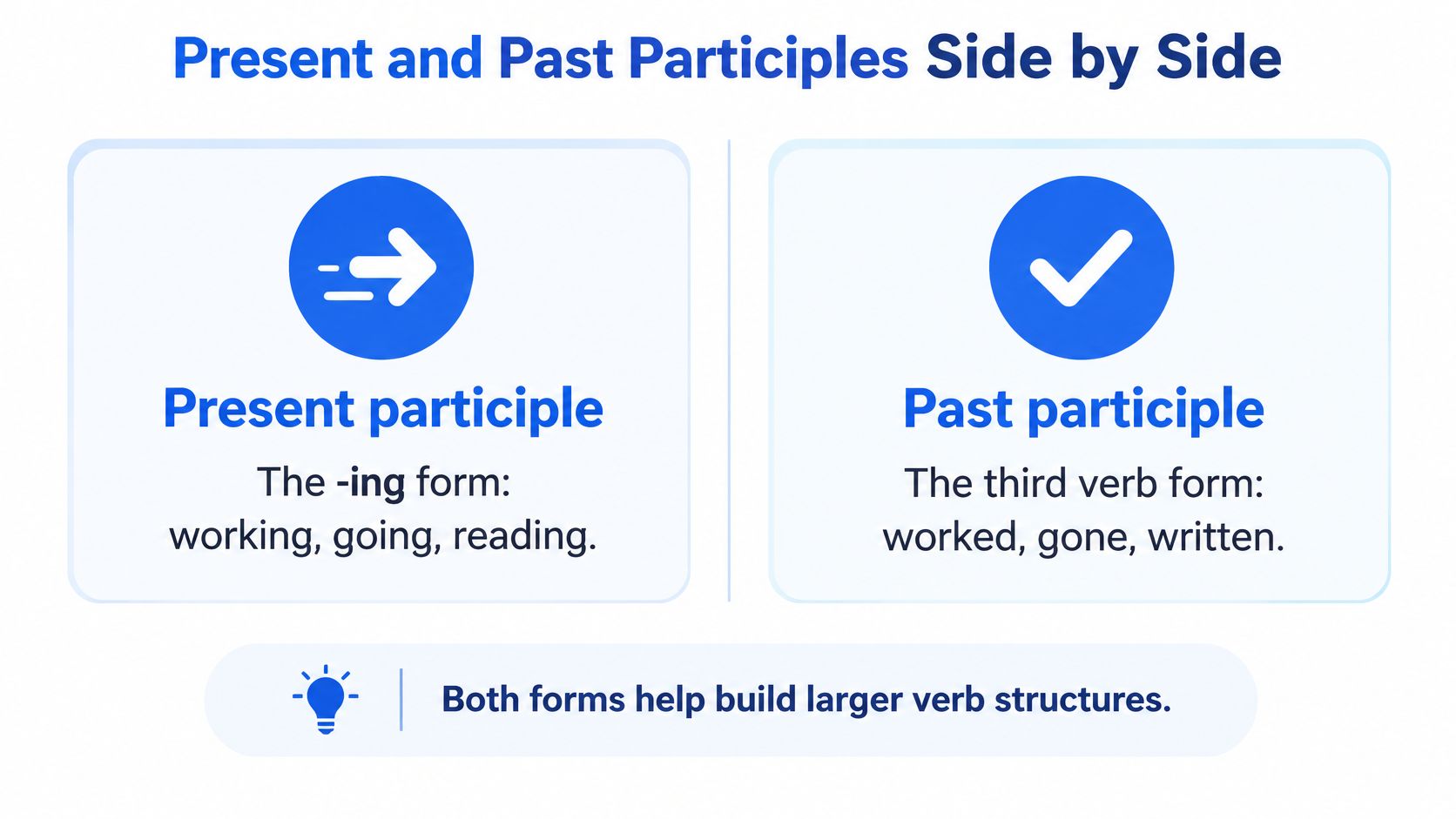
The present participle is the -ing form, such as working, going, and reading. The past participle is the third verb form, such as worked, gone, and written.
A participle is non-finite, meaning it doesn't independently show tense and cannot normally serve as a complete sentence's main verb on its own. Compare the incomplete She working with She is working: the auxiliary, or helping verb, completes the verb structure.
Present and past participles compared
| Feature | Present participle | Past participle |
|---|---|---|
| Form | -ing (working, going, reading) | Regular -ed (worked); irregular forms (gone, written, seen) |
| Example sentence | She is working today. | The report was written last week. |
| Main jobs | Continuous tenses; participle clauses; adjectives | Perfect tenses; passive voice; adjectives |
| Where the time comes from | The auxiliary be in progressive tenses; the main clause verb in participle clauses | The auxiliary have or be in verb structures; the main clause in participle clauses |
| Meaning | Active or in progress (a barking dog) | Completed or affected (a broken window) |
The Purdue OWL guide to participles explains that participles can modify nouns and that past participles have endings including -ed, -en, -d, -t, -n, and -ne. Examples include asked, eaten, saved, dealt, seen, and gone, so looking only for -ed won't identify every past participle.
Ask what job the form is doing
Instead of naming the ending and stopping there, identify the question the sentence answers:
- What's happening? She is working. The verb describes an action in progress.
- What additional action accompanies the main one? Walking home, he called his brother.
- What has been completed? I have finished.
- What received the action? The report was written.
- Which person or thing? A smiling child or a damaged phone.
These meanings are useful starting points, not absolute definitions. A past participle doesn't always mean a finished action: The office is cleaned daily describes a routine, while She has known him for years describes an ongoing state.
Practical rule: An -ing form after be usually signals an action in progress. A past participle after have builds a perfect form; after be, it can build a passive or describe a state.
Regular and Irregular Past Participle Forms
For a regular verb, add -ed to the base form: work, worked, worked. The past simple and past participle look identical, but their jobs differ: I worked yesterday versus I have worked here before.
Spelling sometimes changes. Write stop → stopped, doubling the final consonant, and carry → carried or try → tried, changing consonant + y to ied.
Common irregular verbs with past simple and past participle
| Base form | Past simple | Past participle | Note |
|---|---|---|---|
| go | went | gone | Never have went |
| eat | ate | eaten | Past simple and participle differ |
| write | wrote | written | Keep the -tten ending |
| see | saw | seen | Common in perfect forms with have |
| take | took | taken | Don't substitute took after have |
| begin | began | begun | Learn with sing and drink |
| break | broke | broken | Used in the passive: was broken |
| speak | spoke | spoken | Same pattern as break |
| do | did | done | Have done, not have did |
| buy | bought | bought | Past simple and participle match; the base differs |
| learn | learned / learnt | learned / learnt | Both accepted; British English often uses learnt |
| get | got | got / gotten | Gotten is standard in American English |
Many irregular verbs have different past-simple and past-participle forms. That's why I have gone is correct, but I have went isn't: went belongs in a sentence such as I went home.
Keep spelling and regional alternatives separate
Present participles have spelling adjustments too:
- Double the consonant where required: run → running, after a short stressed vowel in this pattern.
- Drop a final silent e: make → making.
- Change ie to y: lie → lying.
These are spelling patterns, not changes in grammatical meaning. Running, making, and lying still perform the same kinds of jobs as other present participles.
The Cambridge guide to British and American English recognizes alternatives such as learned/learnt, burned/burnt, dreamed/dreamt, and spelled/spelt. American English commonly favors some -ed forms, while British English accepts both forms for these verbs.
With get, gotten is standard in American English, while got is common in British English. American English also uses got in expressions such as I've got a question, so don't replace every got mechanically.
For study, group verbs by sound rather than memorizing an undivided list. Practise begin, began, begun alongside sing, sang, sung and drink, drank, drunk, then say a useful sentence with each participle.
Present Participles in Progressive Tenses and Clauses
Use be + present participle to answer the question What action is in progress at the relevant time? That time can be present, past, or future, as the Cambridge Dictionary explanation of the present participle illustrates through its use in continuous constructions.
Compare these sentences:
- Present: She is studying.
- Past: They were travelling.
- Future: We will be meeting at noon.
The action word keeps its -ing form. The surrounding verb structure tells you when to place the action.

Separate actions from states
Verbs such as know, want, believe, and own normally describe states rather than actions unfolding over time. Use I know the answer, not I am knowing the answer, and She owns a car, not She is owning a car.
Don't turn this into an absolute ban on every continuous use of a state verb. Meaning and context can change, but the simple form is the dependable choice for these ordinary examples.
Use participle clauses to add connected information
In Walking home, Karim called his brother, the opening phrase gives additional information without repeating Karim. The British Council guide to participle clauses explains their active meanings, time relationships, and usual shared-subject requirement.
Present-participle clauses can express:
- Simultaneous action: Smiling, she opened the door. She smiled while opening it.
- Reason: Feeling tired, I went to bed early. Tiredness explains the decision.
- Result: The train was delayed, causing me to miss the interview. The delay caused the missed interview.
- Extra information: Living in Rabat, she teaches English. The opening phrase adds information about her circumstances.
A result clause can refer to the preceding situation as a whole. However, an introductory participle clause normally describes the main clause's subject.
Consider the faulty sentence Walking to school, the rain started. Its structure makes the rain appear to be walking. Repair it as Walking to school, I got caught in the rain.
Ask who performs the opening action. That person should normally be the subject immediately following the introductory clause.
The participle clause has no independent tense. In Walking home, Karim called his brother, called places the event in the past; Walking home, Karim calls his brother places it in a present-time narrative or routine.
Use the shortened version only when the relationship remains clear. If the reader must guess who acts or why events are connected, a full clause is better.
Past Participles in Perfect and Passive Structures
A past participle answers different questions depending on its auxiliary. With have, it helps connect an event to a reference point; with be in a passive, it shows what receives the action.
Build the structure before choosing the meaning
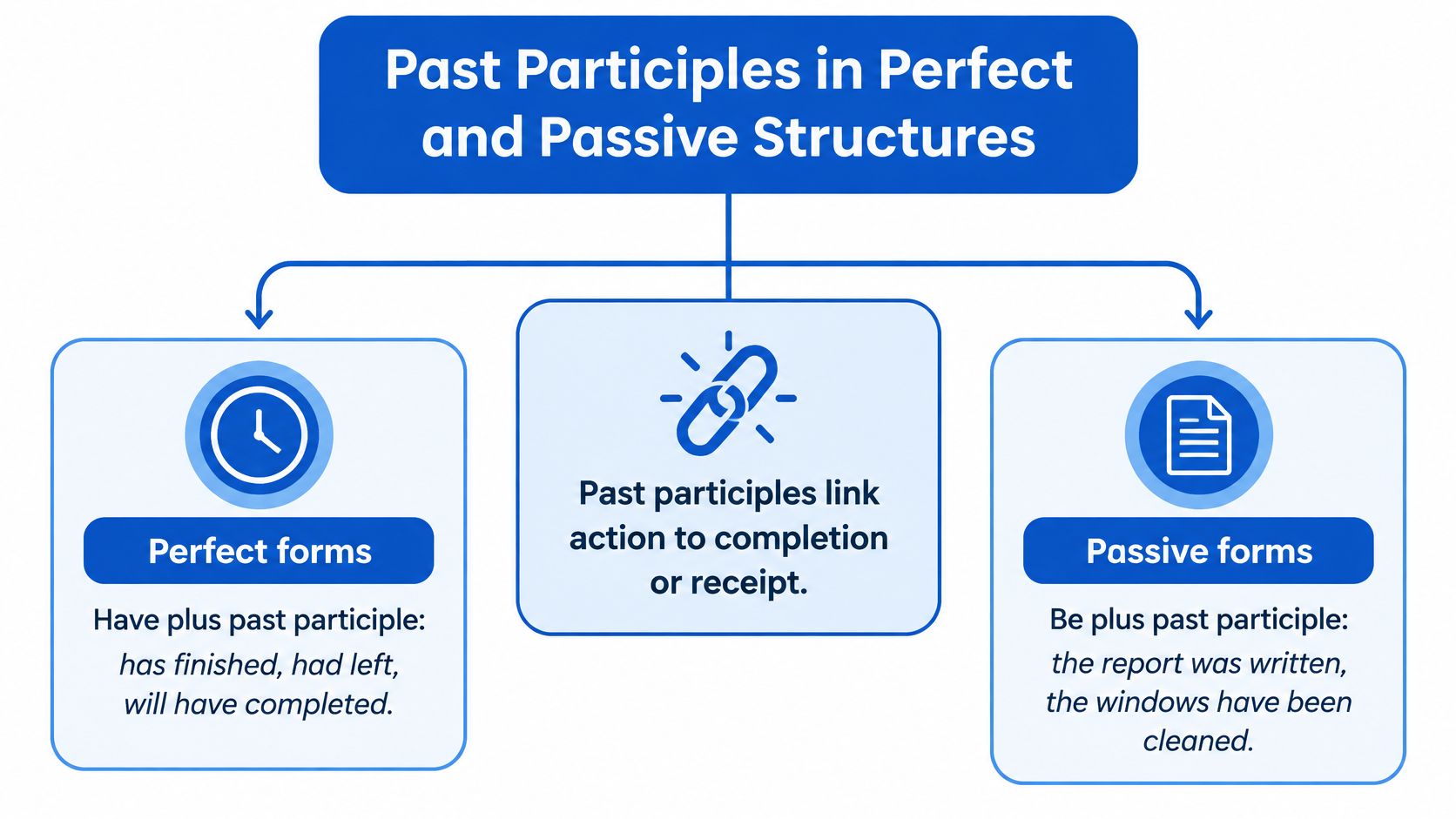
Perfect forms use have + past participle:
- Present perfect: She has finished the presentation.
- Past perfect: She had left before the meeting started.
- Future perfect: She will have completed the report by Friday.
Passive forms use be + past participle:
- Past passive: The report was written.
- Perfect passive: The windows have been cleaned.
- Progressive passive: The file is being checked.
In have been cleaned, been is the past participle of be, while cleaned names the action received. In is being checked, being helps express an action in progress, while checked supplies the passive meaning.
Ask what matters now
The Cambridge discussion of the present perfect highlights why form alone isn't enough: the present perfect can describe completed events as well as situations connected to the present.
Compare I lost my key with I've lost my key. The first presents a past event without explicitly making the present connection; the second naturally emphasizes a current consequence, such as not being able to open the door.
That doesn't mean the simple past proves the key has been found. The speaker's emphasis changes, not necessarily the actual situation.
Similarly, I have lived here for five years normally means the residence continues now. I lived there in 2020 presents the residence within a finished past period.
| Communication need | Useful example |
|---|---|
| A current result | I've just sent the email. |
| Experience up to now | Have you ever given a presentation? |
| An unfinished duration | I've worked here since September. |
| A finished past occasion | I sent the email yesterday. |
Already, yet, just, ever, recently, for, and since often support present-perfect meanings. They aren't automatic switches: I lived there for several years is correct when the period is finished, and American English commonly uses the simple past with just or already.
Finished-time expressions such as yesterday, in 2020, and last week normally call for the simple past when they locate the event:
Have you eaten?
Yes, I ate at noon.
The question asks about the situation now. The answer supplies a specific past occasion.
Name the agent only when it helps
The contract was signed by the manager identifies both the affected document and the person responsible. The contract was signed omits the agent, the doer of the action.
That omission suits reports, news, and formal writing when the result matters more than who performed the action. Keep the agent when responsibility is important.
When to Use -ing or -ed
For adjectives describing feelings, -ing usually identifies the cause, while -ed identifies the person experiencing the feeling. Ask whether the noun creates the reaction or experiences it.
| Source of the feeling | Person experiencing it |
|---|---|
| The film was boring. | I was bored. |
| The news is surprising. | We were surprised. |
| The lesson was interesting. | The students were interested. |
| The trip was exciting. | The travellers were excited. |
| The interview was tiring. | The candidate felt tired. |
A person can also cause a feeling. The teacher is interesting means the teacher attracts attention; The teacher is interested means the teacher feels interest in something.
Describe the intended relationship
In a job interview, I'm interested in the role communicates your attitude toward the position. I'm interesting describes you as someone other people may find engaging, which isn't the same message.
At work, compare The presenter was engaging with The audience was engaged. The presenter attracted attention, and the audience paid attention.
Meaning check: Don't choose the ending because the noun is a person or a thing. Choose it according to the relationship you want to express.
Participial adjectives can appear before a noun, as in a broken window, a smiling child, or a written report. They can also follow linking verbs: The window looks broken or The report seems finished.
Recognize expressions that need separate learning
Not every participial adjective describes an emotion. Expressions such as a retired teacher, a well-known company, and an experienced manager describe status, reputation, or experience.
Nor does every adjective ending in -ed come from an ordinary corresponding verb. Talented is a useful example; concerned, by contrast, is related to the verb concern.
For Arabic-speaking learners, checking the English sentence's intended meaning is more reliable than translating an adjective word for word. The guide to common English grammar mistakes Arabic speakers make offers related sentence checks without treating every learner's difficulties as identical.
Common Participle Mistakes and How to Fix Them
The belief that -ed always means past time causes trouble. In The room is cleaned daily, the sentence describes a present routine; in She looked bored, the adjective describes a feeling.
A useful diagnosis separates errors in meaning, sentence structure, and word form. A sentence can be understandable while still needing correction.
Diagnose the cause, not just the ending
A current result expressed without the intended emphasis
I lost my keys, so I can't get in can become I've lost my keys, so I can't get in when you want to emphasize the present consequence. The original isn't automatically wrong, particularly in American English. This is a choice about perspective, not a universal correction.A missing auxiliary
I seen that film twice becomes I have seen that film twice in standard English when describing experience up to now. The listener may understand the original, but seen doesn't work as the finite main verb in that sentence.An incorrect irregular form
I have wrote the email becomes I have written the email. The intended message is usually clear, but the verb form is nonstandard. This is a form-selection error rather than a different intended event.The wrong adjective relationship
The lesson was very bored becomes The lesson was very boring. The intended meaning is that the lesson caused boredom, not that the lesson experienced it. This error changes the relationship between the noun and the feeling.A dangling participle
Walking to school, the rain started becomes Walking to school, I got caught in the rain. The original attaches the walking action to the wrong subject. Unlike a recognizable irregular-form slip, this creates a misleading sentence structure.
Check a sentence aloud
Read the sentence, then identify these parts:
- Auxiliary: Can you name the helping verb, if the structure needs one?
- Participle: Have you selected the correct form rather than a similar-looking past-simple form?
- Subject: Who performs the action in an introductory participle clause?
- Intended message: Are you describing a cause, an experience, an action, or its recipient?
For a writing task, underline the auxiliary and circle the participle before submitting your answer. For speaking practice, repeat the corrected sentence as a complete phrase rather than rehearsing only the isolated word.
Learners working on broader sentence accuracy can also use the guide to English grammar mistakes Moroccan learners make. Choose the checks that match your own writing or speech, rather than assuming every listed error applies to you.
Practise Participles and Check Your Level
Complete these tasks before checking the answers. Say each corrected sentence aloud so you practise the whole structure, not just the missing word.
Try the exercises
Supply the past participle
She has ___ reports (write). We have ___ (eat). He has ___ home (go). I have ___ it (see). They have ___ notes (take). The course has ___ (begin). It was ___ (break). We have ___ before (speak). She has ___ the task (do). I have ___ tickets (buy).Choose the adjective
The meeting was boring/bored. I'm interesting/interested in science. The journey was tiring/tired. We were surprising/surprised. The children felt exciting/excited.Combine the sentences
She opened the file. She noticed an error. Begin with Opening and keep the shared subject.Choose the tense in each dialogue
A: When did you arrive? B: I arrived/have arrived yesterday.
A: Is the report ready? B: I have just finished/finished yesterday it.
A: How long have you worked here? B: I worked/have worked here since September.
A: When did she leave? B: She left/has left last week.
A: Have you eaten? B: Yes, I ate/have eaten at noon.Repair the attachment
Walking to the office, my phone rang. Make the walker the main subject.
Check your answers
- Past participles: written, eaten, gone, seen, taken, begun, broken, spoken, done, bought.
- Adjectives: boring, interested, tiring, surprised, excited.
- Combined sentence: Opening the file, she noticed an error.
- Dialogue choices: arrived with yesterday; have just finished with just; have worked with since September; left with last week; ate with at noon.
- Attachment repair: Walking to the office, I heard my phone ring.
Write your own sentences about work, study, or travel, using these models to check the structures. Note whether your difficulty is remembering forms or choosing the intended meaning.
Englify's free online English placement test includes a spoken part and helps identify your starting point across its A0–C1 learning levels. Use the feedback to identify whether participle accuracy needs attention; after each session, learners receive a written report with phrases to reuse and mistakes to drop.
At Englify, our live English classes on Google Meet give you opportunities to use participles in conversation and receive corrections while you speak. Book a free trial session to practise describing experiences, explaining results, and discussing everyday actions with teacher feedback.