Knowledge hub
English Placement Test Online: Formats and CEFR Scores
Learn what an English placement test online measures, how CEFR scores work, what to expect, and how to choose the right Englify course for your level.

An online English placement test is a short assessment taken remotely that estimates your CEFR level, from A1 to C2, so you can join a suitable course. It gives you a starting estimate, not a certificate.
But if your result says you're intermediate, why might you still struggle to answer a simple question aloud? The answer often lies in which skills the test measured. A useful placement process connects the score with a short speaking check, your learning goals, and the kind of support you need.
Table of Contents
- What an Online English Placement Test Measures
- CEFR Levels Mapped to What You Can Do
- What to Expect During an Online Placement Test
- Preparation Tips and Sample Questions by Skill
- How to Read Your Result, Level by Level
- Limits, Fairness and Data Questions Answered
- Choose Your Englify Course After the Placement Test
What an Online English Placement Test Measures
An online English placement test estimates your current ability for course placement, rather than proving that you're ready for university, an examination, or a particular job. Its value is practical: helping a teacher choose material that challenges you without leaving you lost.
A useful assessment is CEFR-referenced and multi-level, not a collection of grammar questions. The Council of Europe's assessment guidance connects assessment with teaching and learning, using descriptions of what learners can do in communication. That means looking beyond correct answers to the activities you can complete.
Reading a message, following spoken directions, explaining a problem, and writing a request involve different abilities. A test should make clear which of those abilities it has sampled.
Skills an online English placement test checks
| Skill | What it checks | How an online test usually handles it | What a short test can miss |
|---|---|---|---|
| Reading | Main ideas, specific details, vocabulary in context | Multiple-choice or gap-fill items on short texts | Long documents read at work or university pace |
| Listening | Key details in recorded speech and different accents | Audio clips with questions, often played once or twice | Following fast, overlapping conversation |
| Grammar and vocabulary | Accuracy and range of language knowledge | Discrete items, often adaptive in difficulty | Whether that knowledge comes out in real speech |
| Speaking | Fluency, pronunciation, interaction and response speed | Recorded answers or a short live interview | Sustained conversation and confidence in meetings; scoring reliability depends on the test |
| Writing | Grammar, vocabulary, organisation and task completion | A short typed task such as an email or paragraph | Ideas and style that appear only in longer writing |
Receptive skills involve understanding language, especially through reading and listening. Productive skills involve creating language through speaking and writing. Selecting the correct sentence isn't the same task as producing that sentence while someone waits for your answer.
Look for evidence behind the label
Consider a hypothetical profile: B1 overall, A2 speaking, B1 reading. That's more useful than a single intermediate label because it identifies a teaching priority.
A learner with that profile might understand familiar written information but need support forming spoken responses. Another learner could communicate comfortably while making frequent grammatical mistakes. Giving both learners identical practice would overlook their different needs.
Practical rule: If the test didn't ask you to speak, don't read its result as confirmation of your speaking level.
For parents, the same distinction matters when a child performs well on school exercises but stays quiet in conversation. Quietness alone doesn't establish low ability, and correct written answers don't establish oral confidence.
Online questions can efficiently sample comprehension and language knowledge. To understand productive performance, ask for a relevant writing task and a live conversation or trial lesson where a teacher can observe how the learner responds.
CEFR Levels Mapped to What You Can Do
The Common European Framework of Reference for Languages, or CEFR, gives teachers and learners a shared way to describe proficiency. The British Council's guide to English levels explains the six principal levels, A1, A2, B1, B2, C1 and C2, grouped into basic, independent and proficient users.
A level is more informative than beginner or advanced because it connects learning with recognizable activities. However, it describes a range of abilities, not a promise that every task at that level will feel easy.
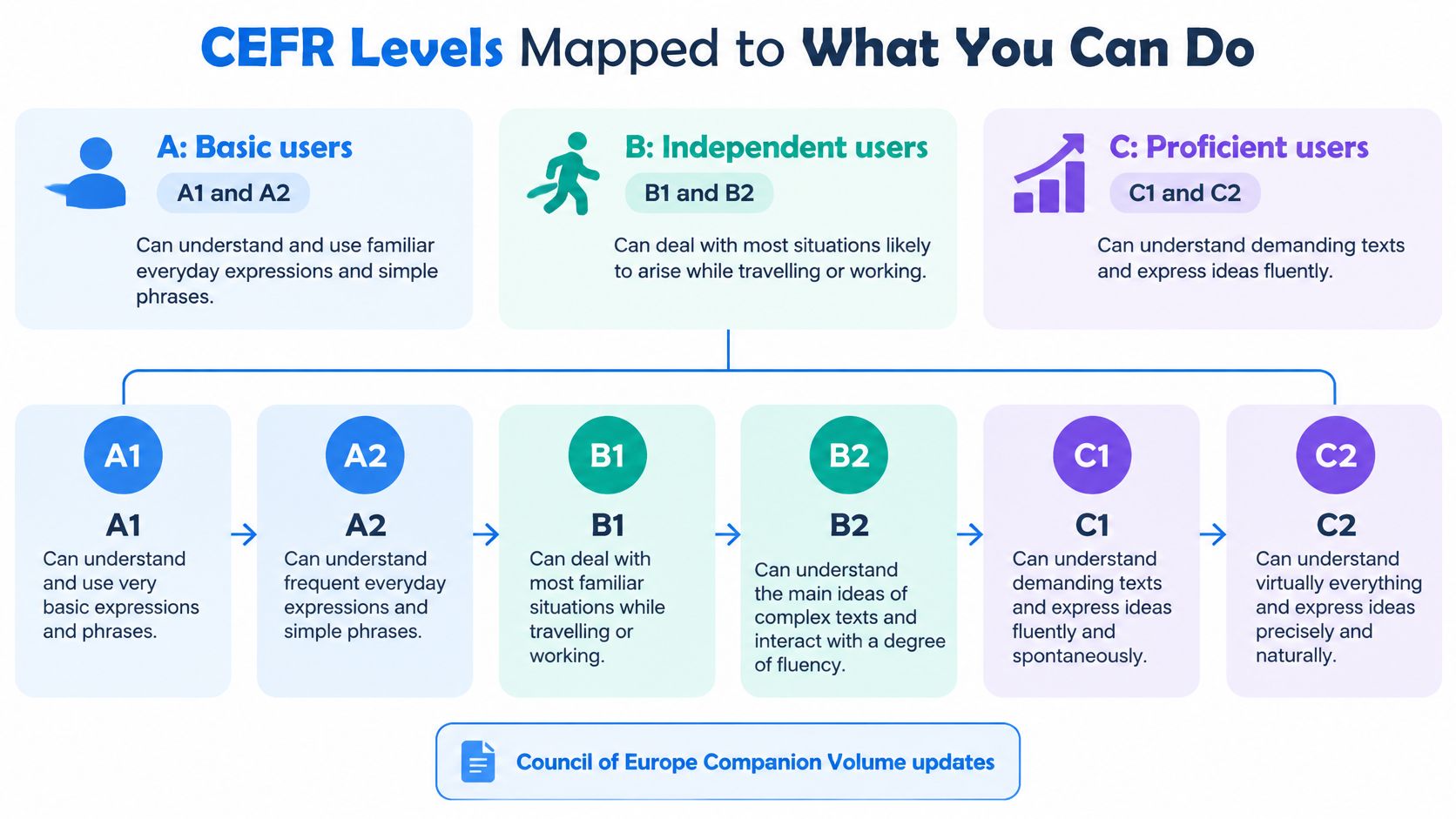
Everyday examples of each level
| CEFR level | Broad band | A practical can-do example |
|---|---|---|
| A1 | Basic user | Introduce yourself and ask simple personal questions when the other person speaks clearly and helps |
| A2 | Basic user | Handle routine shopping, ask for directions and exchange short messages about familiar matters |
| B1 | Independent user | Cope with familiar travel situations and briefly explain experiences, plans and opinions |
| B2 | Independent user | Discuss a range of topics, explain a viewpoint and contribute to familiar work discussions |
| C1 | Proficient user | Use language flexibly for social, academic and professional purposes |
| C2 | Proficient user | Understand demanding communication and express fine distinctions with precision |
At A1, a successful exchange might be giving your name, saying where you live, and asking someone about their family. The listener may need to slow down or repeat a question.
At A2, you can handle more routine exchanges independently. You might ask about a train departure, explain a simple shopping problem, or talk briefly about your working day.
B1 involves connecting ideas rather than only exchanging short facts. For example, you could explain why you want to change courses and describe what you hope to study.
Independence doesn't mean perfection
At B2, you can participate more actively in discussions and support an opinion. A familiar meeting may be manageable, while unfamiliar technical language or rapid interruptions still require effort.
At C1, the emphasis shifts toward flexibility, organization, and recognizing less explicit meaning. C2 involves greater precision and ease, rather than knowing more difficult words.
The Council of Europe's updated Companion Volume also includes Pre-A1. This is a useful reference when discussing starter labels such as A0, but A0 shouldn't be treated as an additional principal CEFR level or assumed to have an identical definition across providers.
Englify's CEFR-based course range is A0–C1, so C2 falls outside that range. Its guide to English levels and the CEFR provides a useful companion when comparing a placement recommendation with course descriptions.
Remember that can-do descriptors aren't grammar checklists. A learner can explain a familiar experience successfully while still making tense errors. Teachers need to judge both the communication achieved and the support required.
What to Expect During an Online Placement Test
Before taking an English placement test online, check its format. Some assessments contain only automatically scored questions; others add recorded speaking, typed writing, or a teacher interview.
The Cambridge English Placement Test description offers a concrete example: it assesses Reading and Use of English together with Listening, and its adaptive questions change according to previous responses. Speaking and writing therefore shouldn't be assumed to appear in every online test.
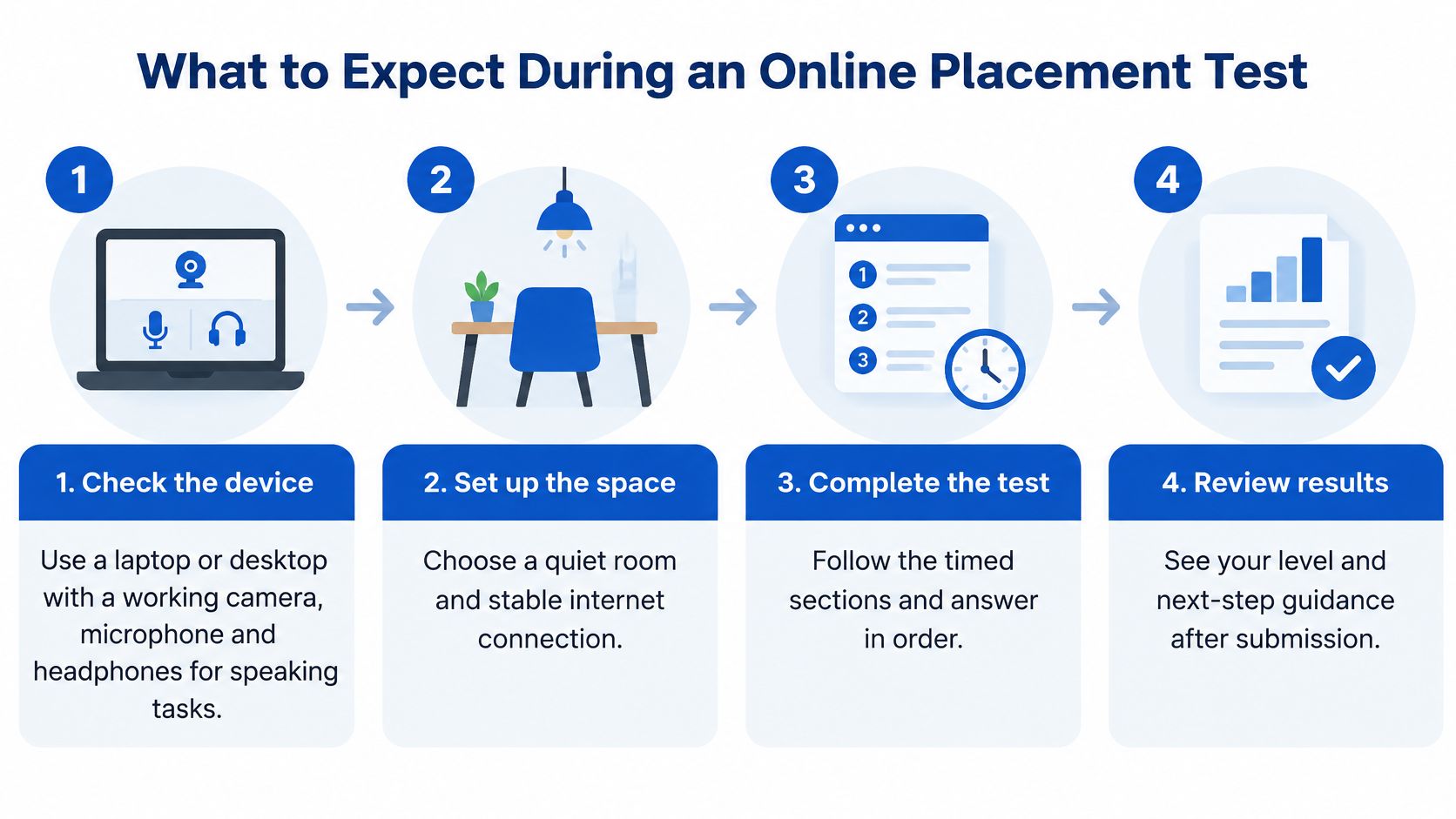
A calm test-day walkthrough
Check your device. A laptop or desktop is a sensible choice for typing and speaking tasks. Test your headphones, microphone and camera if the assessment requires them.
Prepare the space and permissions. Choose a quiet room, connect to a stable network, and allow the required microphone or camera access. Close applications that might interrupt you.
Read the instructions before starting. Check time limits, replay rules and whether you can return to earlier questions. Don't assume the timer will pause if someone interrupts.
Answer the initial questions independently. In an adaptive test, correct answers generally lead toward harder items, while incorrect answers lead toward easier ones. Hard questions aren't necessarily a sign that you're doing badly.
Complete speaking tasks if included. You may record responses or speak with a teacher. Answer the actual prompt rather than delivering a memorized introduction.
Complete any writing task. For an email or paragraph, check that you've addressed the purpose, not just written grammatically correct sentences.
Submit and save the result. Keep the level recommendation and any skill breakdown so you can discuss them when choosing a class.
Avoid preventable disruptions
- Don't switch tabs for help. Translation tools or outside answers make placement less useful because the course may then be too demanding.
- Don't guess before reading. Give yourself time to understand the instruction and the answer choices.
- Don't ignore background noise. A television or nearby conversation can interfere with listening and recorded speech.
For parents or teachers administering a form-based assessment, Form Timer's best practices for Google Forms exams is a relevant setup resource. Follow the actual test provider's instructions rather than assuming every form uses the same timing settings.
For learners in Morocco taking the test over a shared home connection or mobile data, check audio playback before beginning. If the connection drops, note which task was interrupted and ask about a retake before accepting the result as final.
Preparation Tips and Sample Questions by Skill
Sample placement items by skill
| Skill | Sample item | Answer | What it reveals |
|---|---|---|---|
| Reading | A notice says: The library closes at 6 p.m. on weekdays but at noon on Saturdays. When does it close on Saturday? | Noon | Finding a specific detail quickly |
| Listening | Voicemail: Hi, it's Sara. Can we move Tuesday's meeting to Thursday at ten? | Thursday, at ten | Catching key details at natural speed |
| Grammar | She ___ to Casablanca twice last year. (has been / went / had gone) | went | Simple past for a finished time period |
| Vocabulary | Choose the word closest in meaning to postpone: delay / cancel / cover | delay | Recognizing the intended meaning; a fuller sentence would also test context |
| Writing | Write two sentences asking a colleague to reschedule a meeting. | A polite request with a clear new time | Task completion and tone |
| Speaking | Describe your typical weekday in one minute. | No single correct answer | Fluency, organisation and pronunciation |
These are illustrative exercises, not questions from an official test. The times and response lengths belong to the examples, not to a particular provider's test specification.
For the writing prompt, an acceptable response could be: Could we move our meeting to Thursday morning? Please let me know whether that works for you. The important features are a clear request, an alternative time, and an appropriate tone.
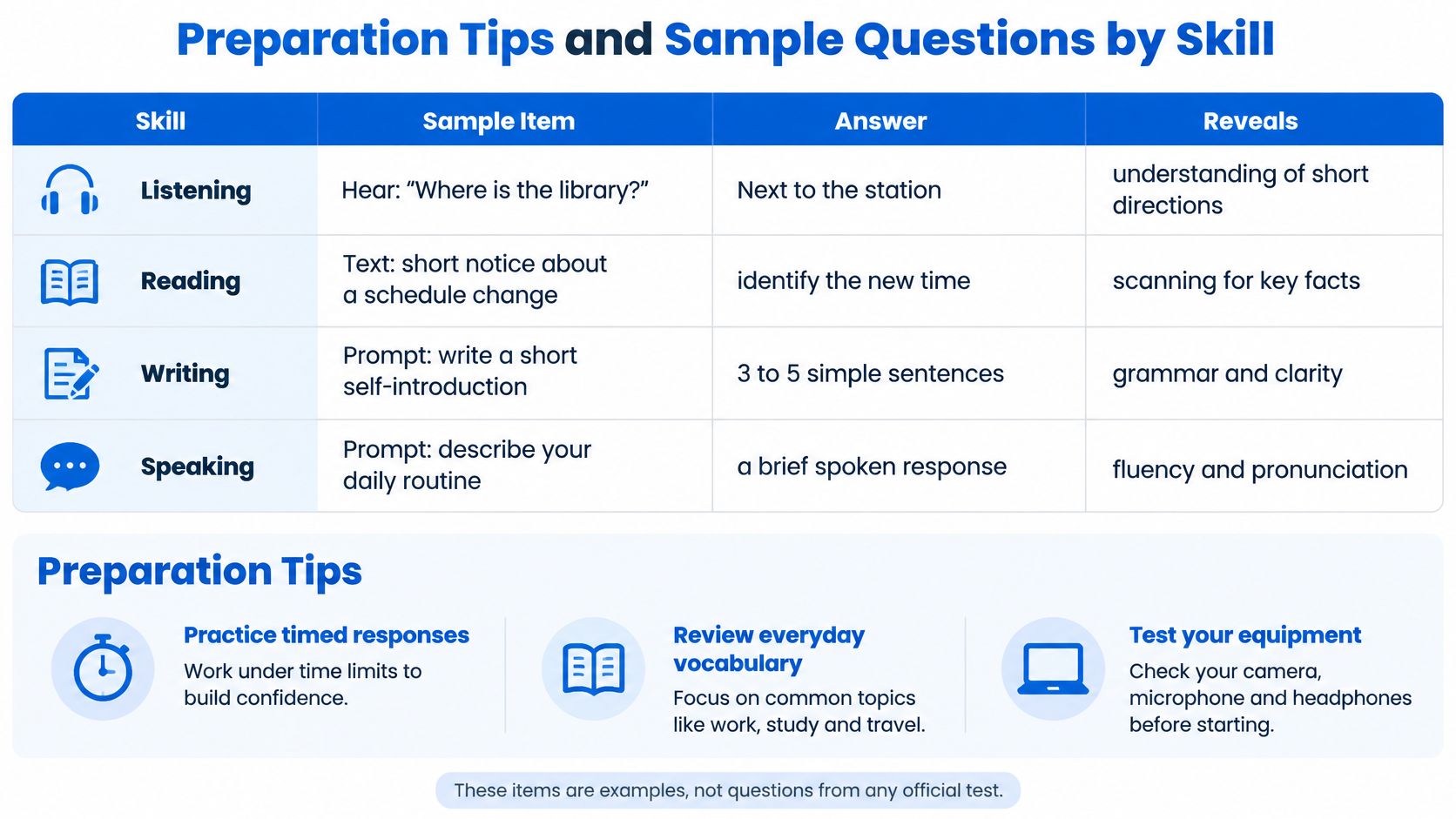
Prepare the skill rather than the answer
You don't need to rehearse a whole examination to become comfortable with placement tasks. Use short, realistic activities that make the format familiar.
- Listen for useful details. Play a short clip at natural speed and identify the speaker's purpose, place, or proposed arrangement. Check the transcript afterward to locate what you missed.
- Read everyday information. Use notices, timetables and messages. Look for deadlines, changes and exceptions rather than translating every word.
- Speak without a script. Describe your routine or explain a familiar problem, record yourself, and listen for unfinished ideas, long pauses and unclear words.
- Write practical messages. Ask to change an appointment or request information. Check verb tense, politeness, and whether the reader knows what to do next.
- Learn useful phrases. Practise language for asking for clarification, explaining a delay, and expressing an opinion instead of memorizing isolated vocabulary lists.
For a teenager, a useful speaking topic might be explaining a favourite school subject. For an adult, it might be describing a typical meeting or a travel plan. Choose subjects you understand so that the practice focuses on English rather than specialist knowledge.
A note for Arabic-speaking learners
Some learners benefit from focused practice distinguishing p and b, or the vowel sounds in ship and sheep. Don't treat those examples as a diagnosis based on someone's first language: individual experience, schooling and exposure differ.
Try listening to contrasting word pairs, repeating them, and then using them in short sentences. Pay attention to word stress as well as individual sounds, especially when a familiar written word is difficult to recognize in speech.
Prepare to show what you can do independently, not to produce a higher label than your everyday skills support.
Parents can help by checking equipment and explaining the procedure. During the assessment itself, let the child answer without prompting or translation.
How to Read Your Result, Level by Level
A placement result is a starting hypothesis, not a verdict. Read it as a recommendation to test against actual classroom performance, especially if your speaking ability feels different from the reported level.
A numerical score only makes sense within its own assessment. The published Cambridge placement-test scale maps 10–19 to A1, 20–29 to A2, 30–39 to B1, 40–49 to B2, and 50 or higher to C1/C2. These thresholds belong to that scoring system, not to every online English test.
Example score-to-level scale and next steps
The score mappings below use that Cambridge scale. The next steps are teaching recommendations, not official admission rules.
| Score range (example scale) | CEFR level | Practical next step |
|---|---|---|
| 10–19 | A1 | Start in an A1 group and check speaking early in the trial |
| 20–29 | A2 | Start in an A2 group and confirm listening and speaking in the trial |
| 30–39 | B1 | Start in a B1 group; choose a speaking-focused class if speaking lags |
| 40–49 | B2 | Start in a B2 group after a live conversation check |
| 50 or higher | C1/C2 | Consider a C1 group after a live check; C2 is outside Englify's range |
Don't convert a percentage into a CEFR level yourself. An apparently impressive percentage on easy questions may say something quite different from a lower percentage on demanding material.
Read the report in a useful order
Start with the overall level, which supports initial grouping. Then examine the skill profile and identify whether a weaker area might prevent comfortable participation.
Suppose your comprehension supports intermediate study, but you struggle to respond spontaneously. A teacher might recommend an intermediate group with targeted speaking support, or a more focused speaking class. The right decision depends on whether you can follow the lesson, participate with support, and benefit from the material.
Does a high result mean strong speaking? Not necessarily. If the assessment mainly tested recognition and comprehension, the score doesn't establish how well you manage a conversation.
Placement check: Can you understand the teacher's question, give a relevant answer, and respond to a follow-up without someone translating for you?
A borderline A2/B1 recommendation is a reason to gather more evidence, not to chase the higher label. A short live exchange can reveal whether the difficulty is limited vocabulary, slow retrieval, unfamiliar pronunciation, or anxiety about speaking.
Before your trial, write down:
- Your reported level. Include the test name and any available skill results.
- Your weaker areas. Note where you struggle in actual tasks, not only where you lost marks.
- Your immediate goal. Describe a concrete situation, such as answering interview questions or contributing to a seminar.
If the report remains unclear, the guide to how to know your English level can help you prepare questions for the teacher. Ask for an explanation of the recommended starting class and what evidence would justify moving groups.
Limits, Fairness and Data Questions Answered
Instant scoring is convenient, but it doesn't remove questions about privacy or fairness. A scoping review of AI in language assessment identifies uses including automated scoring and speech recognition while highlighting unresolved privacy and security concerns.

Questions to ask before testing
- Is my voice recorded? Ask whether speaking is recorded, whether recordings are stored, and when they're deleted. For a child, request a clear explanation before giving permission.
- Can an accent affect the result? Ask whether a teacher reviews automated speaking scores, particularly when the result seems inconsistent. An accent isn't itself an error; the teaching priority is clear, understandable communication.
- What happens to my data? Request written information about what is collected, who can access it, and whether responses are used to improve automated systems.
- Will a basic phone work? Check device requirements and try the audio first. Ask for an alternative if the screen, microphone or connection makes completing tasks difficult.
Cost, timing and retakes
Englify offers a free placement test and free trial session. Confirm the current test duration, included tasks and retake arrangements before starting; don't assume that free means untimed or that interrupted attempts can automatically be restarted.
Ask separately about assessment recordings and lesson recordings. They serve different purposes, and storage or access arrangements shouldn't be assumed to be identical.
Does the result prove readiness for an exam or job?
No. A precise CEFR label doesn't guarantee success in an interview, an academic course, or a formal examination. Practise the relevant task and check the receiving institution's actual requirements.
Online assessment can support efficient grouping, but convenience isn't the same as neutrality. When technology or an unexpected result creates doubt, ask for a human review rather than treating the automated outcome as final.
Choose Your Englify Course After the Placement Test
Choosing an Englify course by learner group
A placement result works best as a starting hypothesis: an estimate of language ability that becomes more reliable once a teacher hears the learner speak in a live session. Read it alongside age, goals and schedule before choosing a course.
| Learner | What the result tells you | Englify option to consider |
|---|---|---|
| Parents of young children | Estimated level, to combine with the child's age | Kids classes grouped by age: 4–7, 8–11 and 12–17 |
| Teenagers | Language starting point, to discuss alongside school needs and speaking confidence | Teen classes, with exam preparation support where needed |
| University students | Current level to compare with their target and oral communication needs | Small groups for conversation or private classes for speaking practice |
| Adults | Starting point for goals in speaking, travel, work or everyday life | Private one-to-one for pace; small groups for regular practice |
| Working professionals and companies | General language foundation, supplemented by workplace-task checks | Business English programme, with options for company teams |
Choose the course by level, learner needs and learning format, guided by the score rather than dictated by it. A placement test can estimate language ability, but it cannot independently determine a child's maturity, an adult's availability, or a company's communication priorities.
For children, ask how age-appropriate materials and activities match the recommended level. For teenagers, explain whether the immediate concern is understanding schoolwork, participating orally, or preparing for an examination, and confirm which support is included.
Match the format to the task
Private classes suit learners who need close attention to pace or a narrow goal, such as interview answers. Small groups of up to six learners provide opportunities to listen, take turns, ask follow-up questions and respond to different people.
Both formats use live sessions through Google Meet. For professionals, bring a realistic task to the needs discussion: presenting a project update, writing a difficult email, or explaining a delay to a client.
Personalized content should connect the recommended level with those situations. Learner reports can help you track specific changes, such as clearer explanations or more independent responses, rather than relying only on a new level label. For parents, written reports after each session should make the next learning priority understandable.
Compare the available online English classes, and check current prices, group details and schedules on the website. Take the free placement test for an initial estimate, then use the free trial to discuss the recommendation and confirm the level through live speaking with a teacher.
Englify offers live online English classes with small-group and private options, supported by personalized learning and learner reports. Visit Englify to take the free placement test and book a free trial session, so your course choice reflects both your test result and how you communicate.