Knowledge hub
How to Know Your English Level Accurately
How to Know Your English Level with CEFR can-do checks, test score ranges, and a four-skill profile that shows what to study next.

Can you understand an English article but struggle to explain the same topic aloud? A single quiz score won't show that difference. To know your English level accurately, compare what you can do in each skill with CEFR descriptions, collect practical evidence, and confirm uncertain results through a placement assessment.
The useful outcome isn't just a label such as intermediate. It's a profile that tells you which skill needs attention for your next interview, university assignment, meeting, or everyday conversation.
Table of Contents
- CEFR Levels and What You Can Actually Do
- Check All Four Skills in One Sitting
- Read Placement and Exam Scores Carefully
- Signs That Separate Speaking and Writing Levels
- Mistakes That Push Your Level Up or Down
- Use Your Profile to Choose the Next Step
CEFR Levels and What You Can Actually Do
Your English level is the CEFR band that matches tasks you can perform, not the number of years you've studied or the grammar rules you recognize. Start with the everyday tasks below, then consider how much help you need to complete them.
CEFR levels and everyday can-do tasks
| Level | What it means | Sample can-do |
|---|---|---|
| A1 | Basic user who needs help | Ask and answer simple personal questions if the listener helps |
| A2 | Basic user on familiar topics | Handle short routine exchanges and simple written messages |
| B1 | Independent on essential points | Explain a familiar idea, follow a clear talk, and write a simple email |
| B2 | Independent and relatively fluent | Join a meeting or class discussion and write a clear report |
| C1 | Proficient and flexible | Argue a case, adapt tone, and handle complex texts with little strain |
| C2 | Proficient and precise | Understand almost everything and express fine shades of meaning |
The Council of Europe's self-assessment grid organizes proficiency into six main levels, A1, A2, B1, B2, C1, and C2, and assesses five areas: listening, reading, spoken interaction, spoken production, and writing. Its separate descriptions let you identify differences between understanding English, producing it, and responding to another person.
What the levels look like in everyday life
At A1, you might ask the price of a ticket but need the seller to repeat the answer slowly. That help matters: completing a transaction with patient support isn't the same as managing it independently.
At A2, you can manage a familiar exchange, read a school timetable, or send a simple message about being late. A conversation may become difficult when the other person moves beyond the expected topic.
At B1, you can explain an essential idea, follow a clear talk on something familiar, and write a straightforward email. For example, you can describe why you missed a class and ask what work you need to complete.
At B2, you can contribute to a meeting or class discussion with relative fluency. You can explain a travel problem, respond to questions, and write a clear report rather than just a collection of short statements.
At C1, you can adapt your language for academic or professional purposes, develop an argument, and choose an appropriate tone. C2 involves highly precise expression, including subtle differences in meaning, and needn't be your default course target.
Choose a provisional level for each skill
Read the descriptions separately for each activity. Mark the highest description you can match consistently, without translation tools, a prepared script, or someone supplying your sentences.
Don't claim a higher band because you managed a task once on a favorite topic. Equally, don't place yourself lower because you occasionally forget a word.
For a fuller explanation of the labels, use this guide to English levels and the CEFR.
Working-level rule: For a specific goal, use the weakest skill that goal genuinely requires as your provisional starting point, then ask a teacher to confirm it.
For example, strong reading won't automatically prepare you for a spoken interview. Your reading ability remains valuable, but your speaking performance should guide the interview practice you choose.
Check All Four Skills in One Sitting
A home check should produce evidence by skill, not a final certificate. The Council of Europe's updated CEFR framework describes separate communicative activities, including interaction, rather than treating language ability as one undifferentiated score.
Use the following as a suggested 45-minute home exercise, not a standardized test. Choose accessible materials and keep your original answers so a teacher can review them.
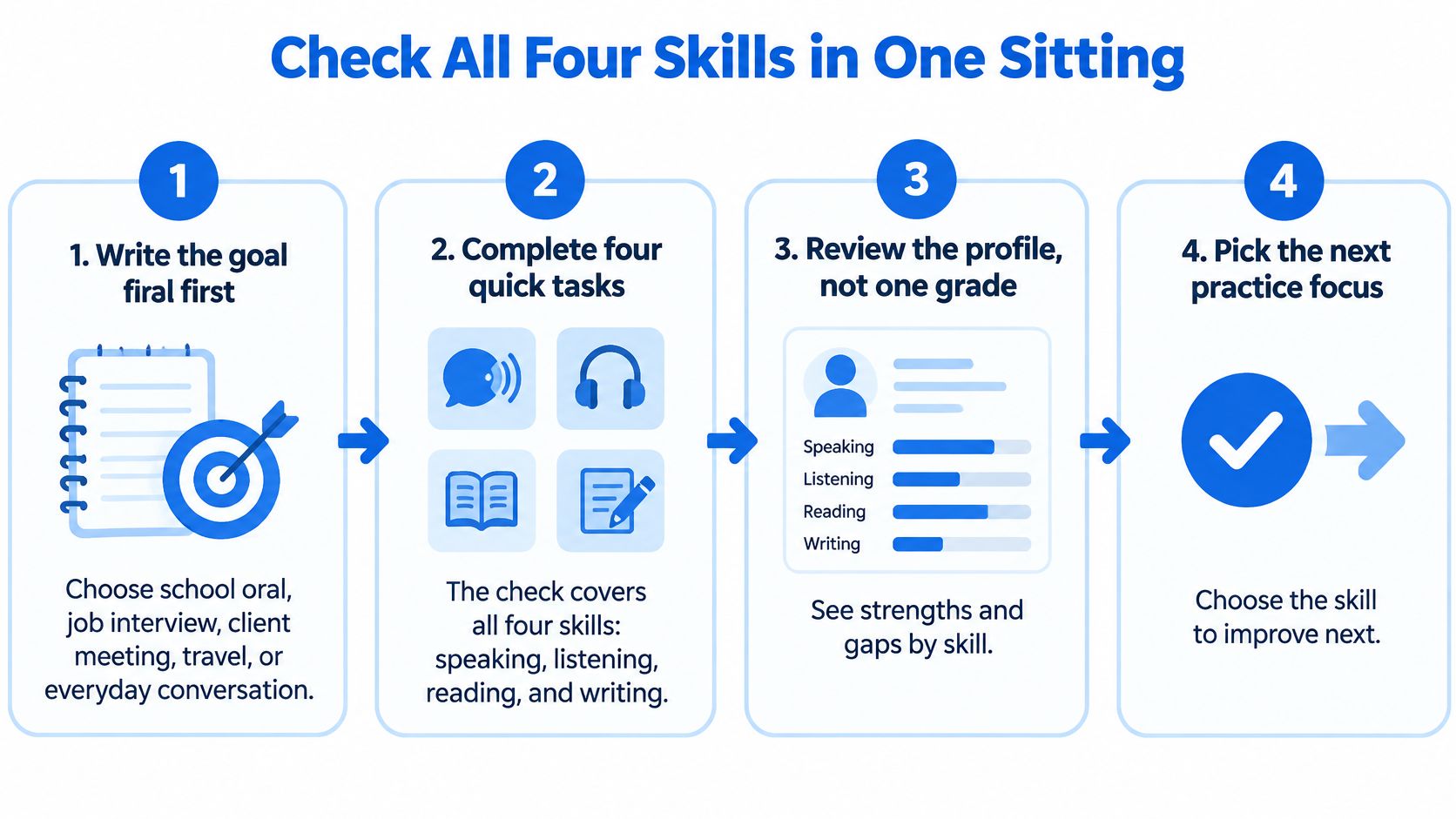
Complete the tasks without preparing answers
Write your goal first.
Choose a school oral, job interview, client meeting, travel situation, or everyday conversation. Make it specific: explaining a project and answering follow-up questions gives you a clearer target than improving English.Listen for meaning and detail.
Play a clear news or lesson clip of about two minutes once, without subtitles. Write the main point and supporting details. Catching the topic is different from understanding reasons, qualifications, or the speaker's implied attitude, but clip difficulty must also inform the judgment.Read an unfamiliar article.
Allow yourself eight minutes, then explain its main argument without looking back. Record whether you translated line by line, followed the argument despite unknown words, or summarized the writer's position independently. Don't treat reading speed alone as a CEFR result.Record spontaneous speaking.
Speak for 60 to 90 seconds about a problem you solved, without a script. Listen for unfinished ideas, linked sentences, and your ability to explain around a missing word. Ask whether someone unfamiliar with the situation could follow your answer.Write a practical email.
Aim for about 120 words asking for information or explaining a delay. Check whether the recipient can identify the purpose, understand the context, and know what to do next. Keep the uncorrected version rather than submitting a version rewritten by a tool.
Interpret the evidence cautiously
Match behavior to a provisional band.
Compare each sample with the relevant can-do descriptions. Write a separate label for listening, reading, speaking, and writing, with a short reason beside each. A brief task suggests a level; it doesn't establish one conclusively.Record the conditions.
Note anxiety, an unfamiliar accent, interruptions, a poor connection, or a completely unfamiliar topic. For Arabic-speaking learners whose previous study emphasized written exercises, reading may run ahead of spontaneous speech. Record that gap if it appears, rather than assuming it applies to everyone.
For a five-minute screen, read a short paragraph aloud, answer three spontaneous questions, and mark the observed performance as clear, shaky, or unable. This doesn't assess all skills adequately, especially listening and writing. If two or more observations are shaky, complete the full check before choosing a course.
A sample profile might be B1 listening, B2 reading, B1 speaking, and A2 writing. Add a practical conclusion: for an email-heavy role, writing needs attention first. Treat the entire profile as a hypothesis for a teacher or structured placement assessment to confirm.
Read Placement and Exam Scores Carefully
IELTS bands and approximate CEFR ranges
| IELTS band | Approximate CEFR | How to use the result |
|---|---|---|
| Below 4.0 | Often A1–A2, depending on the skill | Don't fix a level; add a live speaking and writing check |
| 4.0–5.0 | Broadly B1 | Consider familiar study and work tasks; inspect the weak component |
| 5.5–6.5 | Broadly B2 | Consider study and workplace demands; keep speaking and writing separate |
| 7.0–7.5 | Broadly C1 | Review academic or professional performance and the lower component |
| 8.0–9.0 | Broadly C2 | Report the exact band, not a C2 certificate |
These broad correspondences come from the IELTS scores guide, which explains that IELTS uses a 0–9 band scale and doesn't have a one-to-one conversion to CEFR levels. The table is an orientation tool, not a substitute for the original score report or an institution's entry requirements.
Keep the component scores visible
An overall score can conceal a weaker skill. A learner may understand demanding written material yet struggle to organize an answer aloud under time pressure.
Keep the listening, reading, writing, and speaking results together. When describing your ability, report the exact IELTS band and its approximate CEFR correspondence, rather than replacing the original result with a supposedly exact level.
For adjacent placements, the deciding evidence is often what happens during a demanding task. Can you develop an explanation, handle an interruption, connect your ideas, and continue independently? Recognizing a difficult grammar structure doesn't answer those questions.
A score is evidence about performance on a particular assessment. It isn't proof that every skill works equally well in every setting.
Choose an assessment that answers your question
Different assessments serve different purposes:
- A short online quiz can quickly sample grammar, vocabulary, and reading. It usually leaves spontaneous communication less visible.
- A four-skill exam samples performance under defined conditions and provides component results.
- Teacher placement adds a conversation and writing sample, allowing the teacher to examine how much support you need.
If you're deciding which route suits your purpose, Celprep's English proficiency test guide is a further resource for exploring test options. For course entry specifically, this explanation of what an English placement test measures helps distinguish placement from formal certification.
Start with the intended use: conversation, university study, workplace writing, or an exam. Then choose an assessment covering the necessary skills and confirm borderline results through a short interview and an unassisted writing sample.
A free placement test followed by a free trial class is one way to add that live evidence before joining a group. In the academy's course labels, A0 means complete beginner, with courses continuing through C1; A0 shouldn't be confused with one of the main CEFR bands.
Finally, don't treat a quiz result as a certificate. If an employer or university requires a particular qualification, check its accepted tests and requirements directly.
Signs That Separate Speaking and Writing Levels
Speaking and writing deserve close attention because you must build the message yourself. Selecting a correct answer from a list doesn't show whether you can explain a delay, answer an unexpected question, or write a useful request.
A short sample can reveal what to investigate, but no isolated sentence establishes a CEFR level. Judge the whole performance, including the task, the support available, and whether the message works.

Listen for independence, not just accuracy
Use an unscripted recording and listen in separate passes: first for a complete message, then for connections and repairs, and finally for how much help a listener would need. These are useful signs to discuss with a placement teacher:
- A2-type performance stays close to familiar personal information and practiced expressions.
- B1-type performance tells a short experience, gives essential reasons, and asks for clarification when needed.
- B2-type performance develops a point, responds to follow-up questions, and continues after a mistake.
- C1-type performance organizes a sustained answer and adjusts language for a client call versus a conversation with a classmate.
Consider the same task: explaining a missed deadline. A B1-type answer communicates what happened and what you'll do next; a B2-type answer can also explain competing priorities, respond to a challenge, and negotiate a revised plan.
An accent isn't a reason to lower your level by itself. Focus on whether pronunciation makes the message difficult to understand, rather than whether you sound like a particular group of speakers.
For practice between assessments, Translate AI's English speaking guide offers a related starting point. Learners checking the intermediate boundary can also compare their tasks with this explanation of B1 English ability.
Look for purpose and organization in writing
Compare a message to a classmate, an email to a manager or teacher, and a short opinion of similar length. Look for differences in clarity, organization, and tone, not just longer words.
An A2-type response may be understandable but formulaic. B1-type writing communicates the request or story with simple connections, while B2-type writing organizes paragraphs around a clear purpose. C1-type writing shows more controlled tone and nuance.
For example, a basic request for course information provides little evidence on its own. A stronger email establishes the purpose, gives relevant background, asks precise questions about placement and attendance, and closes appropriately.
Keep the original sample: A later teacher report should explain what changed in your performance, not merely offer a fresh impression.
Parents can save a child's original work alongside feedback; adult learners can keep a folder of emails and recordings. Use comparable tasks later, without memorizing the original answer.
Mistakes That Push Your Level Up or Down
Counting years of study as a level is a common way to overestimate English ability. Time enrolled in school isn't the same as time spent completing structured learning tasks and using English independently.
The following cumulative estimates from Cambridge English's guided learning hours guidance include lessons and structured learning tasks from complete beginner: A1, 90–100 hours; A2, 180–200; B1, 350–400; B2, 500–600; C1, 700–800; and C2, 1,000–1,200.
Guided learning hours to reach each CEFR level
| CEFR level | Approximate guided hours from complete beginner |
|---|---|
| A1 | 90–100 |
| A2 | 180–200 |
| B1 | 350–400 |
| B2 | 500–600 |
| C1 | 700–800 |
| C2 | 1,000–1,200 |
These are estimates, not guarantees, and they aren't additional hours required at every stage. Learning intensity, previous language experience, age, motivation, exposure, and feedback quality all affect progress.
A few casual months may leave you with partial beginner abilities rather than a stable band across every skill. Use the estimates to question unrealistic expectations, not to calculate a level from your calendar.
Pair each placement mistake with a correction
- Using only a grammar quiz. Recognizing rules can make your result look stronger than your spontaneous communication. Add an unprepared speaking sample and a practical writing task.
- Averaging away a gap. A comfortable reading result doesn't solve difficulty answering interview questions. Preserve the separate skill labels and identify which one matters for the task.
- Choosing a favorite topic or using notes. Familiar content can conceal difficulty organizing new ideas. Try an unfamiliar but accessible text and answer without prepared sentences.
- Accepting a disrupted performance. Exhaustion, anxiety, or poor audio can make ability look lower. Repeat the check in better conditions before deciding that you need a lower group.
- Treating an old result as permanent. A school grade or past exam result may no longer describe your current ability. Repeat comparable task types after several months and examine what you can now complete independently.
Don't keep testing until you obtain the label you want. If results conflict, take the samples to a teacher and ask what specific behavior supports the placement.
Three pieces of evidence beat one impression: a can-do match, a structured assessment, and successful performance in a real conversation, email, or reading task.
Use Your Profile to Choose the Next Step
A placement result is really four smaller verdicts sharing one label. Your reading might sit at B2 while your speaking stalls at B1, so treat the profile as a map showing which road needs work first. Choose your next step according to the communication you need, and let the weakest goal-critical skill set the pace.
If speaking is your lowest goal-critical skill, choose live practice that lets you complete a message and handle responses. A harder reading class may expand your knowledge without addressing the moment you get stuck aloud.
Match the practice to the task
- For school or university speaking, rehearse an explanation, then answer unscripted follow-up questions. Ask for feedback on clarity and independence, not just grammar.
- For interviews or meetings, practice describing experience, explaining a decision, and responding when someone challenges your answer.
- For weaker writing, produce the exact format you need, such as emails, short reports, or exam essays. Save the first draft, feedback, and revision so you can identify changes.
If the skills needed for your goal sit comfortably in the same band, that band is a reasonable course starting point. Where adjacent bands appear, a lower-pressure starting group can be sensible when speaking or writing under pressure is central, provided the teacher checks that the work remains appropriately challenging.
Move up when you can perform the relevant tasks consistently without help. Reassess with comparable task types after a few months rather than interpreting every difficult class as a change in level.
Confirm the profile through a live assessment
Englify, a professional online English and French academy serving learners across Morocco, offers a free online placement test and a free trial session through Google Meet. It provides live small-group and private classes, CEFR-aligned content, and written learner reports to support practical communication and progress tracking.
Bring your home-check profile, a speaking prompt, and an uncorrected writing sample to the trial. Ask the teacher which observed behaviors support the recommended placement and which task should become your immediate practice focus. A profile that looked uneven on paper sometimes balances out in live conditions, and sometimes the gap is exactly where you measured it. Either answer is useful.
A trial shows current performance; it doesn't guarantee an outcome. The strongest next step is a clear starting point, a relevant practice task, and evidence you can compare later.
Visit Englify to take the free placement test and book a free trial session on Google Meet. Bring your skill profile and an original writing sample so you can discuss an appropriate starting level and a personalized next step.