Knowledge hub
Free Online Placement Test: What Your Score Means
Take a free online placement test to find your CEFR level from A0 to C1, see sample questions, and learn how to read your score before you enrol.

Would you trust one word, like "intermediate", to describe all of your English, including the parts nobody tested? Most learners do. They take a free online placement test, read the single label at the end, and treat it as a verdict on everything they can do. That reading produces three common placement mistakes: joining a conversation class too low, entering an exam group too high, and assuming a level in reading applies to speaking.
A placement test that's built properly doesn't work that way. It gives you a provisional estimate on a recognised scale plus a profile of how you did in each skill, and the profile is usually the more useful half. A learner can read at B1 and speak at A2. That combination isn't a contradiction and it isn't a testing error. It's an ordinary stage of language development, and it changes which class makes sense.
The label itself is the right place to start.
Table of Contents
- Which CEFR Level Your Result Shows
- Sample Questions for Each Skill
- How to Take the Free Test Step by Step
- Reading Your Score Skill by Skill
- Why Your Result May Differ From Your Teacher or Exam
- Confirm Your Level With a Free Trial Class
Which CEFR Level Your Result Shows
A free online placement test ends with an estimated CEFR level. That's a position on the Council of Europe's scale, not a certificate, not a pass mark, and not a judgement about how good your English is. The framework divides proficiency into six levels, A1, A2, B1, B2, C1 and C2, grouped into Basic User, Independent User and Proficient User, as the Council of Europe's CEFR page explains. A short digital test can use that scale to say something far more useful than "beginner" or "advanced".
What the three groups mean in practice
Basic User covers A1 and A2. At A1 you introduce yourself and ask and answer simple personal questions about where you live, what you do, and who you know. At A2 you handle routine exchanges: shopping, short travel situations, asking a price, booking a table. Many adults who studied English at school for years still sit here, because classroom English rewarded grammar rules and reading more than spontaneous speech.
Independent User covers B1 and B2. B1 is where real conversation starts: you deal with most travel situations, describe experiences and plans, and give a short opinion with reasons. B2 is where workplace conversations open up, including discussions of familiar and some abstract topics with reasonable fluency.
Proficient User covers C1 and C2. At C1 you express ideas fluently and flexibly and can use English for demanding study or professional work. C2 sits beyond the range most learners need in the near term.
The entry band and the plus levels
Englify's courses run from A0 to C1, so a beginner who recognises familiar words and short phrases with support gets an honest A0 starting point rather than being dropped into material they can't follow. Between the main bands sit three "plus" levels, A2+, B1+ and B2+, used when ability falls between two levels and a single band would place the learner badly.
| CEFR level | User group | What the learner can typically do |
|---|---|---|
| A0 | Entry band (Englify starting point, below A1) | Recognises familiar words and short phrases with support |
| A1 | Basic User | Introduces themselves and asks and answers simple personal questions |
| A2 | Basic User | Handles routine tasks such as shopping, simple travel and short everyday exchanges |
| A2+ | Between Basic and Independent User | Copes with most routine tasks but needs help with longer or unfamiliar topics |
| B1 | Independent User | Deals with most travel situations and describes experiences, plans and opinions |
| B1+ | Between Independent User levels | Holds longer conversations and explains reasons, with some hesitation |
| B2 | Independent User | Interacts with reasonable fluency in familiar and abstract topics, including work discussions |
| B2+ | Between Independent and Proficient User | Participates in complex discussions with occasional gaps in accuracy |
| C1 | Proficient User | Expresses ideas fluently and flexibly, using English for demanding work and study |
| C2 | Proficient User | Above Englify's A0 to C1 range; included for reference only |
What can-do descriptors actually tell you
The Council of Europe writes each level as "can-do" statements, describing what a learner can understand, say, write or do rather than which course they finished. That's why two learners carrying the same B1 label can sound completely different: one reached it through reading and writing, the other through daily conversation.
What the label is for: choosing a starting point and a target, not grading your potential.
At the start of a course, a placement test maps each student to a CEFR level so the group's target is clear from day one. For the fuller comparison of the bands, our guide to English levels on the CEFR scale walks through each one. Keep one limit in mind, though. The level doesn't say you're equally strong across the four skills, and it doesn't say you'd cope in a meeting tomorrow. That information lives in the skill breakdown.
Sample Questions for Each Skill
A test that asks only grammar questions measures grammar. Nothing more. The Council of Europe's self-assessment grid covers 34 scales involving listening, reading, spoken interaction, spoken production and writing, according to the CEFR self-assessment grid, which tells you how many separate abilities sit inside one label. The items below are illustrations of common formats, not questions from a specific test. Each one reveals a different ability.
| Skill | Illustrative item | What it shows |
|---|---|---|
| Grammar | Choose the correct tense in a sentence about where you have lived since a set year | Control of tenses and sentence structure |
| Vocabulary | Match reschedule to its meaning in a short context | Understanding of words in use |
| Reading | Identify what a customer asks for in a short email about a late delivery | Main ideas and specific details in written text |
| Listening | Note a changed meeting time from a short voicemail at natural speed | Understanding of spoken details |
| Writing | Reply to a meeting invitation in two sentences | Written accuracy and register |
| Speaking | Describe your typical workday in one minute | Fluency, pronunciation and interaction |
Take the grammar item first. Choosing between "I have lived", "I lived" and "I am living" in a sentence anchored to a year shows whether tenses are controlled or guessed. The vocabulary item goes further than recognition: matching reschedule to its meaning in a sentence shows whether the word is usable, not just familiar. The reading item, a short email about a late delivery, asks what the writer wants, which separates readers who catch the main request from readers who only decode words. The listening item plays a voicemail at natural speed in which a meeting moves by an hour; if you can note the new time, your ear is handling real speech rather than slowed-down classroom audio.
Why the speaking item decides more than the rest
One minute describing your typical workday tells a teacher things no multiple-choice item can. It shows fluency, sentence stress, pronunciation habits carried over from Arabic or French, and whether you can keep going when you can't find a word. A learner who has memorised every tense rule and stops after twenty seconds has still given useful information: the gap is in production, not knowledge.
Writing works the same way at smaller scale. A two-sentence reply to a meeting invitation shows accuracy and register together, because "Thanks, I'll be there" and "I would be grateful if you could confirm" sit at very different points on the scale.
A test built only on grammar and vocabulary can overestimate practical communication, because recognition is easier than production.
Before trusting any level, check the coverage. Does the test include listening and reading tasks? Is speaking or writing assessed separately, through a short interview, a live trial or teacher review? For learners in Morocco, the UAE and other Arabic-speaking markets, that question decides whether general English, conversation practice, exam preparation or workplace communication training is the right fit.
How to Take the Free Test Step by Step
A placement test works best when you can focus on the questions and speak without distraction. Follow these steps to get a result that reflects your current English.
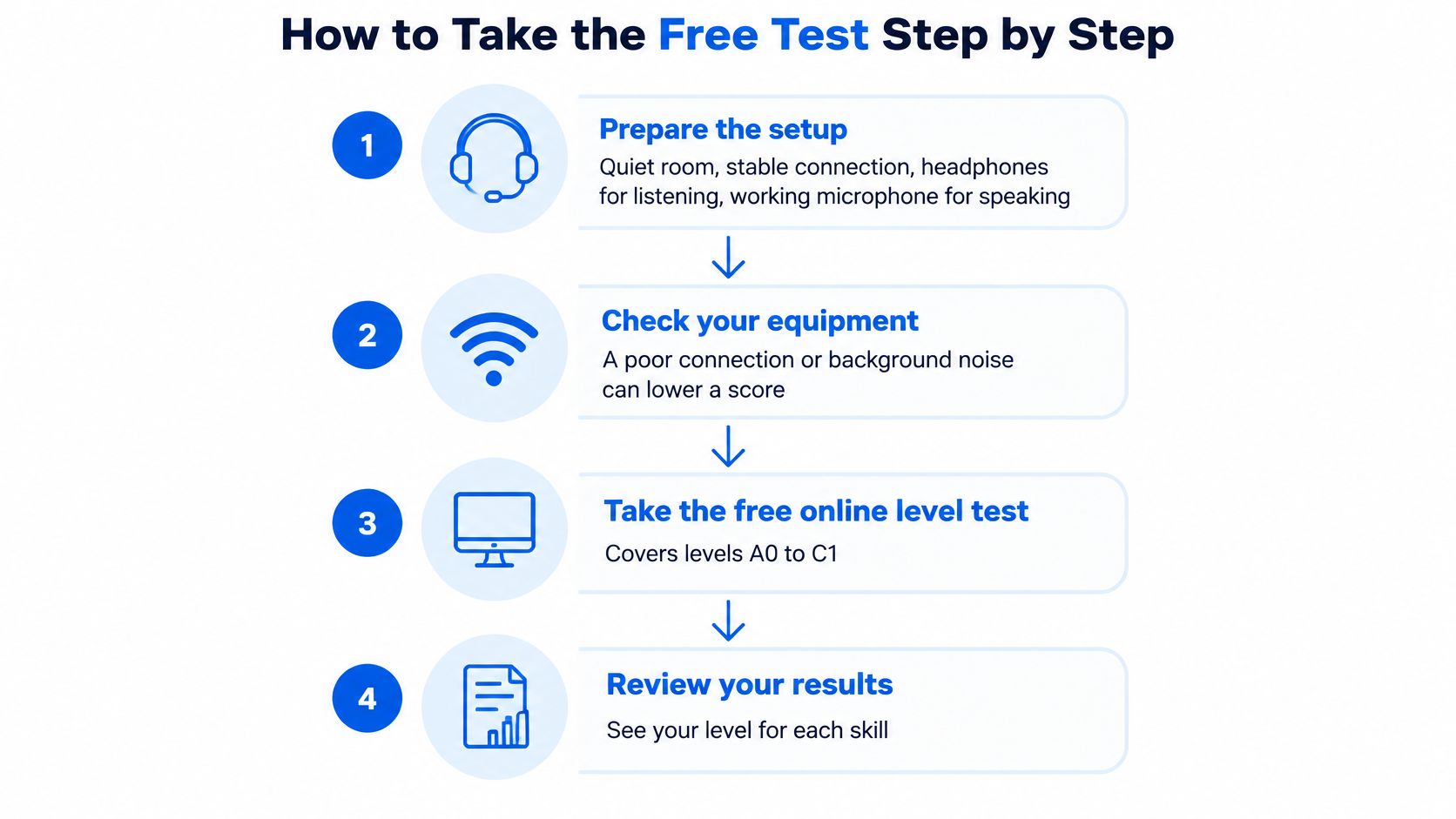
1. Set up a quiet place. Choose a spot with a steady internet connection and have a working microphone ready for the spoken part. Background noise or a poor connection can make it harder to answer comfortably. Avoid squeezing the test into a noisy break.
2. Take Englify's free online level test. It covers levels from A0 to C1 and includes a spoken part. Taking the test does not oblige you to register or buy a package. You can use it to find your current level without committing to lessons.
3. Answer each question carefully. Read or listen to the full prompt before responding, and give each answer your best effort. Cambridge's English Placement Test uses an adaptive format: its questions adjust to earlier answers, and its Reading and Use of English and Listening results are reported on a 0–100 scale with a CEFR level from Pre-A1 to C2, according to Cambridge's exam centre. That describes Cambridge's test, not Englify's.
4. Complete the spoken part. Speaking gives the teacher a chance to assess how you communicate aloud, alongside what your other answers show. If speaking feels less comfortable than reading, still give it a genuine attempt. The difference can help explain why your skills do not all sit at the same level.
5. Read the result as a guide. A CEFR level gives you a useful starting point, not a complete account of every skill. Check what the result suggests about your abilities, and use the level to guide your next learning step.
Reading Your Score Skill by Skill
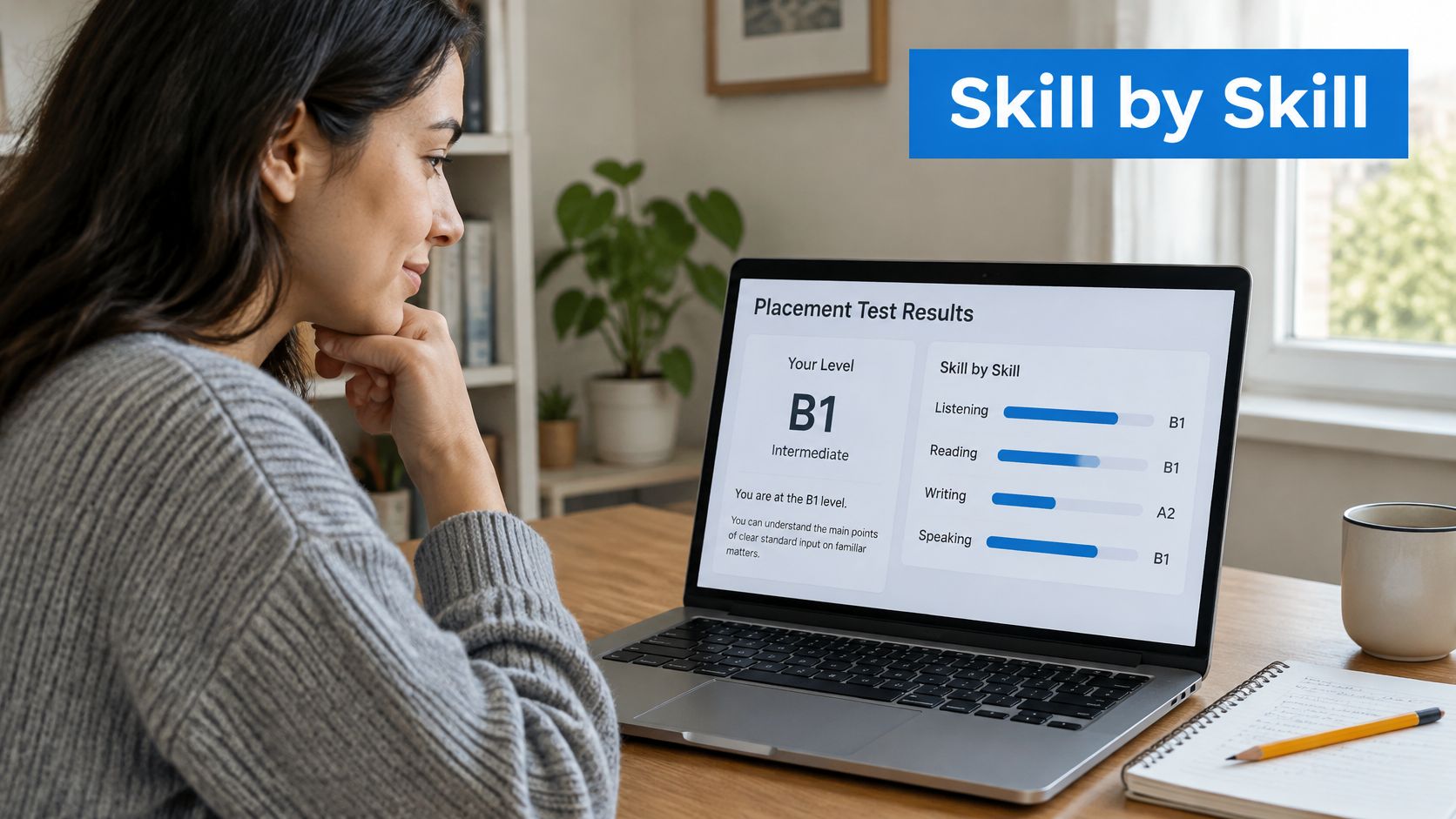
A placement result is more useful when it shows what you can do in each skill, rather than giving you only one label. You might be B1 in reading and A2 in speaking. That difference matters: reading suggests you understand texts at a higher level, while speaking may need more practice before you feel comfortable in a group at that level.
A result is more convincing when similar questions point to a similar level. If you take a comparable test again under similar conditions, the estimate should be broadly stable. Still, stability alone cannot show whether a test has measured every skill you need.
Reports vary in format. Some give one overall level; others show results by skill. Read the labels alongside the evidence, and consider which skills matter for your learning goal.
| Result pattern | What it usually means | Next step |
|---|---|---|
| Same level across all skills | A fairly consistent starting profile | Use that level as a starting point and confirm it in a trial class |
| Reading or listening higher than speaking | You may understand more than you can produce aloud | Look for a class with regular speaking practice |
| Speaking higher than writing | You may communicate more comfortably aloud than in writing | Include writing practice in your learning plan |
| Uneven skills, such as B1 reading and A2 speaking | Your abilities differ by skill, so one label does not tell the whole story | Ask a teacher to assess your speaking before choosing a level |
| Score close to a boundary, such as between A2 and B1 | Your estimated level may be near either band | Use a live class to help decide the best fit |
| Result affected by a poor connection or fatigue | The conditions may have influenced your performance | Retake the test when you can focus and compare the results |
A B1 reading and A2 speaking profile is not a contradiction. You may have had more practice reading and studying grammar than speaking spontaneously. Your reading level can guide text difficulty, while your speaking level can help determine which class gives you room to participate and improve.
Englify provides a written report after each session, including CEFR placement, strengths, and next steps. You can view the sample evaluation report.
Practical rule: Keep track of each skill result and the date. Practice, familiarity with test questions, fatigue, and connection problems can affect a single sitting, so compare results with care.
If your scores sit near a boundary, a teacher's assessment can help clarify which level suits you. A level that is too high may make class activities difficult to follow; one that is too low may not offer enough challenge.
Why Your Result May Differ From Your Teacher or Exam
A free result can disagree with your teacher, your school exam or your own sense of your speaking, and the disagreement is rarely about who's right. The instruments measure different things. Research summarised in work on online language assessment notes that videoconferencing makes remote speaking assessment possible at lower cost, but technical problems and reduced access to non-verbal cues threaten reliability, and at-home conditions differ from one candidate to the next.
Four reasons the numbers disagree
The test leans on receptive skills. If speaking and writing aren't sampled, a learner who reads well and speaks hesitantly can score higher than their conversation shows. The result describes recognition, not production.
The conditions weren't equal. A faulty microphone, a shared room or a dropped connection changes outcomes. A low listening score is sometimes a headphone problem rather than a language problem, and it's worth checking before you build a study plan around it.
A CEFR band isn't an exam score. The scale describes broad proficiency. A B2 label doesn't guarantee an IELTS band, because IELTS measures against its own tasks, timing and scoring criteria. An exam goal needs exam-style diagnostics.
The goal needs a second lens. A nine-year-old and a forty-five-year-old beginner can sit at the same point on the scale, but grouping a child requires age as well as level. A professional preparing for interviews needs business speaking and writing tasks rather than general grammar items.
The same research points out that automatically generated labels can contain errors and need checking against human or standard evidence. So a placement worth trusting combines four things: the automated screen, a short interview, a short writing sample, and a trial lesson aimed at your actual goal.
A mismatch between your test result and your teacher's view is information to explore, not a reason to distrust English study.
Confirm Your Level With a Free Trial Class
How can you tell whether a placement result fits your speaking ability? A free trial class gives you a chance to speak with a teacher and discuss your goals before choosing a course. Taking the test or trial does not enrol you or oblige you to buy a package.
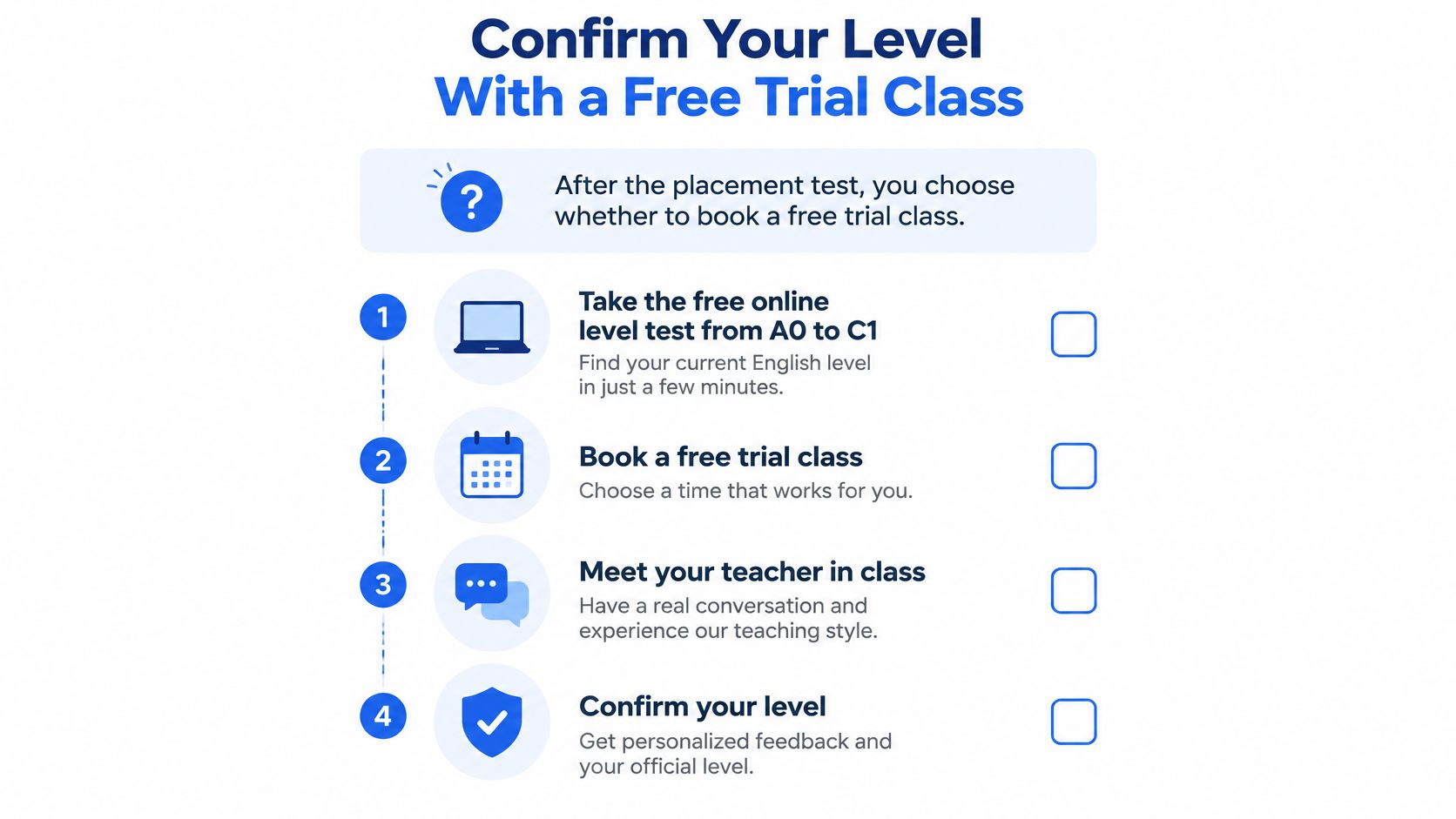
The test and the one-hour trial class are separate. In the trial, you book a slot, join a live class on Google Meet, and get a teacher's assessment of your level, including your speaking. After the placement test, group learners are matched with a small group at a suitable level. You can then discuss available group or private lesson options, including times and prices, without committing to enrol.
What to bring to the trial
- Your result and skill notes. Keep the breakdown handy. If you scored B1 in reading but A2 in speaking, for example, the teacher can focus on the difference rather than treating one label as your whole level.
- Your goal. Preparing for an exam, speaking at work, or feeling more comfortable in conversation can call for different lesson priorities.
- Your availability. Share the times that work for you so you can consider suitable class options.
- Questions about the format. Ask about group or private lessons, how feedback is given, and whether a group is appropriate for your age and level.
If your speaking seems stronger or weaker than your written result, mention it during the trial and ask the teacher to assess it in conversation. The result is a starting point; the live assessment adds another view. Read more about what to expect in a free trial English class.
A checklist for picking a tutoring program can help you compare questions to ask before choosing lessons. Use your test result to start a conversation about your level, then consider the teacher's assessment and your goals before deciding what suits you.