Knowledge hub
English for Kids Online: A Practical Guide for Parents
Discover how english for kids online classes really work, what to look for by age, and how to choose a safe, effective program for your child.
If you're trying to figure out whether English for kids online is working, you probably know the feeling already. Your child logs in, the headphones go on, the teacher smiles, and twenty minutes later you're still asking the same quiet question, did they really speak, or did they just sit there?
That's the right question to ask. Good online English classes for children are not about keeping a screen busy, they're about building repeatable speaking habits, one short session at a time. For families in Morocco and across Arabic-speaking households abroad, that distinction matters even more, because many children are already seeing English at school, but still need structured speaking practice, correction, and confidence.
The market reflects that growing demand. The global kids English learning app market was valued at about $3.8 billion in 2025 and is projected to reach $9.6 billion by 2034, with a 10.8% compound annual growth rate over the forecast period, while the primary school segment held the largest revenue share at 44.8% in 2025, equal to about $1.70 billion (Dataintelo market summary). That scale tells you something simple, families aren't looking for novelty, they're looking for results they can trust.
Table of Contents
- What an Online English Class for Kids Actually Looks Like
- The Four Building Blocks of Every Online English Class for Kids
- How Online English Classes Differ by Age Group
- Live Online Classes vs Apps and YouTube for Kids
- Safety, Teacher Quality, and Parental Reporting
- How to Evaluate a Program Before You Enroll
- Using a Free Trial and Placement Test to Make the Final Call
What an Online English Class for Kids Actually Looks Like
A parent often sees only the edges of the lesson. Your child disappears behind a screen, maybe in a small room with a headset, while the teacher is on the other side of a Google Meet call, guiding them through pictures, prompts, and short speaking tasks. What happens inside that session matters far more than the fact that it's online.
The rhythm of a real lesson
A solid class usually starts with a warm-up, then moves into new vocabulary, guided speaking, and a short activity or story to finish. In a one-to-one or small-group format, the teacher can ask the child to repeat, answer, describe, and correct mistakes immediately instead of waiting until the end. That's the difference between active learning and passive screen time.
Parents usually don't sit in the room the whole time, and they don't need to. What they should expect is a clear structure, visible progress notes, or a dashboard that shows what was covered and what the child needs next. At Englify, that kind of live online class is delivered through the teaching approach used in its kids programs, with sessions built around speaking, interaction, and age-appropriate tasks.
A six-year-old won't always stay perfectly still, and that's normal. A ten-year-old may switch into their first language for a joke, and that's also normal. Progress comes from repetition, not from one impressive lesson, so the core question isn't whether your child was present, it's whether the class made them speak a little more clearly than before.
Practical rule: if a child finishes a lesson with no recall, no speaking, and no follow-up, the class may have been entertaining, but it probably wasn't instruction.
The Four Building Blocks of Every Online English Class for Kids
A strong online program is easier to judge when you split it into four parts. If one part is weak, the whole class usually feels thin, even if the homepage looks polished.
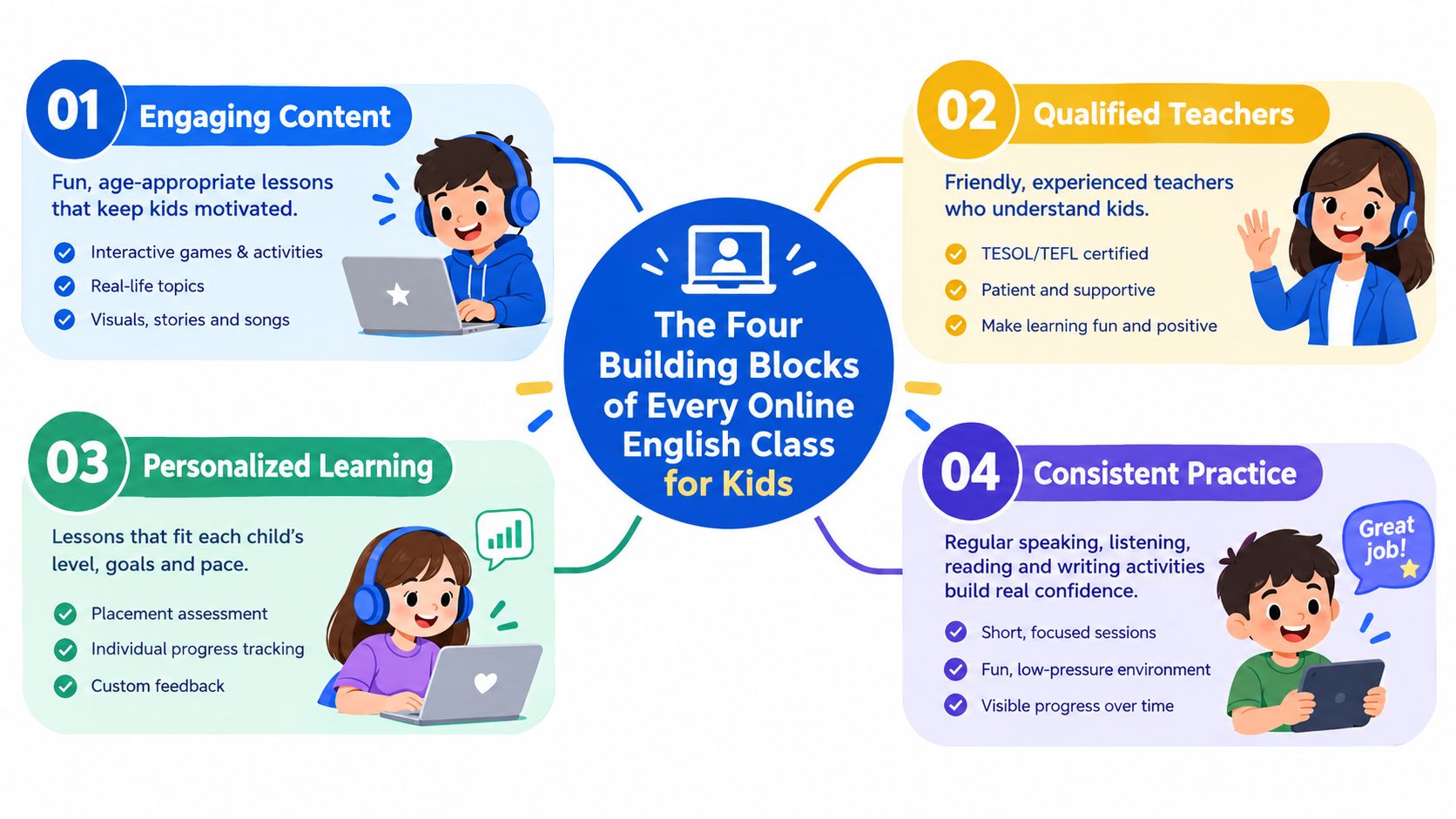
1. The live teacher
The teacher is the engine of the lesson. Good children's teachers know how to keep a child engaged on camera, redirect attention without embarrassment, and get a response even when the child is shy or tired. A thin version of this is a cheerful adult who smiles a lot but never really drives speaking.
2. The materials
Materials should match the child's age and level, not just look colorful. For young learners, that means pictures, songs, stories, and simple visuals, while older children need tasks that move into reading, writing, and discussion. If the materials feel like recycled cartoons or generic worksheets, the class may be convenient, but it's not really personalized.
3. The interactive activities
The child has to produce language, not just hear it. Good activities include role-play prompts, whiteboard games, short speaking drills, and guided tasks that make the child answer in full phrases. A weak lesson often relies on watching, tapping, or repeating without any meaningful output.
4. The reporting layer
Parents need more than a vague “good job” message. A serious academy gives notes, vocabulary lists, homework, or a class report that says what the child did well and what comes next. Without that layer, you're guessing, and guessing makes it hard to support progress at home.
How Online English Classes Differ by Age Group
A lesson that works for a six-year-old can feel flat or frustrating for a teenager. Age changes what a child can sit through, what they can answer, and how much independence they can handle. Good online English classes adjust to that, so the child is practicing language that fits both attention span and stage of development.
| Age Group | Session Length | Materials & Activities | Parent Involvement | Realistic Progress |
|---|---|---|---|---|
| 4 to 7 | Short, focused lessons with frequent changes of pace | Songs, picture books, puppets, movement, and simple speaking prompts | A parent nearby helps with focus and routine | More words used, stronger listening, less hesitation |
| 8 to 11 | Slightly longer lessons with more sustained attention | Reading, writing, simple projects, and short conversations about interests | Weekly check-ins are often enough | Better sentence building, clearer answers, more confidence |
| 12 to 17 | Longer lessons that feel closer to teen or adult study | Discussion, exam support where relevant, and independent speaking tasks | Light oversight, mostly goal setting and attendance | More fluent speaking, better accuracy, stronger exam readiness |
Young learners need structure, not pressure
Children aged 4 to 7 usually do best with short, active lessons. A song, a picture, then a quick speaking task works better than a long explanation, because younger children learn by doing and repeating. A parent nearby can help a child refocus without turning the lesson into a test. The goal is not grammar knowledge at this stage. It is building a small, usable bank of words the child can say with growing confidence.
For families looking at this age band, Englify's 4 to 7 kids program gives a clear example of how age-appropriate pacing and activities should look.
Older children can handle more, if the lesson fits them
Children aged 8 to 11 are usually ready for longer stretches of reading, writing, and conversation, especially if the topic feels familiar. Sports, animals, friends, hobbies, and school life work well because children can connect new words to things they already care about. At this point, the class should start feeling less like nursery content and more like guided communication with a clear purpose.
Teenagers need autonomy and purpose
Teenagers aged 12 to 17 need lessons that respect their age. They can handle discussion, more independent speaking, and exam-related work when needed, but they still need structure and feedback. If a fourteen-year-old is stuck with cartoon-only materials, the class is not meeting them where they are. If a six-year-old is pushed into a long, abstract lesson, the same problem shows up from the opposite side.
The pattern is simple. Younger children need more repetition and more support. Older children need more responsibility and more room to express themselves. A well-matched program makes those differences visible in the lesson design, not just in the age label.
Live Online Classes vs Apps and YouTube for Kids
Parents often compare live classes with apps and videos because all three live on a screen. The problem is that they don't do the same job, and treating them as interchangeable usually leads to frustration.
Live classes create accountability. A teacher hears the child speak, corrects pronunciation in real time, and changes the activity if the child looks lost or bored. Self-study apps are useful for repetition, but the feedback is automated and the child can click through without really speaking. YouTube can build vocabulary and listening familiarity, but it doesn't require a response.
Useful distinction: exposure helps children notice English, guided interaction helps them use it.
Here's the practical difference:
| Feature | Live Online Class | Self-Study App | YouTube / Videos |
|---|---|---|---|
| Teacher feedback | Immediate and personal | Automated | None |
| Speaking practice | Built into the lesson | Limited and scripted | Passive |
| Structure | Fixed schedule and lesson flow | Child-driven | Child-driven or random |
| Parent visibility | Notes, reports, or recordings | Usually limited | Usually none |
| Best use | Real language growth | Extra repetition | Listening and vocabulary exposure |
Apps and videos are not the enemy. They work best as support tools. A child can repeat vocabulary on an app or watch a familiar cartoon in English, but that doesn't replace a live teacher who pushes them to answer, corrects mistakes, and builds speaking confidence over time.
Safety, Teacher Quality, and Parental Reporting
A serious academy should feel organized before your child ever enters class. If the platform is vague about teachers, doesn't explain the learning process, or can't show you how progress is tracked, that's already a warning sign.
What to check before your child starts
You want to know who is teaching, how classes are protected, and how you'll stay informed. Good programs verify teacher identity, use trained instructors, and keep lessons inside a controlled platform instead of allowing open-ended contact between teacher and child. Parents should also be able to see attendance, lesson notes, and follow-up guidance after class.
The questions worth asking
- Who teaches the class? Look for teachers who are trained to work with children and can manage a camera-based classroom well.
- How is the classroom controlled? A locked lesson space is safer than a setup with open chat or outside links.
- What do parents receive? Ask for written feedback, recordings when offered, or progress notes after class.
- Can my child keep the same teacher? Consistency matters, especially for younger learners.
- What happens if I have a concern? A real academy should have a clear contact path and a real person who responds.
A parent shouldn't need to decode a platform to understand what happened in class. If the reporting is strong, you can tell whether the child is repeating the same mistakes, gaining confidence, or ready to move up. If the reporting is weak, it becomes much harder to support learning at home.
How to Evaluate a Program Before You Enroll
The first class tells you more than the landing page ever will. A good provider should welcome that reality, because a free trial or placement step gives both you and the academy a chance to see whether the child and the class are a fit.
What a strong trial should show
A proper trial starts with a real conversation, not a sales pitch. The teacher should ask your child questions, adjust the pace if they hesitate, and recycle vocabulary across the lesson instead of moving on too fast. You should see whether the child is speaking, not just nodding.
The written guidance matters too. This parent guide on choosing an online English course is a useful reminder that the trial is where you inspect the practical details, not where you get dazzled by promises. Ask for the curriculum scope, the class size, the session length, and the policy for make-up lessons before you commit.
Red flags during the trial
- The teacher talks too much. If the child barely speaks, the class is too teacher-centered.
- The lesson feels scripted. A canned flow can't adapt to your child's level.
- There's no real correction. Children need gentle correction, not just praise.
- The materials feel off-age. If the content is too childish or too advanced, the program is guessing.
- The follow-up is vague. If no one can explain what happened in class, you're missing the reporting layer.
A trial session should help you answer one simple question, did my child learn something measurable, even if small? If the answer is yes, and the child still looked engaged at the end, that's a stronger signal than any marketing claim.
Using a Free Trial and Placement Test to Make the Final Call
A placement test is useful because it prevents guesswork. It should show the child's current level, listening comprehension, and how comfortable they are speaking under light pressure. If a program skips that step, it starts blind.
A live trial then shows you whether the program can do something with that information. Watch whether the teacher changes pacing, whether the child speaks for a meaningful part of the lesson, and whether the same vocabulary comes back in different activities so it sticks. A program that gives you structured feedback after the trial is taking learning seriously.
The same principle appears in placement guidance from Cambridge, which describes adaptive testing that can diagnose level and support placement and learning planning (Cambridge placement guidance). That's the right mindset for children too, match the lesson to the learner, then build from there. Englify also offers a free, no-obligation trial plus a level check, which fits that same practical approach.
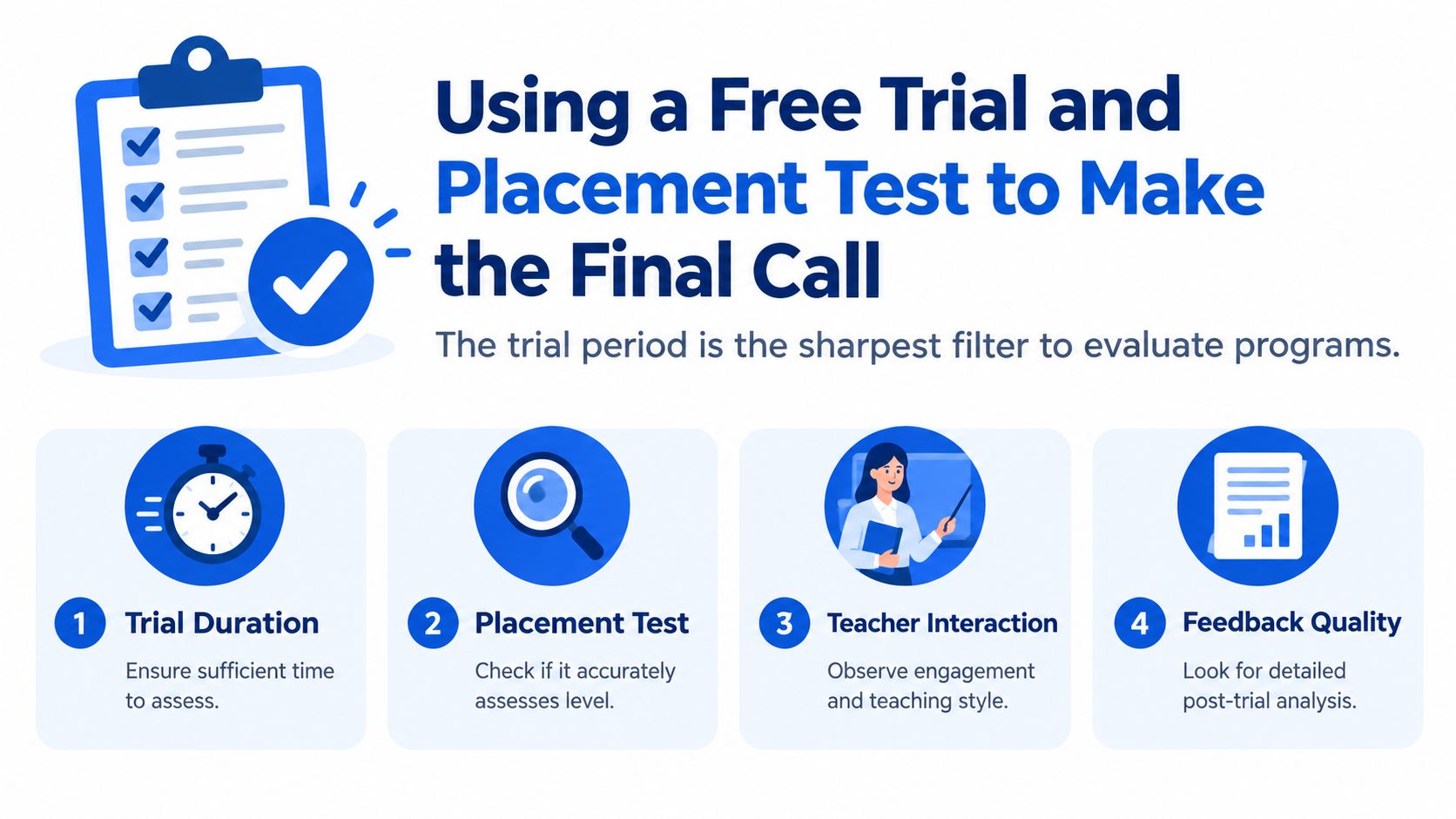
Use the trial like a parent researcher, not like a spectator. If the child is active, the teacher adapts, and the feedback is clear, you've likely found a program worth continuing. If the lesson feels passive, confusing, or overly scripted, move on.
Englify offers live online English classes for children in age-banded groups, with small classes, private options, written reports, and a free placement test plus trial session. If you want to see how that looks in practice for your child, visit Englify and book the first step with a real level check, not a guess.