Knowledge hub
Business English for Professionals: A Practical Guide
Business English for professionals explained: skills, outcomes, and how targeted training aligns with real workplace goals and career growth.
You're in a meeting with colleagues from another country, the discussion is moving fast, and your point is correct. Still, the colleague after you says the same thing more cleanly, sounds more decisive, and suddenly the room leans toward their version. That moment is why business English for professionals is not just about grammar or vocabulary, it's about whether your English carries weight when work is on the line.
In real workplaces, people don't judge English by textbook accuracy alone. They judge whether you can lead a meeting, write a clear email, handle pressure in an interview, and sound credible in high-pressure moments. That's the gap this guide addresses, especially for professionals who already know English but still feel their performance doesn't match their competence.
Table of Contents
- What Business English Really Means at Work
- How Business English Became Its Own Discipline
- Core Skill Areas Every Professional Course Covers
- The Hidden Gap Between Knowing English and Sounding Senior
- Expected Outcomes by CEFR Level
- How Training Aligns With Real Career Goals
- What a Typical Business English Course Looks Like
- Practical Next Steps and Common Questions
What Business English Really Means at Work
A mid-career manager can write grammatically correct English and still sound hesitant in a video call. That usually happens when the language is accurate but not built for the job in front of them. Business English is the language of work, not the language of casual conversation dressed up in formal clothes.
It is performance language, not just correct language
At work, English has to do something. It has to open a meeting, disagree without causing friction, ask for a deadline without sounding demanding, and close an email with enough clarity that nobody has to guess the next step. Cambridge English notes that English is used as a working language by an estimated 85% of international organisations, and its global survey found that English skills matter for over 95% of employers in many non-English-speaking countries. The same report also shows that workplace English needs are functional, with 7% of job tasks requiring native-level English, 49% advanced English, and 31% intermediate English, which helps explain why business English is task-based rather than conversational only. Cambridge English report
That task-based reality matters because the pressure at work is different from the pressure in a general English class. You're not just trying to be understood, you're trying to sound clear under time pressure, appropriate to hierarchy, and credible to people who may include native and non-native speakers. In practice, business English is workplace performance language.
Practical rule: if the sentence is correct but it doesn't move the meeting, the email, or the decision forward, it still isn't doing its job.
Business English also differs from general fluency because it has to fit the situation. A direct answer may work in a team update, but not in a client escalation. A friendly tone may help in a first message, but it can sound vague in a report. The skill is choosing the right tone for the right moment, not just knowing more words.
How Business English Became Its Own Discipline
A manager can have good general English and still struggle in a client meeting. That gap is why Business English became a separate field. As global trade expanded in the late 19th and early 20th centuries, and as English for Specific Purposes took shape more formally in the 1960s, language teaching shifted toward the needs of commerce, science, technology, and law. Business English history
Why the split happened
General English helps with daily conversation. It does not fully prepare someone to negotiate a contract, manage a difficult client call, or write a report that senior leaders will read. Once companies needed people who could run meetings, handle correspondence, and present recommendations professionally, language teaching had to specialise.
The workplace also raised the stakes. Studies cited by the University of Illinois from NACE's 2020 Job Outlook report show that employers valued strong written skills, verbal skills, interpersonal skills, and computer skills in candidates. The point is clear. Professional communication is part of employability, not an optional extra.
Why the old classroom model wasn't enough
The older classroom model focused on grammar practice and general conversation. Business English shifted the goal toward workplace output. Emails need to be clear. Meetings need to stay on track. Presentations need to help decisions happen. Interviews need confidence without sounding rehearsed.
A helpful way to see the difference is this. General fluency is like knowing how to drive. Business English is knowing how to drive in rush-hour traffic, with passengers, directions, and a deadline. The language still matters, but the setting changes how it is used.
That historical shift still shapes modern courses. Meetings, email, presentations, and interviews remain central because they were the first places where business English proved its value, and they are still where weak communication creates the fastest friction.
Core Skill Areas Every Professional Course Covers
A serious business English course doesn't try to teach “everything.” It trains the recurring work situations where English affects results. The strongest programmes focus on the language that appears again and again in real jobs, then build habits around those tasks.
The five areas that matter most
| Skill Area | Workplace Task | Typical Practice Activity |
|---|---|---|
| Meetings | Chairing, agreeing, disagreeing, interrupting, summarising decisions | Role-plays, turn-taking drills, decision recap practice |
| Emails | Subject lines, requests, escalation, follow-ups, closing loops | Drafting exercises, rewrite tasks, tone correction |
| Presentations | Structuring an argument, signposting, handling Q&A | Recorded presentations, slide commentary, delivery feedback |
| Interviews | Behavioural stories, expectation language, sounding confident | Mock interviews, answer framing, self-introduction practice |
| Small talk and networking | First meetings, client dinners, informal trust-building | Networking simulations, conversational prompts, follow-up messages |
What good training actually drills
In meetings, learners need more than “phrases.” They need to know how to enter the conversation, how to disagree politely, and how to summarise action points without rambling. In emails, the challenge is precision. A message can be polite and still be too soft, too vague, or too long.
Presentations bring a different problem. Many professionals can explain an idea informally but lose control when they have to structure a talk, signal transitions, and answer questions in real time. Interviews add another layer, because the speaker must sound reflective, decisive, and senior without sounding arrogant or memorised.
Small talk and networking are often underestimated. Yet the first exchange at a conference, the quick chat before a client dinner, or the follow-up after a meeting can determine whether trust grows or stalls.
Strong programmes don't isolate these skills. They connect them, because the same professional often needs to write the email, join the meeting, and defend the recommendation in the same week.
That overlap is why a course should produce artefacts, not just classroom participation. Sample emails, recorded presentations, mock interviews, and meeting summaries give learners something concrete to improve, which closes the gap between passive knowledge and workplace use.
The Hidden Gap Between Knowing English and Sounding Senior
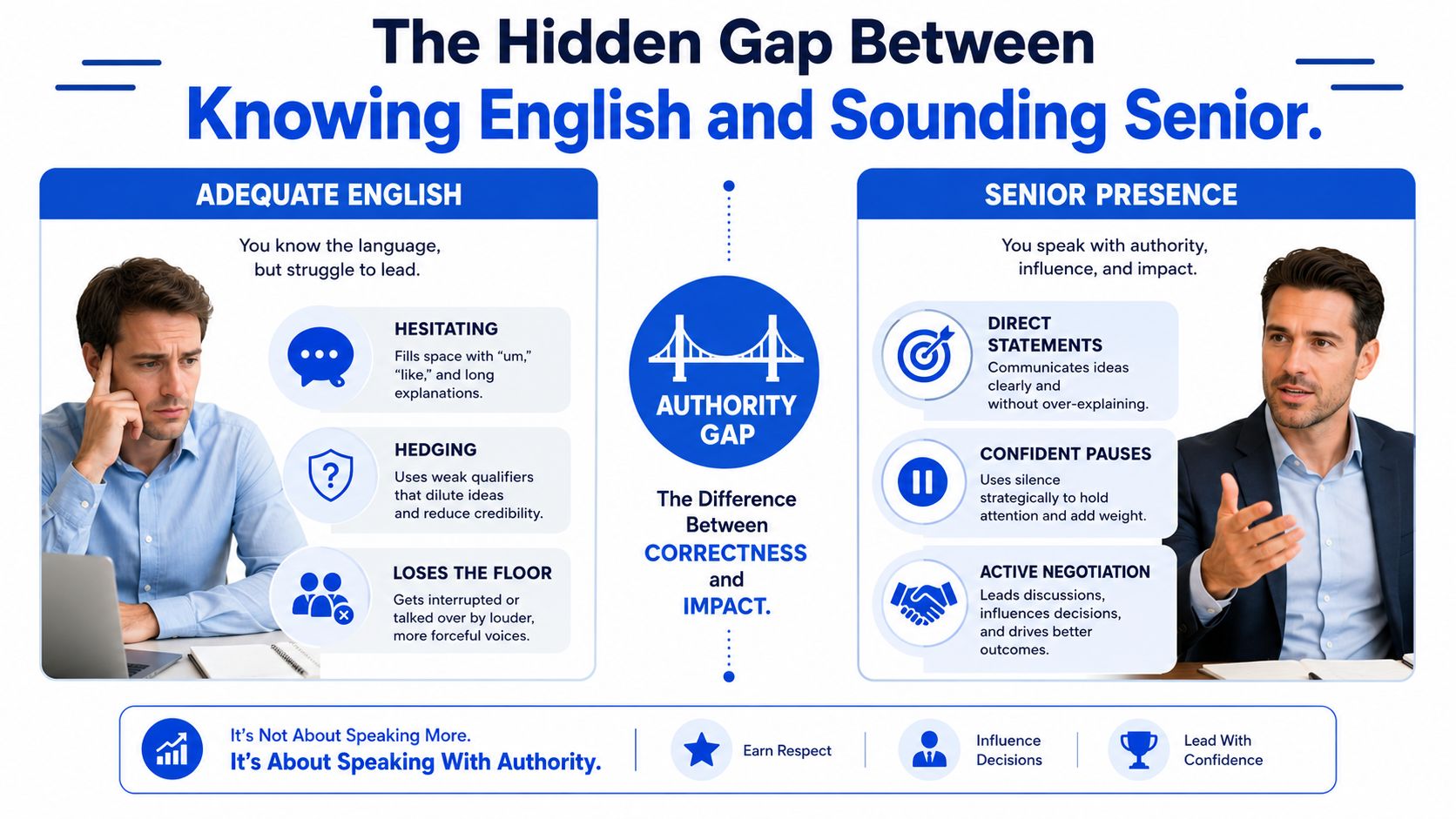
A lot of professionals don't have an English problem. They have an authority problem. They know the language, but under pressure they hedge too much, apologise too early, or let a louder speaker take the floor.
Why correctness isn't enough
A sentence can be grammatically perfect and still sound junior. Phrases like “maybe”, “I think”, “sorry to bother you”, and “just wanted to ask” aren't always wrong, but when they pile up, they can make a speaker sound uncertain even when the idea is strong. Senior presence usually comes from opening moves, pacing, stance words, and how a person handles interruption.
That gap matters because meetings reward confidence. People who sound clear and decisive are often treated as more prepared, even when their content is similar to everyone else's. In written work, AI drafts can hide some of these issues because the text looks polished. In live speaking, the same professional may still freeze, over-explain, or sound less experienced than they are. Recent commentary on workplace English says only 14% of professionals who use English as a second language feel able to express themselves fully at work, which reflects the gap between competence and performance. Why speaking English well at work takes more than being fluent
Where senior presence shows up
The difference is often small but visible:
- Opening language: A strong speaker gets to the point early, without over-softening every sentence.
- Interruption handling: A confident speaker can return to a point without sounding defensive.
- Signposting: “There are three issues here” is easier to follow than a stream of unstructured thoughts.
- Voice pacing: Calm pauses often sound more senior than rushing to fill silence.
- Stance words: “I recommend”, “we should”, and “the main risk is” sound more decisive than endless conditionals.
For managers and team leads, this matters even more. A professional who wants support for their team or a new proposal needs language that sounds credible to peers, not just correct on paper. That's one reason structured training for managers is different from general English practice, and why a focused programme such as business English for managers in Morocco can be more relevant than broad conversation classes.
Expected Outcomes by CEFR Level
CEFR levels turn a vague goal such as “improve my English” into observable workplace performance, as explained in our CEFR levels explained. They also show why one professional needs turn-taking practice while another needs nuance, persuasion, and control of register. British Council guidance describes C1 users as able to use language flexibly and effectively for professional purposes and produce clear, well-structured, detailed text on complex subjects. At A1, learners manage very basic interaction and may depend on repetition or rephrasing. C1 level explained, A0/A1 and lower-intermediate levels
What changes from B1 to C1
| CEFR Level | Meetings | Emails | Presentations | Interviews |
|---|---|---|---|---|
| B1 | Follow simple discussion, ask for clarification, take a basic turn | Send short functional messages | Present familiar topics with support | Answer common questions with preparation |
| B2 | Contribute clearly, defend a point, handle routine disagreement | Write structured, polite professional emails | Organise ideas with clear signposting | Explain experience and goals with more control |
| C1 | Lead discussion, negotiate, adapt to hierarchy and audience | Write concise, persuasive, situation-aware messages | Deliver detailed arguments and handle Q&A with flexibility | Present achievements and decisions with nuance and confidence |
B1 supports survival and participation. B2 supports reliable performance in familiar work settings. At C1, English can carry leadership: the speaker frames a recommendation, responds to challenge, and adjusts tone for a senior stakeholder, client, or colleague.
The change involves professional identity as well as grammar. A learner may know the correct structure yet hesitate, over-explain, or sound less decisive under pressure. Performance tasks expose that gap more clearly than isolated grammar exercises. A meeting simulation, email rewrite, presentation, or interview response shows what the learner can do.
Structured practice can also include AI-assisted work. Professionals need to review machine-generated wording for accuracy, tone, audience, and intent. CEFR progress therefore connects language knowledge with credible workplace action, including the judgment to accept, revise, or reject a draft.
How Training Aligns With Real Career Goals
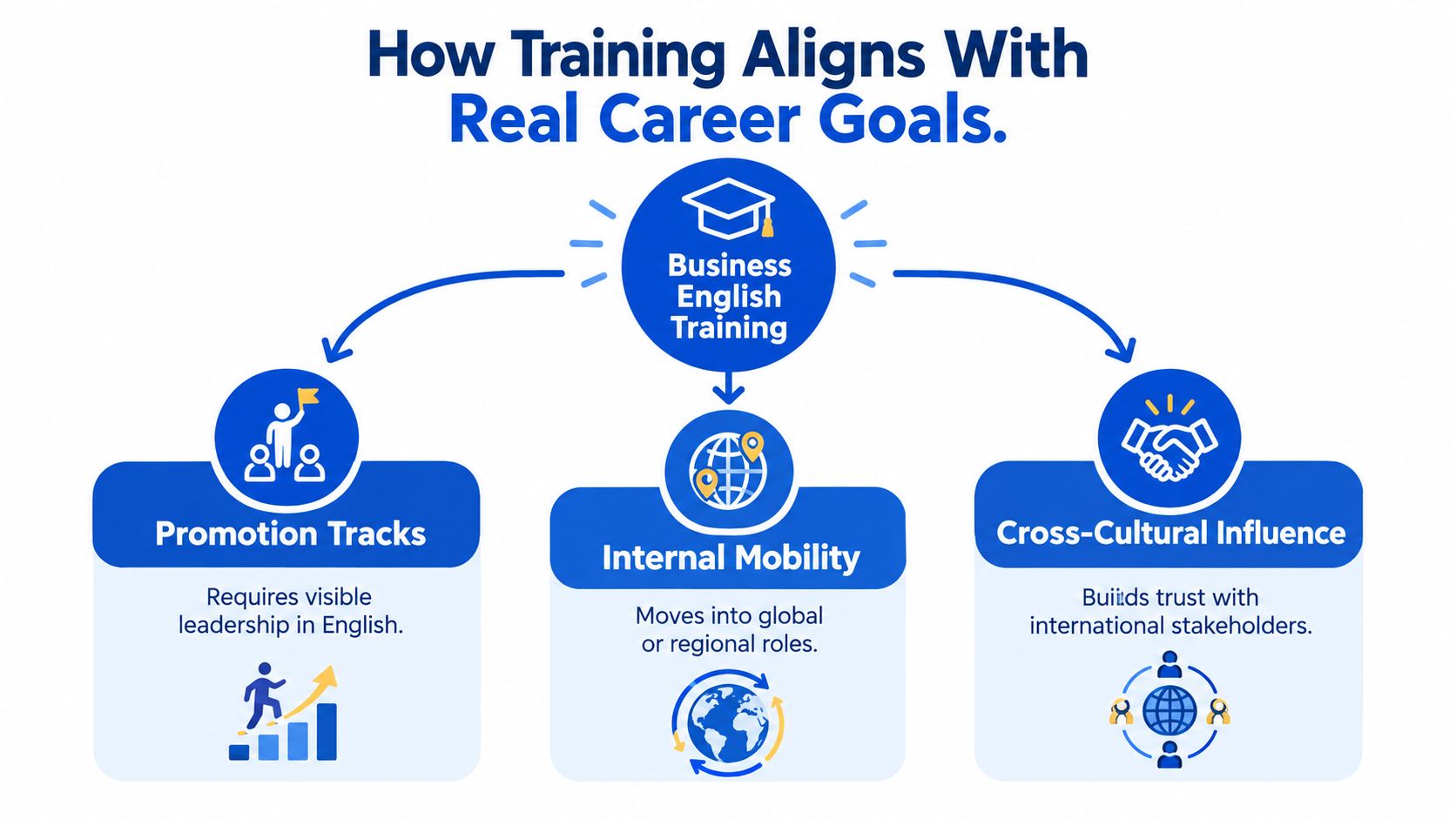
Professionals usually don't enrol because they love language study. They enrol because they want a promotion, a move into a regional role, stronger client relationships, or a better shot at cross-border hiring. English is often the medium through which those goals become visible.
The training path that maps to career outcomes
Business English training becomes more useful when it is tied to a real outcome. Meeting leadership helps people speak up in promotion reviews and team discussions. Executive email writing supports faster, clearer coordination with managers, clients, and colleagues. Presentation defence matters when a professional has to explain a decision in front of stakeholders. Interview storytelling helps with internal mobility and external hiring loops.
That's also where the AI layer changes the skill. Professionals now need to prompt, edit, and verify machine-generated text, not just write every line themselves. The problem is no longer only “Can I draft this email?” It's also “Can I judge whether this draft sounds human, accurate, and on-brand?”
What companies actually need
ETS reports that benchmarking English should compare skills across roles, regions, business functions, and career stages, and its 2026 Global English Skills Report draws on 1,325 HR decision-makers in 17 countries, which shows how employers now think about English as part of performance planning. ETS corporate benchmarking, ETS global English skills report launch
That matters because a course is not just a class when it helps a learner move into a role with more visibility. It becomes a career asset when the learner can show improvement in the exact communication tasks that recruiters, managers, and international teams already care about.
What a Typical Business English Course Looks Like
A good course starts by finding the right level, not by assuming every learner needs the same content. That usually means a placement call, a written task, or a CEFR-mapped test. Englify's online classes use live sessions on Google Meet, with small groups, private options, a free placement test, a free trial session, session reports, and CEFR-based levels from A0 to C1, which fits the kind of structured approach professionals need when they want visible progress. Englify business English course guide
A practical learning cycle
| Stage | What Happens | Why It Matters |
|---|---|---|
| Placement | Diagnostic call, written task, or level test | Matches the course to real ability |
| Customized curriculum | Focus on the learner's workplace needs | Avoids generic lessons that waste time |
| Active practice | Role-plays, simulations, feedback loops | Turns knowledge into performance |
| Measurable progress | Assessments, reports, portfolio work | Makes improvement visible and trackable |
A week inside the course often blends more than one skill. A learner might write an email, practise a client call, and record a short presentation, then receive comments on tone, clarity, pronunciation, and structure. That format matters because business English is rarely used in isolation at work.
What feedback should look like
Good feedback is specific. It points out where the learner sounded too tentative, where the email became too long, or where the presentation lost structure. It may include annotated transcripts, pronunciation notes, rubric-based scoring, or a manager report if the learner's company is funding the training.
The best sign of a serious course is not that it feels easy. It's that the learner can name exactly what improved and why.
Certificates at the end of a course matter less than the evidence behind them. A good programme leaves the learner with clearer speech, tighter writing, and a better sense of how to perform under workplace pressure.
Practical Next Steps and Common Questions
Before enrolling, do a quick audit of your current English at work. Record yourself in a meeting, draft a real email, or rehearse a short update out loud, then look for patterns. The goal is to find the specific gap, whether that's hesitation, weak structure, unclear tone, or trouble handling questions.
What to check before you choose a course
- Match the format to the problem: If you need live speaking confidence, one-to-one coaching or small-group practice will help more than reading lessons.
- Ask for a trial session: A sample class tells you more than a course description.
- Check how progress is reported: If your employer is paying, ask for learner reports or progress notes.
- Confirm the level fit: A course should match your CEFR stage, not your aspiration level.
- Review the coach's experience with workplace English: Business English needs practical feedback, not only general conversation.
If your job uses English every day, a structured course is usually more efficient than trying to improvise from random videos and templates. That's especially true when the issue is not knowledge, but sounding credible in real time.
Common questions
How long does improvement take?
It depends on your starting level and how often you practise, but the fastest gains usually appear when the work is tied to real tasks like meetings, emails, and presentations.
Does Business English work for finance or tech?
Yes, because the core skill is workplace communication. The examples change, but the need to explain, persuade, and collaborate stays the same.
Is Business English certification the same as general English certification?
No. General English certification measures broad language ability, while Business English training focuses on workplace performance.
Can AI replace a structured course?
Not fully. AI can help draft and edit, but it can't reliably teach presence, tone, hierarchy, or live interaction.
Englify offers live online Business English classes through Google Meet, with small groups, private coaching, CEFR-based placement, and practical reporting. If you want training that focuses on meetings, emails, presentations, and interviews, visit Englify and check the free placement test and trial session before you start.