Knowledge hub
Business French Course: Levels, Costs and How to Choose
Business French Course guide: CEFR levels A1 to C1, sample syllabus, delivery formats and how to choose a provider in Morocco.

Can you recognise French business vocabulary but still struggle to explain a delay, interrupt politely in a meeting, or answer a dissatisfied client? That gap is what a business French course should address. The useful question isn't how many phrases you'll learn, but which workplace tasks you'll be able to perform and what evidence will demonstrate your progress.
Table of Contents
- What a Business French Course Covers in Practice
- Who Business French Is For and Why It Matters
- Business French Levels from A1 to C1 Explained
- A Sample Syllabus and 60-Minute Lesson Plan
- Online, Small-Group and One-to-One Formats Compared
- How to Choose a Business French Provider and Judge the Price
- Frequently Asked Questions About Business French Courses
- Enrol in Four Steps and Book a Free Trial
What a Business French Course Covers in Practice
A business French course teaches you to use French for specific professional tasks. These include running meetings, writing emails, giving presentations, negotiating terms, handling client calls and summarising documents for colleagues. Grammar and vocabulary support those tasks rather than becoming the entire syllabus.
Workplace French differs from general conversation through register, sector vocabulary and precision. Register means choosing language that suits the relationship and situation. A message to a familiar colleague can sound different from a response to a procurement officer, even when both communicate the same information.
Precision matters because a vague sentence can leave a colleague unsure who must act or which deadline applies. A course should therefore train you to communicate decisions, responsibilities and constraints, not just produce grammatically correct sentences.
From language knowledge to workplace action
Consider a client complaint. The learner needs to acknowledge the problem, explain what can be confirmed and propose a next step without promising something the company can't deliver. The teacher can then assess whether the response is clear, appropriately formal and operationally useful.
Useful course outputs include:
- Meeting practice: A recorded role-play showing how the learner takes a turn, requests clarification and summarises decisions.
- Email writing: A draft and revised version showing improvements in structure, tone and accuracy.
- Document comprehension: A summary that preserves the central message, deadlines and limitations.
- Presentation practice: An explanation of a proposal followed by unscripted questions.
Technology can also belong in the learning plan. BubblyPhone's resource on cross-border call translation with BubblyPhone gives professionals a starting point for exploring translated calls. A useful classroom activity is to review a translated exchange and identify wording that needs human checking, rather than assume the tool has preserved every implication.
Vocabulary quizzes can check recall, but they don't demonstrate that someone can manage an interaction. The Council of Europe's CEFR descriptors support assessing communication through observable activities rather than vague labels.
The course test: Does the provider name the workplace tasks it trains, and does it assess them through recorded or written evidence?
Who Business French Is For and Why It Matters
A logistics coordinator in Morocco receives a supplier's message about a delayed shipment. Before replying, she must establish what changed, confirm the revised delivery date and explain the proposed remedy. Knowing transport vocabulary helps, but organising a precise, professional response is the actual task.
A hotel receptionist faces a different challenge. He needs to confirm a reservation, understand a guest's complaint and explain the available solution without sounding dismissive. His course should prioritise listening and service interactions, not the same documents a finance officer studies.

Match the course to recurring responsibilities
Business French is particularly relevant to professionals who regularly communicate with French-speaking customers, suppliers or colleagues. In Morocco, that can include relationships with partners in France, Belgium, Switzerland, Canada, and West or Central Africa. Moroccans abroad may also need professional French for internal teamwork rather than international sales.
Typical learning priorities include:
- Sales and customer service: Explaining offers, handling objections and responding to complaints.
- Logistics and procurement: Clarifying specifications, delivery conditions and supplier commitments.
- Finance and administration: Explaining figures, requesting documents and reporting discrepancies.
- University students: Preparing for interviews, internships and workplace correspondence.
French's institutional presence helps explain why these needs extend beyond private companies. The French language overview identifies French as an official language of the United Nations and European Union, and as an official or working language of organisations including the World Trade Organization. These settings create practical reasons to learn the language of negotiation, procurement, administration and formal correspondence.
The right starting question is therefore about your work, not your professional status. If you write French emails, read work documents or join French-speaking calls, a task-focused course is relevant. If you mainly want to order food or manage holidays, general French is likely a better fit.
Neither course guarantees employment or promotion. Its value comes from preparing you for communication your intended role requires.
Business French Levels from A1 to C1 Explained
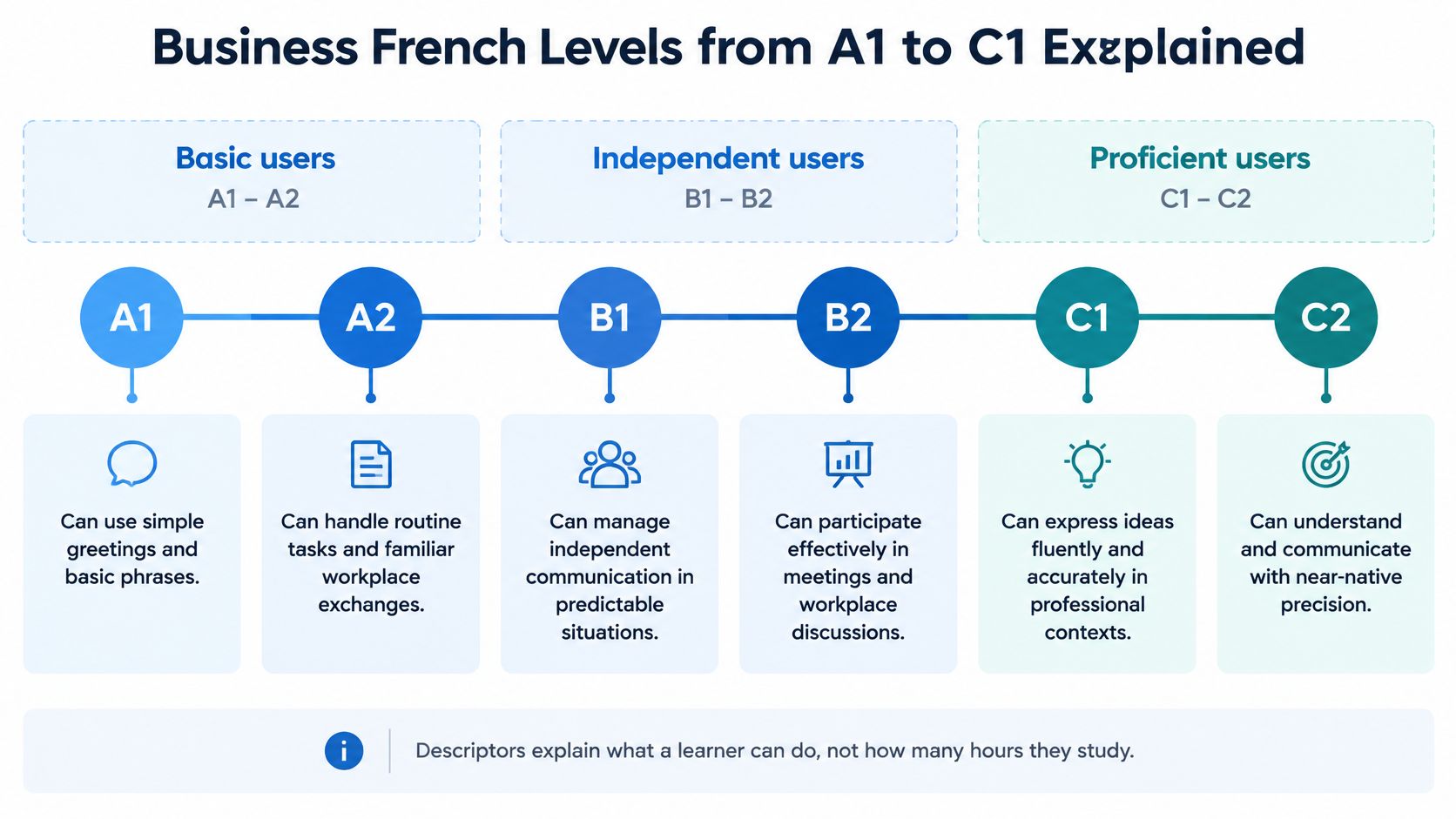
The Council of Europe's level descriptions organise the CEFR into six levels, A1 to C2, grouped as Basic, Independent and Proficient Users. Their descriptors explain what learners can do, not how many hours they've studied, and include the intermediate benchmarks A2+, B1+ and B2+.
CEFR levels and the workplace tasks each level makes possible
| CEFR level | Group | Typical workplace tasks |
|---|---|---|
| A1 | Basic User | Introduce yourself, handle greetings and short routine messages |
| A2 | Basic User | Exchange routine information, write short messages, follow slow and clear instructions |
| B1 | Independent User | Follow the main points of meetings on familiar topics, write simple work emails |
| B2 | Independent User | Follow technical discussions, compare options, write structured reports and follow-up emails |
| C1 | Proficient User | Handle complex negotiations, express nuance, produce polished professional documents |
| C2 | Proficient User | Work with near-native precision, mediate complex discussions, adapt register fluently |
These are workplace applications of the framework, not automatic permissions attached to a certificate. A learner may write comfortably at one level while needing more support with listening. Subject knowledge, preparation and familiarity with the task also matter.
What B2 means at work
The CEFR global scale describes B2 as understanding the main ideas of complex texts, including technical discussions in the learner's specialisation, interacting with sufficient fluency for regular conversation, and producing clear, detailed writing. It also includes explaining the advantages and disadvantages of different options.
Applied to a project meeting, that means understanding the main trade-offs, explaining a preferred solution and writing a coherent follow-up. It doesn't mean understanding every unfamiliar accent or negotiating specialist legal wording without assistance.
C1 involves greater flexibility and control, but advanced language ability still isn't a substitute for technical expertise. Likewise, the phrase near-native precision at C2 describes communicative control, not a requirement to lose your accent.
Don't select a course level by job title. A senior manager can be a beginner in French, while a student may already communicate independently. Start with a French placement assessment, then confirm speaking and writing needs through practical tasks so the learning plan addresses your actual profile.
A Sample Syllabus and 60-Minute Lesson Plan
A useful syllabus builds related skills in sequence rather than switching between disconnected business topics. The following is an illustrative teaching plan, not a promise that every learner can master these tasks within the suggested period.
A sample workplace progression
- Weeks 1 and 2: Introductions and professional emails, including a clear purpose, appropriate greeting and explicit request.
- Weeks 3 and 4: Phone calls and meetings, with practice confirming details and asking for clarification.
- Weeks 5 and 6: Presentations and figures, focusing on explaining changes and answering questions.
- Weeks 7 and 8: Negotiation and disagreement, including conditions, alternatives and polite boundaries.
- Weeks 9 and 10: Reports and executive summaries, separating essential information from background detail.
- Weeks 11 and 12: Mediation and a task-based final assessment using connected workplace scenarios.
A beginner would need simpler inputs and more supported production. An advanced learner could work with ambiguous requests, competing priorities and less predictable questions.
Sixty-minute business French lesson plan
| Segment | Minutes | Activity | Output |
|---|---|---|---|
| Warm-up | 5 | Short greeting and status exchange in French | Speaking confidence checked |
| Vocabulary in context | 10 | Sector terms used in a short realistic message | Terms used correctly in a sentence |
| Model text analysis | 10 | Read a formal email and identify its structure and register | Structure and register named |
| Role-play | 20 | Simulated client call or meeting with a set objective | Turn-taking and clarification rated |
| Feedback and corrections | 10 | Teacher corrects pronunciation, grammar and register | Corrections recorded for the next session |
| Written task | 5 | Short follow-up email or action summary | Central message and key constraints checked |
The timing above is a sample allocation. The teacher should adjust task difficulty and preparation without allowing explanations to consume all the interaction time.
Why mediation belongs in the lesson
Mediation means helping someone else access information or understand an idea. The Council of Europe's CEFR Companion Volume includes separate scales for mediating texts, concepts and communication, alongside oral, written and online interaction.
For a multilingual Moroccan team, a learner might convert a French email into an English action summary. Another task could involve explaining a French document to a colleague who doesn't read French. The assessment should check whether the learner preserves the central message and constraints, not whether every word was translated.
Teachers should also distinguish confidence from performance. A learner's self-reported comfort is useful feedback, but the recording must show whether they clarified an uncertain deadline or misunderstood it.
By the lesson's end, the learner should be able to handle the practised interaction and produce its corresponding follow-up. The corrections then become specific targets for the next attempt.
Online, Small-Group and One-to-One Formats Compared
Online describes where learning happens, not how much interaction you receive. A private video lesson, a live company workshop and a recorded course can all be online while offering very different opportunities to speak.
The Council of Europe's CEFR guidance includes online interaction and interaction strategies such as taking the floor, cooperating and requesting clarification. Those are useful criteria for judging live practice, including video meetings with screen sharing and shared documents.
Business French delivery formats compared
| Format | Best for | Speaking time per learner | Feedback | Main limitation |
|---|---|---|---|---|
| One-to-one live video | Executives and specialists with fixed goals | Full session available for individual work | Immediate and personalised | Usually the highest cost per contact hour |
| Small live group | Teams in similar roles | Shared, with pair role-play | Teacher and peer feedback | Less individual time per learner |
| Company group | Colleagues working on the same tasks | Shared, using internal scenarios | Tailored to company tasks | Harder to schedule across shifts |
| Hybrid (live plus written tasks) | Learners with busy but regular schedules | Live sessions plus written practice | Teacher feedback on written work | Needs discipline between sessions |
| Self-paced recorded material | Learners with irregular timetables | Limited unless paired with live practice | Delayed or automated | Speaking practice is easy to skip |
The trade-offs behind the format
Private lessons offer the most direct route to a narrowly defined goal because the teacher doesn't need to accommodate unrelated priorities. However, a full session of individual attention doesn't mean uninterrupted learner speech. Check whether you'll rehearse your task rather than mainly listen to explanations.
Small groups provide different voices, objections and communication styles. Their value drops if participants have incompatible levels or one person dominates. Company groups can practise shared workflows using anonymised internal documents, but confidential information should be removed before teaching materials are circulated.
Hybrid learning works when the written assignment prepares you for the live interaction. Self-paced material is useful for reviewing vocabulary or replaying explanations, but it shouldn't replace the speaking practice you enrolled for.
MEDIAL's a guide for instructors teaching online is useful background when discussing live, synchronous delivery with a trainer. For a learner-focused comparison, our guide to online French classes can help you consider how delivery fits your routine.
Choose the format by the task you must perform at work, not by the lowest advertised price.
How to Choose a Business French Provider and Judge the Price
Compare cost per contact hour before comparing monthly fees. Divide the total payable course price by the live teaching hours included, then check whether materials, feedback and other services require additional payment.
For a hypothetical example, not an Englify price, a course costing 4,800 MAD for 32 contact hours costs 150 MAD per contact hour. That calculation is only useful if the quoted total and hours cover the same period. Confirm whether the price is per month, per term or for the complete course.
Start with duration and scope
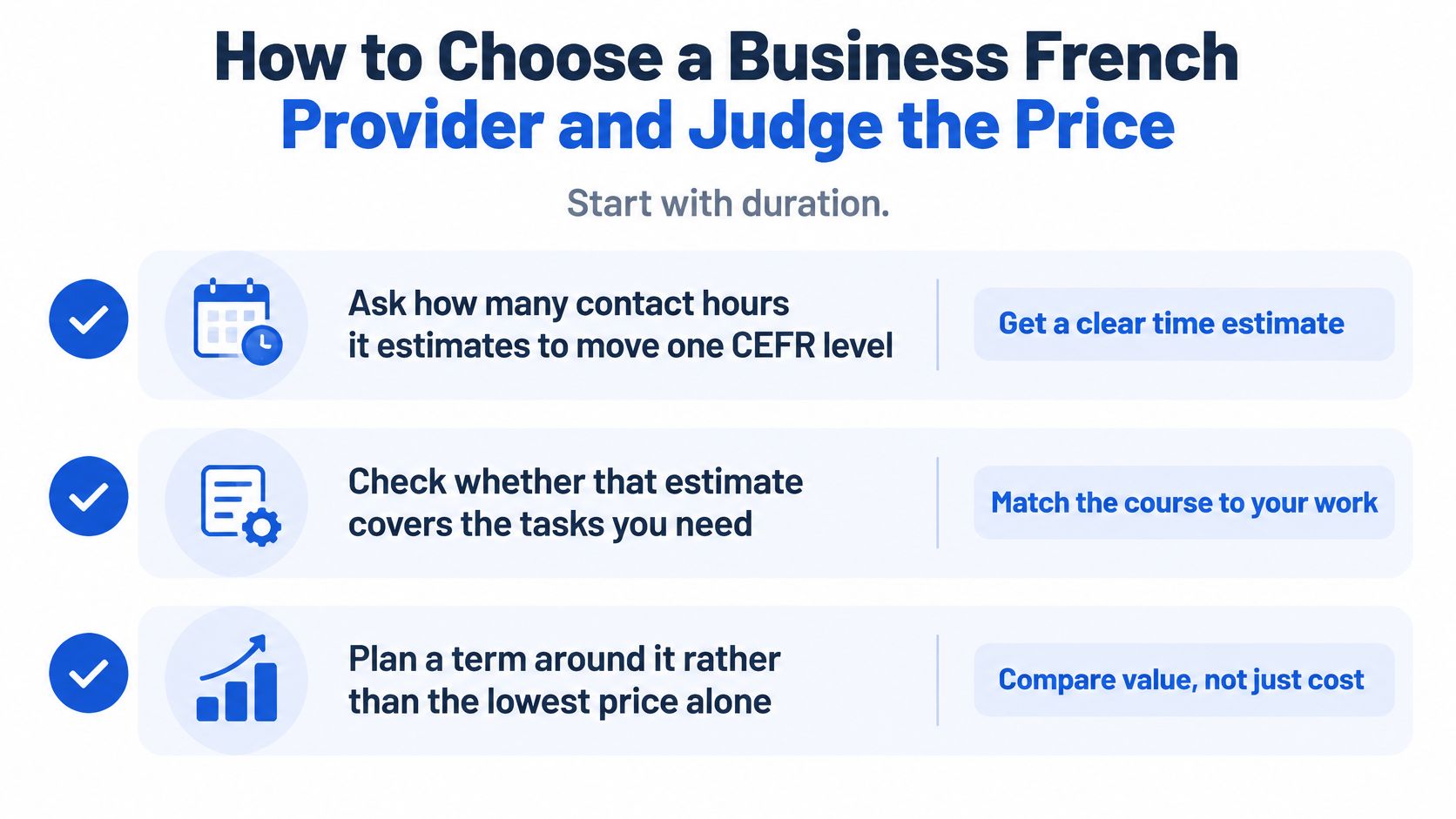
Request an estimated number of contact hours for the intended CEFR step, with the assumptions written down. The estimate should account for your starting profile, independent practice and required workplace tasks. Plan the term around that scope rather than assume a calendar deadline guarantees a level.
Provider checklist for business French courses
| Criterion | Question to ask | Good sign | Red flag |
|---|---|---|---|
| Level placement | How is my CEFR level confirmed? | Free placement assessment before enrolment | Level chosen only by job title |
| Task outcomes | Which workplace tasks will I practise and how? | Named tasks with recorded or written evidence | Generic professional confidence claims |
| Duration | How many contact hours per CEFR level? | Estimate given in writing and linked to tasks | Guaranteed level in a fixed time |
| Price | What is the cost per contact hour and what is included? | Price in MAD with inclusions listed | Hidden fees or unclear unit of payment |
| Feedback | What reports will I receive after each session? | Written reports with strengths and next steps | No reports or only attendance records |
| Teacher support | Can teachers explain in French, Arabic or Darija? | Teachers support learners in more than one language | No support outside the target language |
| Exam link | Is exam preparation included, and which exam? | Named exam with a clear preparation plan | Exam claims without a method |
The language-support row needs context. French-only instruction can be effective, but learners who need occasional clarification should know whether that support exists. Our teachers speak English, French and Moroccan Darija, so a difficult instruction needn't become an avoidable barrier.
Look beyond the hourly calculation
Ask how teachers approach your professional field. Business experience is useful, but it doesn't automatically establish teaching skill. A stronger demonstration is a realistic task, a clear assessment rubric and feedback that explains how to improve your next attempt.
Request an anonymised sample learner report. It should separate observed strengths from next steps rather than merely list the lesson topic. Also confirm what the price includes: placement, trial, recordings, written feedback, materials and any named exam preparation.
Genesisе's resource on turning your expertise into a paid course offers a course-creator perspective. For buyers, the relevant distinction is that packaging professional knowledge into lessons isn't the same as demonstrating learner progress.
Our comparison of free and paid French learning options can help you decide which activities need paid teacher support and which you can complete independently.
Buying rule: A useful hour includes relevant practice and actionable correction. A cheap hour spent on unrelated content isn't necessarily good value.
Frequently Asked Questions About Business French Courses
How long does it take to reach B2 in business French?
There isn't a reliable universal timetable. Your starting skills, attendance, independent practice and required tasks affect the estimate, so request a written contact-hour plan with review points. A course should explain what happens if speaking improves faster than writing rather than promise automatic progression.
Can AI translation replace business French?
AI translation can support drafting and comprehension, but it shouldn't replace your judgment in sensitive communication. Use it for a first draft or a low-risk message you can check, not as the sole reviewer of a contract or sensitive complaint response. Live negotiation also requires someone capable of recognising uncertainty and responding appropriately; legal documents still need qualified professional review.
What can a team demonstrate after three months?
A team can demonstrate changes in assessed performance, but a provider can't promise identical gains for every employee. Agree on a baseline and follow-up task, then compare role-play recordings, email samples and comprehension checks under comparable conditions. Report speaking, listening, reading and writing separately so a stronger overall impression doesn't hide a persistent weakness.
Is a business French course worth it for a university student?
Yes, when the student is preparing for an internship or role that uses French professionally. Interview answers, workplace emails and project explanations are relevant priorities. If the immediate need is foundational communication rather than work, a general French course may be the more suitable starting point.
Do I need advanced French before starting?
No, but the tasks must match your present ability. A beginner can practise introductions and supported routine messages without being ready to negotiate commercial terms. Be cautious when the same learning outcomes are advertised for beginners and advanced professionals.
Enrol in Four Steps and Book a Free Trial
Which workplace tasks do you want to handle more confidently in French? A clear answer helps you judge whether a course's practice and level fit your needs.
Prepare your goals and check the fit
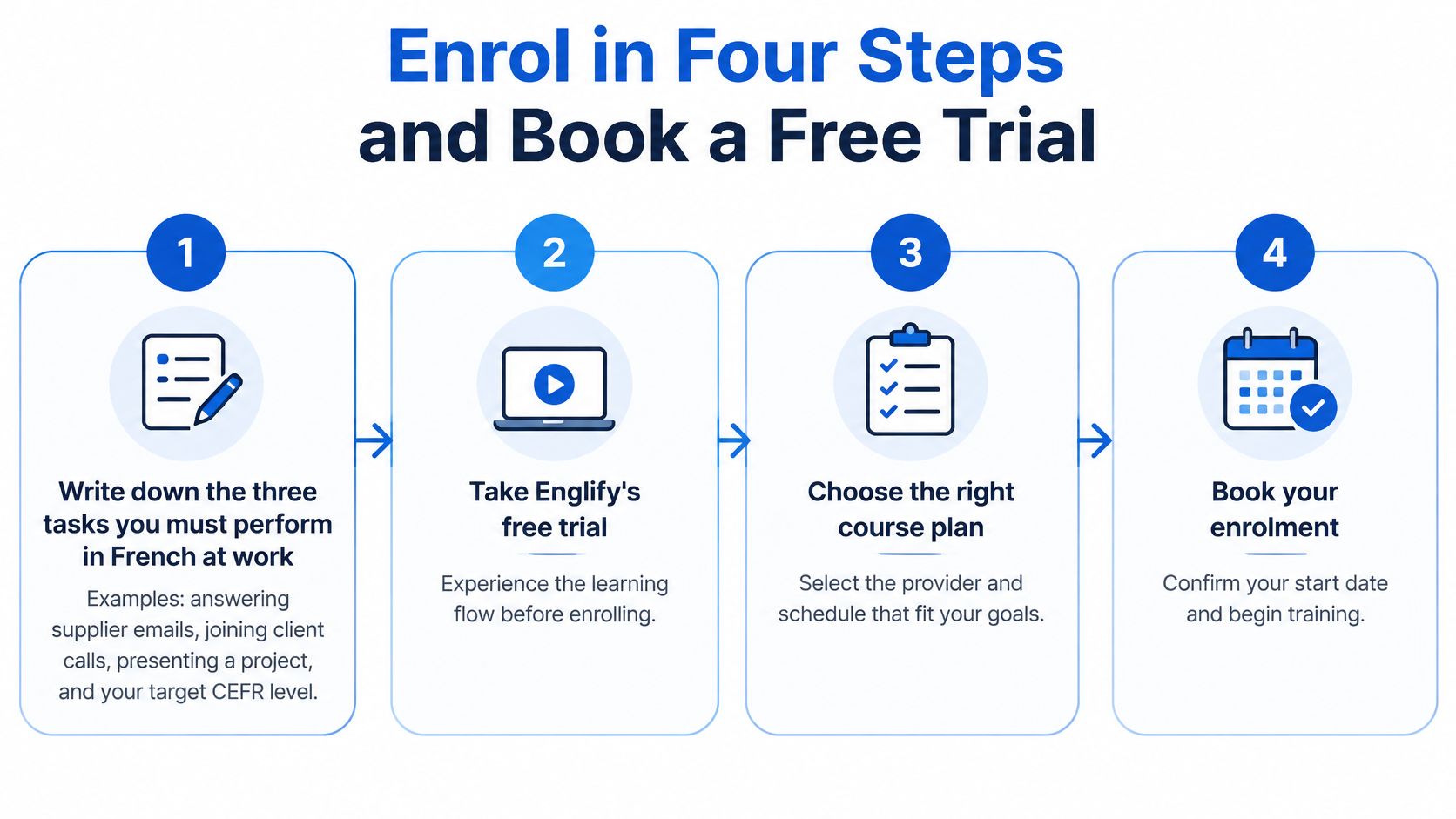
- List your priority tasks. Choose three, such as replying to supplier emails, joining client calls, or presenting a project. Add a target CEFR level if you have one, but treat it as provisional until you are assessed.
- Take the free placement test. Use the result to identify your starting level rather than relying on your degree or job title. An anonymised writing sample can help clarify the kinds of work you want to practise.
- Attend the free trial lesson. Check whether the feedback identifies strengths, difficulties, and practical next steps. Notice how much time you have to speak and apply corrections.
- Confirm the arrangements. Choose an individual or small-group format, agree on a schedule and start date, and ask how your progress on the priority tasks will be reviewed.
What the learning arrangements include
Englify is a Morocco-based online English and French academy serving learners across Morocco. Live lessons take place on Google Meet, last 60 minutes, and are available individually or in small groups, depending on availability.
Personalised French classes cover A1 to C1 and can include DELF/DALF and TCF/TEF preparation. These qualifications assess French proficiency, while workplace practice focuses on tasks such as emails, calls, and presentations. Clarify which outcomes your course will address.
Englify provides written reports after classes and a detailed evaluation after the trial. Use these to track feedback and next steps; they are different from session recordings. Visit Englify to take the free placement test and arrange a free trial. Bring the workplace tasks you want to practise.