Knowledge hub
English for Job Interviews: A Practical Preparation Guide
Practical English for job interviews guide covering STAR answers, common questions, vocabulary, mock interview practice, and tips
You've got the interview invite, the calendar hold, and the uncomfortable truth that your English has to do more than just “be correct.” It has to sound clear under pressure, stay organized when the question turns messy, and show the interviewer you can speak like someone they'd trust with clients, meetings, and live problem-solving. That's exactly what english for job interviews demands now, especially when the first round may be on video, timed, or even screened by AI before a human ever joins the call.
Table of Contents
- Why English for Job Interviews Matters Now
- Self-Assessment Before You Start Rehearsing
- Building STAR Answers That Actually Land
- The Eight Common Interview Questions in English
- Vocabulary and Phrasing That Sounds Professional
- Running a Mock Interview That Improves You
- Day-Of Tips for Video, In-Person, and AI Interviews
Why English for Job Interviews Matters Now
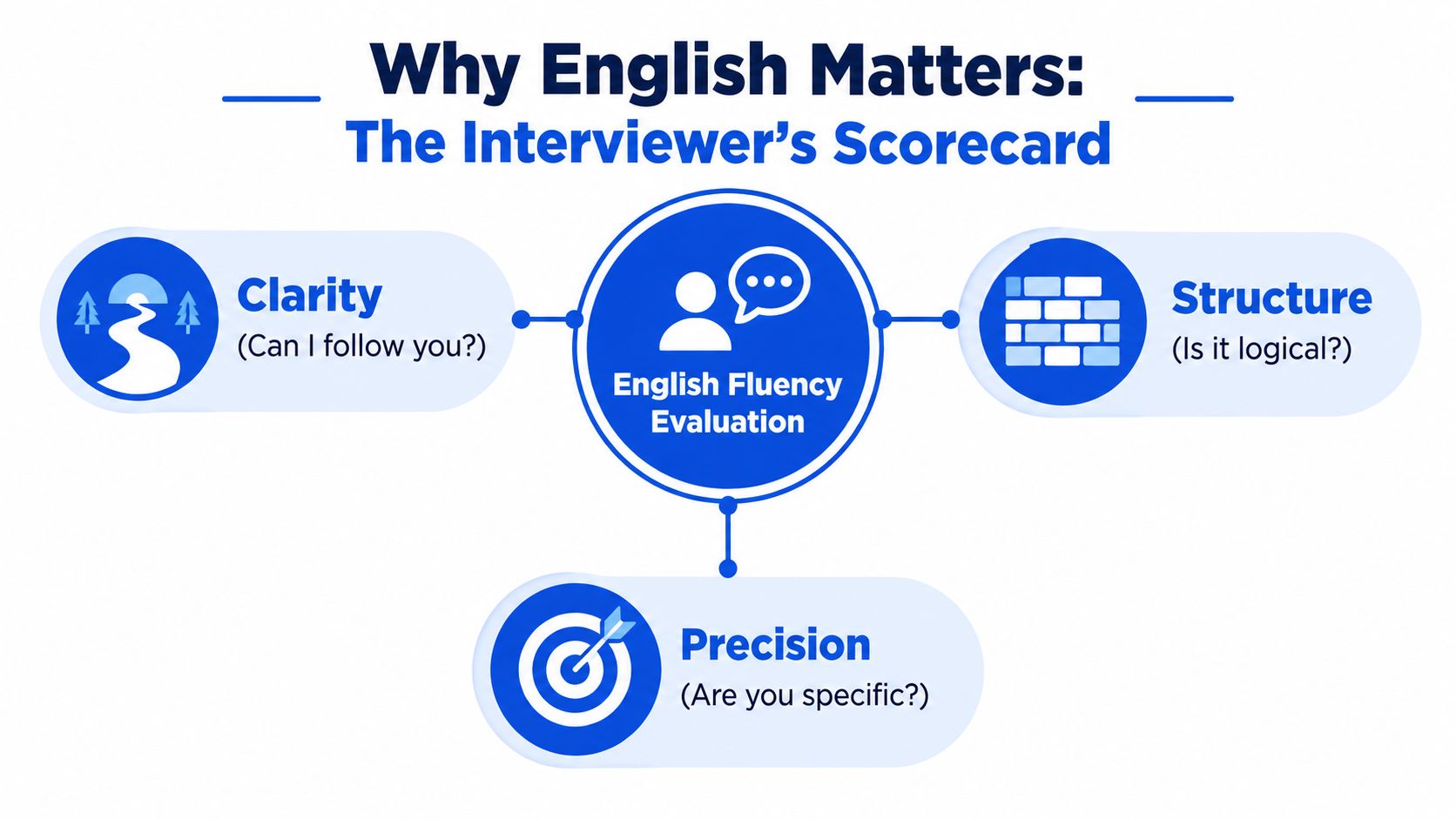
English interview performance is not just about grammar. Interviewers judge clarity, structure, and confidence at the same time, because those are the signals that show whether you can handle a real working conversation. If they cannot follow you, if your answer drifts, or if you sound unsure, they will question your day-one performance even when your CV looks strong.
What the interviewer is really judging
The first filter is simple, can I follow you? That is clarity. The second is whether your answer stays on track, which is structure. The third is whether you sound composed enough to represent the company, which is confidence.
Hiring is tight before English even enters the picture. Only 2% of job applicants are selected for an interview, and the process typically takes about 5 weeks from the first interview onward Standout CV job interview statistics. In many hiring processes, 9 in 10 companies now use video interviews in the early stages of recruitment, 62% of candidates report technical difficulties, and 20% of companies are already using AI to assist with interviewing.
Do not aim for fancy English. Aim for English that is easy to follow, easy to trust, and easy to score.
The old advice, “just speak confidently,” is lazy. Confidence without structure sounds evasive. Grammar without clarity sounds mechanical. This guide gives you a rehearsal-ready system, a self-audit, STAR answers, a question bank, professional phrasing, and a mock-interview loop that improve clarity, structure, and confidence.
Self-Assessment Before You Start Rehearsing
Do a 20-minute audit before you practice
Start with the job itself, not your nerves. Write the target role at the top of a page, then pull out five keywords from the job description that should appear in your answers. If the role asks for client communication, reporting, teamwork, or problem-solving, those words need to show up naturally in your practice answers.
Next, record a 60-second answer to “Tell me about yourself.” Don't judge it by how polished it sounds. Judge it on three things, clarity, structure, and confidence, using a simple 1-to-5 score for each.
Practical rule: your weakest score becomes your rehearsal priority. Don't practice everything equally.
Now listen for red flags. If you hear filler words, run-on sentences, or a thread that disappears halfway through the answer, that's not “a little issue.” That's the thing to fix first. A candidate who knows exactly where the answer falls apart improves faster than the one who only feels generally anxious.
If you want a clean starting point, use this level check before you rehearse: Englify's free online placement test. It's useful because you stop guessing and start training from a real baseline.
Building STAR Answers That Actually Land
STAR is the structure that keeps behavioral answers from collapsing into a ramble. It stands for Situation, Task, Action, Result, and the answer should lean hardest on Action and Result. Northwestern University recommends a split of 15% Situation, 10% Task, 50% Action, 25% Result, while the University of Washington advises about 20% Situation, 10% Task, 60% Action, 10% Result and says to include quantifiable results when possible Northwestern STAR approach, University of Washington STAR method.
One question, one clean story
For “Tell me about a time when…” you do not need a dramatic story. You need a clean story with a clear action. Yale's behavioral interview guidance explicitly recommends the STAR method for questions like “Tell me about a time when…” and “Describe a situation in which…” Yale behavioral interview guidance.
Here's the sentence-by-sentence shape:
- Situation: “The context was…”
- Task: “My responsibility was…”
- Action: “I did…”
- Result: “The outcome was…”
A weak answer sounds like this: “I'm good at teamwork, and I usually help when people are busy. In one project, we had some issues, but we managed to finish.” That answer says almost nothing. It hides the problem, avoids the action, and gives the interviewer no reason to believe you did anything specific.
A stronger answer sounds like this: “The context was a project deadline that moved up unexpectedly. My responsibility was to reorganize the workflow. I cut two non-essential tasks, shortened our check-ins, and took over testing for the final version. The outcome was that we delivered early and the client stayed on board.” That version works because it names the pressure, the action, and the result.
| STAR Answer Time Split | ||
|---|---|---|
| Element | Share | Example Starter |
| Situation | 15 to 20% | “The context was…” |
| Task | 10% | “My responsibility was…” |
| Action | 50 to 60% | “I did…” |
| Result | 20 to 25% | “The outcome was…” |
Keep the story short. Keep the action concrete. End with numbers whenever you can, because numbers make impact easier to see Indeed behavioral interview guidance.
What to avoid
Don't spend half the answer praising your team and the other half blaming your manager. Don't bury the action in passive language. And don't end with a vague “it went well.” End with the result. If there's a number, use it. If there isn't, state the outcome plainly.
The Eight Common Interview Questions in English
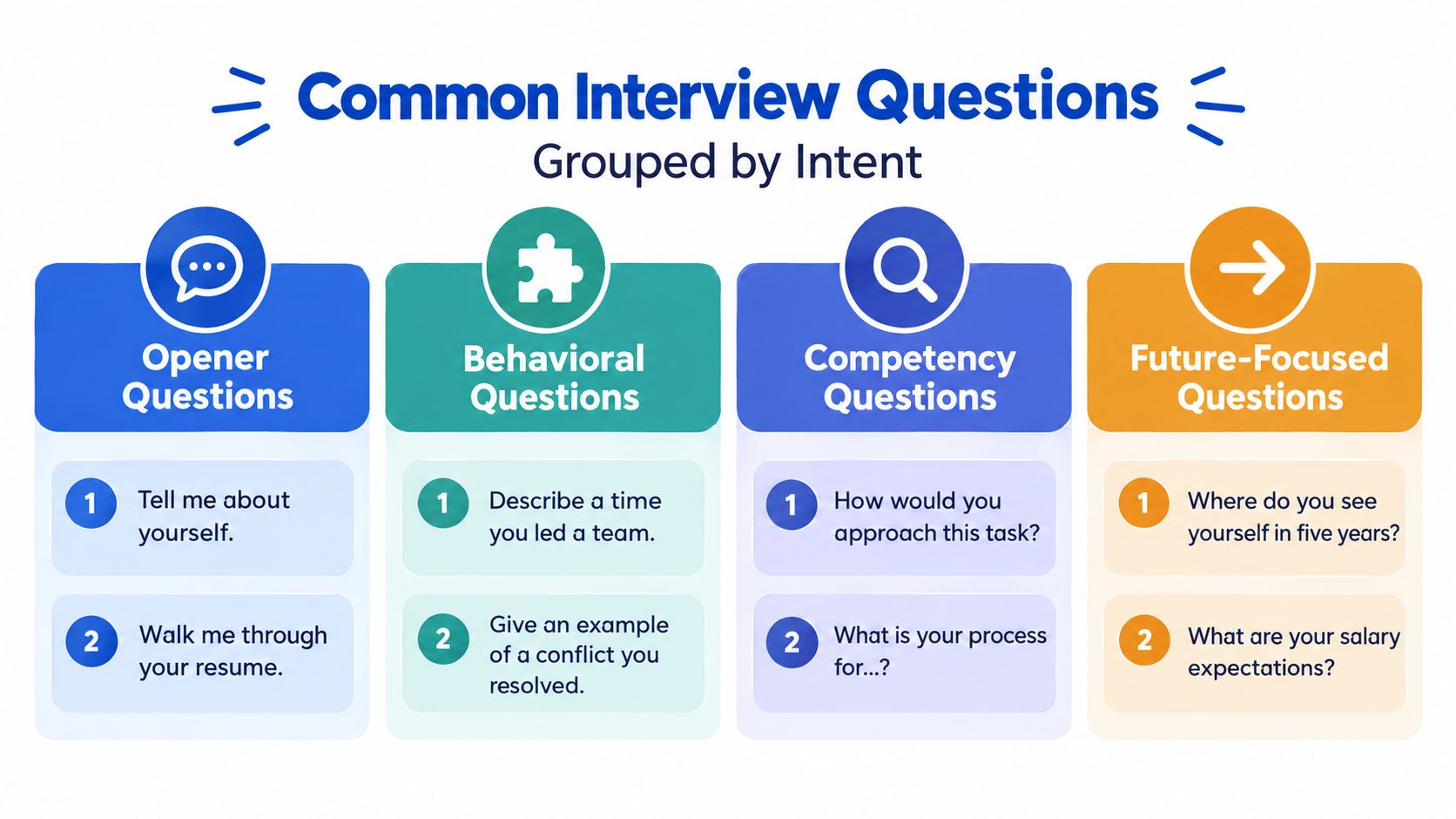
Most candidates waste energy memorizing one perfect script for one perfect question. That's the wrong game. The better move is to group the questions by intent and rehearse the type of answer the interviewer is listening for.
Openers and self-introduction questions
“Tell me about yourself” and “Walk me through your resume” are opener questions. The interviewer is not asking for your life story. They want a short professional summary that fits the role. A strong model phrase is, “I'm currently…”, followed by “Before that, I worked on…” and “What I'm looking for now is…”.
The second opener that matters is “Why should we hire you?” Candidates over-rehearse this one and still under-deliver. They list adjectives. That's weak. Use evidence instead, for example, “I've done this kind of work before, I learn quickly, and I've already handled similar pressure in a past role.”
Behavioral and pressure questions
Behavioral questions include prompts like “Tell me about a time you handled conflict” or “Describe a challenge you solved.” These belong in STAR. The interviewer wants proof that you can work through a real situation, not a theoretical opinion.
Pressure questions are different. “What's your biggest weakness?” and “Tell me about a conflict” test self-awareness. Use a calm, neutral tone. A good model phrase is, “An area I'm working on is…”, followed by what you're doing about it and what has improved.
Motivation and fit questions
“Why this company?” and “Why this role?” are fit questions. They test whether you researched the employer and whether your reason is specific. A decent answer sounds like, “I noticed that your team focuses on…” and “That matches the work I've already done because…”.
If you want a full question bank for practice, use Englify's English interview questions and answers resource. It's especially useful if you're building a repeatable practice list instead of winging every session.
The key is consistency. Once your opener, STAR answers, and motivation answers share the same vocabulary, you sound more coherent and less improvised.
Vocabulary and Phrasing That Sounds Professional
The quickest way to sound credible is better word choice, cleaner connectors, and fewer dead phrases. A candidate who keeps saying “I helped with…” sounds smaller than the role they want. Use verbs that show ownership.
Four vocabulary clusters that change the tone
Use stronger interview verbs when you need to show action:
- Led a team through a deadline.
- Improved a process.
- Drove a project forward.
- Resolved a customer issue.
- Simplified a workflow.
Use soft-skill adjectives only when you can prove them. Collaborative, resourceful, and accountable work because they point to behavior. Hardworking alone is empty. Anyone can say it.
Use connector phrases to replace filler. These sound cleaner than “um” and more polished than rambling:
- The key driver here was…
- What changed was…
- As a result, we…
Pronunciation matters too, especially in interviews where every second is under scrutiny. Drill the th sound with think versus sink, p versus b with plan versus bland, v versus f with very versus ferry, and word stress with PREsent the noun versus preSENT the verb. Those are the places where a strong answer can still sound less controlled than it should. Say the pair out loud, then repeat it inside a full interview sentence.
| Weak phrasing | Professional alternative | When to use it |
|---|---|---|
| I helped with the project | I led the project | When you owned the work |
| I'm hardworking | I'm accountable and consistent | When you can give proof |
| And then, like, we did it | As a result, we delivered it | When you want a clean transition |
| We made it better | We improved the process | When you improved efficiency |
| Good communication | Collaborative and clear communicator | When you can show examples |
If your answer sounds like school English, the interviewer hears school-level readiness. If it sounds like work English, they hear hireable communication.
Do this once a day in the final week. Take one past answer, replace weak verbs with stronger ones, swap filler connectors for structured ones, then read it aloud once. That single drill improves tone faster than passively reviewing vocabulary lists.
Running a Mock Interview That Improves You
A mock interview only helps if it exposes weak spots. If it feels comfortable, it's probably too easy. The goal is not to “finish a rehearsal.” The goal is to find the answer that still falls apart when you're under pressure.
A 15-minute loop that actually fixes things
Pick five questions, two behavioral, two motivation or fit, and one pressure prompt. Record on your phone, laptop camera, or a free AI mock tool, but answer each question in 90 seconds max and do not stop to restart. Stopping teaches perfectionism. Finishing teaches recovery.
Score the recording on four points:
- Clarity: Did you mumble or run on?
- Structure: Did STAR beats appear clearly?
- Confidence: Was the pace steady, with limited fillers and normal eye contact?
- Language: Did your verbs, connectors, and sentence shapes sound professional?
Then pick the weakest answer, rewrite it on paper, and re-record only that question. If the answer still drifts, tighten the first sentence and cut the middle. If it still sounds weak, the problem is usually structure, not vocabulary.
You can also use Englify's mock interview and introduction practice resource as a model for how to shape the opening answer before you start self-recording. That helps you stop wasting the first minute on a messy introduction.
One focused re-record beats five full run-throughs every time.
Repeat the fix-it loop two or three times in the final week. That is enough to turn a shaky answer into a stable one.
Day-Of Tips for Video, In-Person, and AI Interviews
The last 24 hours are not for learning new phrases. They're for reducing friction. The best candidates arrive with fewer surprises, not more notes.
Adjust the setup to the format
For video interviews, place the camera at eye level, use a plain background, angle a ring light about 45 degrees, and close every tab you don't need. Do a 10-second Loom recording first to check mic levels. If your audio is bad, your English is the second problem, not the first.
For in-person interviews, arrive 10 minutes early, carry two printed resume copies, and accept water before the first answer if it's offered. When the panel leans in, slow down slightly and give them space to take in your answer. The room's energy matters less than your own pace.
For AI-screened interviews, slow your speech a little so speech-to-text can catch the words cleanly. Use named keywords taken directly from the job ad, and cut fillers that can make your answer sound uncertain. AI screening is a machine listening for keywords and coherence, not charm.
The gap or accent question needs a direct answer, not an apology. If your accent comes up, name it once with confidence, then move to proof of performance. If you have an employment gap, keep the frame short, state what you learned or maintained, and redirect to current ability.
Two final-week drills keep the nerves down:
- Record one 90-second answer on your phone every day so your tone stays steady.
- Review one one-page acronym sheet every morning with your target role keywords, STAR beats, and closing phrases.
That's enough. Overpreparing the day before usually makes people sound stiff. Controlled repetition makes them sound ready.
Englify offers live online English classes through Google Meet, including private classes and small-group learning, with practical speaking work that fits interview preparation and workplace communication. If you want structured practice for english for job interviews, visit Englify and use the free placement test or a trial session to start with a clear level and a focused plan.