Knowledge hub
French Placement Test Online: How It Works and CEFR Levels
Find out what a French placement test online measures, how CEFR levels A1 to C2 map to your result, and what to do next.

An online French placement test is a short diagnostic assessment that estimates your approximate CEFR level before you start a course, and it isn't an official certificate. A useful result can distinguish B1 reading from A2 speaking rather than hide both behind one score.
If you can understand a French message but struggle to answer aloud, should you join the same class as someone who speaks confidently but writes inaccurately? That's the gap a good placement assessment should identify: what you can understand, what you can produce, and where you need support.
Table of Contents
- What an Online French Placement Test Is
- CEFR Levels Mapped to Your Placement Result
- Adaptive Auto-Tests Versus Teacher-Led Assessments
- Sample Question Types and What Each One Reveals
- How to Prepare for a French Placement Test in Three Days
- Reading Your Result Without Overreading It
- Frequently Asked Questions About Online French Placement Tests
- Take the Free Placement Test Before Choosing a Course
What an Online French Placement Test Is
A placement test helps a teacher choose a suitable starting class. It should assess your current ability, not predict your eventual achievement or reward everything you once studied.
Think of it as a fitting room. You're finding the size that fits today, not the size you hope to wear after a course. Choosing an advanced class because you recognize its grammar can be as uncomfortable as choosing a beginner class when you already communicate independently.
Placement and certification serve different purposes
Placement answers an instructional question: what should you learn next? Formal assessments such as DELF, DALF, TCF and TEF serve certification or official assessment purposes, with the accepted examination determined by the institution or procedure.
A university, immigration authority or employer may require a particular examination and specific skills. A free diagnostic result doesn't replace that requirement. The Council of Europe's guidance on CEFR profiles explains that the framework isn't a ready-made assessment instrument, so different tests can select different tasks and scoring approaches.
Typical placement content includes:
- Grammar and vocabulary: Selecting forms and words that fit a sentence.
- Reading and listening: Understanding messages, notices and spoken information.
- Writing and speaking: Producing language rather than recognizing an answer.
For learners in Morocco, French may sit alongside Arabic and Darija in school, university and work. Someone who reads French course materials regularly may have had much less opportunity to hold an unscripted conversation. Another learner may communicate comfortably at work while finding formal writing difficult.
A useful placement result describes the learner's current profile, not their intelligence, potential or worth.
Look for an estimated CEFR level, evidence by skill, and a warning when the classification is uncertain. Those details help a teacher choose both the class and its learning priorities.
CEFR Levels Mapped to Your Placement Result
The Common European Framework of Reference for Languages, or CEFR, describes what learners can do with a language. The Council of Europe defines six principal levels, A1, A2, B1, B2, C1 and C2, while some assessments also report a pre-A1 band.
These are reference points, not universal percentage brackets. Each assessment must select and adapt descriptors for its language, learners and purpose, so a CEFR label needs evidence behind it.
CEFR levels, abilities and class focus for French
The abilities below are a practical lookup, while the class-focus column gives teaching priorities rather than a compulsory grammar syllabus.
| Level | Label | What You Can Do in French | Common Class Focus |
|---|---|---|---|
| A1 | Breakthrough | Introduce yourself, ask and answer simple personal questions | Basic present tense and daily vocabulary |
| A2 | Waystage | Handle shopping, routines and short everyday exchanges | Passé composé and common everyday situations |
| B1 | Threshold | Cope with most travel situations, describe experiences and plans | Opinions, plans, narratives and connectors |
| B2 | Vantage | Follow the main ideas of complex texts and speak fluently with native speakers | Argument, abstract topics and spontaneous speech |
| C1 | Effective Operational Proficiency | Use French flexibly for social, academic and professional purposes | Precision, nuance and formal writing |
| C2 | Mastery | Understand virtually everything heard or read and express meaning precisely | Stylistic control and near-native nuance |
Read your row as a description of usable French, not a list of chapters completed. An A1 learner might build basic present-tense sentences about home and daily life. A B2 learner should be able to follow the main ideas of a complex text and develop an argument in conversation.
Knowing an advanced tense doesn't automatically demonstrate advanced communication. Equally, a learner doesn't need flawless grammar to show meaningful conversational ability.
At Englify, the placement assessment at the start of learning maps students to CEFR levels. Before choosing a class, compare the evidence from reading, listening and speaking rather than accepting the highest result as your overall level.
Adaptive Auto-Tests Versus Teacher-Led Assessments
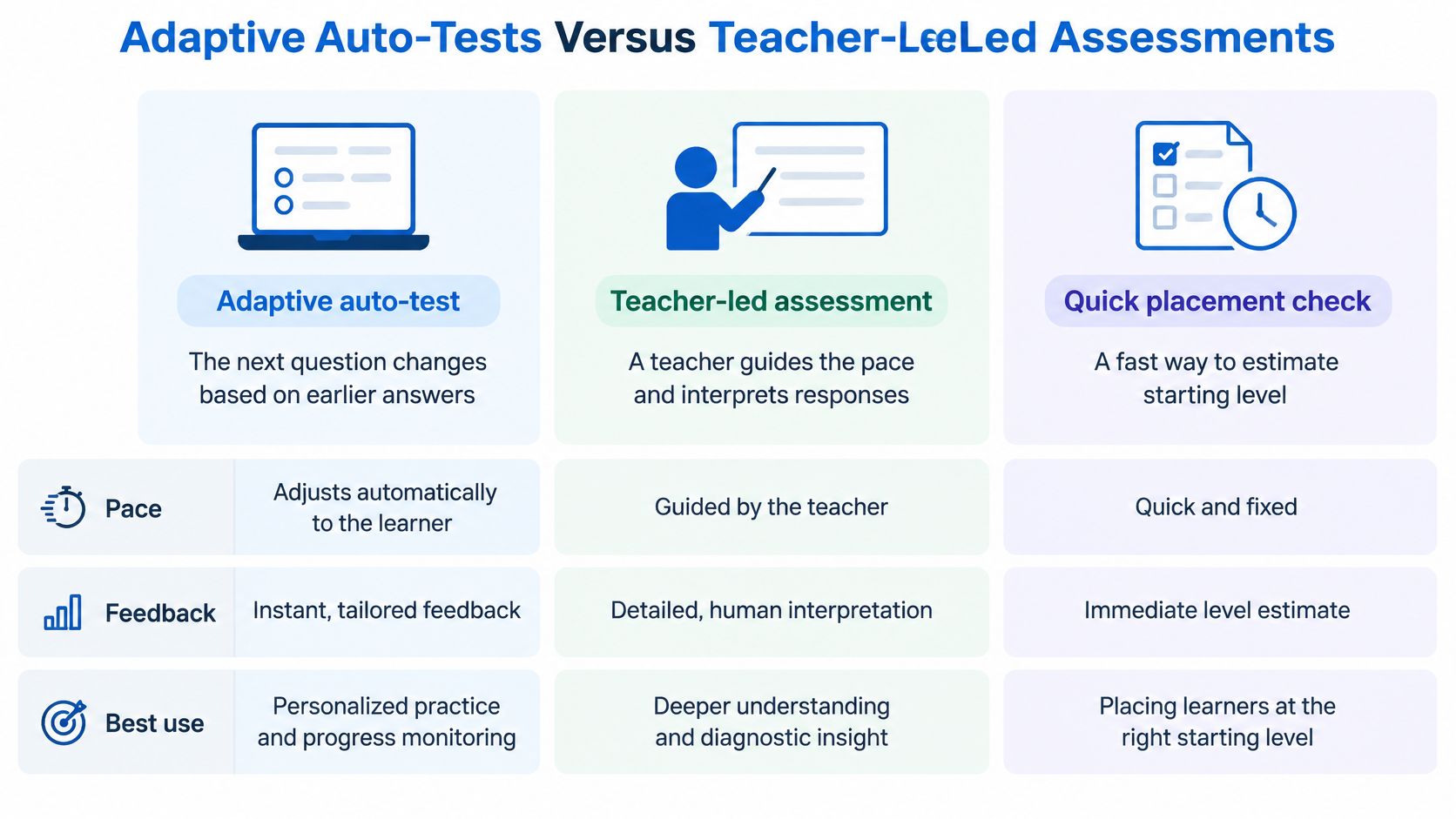
An adaptive auto-test changes question difficulty according to earlier answers. A fixed-question quiz presents the same items to everyone, while a teacher-led assessment uses conversation and follow-up questions to explore what the learner can say.
A hybrid combines objective questions with a spoken task. That distinction matters more than whether the test looks modern or produces an immediate result.
French placement test formats compared
The HelloFrench overview of assessment formats describes typical online tests as taking roughly 10–20 minutes and notes that almost none measure spoken production. That's a general guide, not a promised duration for every format.
| Format | How It Works | Typical Length | Speaking Measured | Best For | Main Limit |
|---|---|---|---|---|---|
| Adaptive auto-test | Question difficulty adjusts to each answer | 10–20 minutes as a general online-test guide | Rarely | Quick first orientation | Limited view of spontaneous speech |
| Fixed-question quiz | Same questions for every learner | Set by the question list and time limit | Rarely | Simple self-check | Less tailored to the learner's level |
| Teacher-led interview | Live conversation with a teacher who asks questions | Set by the booked assessment slot | Yes | Choosing a class by speaking ability | Requires teacher time and consistent criteria |
| Hybrid auto-test plus speaking check | Objective items followed by a short spoken task | Test time plus the speaking appointment | Yes | Learners who want to speak in class | Requires a booked speaking slot |
Adaptive testing is convenient because it directs questions toward your likely ability range. Fixed quizzes are straightforward, but may include many items that are too easy or too difficult to be informative.
A teacher can ask you to clarify, explain a choice or respond to an unexpected question. Those exchanges reveal interaction skills that selecting an answer can't show, although teachers still need clear assessment criteria.
Choose the format around your goal. A quick orientation can start with an auto-test; conversation-focused placement needs spoken evidence. Englify's free CEFR placement test includes a spoken part.
If your goal is formal proof rather than class selection, the comparison of TCF IRN and DELF can help you distinguish examination routes. Before any microphone-based assessment, test your audio and remove avoidable background noise.
Sample Question Types and What Each One Reveals
A grammar item can show that you recognize the passé composé, but it cannot show whether you can use that form when a teacher asks about your weekend. Each question type is a narrow window onto one skill, and the useful result is a profile rather than a single number. A learner might read at B1 and speak at A2. A good test shows both, because the class that fits depends on the weaker skill as much as the stronger one. The formats below are common patterns. Use them to recognize what each task measures.
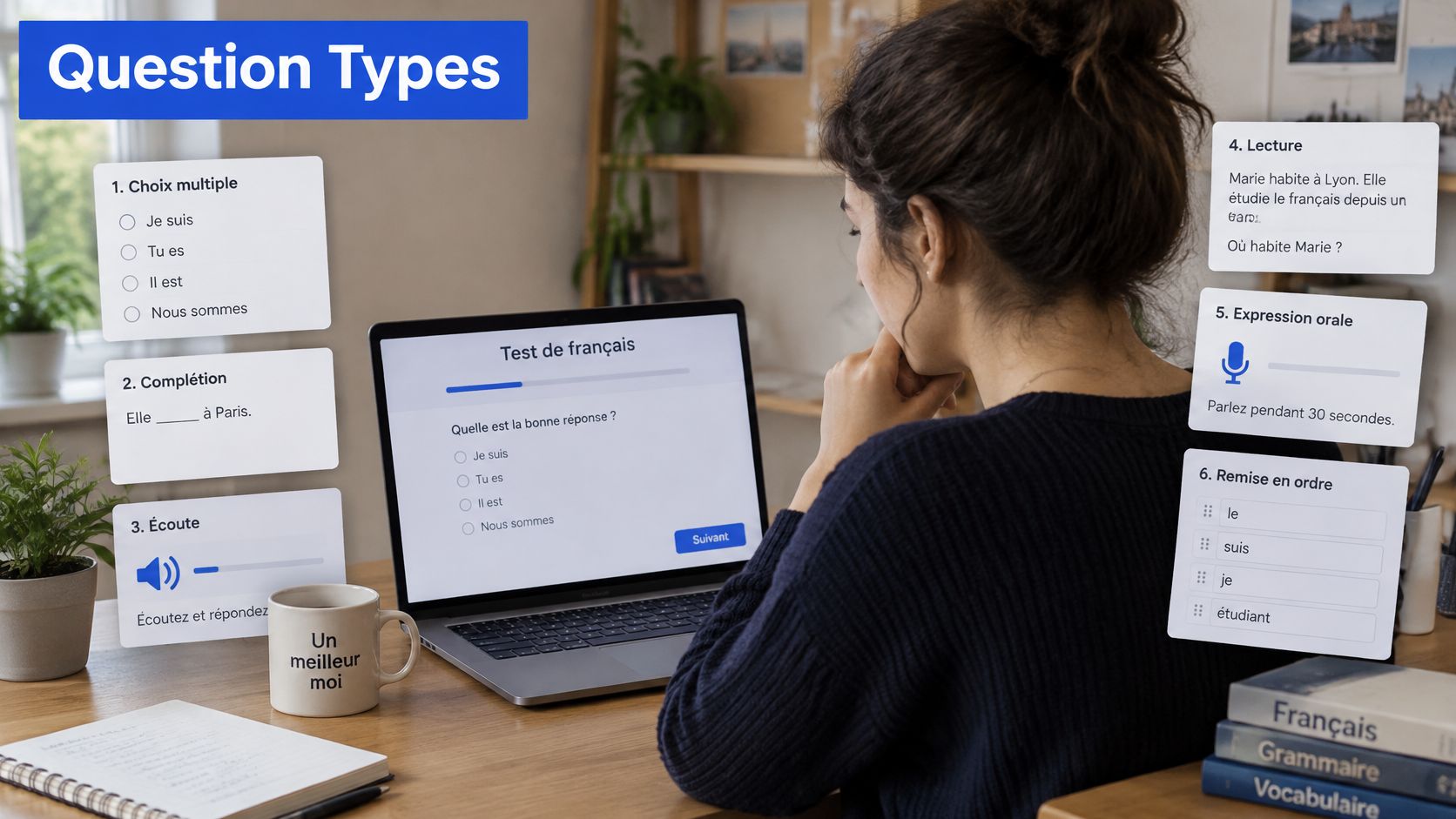
Sample French placement question types
| Question Type | Skill Tested | Example Item | What It Reveals |
|---|---|---|---|
| Gap-fill grammar | Grammar | Hier, je ___ au cinéma. (aller, passé composé) | Control of past tense forms |
| Vocabulary in context | Vocabulary | Je voudrais une ___ de thé. (tasse / table) | Word choice in everyday contexts |
| Short reading text | Reading | A notice about opening hours, followed by true, false or not-given statements | Finding specific information |
| Listening clip | Listening | A short voicemail, then a question about the time or reason | Understanding everyday speech |
| Writing task | Writing | A short 40 to 60 word message to a friend about your weekend | Accuracy and range in writing |
| Speaking task | Speaking | Describe a photo, then answer follow-up questions | Fluency, pronunciation and interaction |
For the grammar item, you need the auxiliary and agreement for aller in the passé composé. For vocabulary, recognizing tasse matters because the surrounding words set the everyday context. Both are recognition tasks. They reveal control of forms and word choice, not live retrieval.
Reading requires more than finding a familiar word. If a notice gives weekday opening hours but says nothing about holidays, a holiday claim is not given, not false. That distinction tests whether you can check meaning rather than match isolated words. For general practice with that habit, this guide shows how to move from skimming to active reading.
Listening adds sound processing: you must identify the information while following connected speech. A voicemail about a changed appointment tests whether you catch the time or the reason.
Writing removes answer choices. A short message about your weekend shows whether you can organize ideas, choose tenses and link sentences without prompts. Speaking goes further because a follow-up question requires an unprepared response. A teacher listens for intelligibility, hesitation, sentence formation and how you repair a misunderstanding.
The Council of Europe's level descriptions separate reception, production and interaction. That separation explains why strong grammar answers should not cancel out difficulty writing a message or sustaining an exchange. Read the result column by column: if reading is B1 and speaking is A2, a conversation-focused class at A2 may teach you more than a B1 reading group.
How to Prepare for a French Placement Test in Three Days
Preparation should help you show your real ability, not temporarily memorize enough answers to enter an unsuitable class. Use this suggested three-day routine to become comfortable with the equipment and task types.
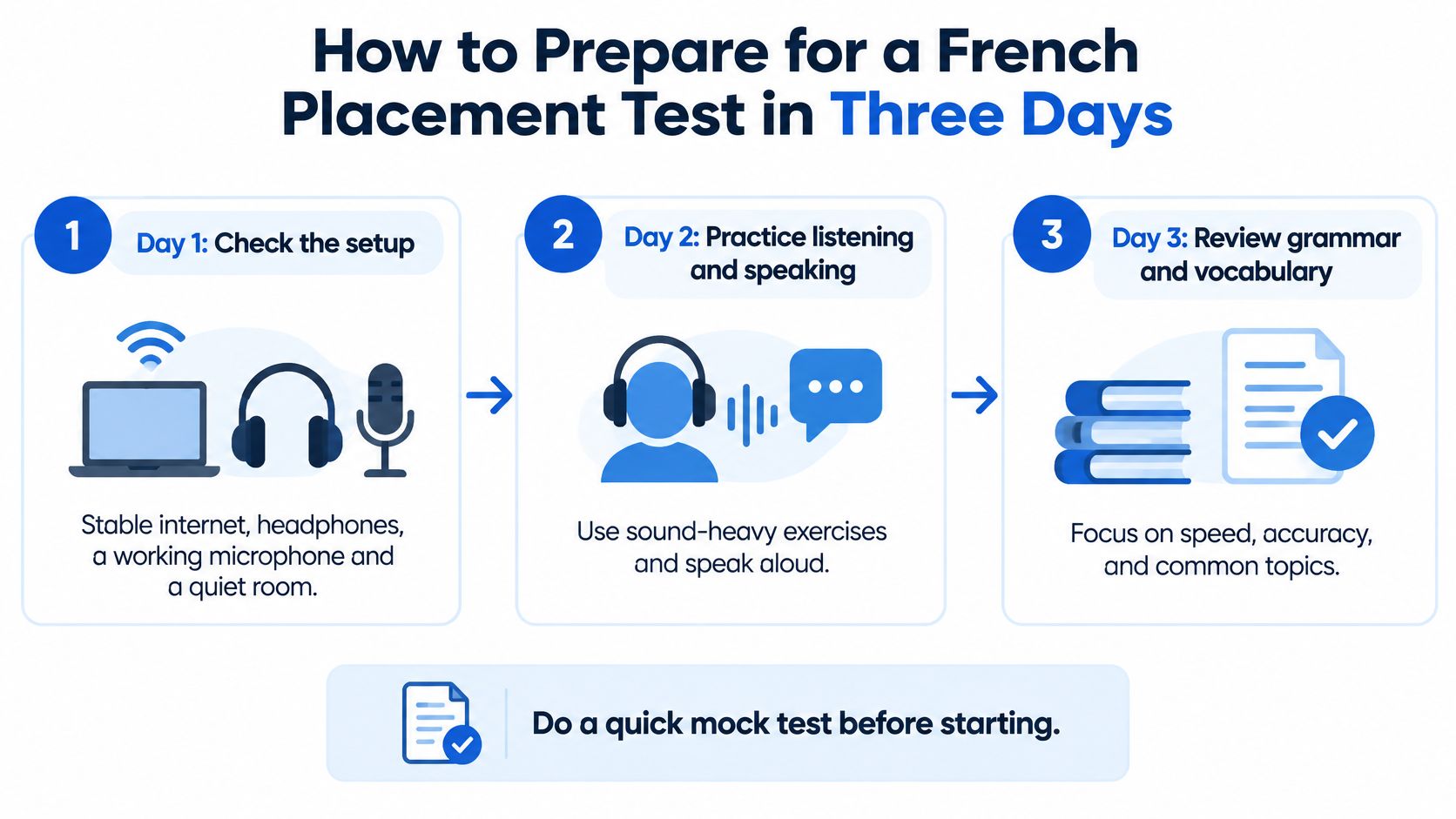
Day 1
Check your internet connection, headphones and microphone in a quiet room. Play a recording, then record your own voice and listen back to confirm that words are clear.
As a practice exercise, describe your morning for five minutes. Notice where you pause, which words you can't retrieve and whether you can explain an idea another way.
Day 2
Review familiar forms: the present tense, passé composé and futur proche. Practise connecting ideas with mais, parce que and donc, then use them aloud rather than only reading explanations.
Try ten minutes of short reading using signs, headlines or messages. Note unfamiliar words, but first attempt to understand the message from its context.
Day 3
Write down five weak spots and practise one before the assessment. Then take the test independently, without a dictionary, translation app or another person suggesting answers.
- Protect your speaking rhythm: If you find yourself translating every phrase from Arabic or Darija, switch to a simpler French sentence you can produce directly.
- Make deliberate answer changes: Change a response when you notice a specific error, not because you feel uncertain.
- Keep communicating: If a word is missing, describe its purpose, appearance or meaning instead of abandoning the sentence.
Preparation principle: Familiarize yourself with the task, but don't script the performance.
Follow the test's instructions about unanswered questions and guessing. If guessing is permitted, make your best choice and move on; if uncertainty marking is available, use it. During speaking, a simple completed thought is more informative than a complicated sentence you never finish.
Reading Your Result Without Overreading It
A placement score isn't necessarily your number of correct answers. Some assessments convert raw points into calibrated scores that account for question difficulty, while others use simpler scoring rules.
For example, the TEF Études results guide awards 1 point for a correct multiple-choice answer and 0 points for a wrong or missing answer, then converts the total into a calibrated score. Its results provide a CEFR level for each assessed skill, while its average score doesn't correspond to a single CEFR level.
Common result patterns and next steps
| Result Pattern | What It Likely Means | Next Step |
|---|---|---|
| Reading B1, speaking A2 | Understands more than the learner can say aloud | Choose a course with regular speaking time and confirm with a speaking check |
| Strong grammar, weak pronunciation | Accurate written knowledge with less control of spoken delivery | Add pronunciation and fluency practice to the course plan |
| Result flagged as borderline | Score sits near a boundary between adjacent CEFR levels | Request a teacher-verified speaking or writing sample |
| Even profile across all skills | Level estimate is consistent across skills | Start at the estimated level and track progress with a follow-up assessment |
| Low result on a short test | The assessment may have missed part of the learner's ability | Take a longer test or a live assessment before deciding |
A useful report explains what was assessed, how confidently the level was assigned, and what to do next. You can examine the example assessment report with those questions in mind.
The Council of Europe's assessment guidance emphasizes reliability, representative content and consistent marking. A polished result screen isn't evidence that the underlying classification is precise.
When a teacher should verify the result
Automated speaking scores need careful interpretation. Microphone quality, background noise, accent variation, hesitation and transcription errors can affect what the system processes; culturally unfamiliar prompts can also make a response less representative.
A low pronunciation score doesn't automatically mean other people can't understand you. Likewise, confident delivery doesn't prove that your grammar or comprehension matches the same level.
Treat an uncertain result as a question to investigate, not a verdict to accept.
If reading and speaking differ by a full level, or the result is borderline, use a short teacher-reviewed sample before committing to a class. The teacher should check whether the class pace is manageable and whether its activities address your actual gaps.
Frequently Asked Questions About Online French Placement Tests
Is an online French placement test the same as DELF or TCF?
No. A placement test guides teaching, while DELF and DALF diplomas and TCF or TEF results serve formal assessment purposes. For an official application, follow the receiving institution's requirements rather than assuming that any French level result will qualify.
How long does the test take?
A short online quiz may fit into a brief study break, but a complete appointment with speaking takes additional time. Check the stated duration and whether the oral assessment happens immediately or in a separately booked slot.
Is Englify's placement test free?
Yes, our placement test is free, and a free trial session is also available. Taking the assessment doesn't oblige you to register or buy a package, so you can use the result to make an informed decision.
Can I skip the speaking part?
If the assessment permits it, you can complete the other tasks, but your report won't establish your speaking ability. For a class involving discussion, interviews or workplace exchanges, complete the spoken assessment rather than treating a grammar score as a substitute.
What if my result sits between CEFR levels?
Ask for a teacher-verified speaking or writing sample. The useful question isn't which label sounds more advanced, but which class lets you participate while still learning something new.
- For parents: Let your child answer independently, even when you recognize a mistake.
- For adult learners: Describe the tasks you need French for, such as presentations, customer conversations or university writing.
- For returning learners: Mention a long study break so the teacher can distinguish rusty retrieval from unfamiliar material.
These details give the teacher context without changing the assessment into a coached performance.
Take the Free Placement Test Before Choosing a Course
What do you need French for? A professional preparing for meetings needs different practice from a teenager seeking school support, even when their estimated levels look similar. The goal decides which evidence matters, and the useful result is a skill profile rather than one score.
Match the goal to the route
For conversation, choose a placement with spoken evidence and a class built around regular interaction. For university admission, immigration, or an employment requirement, find the accepted examination first, then use placement to organize preparation. A placement result, or a diploma such as DELF or TCF, does not automatically replace another exam's requirements. Match the route to the requirement rather than assuming one proof travels everywhere.
At Englify, the free placement test maps you to a CEFR level and includes a spoken component. The range runs from A0 to C1, with A0 as a beginner label rather than an extra principal CEFR level. Personalised online French classes cover A1 to C1 and include DELF/DALF and TCF/TEF preparation.
Use the trial to resolve uncertainty
The placement test and the free trial are separate steps. In the trial, a teacher assesses your speaking, then you receive plan options at your level with no obligation to enroll.
- If the profile is uneven: Use the trial to establish which speaking tasks you can manage independently. You might read at B1 and speak at A2, and that profile matters more than a single label.
- If the evidence is consistent: Begin at the estimated level and set a specific communication target.
- If official proof is required: Plan the accepted examination separately from course placement.
Learners in Morocco can check their fit in a live Google Meet class before committing. Can you follow the lesson, contribute, and receive useful feedback?
Choose a measurable target such as explaining a project, answering interview follow-ups, or writing a clear university enquiry. That gives the placement result a purpose beyond its label.
Englify offers a free placement test with a spoken component and a free trial. Visit Englify to take the test, then choose the course or examination route that matches your skills and goals.