Knowledge hub
Private French Lessons Online: How to Choose
Compare private French lessons online with group classes, see realistic MAD costs, CEFR goals and how to book a free trial.

If you can finish a French grammar exercise but can't answer an unexpected question, what should you really be paying a teacher to change? Private French lessons online are worth considering when you need guided speaking practice, individual correction, and evidence that you can handle a real task more independently. The useful comparison isn't just tutor versus app. It's whether the format helps you do something in French that you couldn't do comfortably before.
Table of Contents
- Private Lessons Compared with Groups and Apps
- Who Gains the Most from Private Hours in Morocco
- How a Private CEFR Lesson Runs and Shows Progress
- What Private French Lessons Cost in Morocco
- How to Choose a Tutor or Academy
- Start with a Free Placement and Trial
Private Lessons Compared with Groups and Apps
A private French lesson online is a scheduled live class with one learner and one teacher. It isn't a recorded course or a shared classroom, so the teacher can organize the lesson around your level, your goal, and your pace.
Private lessons, small groups and apps
| Format | Who is in the room | Speaking time | Feedback | Choose it when |
|---|---|---|---|---|
| Private one-to-one | One learner and one teacher | Most of a 60-minute hour | Immediate correction on your errors | Pace, pronunciation or a specific task matters most |
| Small live group | Up to six learners at one level | Shared turns with classmates | Correction plus peer talk | You want company and a lower cost than a full private week |
| App or free video | You alone | None live | Automated drills, no diagnosis | You only need vocabulary between real lessons |
The private format gives you room to struggle productively. If you can introduce yourself but lose track when someone asks a follow-up question, the teacher can stay with that difficulty rather than move the whole class forward.
However, more attention doesn't automatically mean better learning. A teacher who spends the lesson explaining grammar while you listen hasn't made good use of the private format. You should be speaking, listening, asking for clarification, and trying again after feedback.
When sharing the lesson helps
A small group offers something private tuition can't reproduce fully: classmates with different answers, speaking habits, and ideas. For a sociable teenager or an adult who enjoys discussion, responding to peers can make practice more engaging.
A group also makes sense when you want regular lessons without paying for an entirely private timetable. The important check is whether the learners' levels and goals are close enough for everyone to participate.
For a broader comparison of course structures, the guide to live online French classes can help you distinguish a structured course from occasional conversation practice.
Where apps and videos belong
Use an app to retrieve vocabulary, repeat useful phrases, or review material before class. Use a free video to hear a topic explained again, then bring your unanswered questions to the teacher.
Some tools offer speech recognition, but that isn't the same as a teacher diagnosing why a liaison sounds unnatural or why your listener misunderstood your meaning. A video also won't notice that you've avoided speaking all week.
Practical rule: Choose private lessons when individual pace, pronunciation, or a specific speaking task matters more than sharing the hour.
Private tuition is a weak choice if you only want light exposure with no particular objective. Equally, a group is a weak choice if you're far from the others' level or consistently stay silent while classmates answer.
Who Gains the Most from Private Hours in Morocco
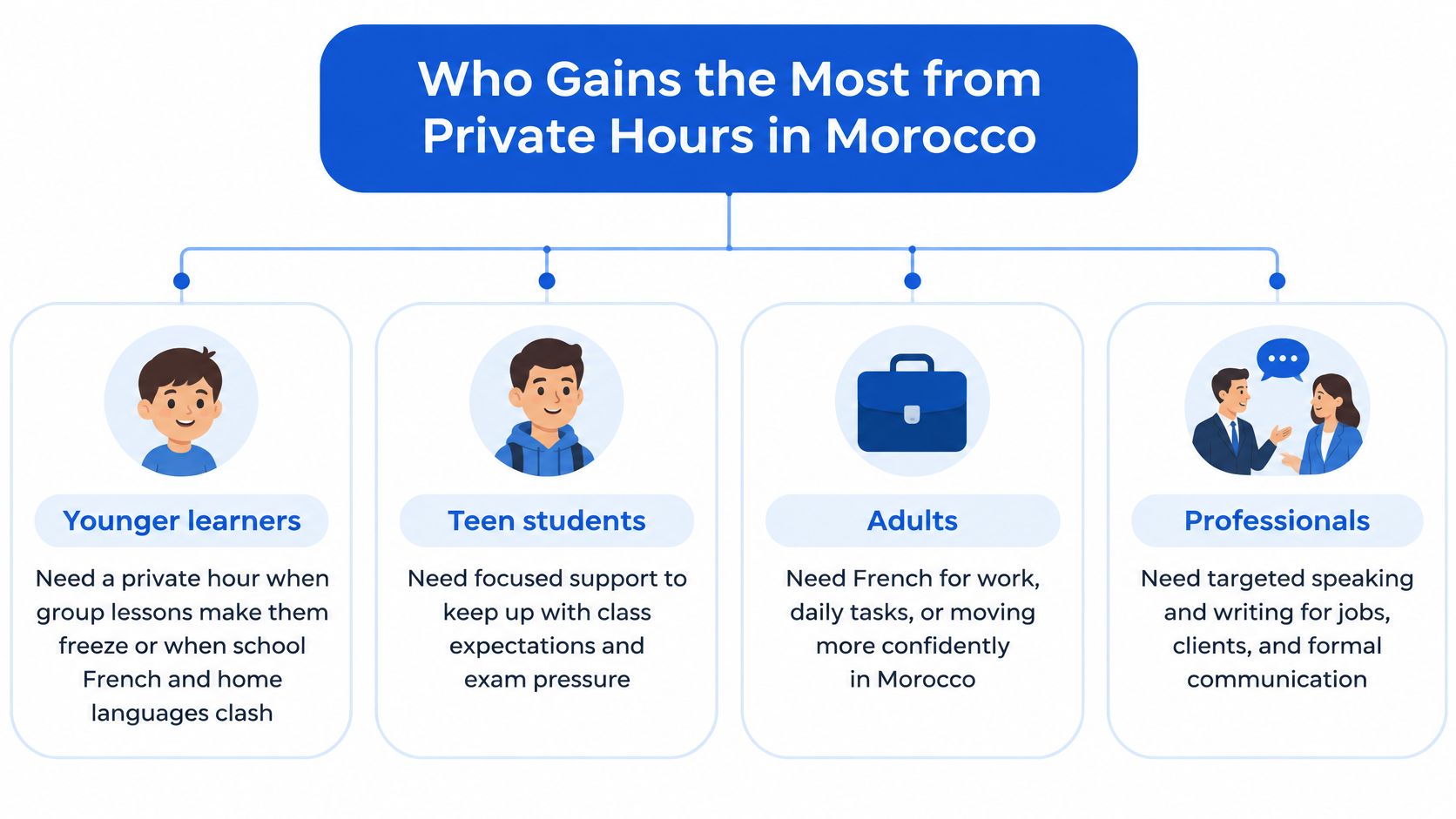
Start with the job French needs to do. A child trying to answer in class, a student preparing an oral, and an engineer discussing a project need different lessons, even when their grammar knowledge looks similar.
French learning also belongs to a wider African context, not just preparation for visiting France. An OIF-linked account from RFI reported that 60% of the world's French speakers lived in Africa in 2024.
Children and teenagers need different kinds of support
Illustrative scene, a younger learner: A Casablanca parent notices that their child completes written homework but says nothing in French class. A private lesson could begin with describing a familiar object, choosing between answers, and gradually producing an independent sentence.
The teacher should find out what causes the silence. Is the child struggling to understand the question, retrieve vocabulary, or speak in front of others? A brief explanation in Darija or Arabic may help a beginner understand the activity without turning the whole lesson into translation.
Illustrative scene, a lycée student: A teenager has a written answer ready but can't explain it aloud without reading. The useful work is to identify the main point, say it from keywords, and answer an unexpected question.
For a certification goal, DELF and DALF preparation should include the relevant task format and assessment expectations. General conversation alone isn't a complete exam-preparation plan.
Adults and professionals need usable tasks
Illustrative scene, a university student or adult: A learner understands a French explanation but hesitates when asking an administrative office for clarification. Practise explaining the situation, requesting a missing document, and checking what to do next, rather than repeating a textbook dialogue unchanged.
Illustrative scene, a professional: An engineer must defend a recommendation in a French-language meeting. The teacher can play a colleague who challenges the proposal, requiring the learner to explain a reason, acknowledge a concern, and clarify the recommendation.
For company teams, distinguish shared needs from individual gaps:
- Shared communication needs: A group can rehearse project updates or customer-service exchanges.
- Individual obstacles: Private work can target an employee's pronunciation, interview preparation, or difficulty handling interruptions.
- Written responsibilities: Email and report tasks need their own feedback, not just conversation about work.
Private lessons aren't the strongest fit for every learner. A child who mainly wants songs, games, and company may prefer an age-banded group, while someone who can't attend regularly should resolve the scheduling problem before committing to private hours.
How a Private CEFR Lesson Runs and Shows Progress
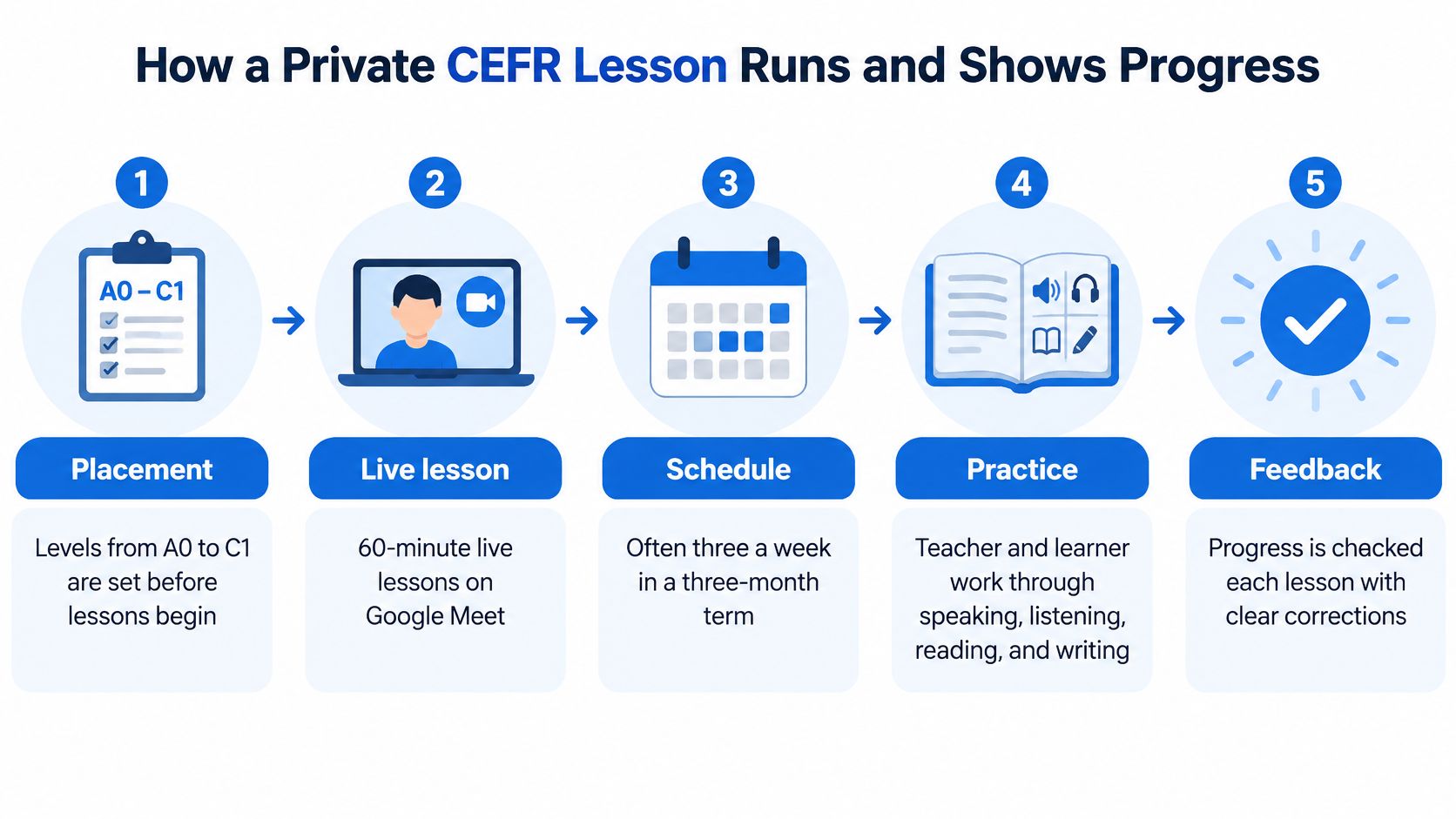
A useful private lesson is a sequence of communication tasks, not an hour of loosely connected chat. In a structured academy programme, live lessons on Google Meet should connect placement, personalized content, practice, and a written account of what comes next.
Academy level labels may run from A0 to C1, with A0 used for complete beginners. Ask what the label means in observable abilities rather than treating it as a permanent description of the learner.
The six moves of a purposeful lesson
Start with an unprepared speaking sample. Ask the learner to describe a recent event, explain a school topic, or respond to a customer problem. Don't give a script first, because the teacher needs to hear what the learner can currently manage independently.
Choose an observable can-do goal. The Council of Europe's CEFR descriptors distinguish B1 abilities such as managing many travel situations, B2 interaction involving greater fluency and sustained viewpoints, and C1 communication that is fluent, spontaneous, and precise for social and professional purposes. Select a manageable task within the relevant level, not a promise to achieve the entire level during a lesson.
Teach the language the task requires. For a client call, this might mean clarifying the request, explaining a delay, and proposing a solution. Include the grammar needed to make those meanings clear, rather than teaching an unrelated tense because it comes next in a book.
Model, practise, and repair. The teacher demonstrates a useful phrase, the learner tries it, and both address a specific difficulty. Then the learner uses the phrase in a fresh response rather than merely repeating it.
Transfer the skill into a realistic exchange. Run a school oral, travel interaction, customer call, or meeting discussion. Change a detail or introduce a follow-up question so the learner has to listen and adapt.
Finish with a written next step. Record what the learner attempted, what became easier, and what still needed prompting. Assign a short follow-up activity that prepares the next lesson.
Correct pronunciation without stopping every sentence
Pronunciation feedback should help listeners understand the learner, not erase every trace of an accent. A chapter in the Cambridge Handbook of Corrective Feedback finds that pronunciation-focused corrective feedback generally improves both individual sounds and features such as rhythm and intonation.
For French, a teacher might target a vowel contrast, liaison, rhythm, or sentence-final intonation. If an error blocks understanding, correct it promptly, model the alternative, and return to the conversation; minor accent features can wait.
Digital communication deserves practice too. The CEFR Companion Volume published in 2020 expanded the framework with online-interaction scales, recognizing that participating in a live exchange involves more than reading or producing isolated sentences.
Measure independence on a comparable task
Keep the initial speaking sample, with permission, and reassess using a parallel task. For example, explain a different delivery delay under similar conditions, rather than repeat a memorized answer about the original problem.
A useful learner report separates:
- Accuracy and vocabulary: Are the forms and words suitable for the message?
- Fluency and intelligibility: Can the listener follow without repeated breakdowns?
- Listening and interaction: Does the learner answer the actual question and repair misunderstandings?
- Confidence: Does the learner attempt the task with less avoidance? Keep this distinct from language proficiency.
Illustrative speaking checkpoints on one target task
| Checkpoint | What to look for |
|---|---|
| Around week 4 | Fewer long pauses on the target task |
| Around week 8 | A second task handled with less prompting |
| Around week 12 | A short meeting or school answer that stays intelligible |
These are illustrative review points, not promised level jumps. Session recordings, where available and agreed, can help learners compare performances rather than rely on memory.
Evidence summarized by Stanford's National Student Support Accelerator favors tutoring three or more times per week, alongside continuity and strong instructional design; it isn't a French-specific timetable guarantee.
Speaking progress doesn't remove the need to read and write. Assign those skills their own tasks, feedback, and review time.
What Private French Lessons Cost in Morocco
What should you budget for private French lessons, and what does the hourly figure cover? The academy's published private-class starting point is 100 MAD per hour. At that rate, three 60-minute lessons each week over a four-week month add up to 12 hours and 1,200 MAD.
That is a calculation, not a quoted French package. French is available in select programmes, so confirm the current offer, teacher availability, and billing arrangement before setting your budget.
Cost picture for a month of study
| Option | Figure you can use | What a month looks like | Limit |
|---|---|---|---|
| Private one-to-one | Published starting point of 100 MAD/hour | An illustrative 12-hour month totals 1,200 MAD at that rate | Confirm the French programme and actual terms |
| Three-month private rhythm | Same hourly starting point | An illustrative 12 hours monthly totals 36 hours and 3,600 MAD across three months | Illustration only; confirm the French programme |
| Small-group English kids plans | 250 MAD/month or 650 MAD for three months | Shared classes have a lower monthly cost than the private-hour illustration | English kids pricing, not a French private rate |
| App or free resources | Separate subscription or free | Vocabulary practice between lessons | No live teacher diagnosis or accountability |
The three-month calculation uses the same four-week budgeting block for each month. Calendar months, holidays, missed sessions, and programme arrangements can change the number of lessons. Ask for a written total so you can compare the actual offer with the illustration.
Pay for the work that needs a teacher
Private hours are most useful when the tutor listens to spontaneous speech, identifies why a learner misunderstood something, and adjusts the next task. A speaking lesson can practise a CEFR can-do, such as clarifying a delivery delay or answering an unexpected question. Silent exercises that learners can complete independently may be better saved for outside class.
Apps can still support practice. An exploratory 2025 study of 261 Spanish-speaking app users, described by Preply, found that nearly one-fifth of those who used the app for at least 21 hours improved their total English score by one CEFR level, while 82% said live tutoring could help them progress faster.
The study concerned English app users, was not causal, and does not establish a French tutoring outcome. For a learner in Morocco, the practical distinction is that an app can support independent repetition, while a human tutor can respond to a spoken answer, ask a follow-up, and help repair a misunderstanding. Private speaking hours do not replace reading and writing practice, and a group class may suit a learner better if shared practice is the priority.
Make the budget sustainable
Before paying for more private hours, decide what to practise independently and what needs a teacher:
- Automate repetition: Review vocabulary and retrieve useful phrases on your own.
- Reserve teacher time: Practise interruptions, clarification, pronunciation, and unexpected questions live.
- Protect attendance: Choose lesson times you can keep during ordinary busy weeks, including around work or school schedules.
- Compare complete plans: Include lessons, required subscriptions, and any stated cancellation charges.
A manageable plan that you attend and prepare for can serve you better than a timetable you repeatedly miss. If private tuition strains your budget, a small group with focused individual support where needed is another option.
How to Choose a Tutor or Academy
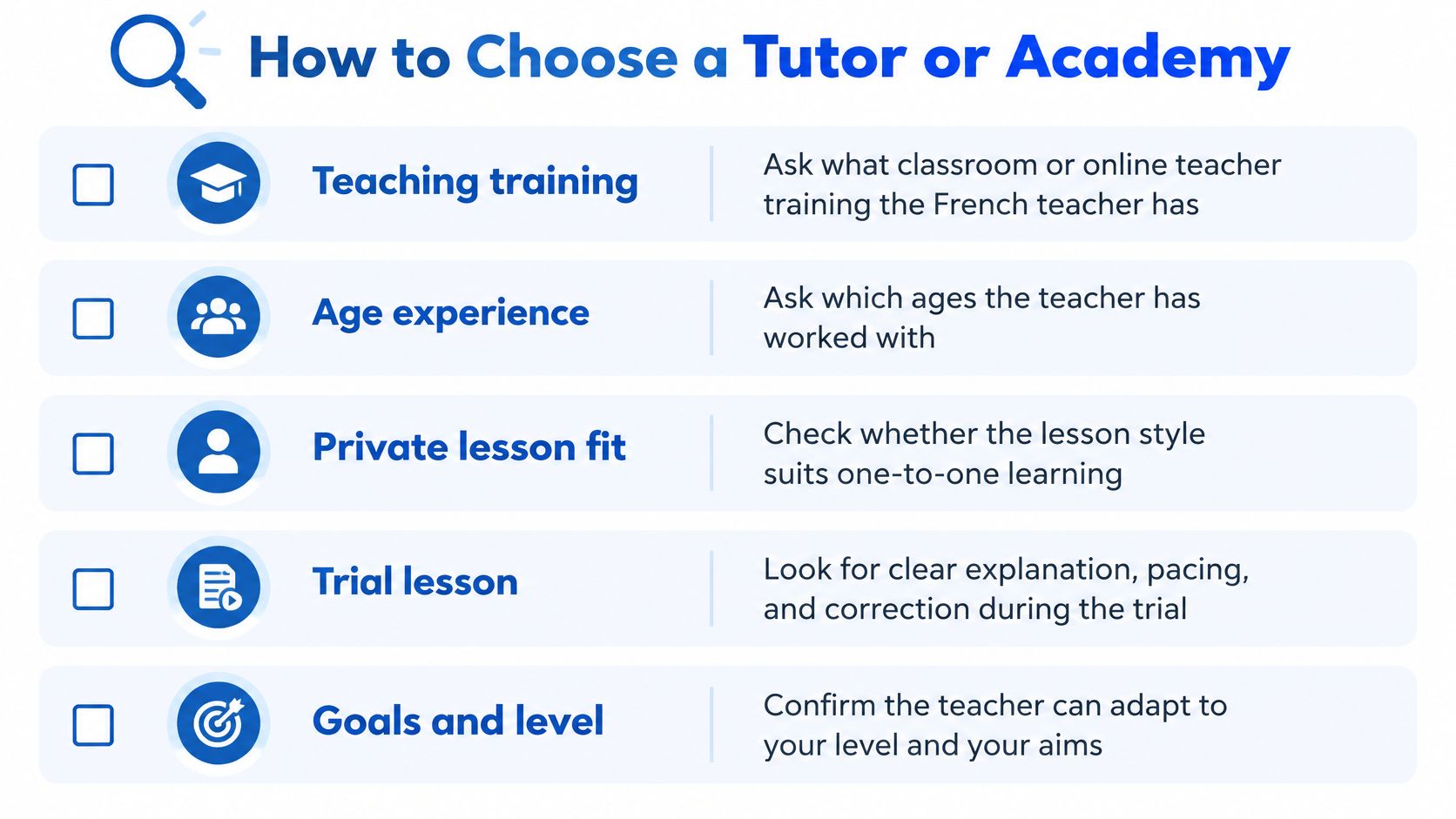
Choose by what happens during the trial, not by how polished the teacher's profile looks. A good French teacher should be able to explain what they heard, why a task was difficult, and how they would adapt the teaching.
A freelance tutor can meet those standards. An academy should support them consistently through placement, scheduling, suitable materials, and learner reporting.
Listen for evidence of a teaching decision
Ask about the teacher's training, online or classroom experience, and experience with your age group. An English-teaching certificate supports a claim about English teaching, not French-teaching qualifications, so confirm the French teacher's own background and who will teach the programme.
During the trial, pay attention to the response when you get stuck. Does the teacher rephrase, offer a useful model, or briefly explain in Arabic, French, or Darija where appropriate? Or do they repeat the same question louder and move on?
Use concrete checks:
- Level judgment: Can the teacher explain the placement using something you said or understood?
- Task selection: Does the activity match your school, work, travel, or everyday objective?
- Correction: Do you get a chance to use the correction in another response?
- Adaptation: Does the teacher change the support when the task is too easy or difficult?
- Continuity: Can you normally work with the same teacher across the term?
A speaking-first approach still allows concise grammar explanations. The warning sign isn't grammar itself; it's an explanation that never returns to meaningful use.
Check the arrangements before paying
Ask for available slots in Morocco time, including mornings, afternoons, and evenings. If you live in the UAE or elsewhere abroad, confirm the lesson time in both locations rather than assuming the clocks align throughout the year.
A flexible timetable should mean something practical. Ask what happens when a shift changes, how much notice rescheduling requires, and whether a replacement slot is realistically available.
Before giving card details, get the price, missed-session rules, and agreed programme in writing.
Also clarify who receives reports for younger learners and how recordings, if offered, are accessed and handled. Don't assume that a recording replaces a missed interactive lesson.
An academy's structure is useful only if these arrangements work for your household or working week. A detailed trial evaluation should help you decide whether the teaching and the system fit, without requiring you to infer either from a slogan.
Start with a Free Placement and Trial
Treat the first appointment as a way to identify the right starting task, not as a commitment to a long course. The placement should distinguish what you can understand from what you can produce, then identify whether speaking, listening, reading, or writing needs the most attention.
For a learner who already encounters French at school or in administration, testing only the alphabet won't answer the important question. The teacher needs to see what happens when you explain something, respond without preparation, or ask for clarification.
Bring a situation you actually face
Prepare a school oral, a bac-style answer, a customer discussion, a travel exchange, or an everyday errand. Bring the relevant prompt or a non-confidential example so the teacher can make the trial concrete.
- Before the appointment: Check Google Meet, your microphone, and a quiet place to speak.
- During the lesson: Attempt the task without hiding every difficulty behind a prepared script.
- Afterwards: Ask for a written evaluation describing strengths, obstacles, and a sensible next target.
For parents, the trial report should make the recommendation understandable without requiring teaching knowledge. For adults, it should explain why private tuition or a small group suits the task and attendance pattern.
Confirm the practical fit
Choose a slot before work, after school, or in the evening that you could realistically maintain. Parents, shift workers, and Maghreb professionals abroad should confirm the local time and rescheduling arrangements before enrollment.
Administrative organization matters too. For school managers comparing scheduling and learner administration, Tutorbase for language schools is a relevant resource to explore; software alone doesn't establish teaching quality.
Use the free French placement test to begin the level check, then arrange the free trial on Google Meet. Expect a teaching experience and written evaluation, not just a sales conversation, and decide on the format only after you understand the recommendation.
Englify offers live online French lessons through Google Meet, with personalized private classes and selected small-group programmes. Visit Englify to arrange your free placement test and free trial, bringing a real speaking task you want to handle more confidently.