Knowledge hub
Business English for Beginners Your First Workplace Guide
Business English for beginners made simple. Learn core vocabulary, phrases, exercises and a starter lesson plan to speak confidently at work.
Your first day at work, your manager says, “Can you send me a short update and join the call in ten minutes?” You understand the words, but the pressure comes from a different place. You need the right sentence fast, you need it to sound polite, and you need it to be clear enough that nobody has to guess what you mean.
That is what Business English for beginners really is. It is not advanced corporate jargon, and it is not perfect grammar on day one. It is a small set of repeatable workplace scripts that help you introduce yourself, ask simple questions, write short emails, and respond when something is unclear.
For many learners, especially Arabic-speaking professionals, students, and job seekers, the hardest part is not vocabulary alone. It is knowing what to say first, what to say next, and how to repair a conversation when it starts to wobble. That is why the safest path is to start with survival language, then move into short emails, simple scheduling, and basic workplace interaction.
Table of Contents
- What Business English for Beginners Really Means
- Understanding the Core Building Blocks of Workplace English
- How Beginner Levels Map to Real Work Tasks
- Essential Vocabulary and Phrases for Your First Weeks at Work
- Simple Exercises That Build Speaking Confidence Fast
- Choosing a Beginner Lesson Plan That Fits Your Goals
- Your Next Steps to Confident Business Communication
What Business English for Beginners Really Means
A beginner does not need to sound like a senior executive. A beginner needs to function. In practice, that means handling the moments that come up in the first week of a job, a training session, an interview, or a university project meeting.
Think of General English as the whole toolbox, and Business English as the few tools you reach for at work. You are not trying to learn every tool at once. You are learning the screwdriver, the measuring tape, and the one wrench that solves the most common problems.
A beginner's first wins are small but real. You say your name clearly, explain your role, ask for repetition when a message is too fast, and write a short note without sounding rude. Those are not minor skills, because they let you participate instead of watching from the side.
Practical rule: if the message gets the job done, beginner level is enough for now. Workplace English rewards clarity, courtesy, and task completion before it rewards fancy vocabulary.
That is also why beginner Business English feels different from academic English. Academic English often asks you to analyze ideas. Workplace English asks you to do something useful: greet, confirm, request, follow up, or clarify. Once learners understand that difference, the subject stops feeling abstract.
An online academy like Englify fits naturally for learners who want structured support, since its classes are built around practical communication and live practice through Google Meet. The point is not to memorize long lists of terms. The point is to become comfortable enough to speak when a colleague, teacher, or recruiter expects an answer.
Understanding the Core Building Blocks of Workplace English
The cleanest way to understand workplace English is to separate language from function. Language is the words and grammar. Function is what those words do in a real office, like introducing yourself, making a request, or confirming a deadline.
What the workplace actually asks you to do
At beginner level, the core functions are simple. You say who you are, what you do, what you need, and what you understood. That is enough to keep a conversation moving without trying to control every detail of the language.
A useful standard here is clarity-first communication. Messages should be clear, concise, correct, courteous, and concrete, because ambiguity creates misunderstanding in emails and meetings. If your sentence is short but precise, it usually works better than a longer sentence that sounds impressive but leaves people confused.
Why this is not the same as “knowing English”
You can know many English words and still struggle at work. The problem is often not vocabulary size, it is sequencing. In a workplace, people expect you to answer in a way that matches the situation, not just in a way that shows grammar knowledge.
A beginner therefore needs a small set of reusable patterns. For example:
- Greeting pattern: “Good morning, I'm Sara from accounting.”
- Request pattern: “Could you send me the file, please?”
- Confirmation pattern: “So the meeting is at 2 p.m., right?”
These patterns are powerful because they reduce the mental load. You do not have to invent a new sentence every time.
A learner who can complete the task has already done the important part. Perfect language can come later.
For a broader explanation of level labels and how they work, the CEFR framework is a useful reference point, and Englify's CEFR guide can help readers place themselves more accurately without guessing.
How Beginner Levels Map to Real Work Tasks
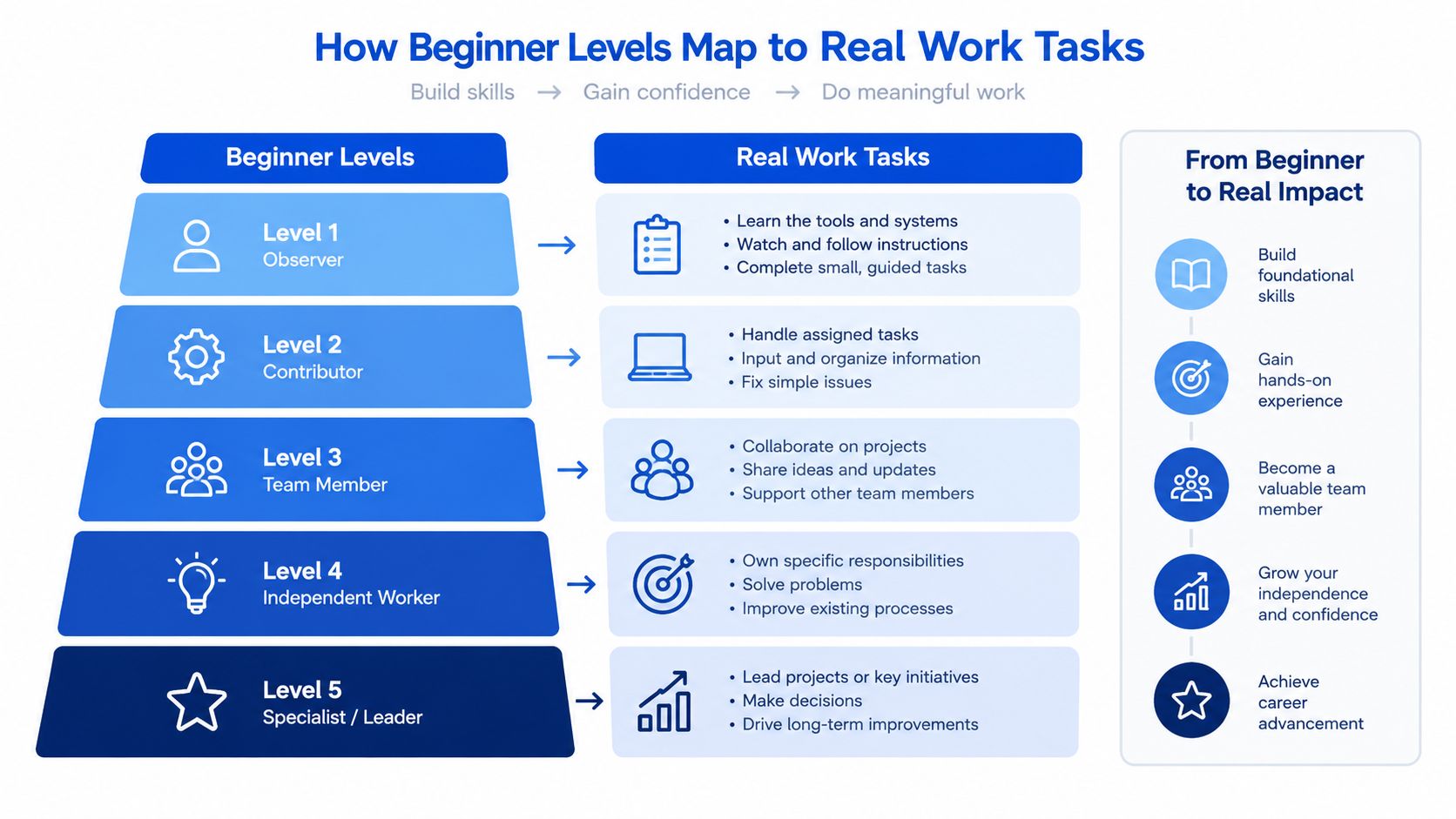
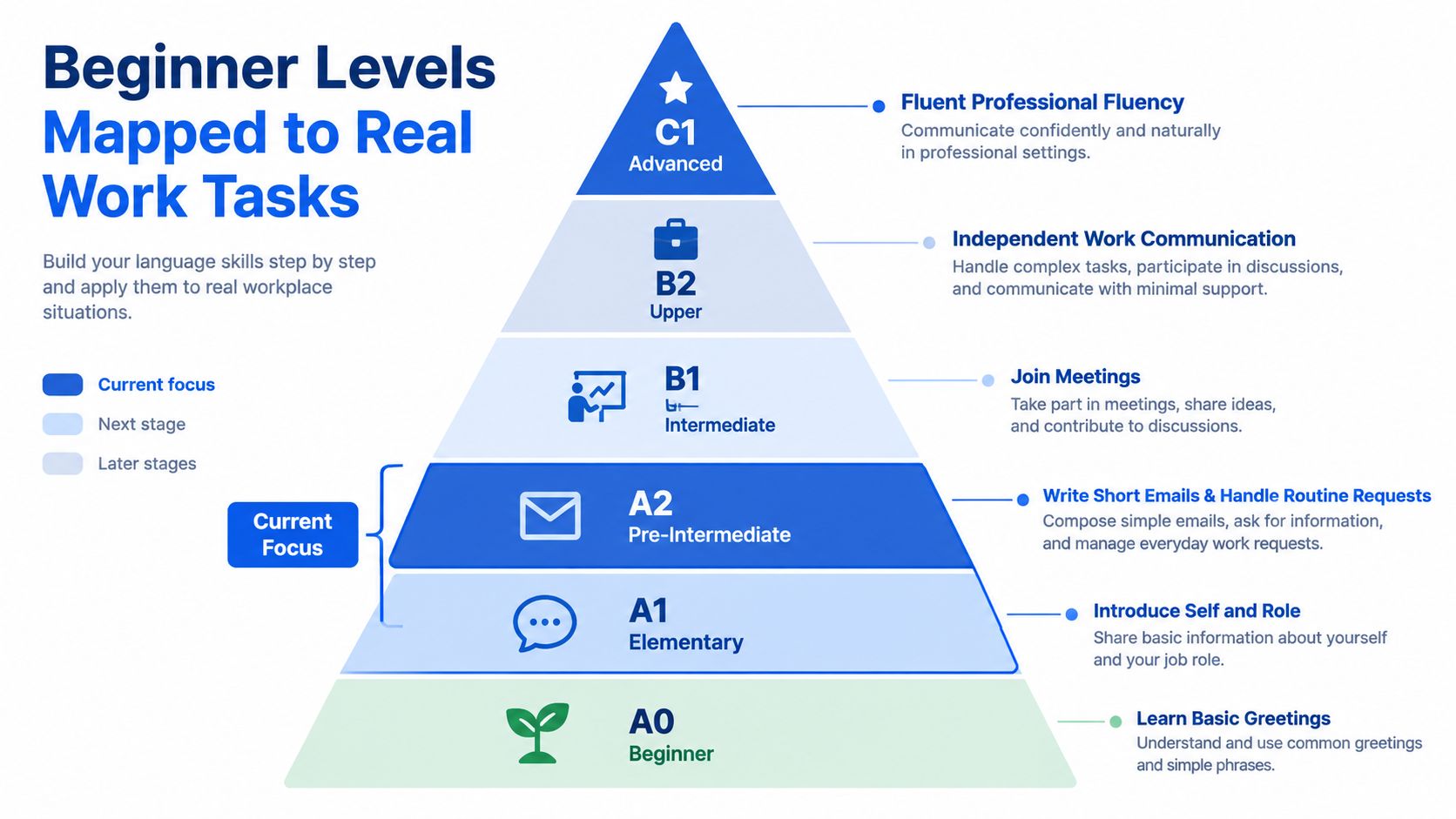
The CEFR is the standard used to describe language ability from beginner to advanced, and workplace English assessments often align with it. Cambridge's Business Skills Test covers A1 to C1, while Linguaskill Business covers B1 to C2, which shows that business communication can be mapped to precise bands instead of being treated as a vague label Cambridge Business Skills Test.
For beginners, the most realistic starting point is usually A1/A2, where the tasks are survival-based rather than fluent. That means introductions, basic instructions, common workplace expressions, very short emails, greetings, and simple follow-up phrases. Expert course mappings also show that B1 learners are typically ready for short scheduling emails, while B2 learners begin contributing more actively in meetings and proposals PMU course mapping.
What that progression really feels like
At A1, you might say, “I'm in sales,” or “I need help with this file.”
At A2, you might write, “Could we move the meeting to Thursday?”
At B1, you start handling short scheduling emails without panic.
The point is not that one level is “good” and another is “bad”. The point is that task complexity rises only after the learner has a stable general-language base. That is why it makes sense to learn short, repeatable scripts first. They are the bridge between knowing a few words and using them under pressure.
For a beginner, self-location is often enough even before a test. If you can introduce yourself but freeze in a call, you are probably still in the early survival stage. If you can manage short emails but need help during live conversation, your speaking is lagging behind your reading and writing.
In other words, the level label matters less than the task you can complete. A learner who can handle a basic request politely is already moving in the right direction.
Essential Vocabulary and Phrases for Your First Weeks at Work

The best beginner phrases are reusable. If a phrase only works once, it is not a strong workplace script. You want language that can survive Monday morning, a rushed email, and a quick call from your manager.
Start with the moments that happen every week
Introductions and roles
- “I'm…” works when you need to say your name.
- “I work in…” helps you explain your department.
- “My role is…” gives a clear job title or function.
Example: “I'm Youssef. I work in customer support, and my role is to handle client requests.”
Greetings and small talk
- “Good morning” is safe and professional.
- “How are you?” is fine in many workplaces, but keep it brief.
- “Nice to meet you” is useful in first contact situations.
Keep small talk light. Beginners often overthink this part, but a short friendly line is enough.
Requests and clarifications
- “Could you repeat that, please?”
- “Sorry, I didn't catch that.”
- “Could you send me the details?”
These are not signs of weakness. They are repair phrases, and they save conversations from breaking down.
Scheduling and follow-up
- “Are you free on Tuesday?”
- “Can we move it to later?”
- “I'll follow up by email.”
For email-specific language, Englify's guide to professional emails is a useful companion because beginners often need the same short phrases in writing before they can use them smoothly in speech.
Arabic-speaker-friendly note: many learners want to translate directly from Arabic, but workplace English often prefers shorter sentences. A simple line like “Please send the file” is usually stronger than a long, heavily translated sentence.
Use phrases as scripts, not decorations
The goal is to make these phrases automatic. Say them out loud. Change the details. Replace the job title, the day, or the file name. That small shift turns a memorized sentence into a working habit.
A useful pattern is this:
- Base phrase: “Could you send me the report, please?”
- Variation: “Could you send me the updated version, please?”
- Variation: “Could you send it today, please?”
That is how beginner vocabulary becomes workplace language.
Simple Exercises That Build Speaking Confidence Fast
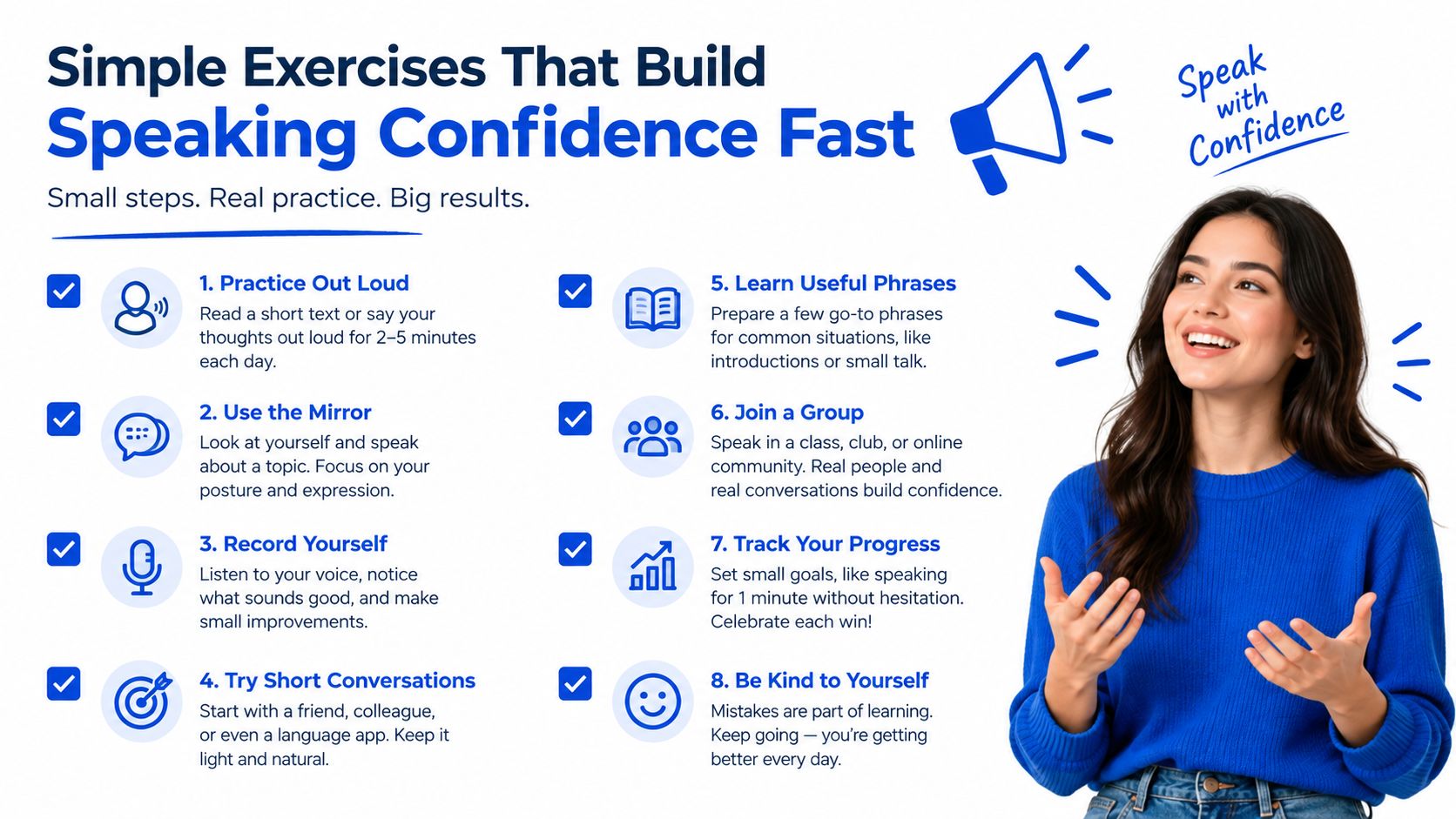
Speaking confidence usually grows when learners stop aiming for long conversations and start practicing short, repeatable tasks. A beginner does not need a perfect “performance”. A beginner needs a few safe reps in realistic situations.
Practice one weak moment at a time
If phone calls scare you, practice only phone opening lines first. If interruptions confuse you, practice how to pause and restart. If you freeze when someone asks a follow-up question, practice just that one response.
A good micro-goal sounds small on purpose. For example:
- Today's goal: introduce yourself in 20 seconds.
- Next goal: ask one clarifying question.
- Later goal: confirm a meeting time without reading from notes.
These goals work because they reduce pressure. The learner can succeed quickly, then build from there.
Use scripts, then slowly change them
Englify's speaking practice article fits this approach well because solo practice is often the easiest first step. Repeat a phrase, then swap one word, then make a tiny variation. That is enough to train the mouth and the mind together.
Try this sequence:
- Read it: “Could you send me the document, please?”
- Say it from memory: “Could you send me the document, please?”
- Change it: “Could you send me the updated document, please?”
- Use it in a role-play: one person asks, the other replies.
This looks simple, but it builds the habit of responding under light pressure. That is exactly what many beginners need before real calls or meetings.
Build a personal phrase bank
A phrase bank is just a small list of sentences you can reuse. Keep sections for greetings, requests, clarifications, and follow-ups. Add the phrases that feel natural to you, not the ones that sound impressive.
A useful phrase bank also helps with repair language:
- “Let me check that.”
- “Can you say that again, slowly?”
- “I'll get back to you shortly.”
These lines protect the conversation when you need a second to think. They also give you time without sounding lost.
The point of practice is not to perform. It is to make the next real conversation feel familiar.
Choosing a Beginner Lesson Plan That Fits Your Goals
A beginner can learn alone, but structure usually helps more than guesswork. The choice is not between “study hard” and “do nothing”. It is between a loose routine and a guided path that gives you feedback, pacing, and accountability.
| Learning Path | Best For | Structure and Support |
|---|---|---|
| Self-study | Learners who already stay consistent on their own | Flexible, low-cost, but easy to drift toward random vocabulary and weak speaking practice |
| Small-group live classes | Students and professionals who want interaction without full pressure | Shared speaking time, teacher correction, and realistic practice with other learners |
| Private classes | Learners with a specific workplace need or tight schedule | Personalized pace, direct feedback, and more room to focus on one weak skill at a time |
Free placement testing is useful because it turns guessing into a starting point. Lingoda says its placement test is free, takes about 5 minutes, gives an instant result, and produces class recommendations that match your level Lingoda placement test. That kind of step matters because a learner who starts at the right level wastes less time and feels less overwhelmed.
Live online instruction also gives beginners something self-study cannot fully replace: real interaction. The British Council offers live online group and one-to-one classes, and its business-English options include both formats, with group classes at 55 minutes and private classes at 25 minutes British Council online courses. That structure shows how online lessons can stay short enough to be manageable while still leaving room for speaking.
Good lesson plans make progress visible. Recordings, reports, and teacher notes help learners see what changed, not just how hard they tried.
For learners who want a more guided path, Englify offers live online English classes through Google Meet with small groups, private options, CEFR-aligned levels from A0 to C1, a free placement test, session recordings, and learner reports. That mix is useful for beginners because it connects placement, practice, and progress in one place.
Your Next Steps to Confident Business Communication
Begin with the sentences that solve real problems. Say your name clearly, ask for repetition, confirm the time, write the short email, and practice the same line until it feels easy. Once those scripts are stable, meetings and presentations become less intimidating because you already know how to stay in the conversation.
A simple 30-day plan is enough to create momentum. Use the first week for introductions and greetings, the second for requests and clarifications, the third for short emails, and the fourth for phone or meeting practice. Keep the focus narrow, because beginners improve faster when they repeat fewer things more often.
If you want structure, feedback, and a starting level that matches your needs, a placement test is the smartest first move. It gives you a clear point of entry before you choose small-group or private learning, and it keeps the path practical instead of vague.
Englify offers live online Business English classes through Google Meet, with small groups, private lessons, CEFR-based levels, and support that fits beginner learners who want real speaking practice. If you want a clearer starting point for your own goals, visit Englify and take the free placement test or book a free trial session.