Knowledge hub
Business English for Managers: Skills That Actually Work
Business English for managers explained clearly — the language and soft-skill competencies that matter, practical learning topics, CEFR alignment, and how
You're fifteen minutes into a call with a supplier in Dubai and a colleague in Lyon. You understood every word, or almost every word. Then someone says, "We might need to revisit that timeline," the room goes quiet, and you can't tell if that's a polite suggestion, a firm objection, or a decision already made. You nod anyway. Two days later, the deadline moves and nobody told your team.
That gap, between understanding English and managing in English, is exactly what this guide is for.
Table of Contents
- What Business English for Managers Really Means
- The Core Competencies Every Manager Needs
- Why Listening and Interactional Control Matter More Than Scripts
- Sample Lesson Topics and What They Practise
- How Progress Is Measured and Where CEFR Fits
- How to Choose or Evaluate a Manager-Focused Course
- Practical Mantras and Tips for Immediate Improvement
What Business English for Managers Really Means
Business English for managers isn't general English with fancier vocabulary. It's the ability to do consequential management work in English, clearly and under pressure. That means chairing a meeting, explaining a decision, checking that everyone understood it the same way, disagreeing without damaging the relationship, and writing an email that produces action instead of another round of questions.
The demand isn't going away. A 2024 EF analysis of global English proficiency and corporate use estimated approximately 1.3 billion English speakers worldwide and reported that 85% of multinational companies use English as a business language. The same analysis found global adult proficiency declined for the fourth consecutive year, with 60% of countries scoring lower than the previous year. High dependence, uneven proficiency. That's the gap managers work inside every day.
A Working Definition You Can Actually Use
Think of it in three layers. First, you need operational clarity. Can you state a purpose, a deadline, and an owner in one breath? Second, you need relational control. Can you soften a refusal, invite a quiet colleague in, or give corrective feedback without sounding hostile? Third, you need cross cultural reading. Can you tell when "yes" means "I agree," when it means "I heard you," and when it means "I don't want to contradict you in front of others"?
Most courses stop at layer one. They hand you phrases for meetings and emails and call it done. Those phrases help, but they don't tell you what to do when a stakeholder hedges, a direct report goes silent, or two regional offices hear the same instruction differently.
Knowing how to open a meeting isn't the same as knowing how to close one with a decision everyone can repeat back accurately.
For managers in Morocco and the UAE, this plays out across Arabic, French, and English in the same working week. Pragmatic meaning shifts between languages. Directness that's normal in one context reads as abrupt in another, and turn taking conventions change too. A manager who only learned scripts will struggle here, because the script assumes everyone else follows it.
By the end of this article, you'll be able to name the competencies worth training, judge whether a lesson topic builds them, locate yourself on the CEFR scale in manager terms, and evaluate any course against a short checklist. You'll also leave with habits you can use in tomorrow's meeting, before any course starts.
The Core Competencies Every Manager Needs
A useful way to picture this is simple. English is the operating system. Your management craft is the software running on it. If the operating system stutters, good software still fails to load. But installing a faster operating system doesn't make you a better manager either. You need both layers working together, and training should treat them as distinct.
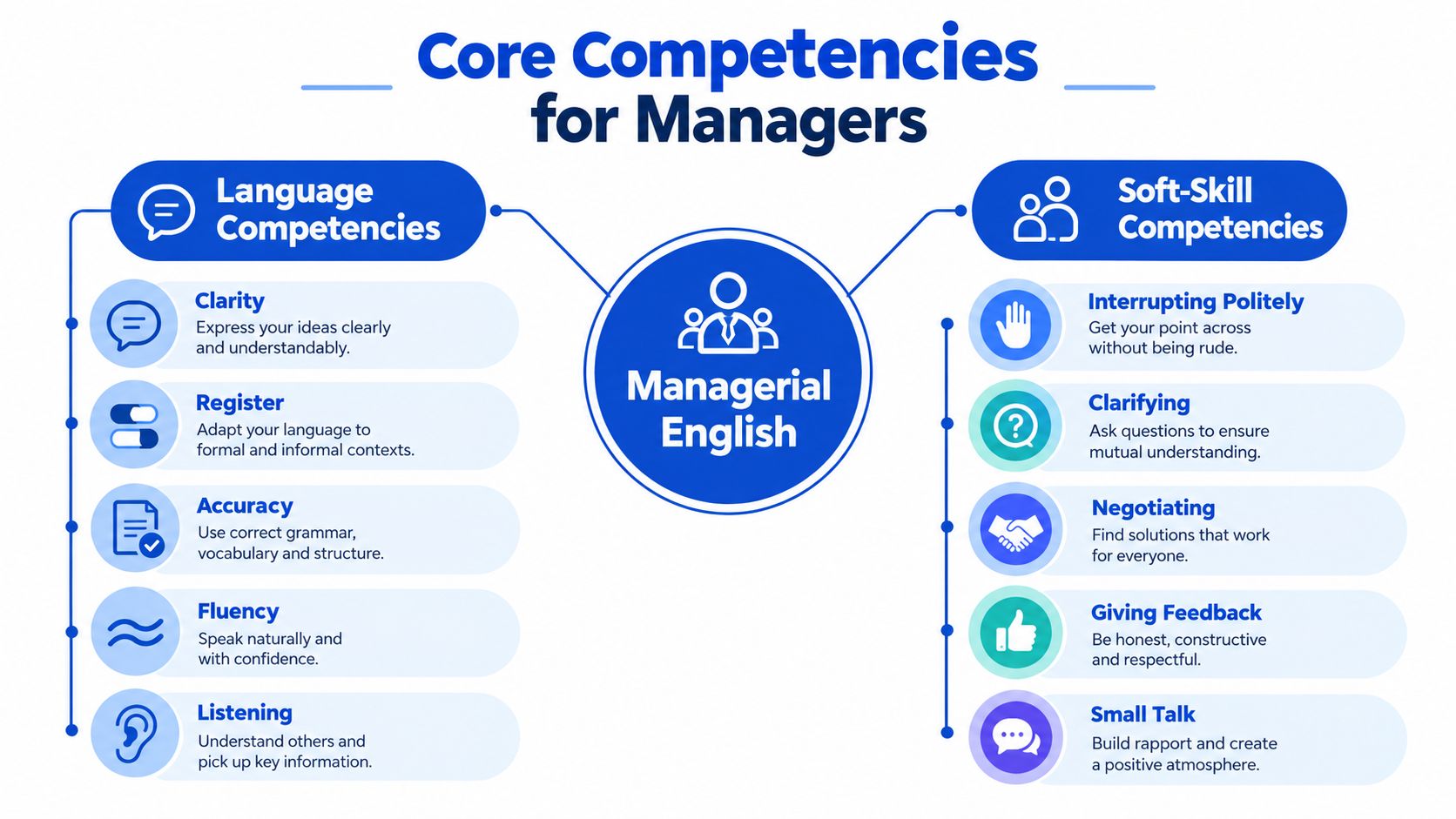
Language Competencies
These are the mechanics, and they matter more than confidence coaches admit.
- Clarity: Short sentences, explicit action verbs, one idea per sentence. "Send the revised forecast to Finance by Thursday" beats a paragraph that buries the request.
- Register: The ability to shift tone for an executive, a peer, and a direct report without sounding stiff or overly casual in any of the three.
- Accuracy: Not perfection. Accuracy means your grammar doesn't create ambiguity about timing, obligation, or responsibility. "We should have sent it" and "We should send it" describe different problems.
- Fluency: Keeping going while you think, using reliable linking phrases instead of long silences or filler that erodes credibility.
- Listening: Catching numbers, names, conditions, and hedging language the first time, across accents and imperfect audio.
Soft Skill Competencies in English
These rarely appear on vocabulary lists, yet they're where managers succeed or fail.
- Interrupting politely: "If I could jump in here, let's refocus on the decision we need" takes control without giving an order.
- Clarifying without losing authority: "When you say soon, do you mean this week?" sounds like leadership, not weakness.
- Summarising decisions: Restating what was agreed, who owns it, and by when, before people leave the room.
- Inviting dissent: "What are we missing?" asked early, before you've signalled your own preference too strongly.
- Disagreeing diplomatically: "I see it differently. Have we considered the cost of delaying?" challenges the idea, not the person.
Watch how both layers combine in one ordinary moment. A project is blocked and you need to escalate. Clarity gives you the structure. Register tells you how direct to be with a senior stakeholder. Listening tells you whether their reply was a commitment or a deferral. Summarising locks it in. Remove any one layer and the escalation fails.
That's why grammar scores alone never explain a manager's performance in English. Someone can write a flawless email and still lose a room. The competencies above are the target. Training is only useful if it builds them deliberately.
Why Listening and Interactional Control Matter More Than Scripts
Most managers don't fail because they lack phrases. They fail because they misread what they heard. A cautious objection sounds like agreement. Politeness hides a refusal. An indirect request ("It would be great if someone could look at this") lands as background noise, and nobody acts.

The data for Morocco makes this concrete. The 2025 EF English Proficiency Index fact sheet for Morocco reports a reading score of 532 and a listening score of 460, a 72 point gap. Reading gives you time to recheck. Listening doesn't. In a live meeting, meaning arrives once, at speed, often through a weak connection, and you have to respond before you've fully processed it.
What Interactional Control Actually Looks Like
Interactional control is the skill of managing the conversation itself, not just contributing to it. It includes four repeatable moves.
- Paraphrase before responding: "So your concern is the launch date, not the budget. Is that right?"
- Check understanding explicitly: "Can I confirm what we've agreed so far?"
- Repair misunderstandings early: "I think I gave the wrong impression. Let me put that more clearly."
- Name the ambiguity: "That could mean two things. Which one are we deciding today?"
These moves protect you when accents, hedging, and hierarchy collide. They also protect your team, because a manager who checks understanding gives others permission to admit they didn't follow.
There's a performance reason to prioritise this. A study of expatriate managers and English proficiency found that English proficiency strengthened the relationship between cultural intelligence and in role job performance, and managers combining strong English with host country language ability showed a stronger performance relationship than less proficient peers. The mechanism is reduced friction. You interpret indirect requests, negotiate meaning, and build trust without leaning on translation.
Practical rule: If you can't summarise the other person's position to their satisfaction, you haven't understood it yet, no matter how many words you recognised.
Practically, this means training should include listening under realistic conditions, multiple accents, fast speech, interruptions, and implied disagreement, alongside the meeting language covered in our guide to Business English for meetings. Scripts are a starting point. Control of the interaction is the goal.
Sample Lesson Topics and What They Practise
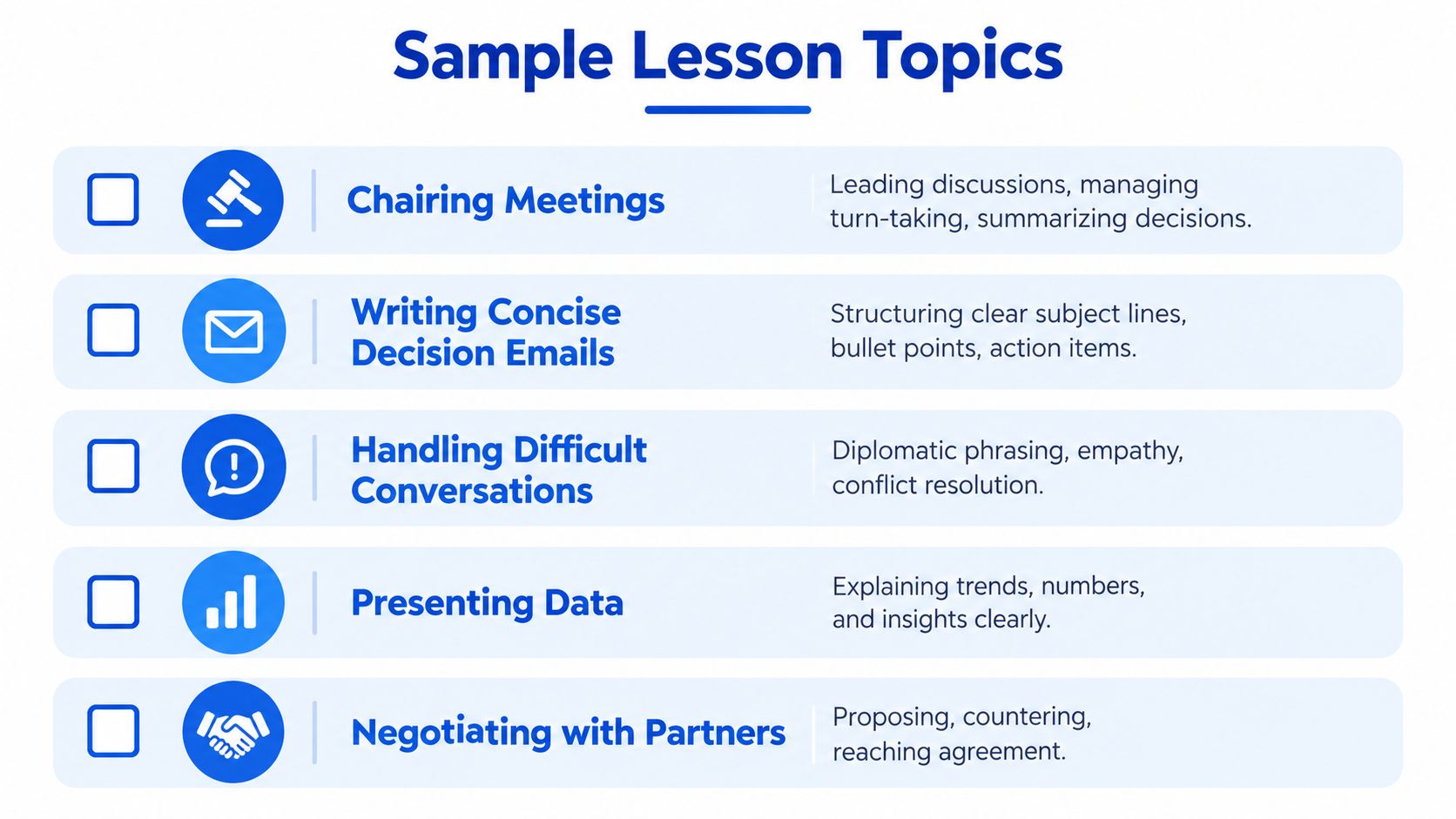
A manager focused curriculum should read like your calendar, not like a textbook index. Each topic below pairs a realistic scenario with the outcome it should produce. If a course can't state the outcome this clearly, it's probably teaching vocabulary in isolation.
Meetings, Email, and Presentations
Chairing a decision meeting. Scenario, a 30 minute status meeting where a decision has stalled twice. You practise stating the objective in one sentence, separating discussion points from decisions, and closing with owners and deadlines. The stakes are real. In a survey of 182 senior managers on meeting effectiveness, 65% said meetings prevented them from completing their own work, 71% considered meetings unproductive and inefficient, and 64% said meetings came at the expense of deep thinking. Better meeting language is a direct response to that waste.
Writing a concise decision email. Scenario, you need approval to change a supplier. You practise a five part structure, purpose, context, recommendation, risk, requested action. Outcome, a reader can approve or refuse without asking a clarifying question.
Presenting metrics with a story arc. Scenario, quarterly results are mixed. You practise leading with the conclusion, then explaining the trend, then naming the action. Outcome, executives hear the implication, not just the numbers.
Coaching, Projects, and Escalation
Running a coaching or career conversation. This is the topic most courses skip, and it's arguably the most important. The 2025 LinkedIn Workplace Learning Report found that only 15% of employees globally said their manager had helped them build a career plan in the previous six months, down five percentage points from 2024. Scenario, a capable team member is underperforming and you suspect the issue is unclear priorities. You practise open questions, evidence based feedback, and agreeing next steps together. Outcome, the person leaves knowing exactly what to change and why it matters.
Communicating project status and escalating risk. The Project Management Institute report on communication effectiveness reports that 80% of projects in organisations with highly effective communicators meet their original goals, compared with 52% where communication is minimally effective. Scenario, a milestone will slip. You practise separating completed work, current blockers, and the decision you need from senior stakeholders, using language that names impact and proposes a solution instead of assigning blame.
Conducting interviews. Scenario, you're hiring across borders. You practise consistent question frames, follow up probes, and note taking language so candidates are assessed on evidence, not on how comfortably they chat.
Notice the pattern. Every topic ends in an observable behaviour, something a trainer can watch, record, and give feedback on.
How Progress Is Measured and Where CEFR Fits
CEFR levels are useful only when they translate into things you can watch a manager do. A generic speaking score tells you very little. A work descriptor, such as giving a presentation, understanding a formal email, taking meeting notes, or writing a report, tells you whether training is working.
| CEFR Level | Manager Can Do | Typical Lesson Focus |
|---|---|---|
| A1 to A2 | Handle routine exchanges, introduce themselves and their role, write short structured messages with support | Core sentence patterns, common workplace phrases, numbers, dates, and simple requests |
| B1 | Run a predictable meeting with a prepared agenda, write a workable status update, follow familiar topics | Meeting openings and closings, status structures, clarification phrases |
| B2 | Chair meetings with disagreement, write concise decision emails, adapt register across hierarchy levels | Diplomatic disagreement, summarising decisions, escalation language, feedback structure |
| C1 | Handle sensitive conversations, catch indirectness and hedging, negotiate nuance across cultures | Coaching conversations, negotiation under pressure, repairing misunderstandings, implied meaning |
If you're unsure where you sit, our explainer on English levels and the CEFR scale breaks the framework down in plain terms before you map it to management tasks.
Why Transfer Matters More Than Attendance
Completing lessons isn't the same as changing behaviour at work. A review of communication training research on predictors of transfer identifies four major predictors, cognitive ability, self efficacy, motivation, and perceived utility, meaning the learner's belief that the training has practical value. That last one is under your control as a course designer or buyer.
A transfer focused cycle looks like this. Diagnose one specific job requirement, such as leading a 30 minute meeting. Model a framework for it. Require the learner to perform it in a realistic simulation. Give immediate feedback on intelligibility, accuracy, terminology, tone, and interaction management. Then assign an on the job task and review evidence of it next session.
Progress you can measure sounds like this. Last month you summarised decisions when prompted. This month you do it unprompted, in under a minute, with owners named.
The labour market rewards this kind of capability. Eurostat and European Commission data on Europeans and their languages shows 28.6% of employed EU residents aged 25 to 64 claimed proficiency in their strongest foreign language in 2022, while 90% of highly educated working age adults knew at least one foreign language, and in a 2023 survey across all 27 member states, 51% cited improved job opportunities and 40% cited workplace use or business trips as a main benefit of learning another language. Senior management, multinational companies, and sales and marketing were specifically identified as areas where language skills give a competitive advantage. Measurable progress, in other words, has career value beyond the classroom.
How to Choose or Evaluate a Manager-Focused Course
Use the competencies and lesson topics above as your filter. A good course should survive direct questions about each one.
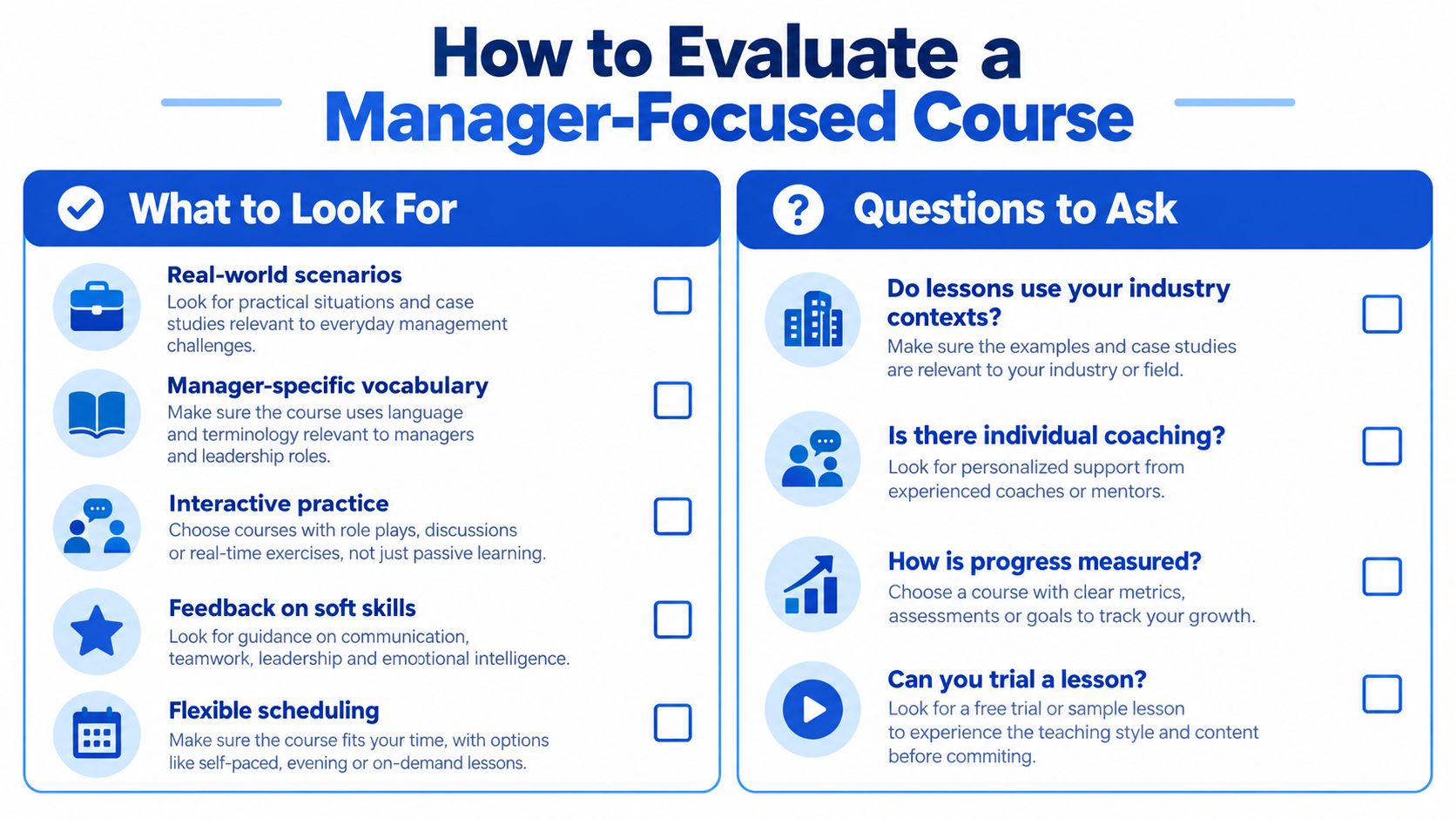
Questions Worth Asking Any Provider
- Is speaking practice live, with corrective feedback? Ask who corrects you, on what, and whether feedback covers tone and interaction management or only grammar.
- How large are the groups? Ask how many minutes of speaking time you'll realistically get per session.
- Is the curriculum CEFR aligned? Ask which work descriptors define progress at your target level.
- Can I test my level and try a session first? A placement test and a trial lesson tell you more than any brochure.
- How is progress reported? Ask whether reports describe observable behaviours, and whether an employer can read them. Our overview of English courses for employees covers what organisations typically need from that reporting.
- Does scheduling fit working hours? Ask about morning, afternoon, and evening options, and how rescheduling works.
Be honest about the trade off between formats. Small group classes cost less per learner and expose you to different accents and viewpoints, which helps listening. Private one to one classes cost more but let the trainer build every scenario around your actual job, your upcoming board presentation, your difficult direct report. Neither is automatically better. The right answer depends on how specific your situations are and how fast you need to move.
A course that can't show you a sample progress report probably can't show you your progress either.
Time pressure is the other reality to plan around. A widely cited Project Management Institute estimate on project managers and communication time states that project managers spend approximately 90% of their time communicating. Training that mirrors that working day, status updates, escalations, negotiations over deadlines, earns its place in a crowded calendar. Training that doesn't will be the first thing you cancel.
For context on fit, Englify runs live online sessions on Google Meet across CEFR levels A0 to C1, with small groups capped at six learners, private one to one options, a free placement test, a free trial session, session recordings, and written learner reports, with scheduling that works around Moroccan working hours. Treat those as items to verify against the checklist above, the same way you'd verify any provider.
Practical Mantras and Tips for Immediate Improvement
You don't need to wait for a course. These habits work in your next meeting, and they're deliberately small.
Four Habits to Start This Week
- Purpose in one sentence: Open every meeting by naming the outcome you need. "By the end of this call, we need to decide X." If you can't say it in one sentence, the meeting probably isn't ready.
- Decisions separate from discussion: Keep two mental columns while you chair. Before closing, read the decision column aloud with owners and deadlines attached.
- Summarise before you respond: Repeat the other person's point in your own words, then answer it. This single habit catches most misunderstandings while they're still cheap to fix.
- Structure every email the same way: Purpose, context, request, deadline, next step. Five elements, in that order, every time.
Concision matters because attention is scarce. Harvard Business School Publishing research on meeting overload reports that 70% of meetings keep employees from doing productive work, that during the pandemic average meeting length fell by 20% while the average number of meetings rose by 13.5%, and that newly promoted managers held almost one third more meetings than seasoned managers. Shorter, clearer language is how you push back against that pattern.
Add one weekly ritual. Record a one minute spoken update on your phone, transcribe it, and find two avoidable mistakes. Not ten. Two. Fix those two patterns the following week and record again. Within a month you'll hear the difference, and you'll have evidence of it.
If you'd rather know where you stand before building a plan, a free placement test or a single trial session will show you which of these competencies needs work first. Start with the one that costs you most at work.
Englify offers live Business English training for managers and professionals on Google Meet, in small groups of up to six or private one to one classes across CEFR levels A0 to C1, with a free placement test, a free trial session, session recordings, and written progress reports. If you want your English practice built around the meetings, emails, and difficult conversations you face, visit Englify to book your free placement test and trial session.