Knowledge hub
French Classes for Kids: How to Choose Well
French classes for kids work best by age and CEFR level, with speaking first. A guide for Moroccan parents on formats, trials and reports.
Starting younger isn't automatically better. And for many Moroccan children, the key question isn't when to start French, but which skills they already have. A child may understand a teacher, answer a cousin in Darija, and struggle to read the same words on a page.
Choosing French classes for kids means matching age, listening, speaking and literacy, not selecting a beginner class with an attractive timetable. The right class gives your child useful things to say, enough support to attempt them, and progress you can recognise without being a French teacher yourself.
Table of Contents
- What Good French Classes for Kids Look Like
- CEFR Levels Children Can Actually Use
- Speaking First Lessons and French Sounds
- How to Compare Formats Schedules and Costs
- Kids Who Already Know Some French
- Parent Reports and Fair Help at Home
- Frequently Asked Questions About Kids French Classes
- How to Start French Classes in Morocco
What Good French Classes for Kids Look Like
A strong class is live, grouped by age and level, and built around usable communication. Your child should practise French they can use that week, not spend the lesson completing grammar sheets.
Age bands for kids French classes
| Age band | Main focus | Lesson shape | Progress you can see |
|---|---|---|---|
| 4 to 7 | Songs, stories, routines, repetition | Short playful turns inside 45–60 minutes | Follows instructions and repeats useful phrases |
| 8 to 11 | Phonics, spelling, simple reading, structured talk | About 60 minutes with clear tasks | Reads a familiar text and answers predictable questions |
| 12 to 15 | Patterns, longer turns, school French | About 60 minutes of talk plus short writing | Speaks in connected sentences and handles school tasks |
Treat these lesson lengths as planning examples, not attention-span rules. A younger child shouldn't be expected to sit through an uninterrupted explanation just because the session lasts an hour. The teacher can alternate a greeting routine, picture story, movement game and short exchange while keeping the language focus consistent.
Age changes the teaching, not the child's potential
The European education review published by Eurydice explains that, with instructional time held constant, learners starting around age 11 can initially outperform those starting around age 8, although earlier starters may retain long-term pronunciation benefits. Older children can draw on stronger literacy, attention, memory and awareness of language patterns.
That finding matters when a parent worries that their child has missed the right moment. An older beginner doesn't need a preschool course delivered faster. They need age-respectful material, clear explanations and opportunities to use what they understand.
For a younger child, pointing to the right picture after hearing an instruction is meaningful progress. For an older child, reading a short description and asking a follow-up question may be a more appropriate target.
Practical rule: Choose the teaching approach for the child's developmental stage, then choose the language challenge for their actual skills.
Look for participation, not just activity
A colourful lesson isn't necessarily an interactive lesson. Children can watch slides, sing along and complete matching games without ever answering independently.
Look for these signs:
- Individual responses: The teacher checks what each child understands rather than accepting only group answers.
- Supported speaking: Pictures, sentence starters and demonstration help children attempt an answer.
- Reused language: Children meet a phrase in a story, practise it in a game and use it in a conversation.
- Visible independence: The teacher gradually removes prompts instead of supplying every answer.
Pick the age-band row that best matches your child, then check the syllabus for actions: greeting someone, following instructions, asking for an object or describing likes. A list of textbook chapters tells you much less.
CEFR Levels Children Can Actually Use
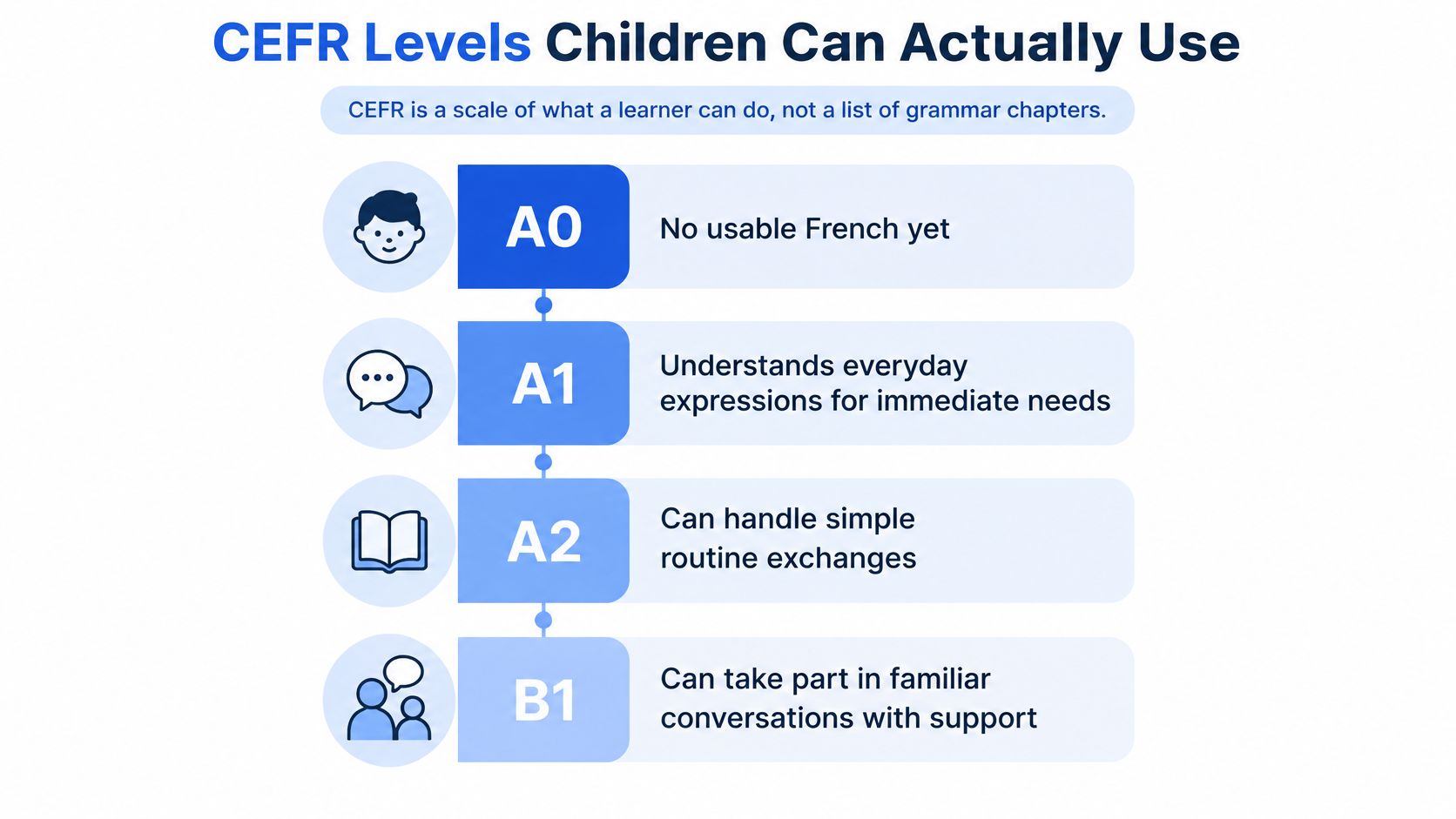
CEFR, the Common European Framework of Reference for Languages, describes what a learner can do with a language. It isn't just a sequence of grammar chapters or a measure of how long a child has attended lessons.
The Council of Europe's CEFR descriptors include understanding everyday expressions for concrete needs when speech is clear, slow and repeated, following carefully delivered questions and short directions, and writing very simple online messages about preferences or hobbies. These are useful starting points because parents can hear or read the result.
Translate the level into a child-sized task
A0 is commonly used by academies as shorthand for no usable French yet. It's a starting label, not one of the main CEFR proficiency bands. A child at this point needs demonstration, pictures and familiar routines before independent communication becomes realistic.
The following table gives practical, child-friendly examples rather than a complete assessment checklist.
CEFR can-do targets for children learning French
| Level | Listening | Speaking | Reading and writing |
|---|---|---|---|
| A0 | Needs gestures and translation to start | Little or no French yet | Not reading French yet |
| A1 | Slow, repeated everyday phrases and classroom instructions | Greets, names people and things, says likes | Copies words and writes a very short formulaic message |
| A2 | Simple directions and familiar daily topics | Describes a routine in short sentences | Reads a short familiar text and writes a brief note |
| B1 | Clear speech on known subjects if the pace is manageable | Tells a short story and gives a simple reason | Reads and writes several connected sentences |
At A1, success might mean introducing themselves and answering a familiar question without a parent translating. At A2, a child might describe their school-day routine or exchange simple information about an outing. At B1, the challenge becomes sustaining a familiar conversation, explaining a preference or recounting a personal event.
Higher bands towards C1 are long-term proficiency aims, not a promise attached to primary-school enrolment. Tasks must also remain age-appropriate: a child shouldn't need adult knowledge to demonstrate their French.
Ask which skill the level describes
An overall label can conceal important differences. A child might manage A2 listening tasks but need A1 support when writing. That isn't a contradiction, and it shouldn't automatically send them back to the beginning in every skill.
Use the French placement test as an initial check, then look for an interpretation that separates understanding, interaction and literacy. A useful assessment note names the action completed, the support needed and the next target.
Fluency isn't a sufficiently precise report. Answering a familiar question independently or writing a short message gives a parent something concrete to recognise.
Speaking First Lessons and French Sounds
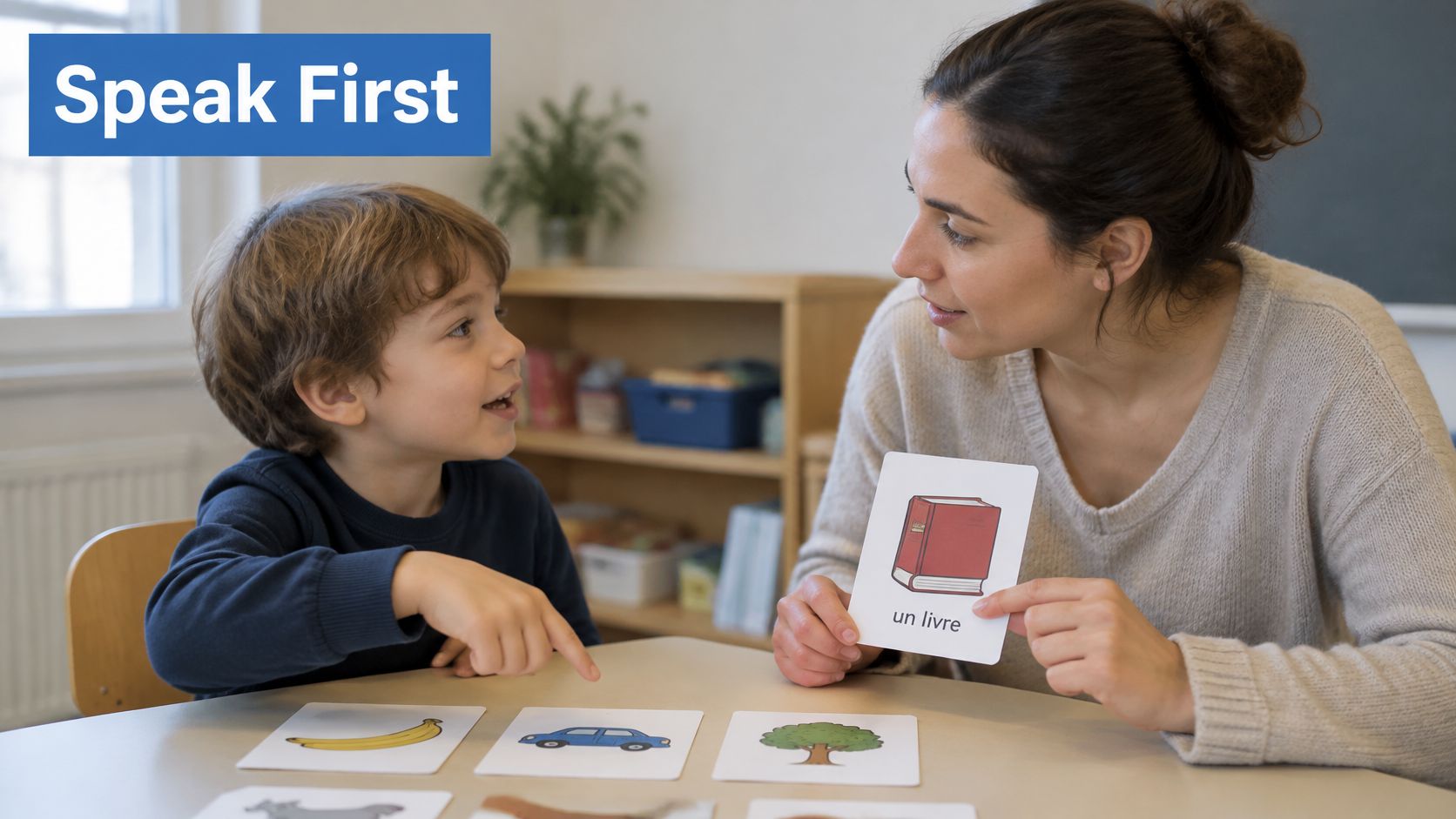
Say a teacher shows a picture of a school bag and asks the child to choose what goes inside it. The child names an object, requests it, receives a brief pronunciation correction and tries again while completing the game.
That's speaking-first teaching: the child uses French to accomplish a small task, then improves the attempt. Grammar still matters, but the teacher introduces it where it helps communication instead of making correct rule recitation the entrance requirement for speaking.
Use a repeatable listening and speaking cycle
A productive lesson can recycle greetings, numbers, a story question and a target sound without feeling repetitive. The activity changes while the language remains familiar.
- Listen: The teacher models the phrase and checks that the child recognises its meaning.
- Imitate: The child tries the sound or phrase without needing to invent an entire answer.
- Adjust: The teacher gives a brief, specific correction.
- Use it: The child returns to the game or dialogue and says the phrase for a purpose.
A 2025 study published in the International Journal of Bilingualism, involving 45 children aged 6–9, found no significant bilingual advantage in perceiving or producing unfamiliar third-language sounds; accurate sound learning depended on prolonged exposure to that language's specific sound properties. Knowing other languages is therefore not a substitute for deliberate French pronunciation practice.
Practise French sounds on purpose
Useful targets include the rounded vowel contrast conventionally written as u versus ou, nasal vowels, the French uvular r, and the rhythm of connected speech. The teacher should choose manageable targets rather than correcting every unfamiliar sound at once.
For example, a child can first identify which sound they hear, then imitate it, then use it in a familiar phrase. A short baseline recording and a later recording of comparable material can reveal whether the words are easier to understand.
Aim for intelligibility and increasing control, not accent perfection.
Cartoons can provide enjoyable listening material, but a screen won't notice that a child consistently confuses a sound. Pair viewing with an adult-led question, a retelling or a classroom activity that requires a response.
For extra activity ideas, Playz's play-based language guide for home or class can help parents turn practice into a game rather than another worksheet. Choose an activity that reuses the teacher's target language, then ask how often your child speaks individually and which French sounds are being practised deliberately.
How to Compare Formats Schedules and Costs
Start with the obstacle your child faces. A hesitant speaker, a child with uneven literacy and a confident learner who enjoys classmates may need different arrangements even when their school marks look similar.
Format comparison for kids French classes
| Format | Best for | Main limit |
|---|---|---|
| Private lesson | Shy child, wide level gap, shifting timetable | Less peer talk |
| Small group | Peer talk and a steady routine | Above about six children, protecting individual speaking turns becomes harder |
| Recorded video | Reviewing songs and phrases | Cannot correct French in the moment |
The group-size point is a practical screening guideline, not a universal learning threshold. Watch how the teacher allocates turns: even a small class can leave a quiet child unchallenged if the most confident pupils answer everything.
Compare interaction before convenience
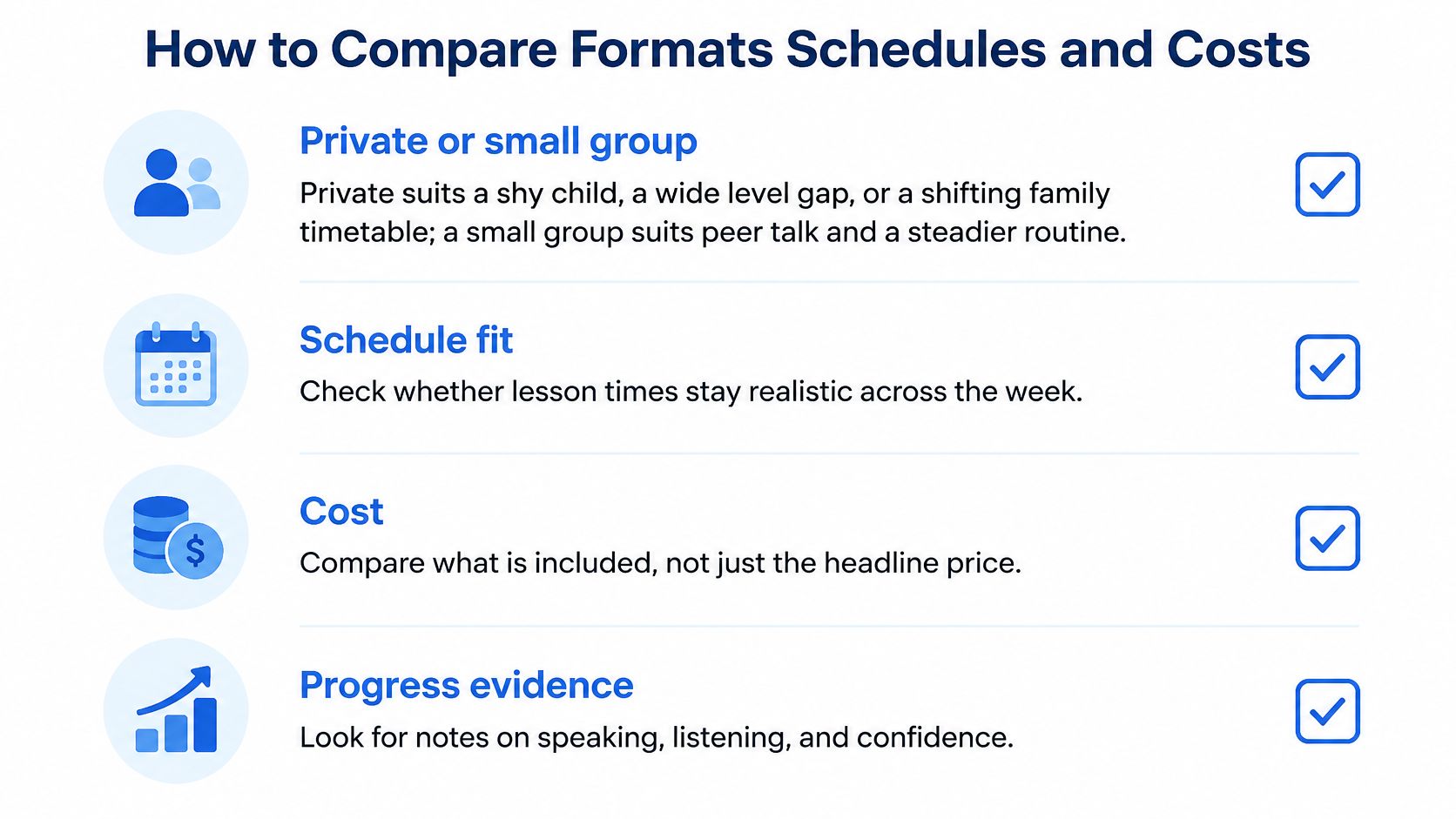
Private teaching allows the teacher to adjust the pace and choose personalised content. It can suit a child who needs time to respond, though a hesitant learner may also enjoy a carefully matched group. Private doesn't automatically mean more comfortable.
Small groups provide reasons to listen to classmates, ask questions and take turns. Their value depends on sensible matching and active teaching, not merely putting children of similar ages in the same online room.
The guide to private French lessons online can help you weigh individual attention against peer interaction. Choose for the child's constraint, not because one format sounds more prestigious.
Check the timetable and trial together
A realistic after-school or weekend slot in Moroccan local time matters more than an impressive timetable that conflicts with meals, homework or transport. Don't assume a European advertised time is your family's local time.
Consider a schedule with regular live lessons and manageable practice between them. More sessions aren't useful if the child regularly arrives exhausted or misses them.
A worthwhile trial includes a genuine mini-lesson, not just a conversation with a parent. Afterwards, you should be able to identify:
- Starting point: What could the child do independently?
- Teaching fit: Did the teacher adapt when the child hesitated or found a task easy?
- Next goal: What specific skill should the child practise next?
- Practical fit: Could the family maintain this slot and setup?
Compare the complete cost
Compare live teaching time, group size, materials and reporting before comparing monthly fees. Check whether the quoted arrangement is a group place or an individual lesson, and what happens when the family cannot attend.
Avoid treating recorded content as equivalent to live interaction. Recordings are useful for review, but they don't provide an immediate response to the child's attempt.
Warning sign: A provider promises fluency by a date but cannot explain what the child will practise in the next lesson.
Other concerns include widely mixed developmental stages, lessons built only around verb tables, no individual speaking turns and no understandable written feedback. A polished presentation isn't evidence that the format fits your child.
Kids Who Already Know Some French
A child who understands French but answers in Darija isn't the same learner as a child who understands no French. Nor is a child who passes grammar tests necessarily ready for an unscripted conversation.
In Morocco, school French, some kindergarten programmes and family exposure can produce split skill profiles. Adding more of the same exposure may leave the actual difficulty untouched.
Place the skills, not the family label
Australian research on heritage-language French, based on 74 surveyed parents, found strong family interest in maintaining French alongside limited suitable options and curricula often designed for foreign-language learners. That doesn't establish how common the problem is in Morocco, but it identifies an important curriculum mismatch for multilingual families.
Separate these placement questions:
- Understanding: What can the child follow without translation?
- Independent speech: What will they say without an adult supplying the sentence?
- Reading: Can they recognise and understand familiar written words?
- Writing: Can they produce a meaningful sentence?
- School demands: Do they need French for classroom instructions, explanations or subject work?
A heritage or home-exposed learner may need explicit literacy teaching without needing beginner listening material. Conversely, a school-taught child may recognise written patterns but need substantial oral practice.
Two Moroccan placement scenarios
Consider a hypothetical 7-year-old in Tangier who nods when an older cousin speaks slowly in French but answers in Darija. Begin by checking comprehension through actions and picture choices, then offer predictable, low-pressure speaking routines. A literacy workbook shouldn't be the automatic first response to reluctance to speak.
Now consider a hypothetical 12-year-old who passes school grammar tests but stays silent in conversation. Returning to colours and numbers may feel childish and fail to address the problem. More suitable tasks include explaining a classroom answer, asking for clarification and giving a short account of a school day.
Neither child needs their existing knowledge dismissed. Both need a teacher to identify what transfers into independent communication and what still requires support.
Tell the academy whether the priority is confidence, school support, literacy or a combination. Keep Arabic and Darija as valued family languages rather than presenting French as their replacement. The right curriculum fills a gap; it doesn't erase a child's linguistic starting point.
Parent Reports and Fair Help at Home
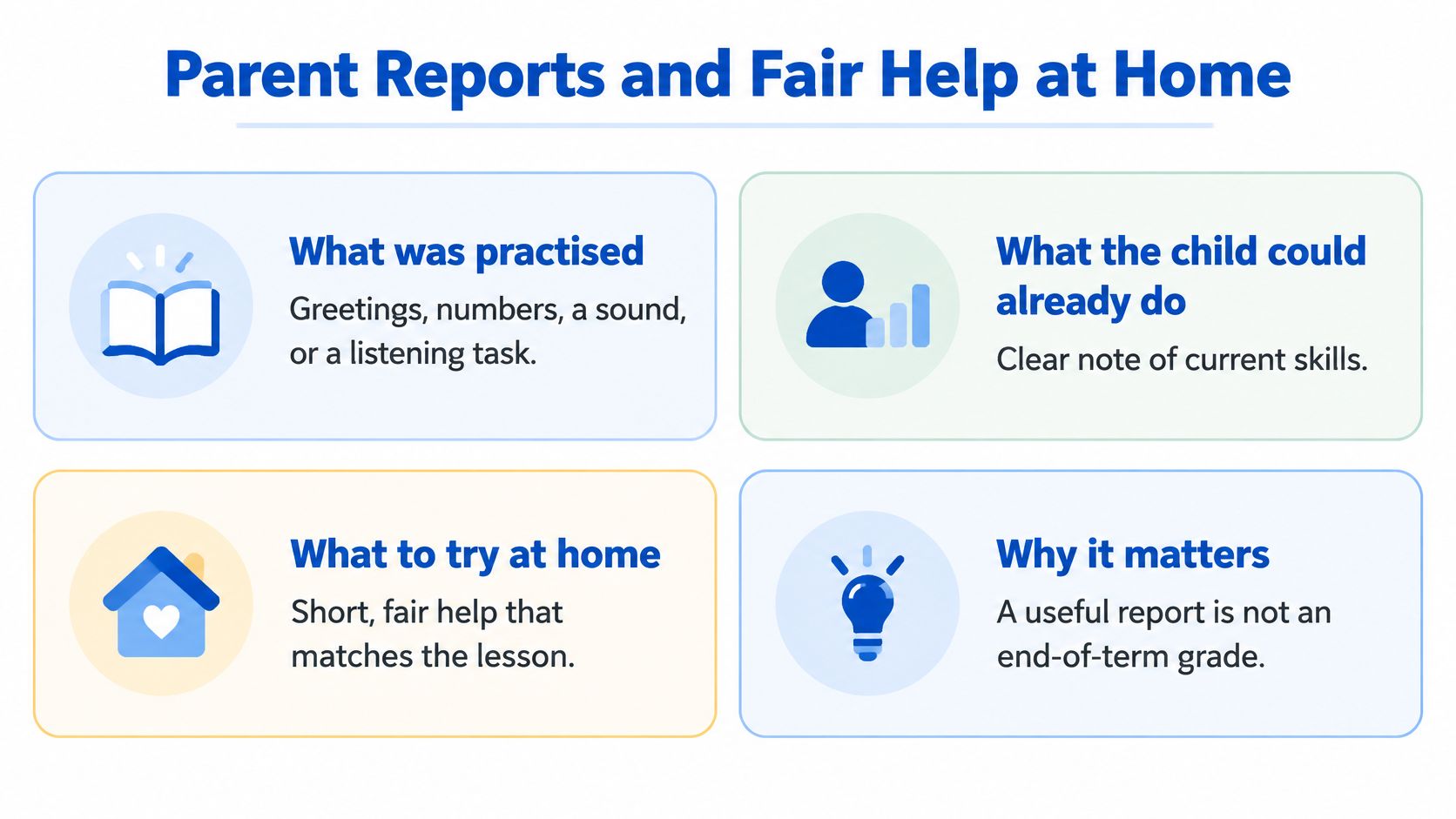
A child's age or course label cannot show what they can do independently. School French and home exposure may build listening, speaking and literacy at different rates, so a useful parent report describes the child's response, not just the lesson topic. A term grade alone may hide whether the child understood a question or needed substantial prompting.
The ACTFL proficiency framework considers listening, speaking, reading and writing, along with the tasks a learner can handle and the language they understand or produce. For parents, that distinction matters: completing a worksheet with help does not show whether a child can hold a conversation on their own.
Read the report for evidence
Look for the lesson target, what the child did and what to try next. For example, a report might say that the child followed familiar instructions independently but needed a picture prompt to answer a question. That gives you more to work with than a list of completed activities.
- Practised: Greetings, vocabulary, a sound contrast or a listening task.
- Demonstrated: What the child managed without someone supplying the answer.
- Next attempt: A manageable action to revisit at home.
- Support needed: Whether repetition, pictures or sentence starters helped.
At Englify, parents receive written session reports and a detailed trial evaluation. Use each written report to revisit the activity and practise a familiar phrase at home, not as a substitute for live correction.
Keep home support small and fair
A study of French learning in Madagascar associated homework assistance with 60% of the study's reported performance contribution and home reading with 20%. These findings describe that study, not a rule for dividing family time or a promise of results.
Heavy tutoring at home can favour children whose parents have more time or stronger French. Offer siblings the same chance to take part, rather than giving every speaking turn to the child who volunteers first.
Try a five-minute routine: listen to a short teacher-selected clip, let the child explain its meaning in any language, then practise a familiar phrase together. Or share a picture of a family meal or familiar Moroccan place and invite the child to name what they can. The aim is to notice what comes naturally, not to turn family time into another lesson.
For broader ideas about household routines and parent-child communication, Family Xchange's advice for parents offers a complementary starting point. You do not need to become the French teacher. Notice spontaneous words, understanding and willingness to try, rather than counting pages completed beside you.
Frequently Asked Questions About Kids French Classes
Is 4 too young for French classes?
No, provided the class is designed for young children. Songs, stories, movement and repeated routines make a more suitable starting point than lengthy explanations. Readiness also includes whether the child can engage with the teacher and return to an activity with support.
My child hears French at home, so should they skip beginner classes?
Not automatically. Home exposure doesn't tell you how confidently a child speaks or how independently they read and write. Request separate skill observations so familiar material can be skipped without overlooking genuine gaps.
Will learning French harm my child's Arabic or Darija?
Early French learning doesn't require replacing home languages. The European Commission's early-language-learning guidance reports that, after 36 months of age, early foreign-language learning was not found to cause real problems for mother-tongue learning or use. Continue meaningful conversation, stories and family activities in Arabic or Darija.
What if my child only understands and will not speak?
Choose a teacher who plans individual speaking turns rather than waiting for volunteers. Start with choices, familiar responses and brief tasks that don't require performing in front of everyone. Feedback should be immediate but selective, so the child can finish communicating rather than being interrupted at every word.
The first useful change may be a child volunteering a familiar phrase, not suddenly speaking at length.
If reluctance appears only in French lessons, examine the task and classroom pressure. If you have broader concerns about your child's communication across languages or settings, discuss those concerns with an appropriate qualified professional rather than assuming extra French tuition is the answer.
How to Start French Classes in Morocco
Starting younger is not automatically better. A child may have heard French at school or at home yet still find speaking, reading and writing uneven. Begin by identifying what the child can understand and say, then use a level check and trial lesson to choose an appropriate challenge.
- Note the child's age, school exposure and main difficulty. Separate listening and understanding from speaking and literacy.
- Complete a free level test and attend a free trial lesson. Observe whether the child gets a genuine chance to respond.
- Review the trial evaluation for strengths, support needs and a clear next target.
- Choose an age-matched group or individual classes based on the child's skill profile and your family's timetable.
- Keep the lesson time steady and practise briefly at home between sessions.
Choose a workable starting arrangement
Englify is a Morocco-based online English and French academy serving learners across Morocco. Its French classes in Morocco take place live on Google Meet, with 60-minute lessons and small-group or private one-to-one options. A free level test and trial lesson give families a chance to check the fit before enrolling.
Children's groups are arranged for ages 4 to 7, ages 8 to 11, and teenagers. Published group prices are 250 MAD for one month, 650 MAD for three months, 1,000 MAD for six months and 1,400 MAD for nine months. Check French-group availability and the timetable with the team before deciding, since the right format also depends on what your child needs to practise.
Decide from the trial evidence
A useful trial shows whether the instructions make sense, the level is suitable and the child gets time to try an answer. Look for a reachable challenge, not a promised result date.
If the task seems too easy, ask for a more demanding sample. If your child struggles, ask whether the teacher can adjust the support. The trial evaluation should help you understand the child's starting point and next learning goal, so the first lessons build on what the child can already do.
Choose the arrangement that fits both the child's skills and your family's routine. Use the free level test and trial lesson to assess that fit before enrolling.