Knowledge hub
Gerund and Infinitive: Rules, Meanings and Verb Lists
Learn when to use a gerund and infinitive, which verbs take each form, how meaning changes with stop and try, plus reference lists and practice.
Why do verb lists fail you the moment the sentence changes meaning? You can memorize "enjoy + -ing" and "decide + to" and still write "I stopped to smoke" when you meant you quit. A gerund and infinitive choice is not a style preference. The form follows the verb in front of it, the position in the sentence, or a shift in meaning. Get those three checks in order and the lists start working for you instead of against you.
Table of Contents
- Gerund or Infinitive at a Glance
- Verbs That Take a Gerund, an Infinitive or Both
- Rules That Depend on Position, Not the Verb
- Verbs That Change Meaning with Each Form
- Where Learners Slip in Work, School and Travel
- Practice Exercises and Answer Key
- Quick Answers to Common Gerund and Infinitive Questions
- Choose by Meaning, Then Check Your Accuracy
Gerund or Infinitive at a Glance
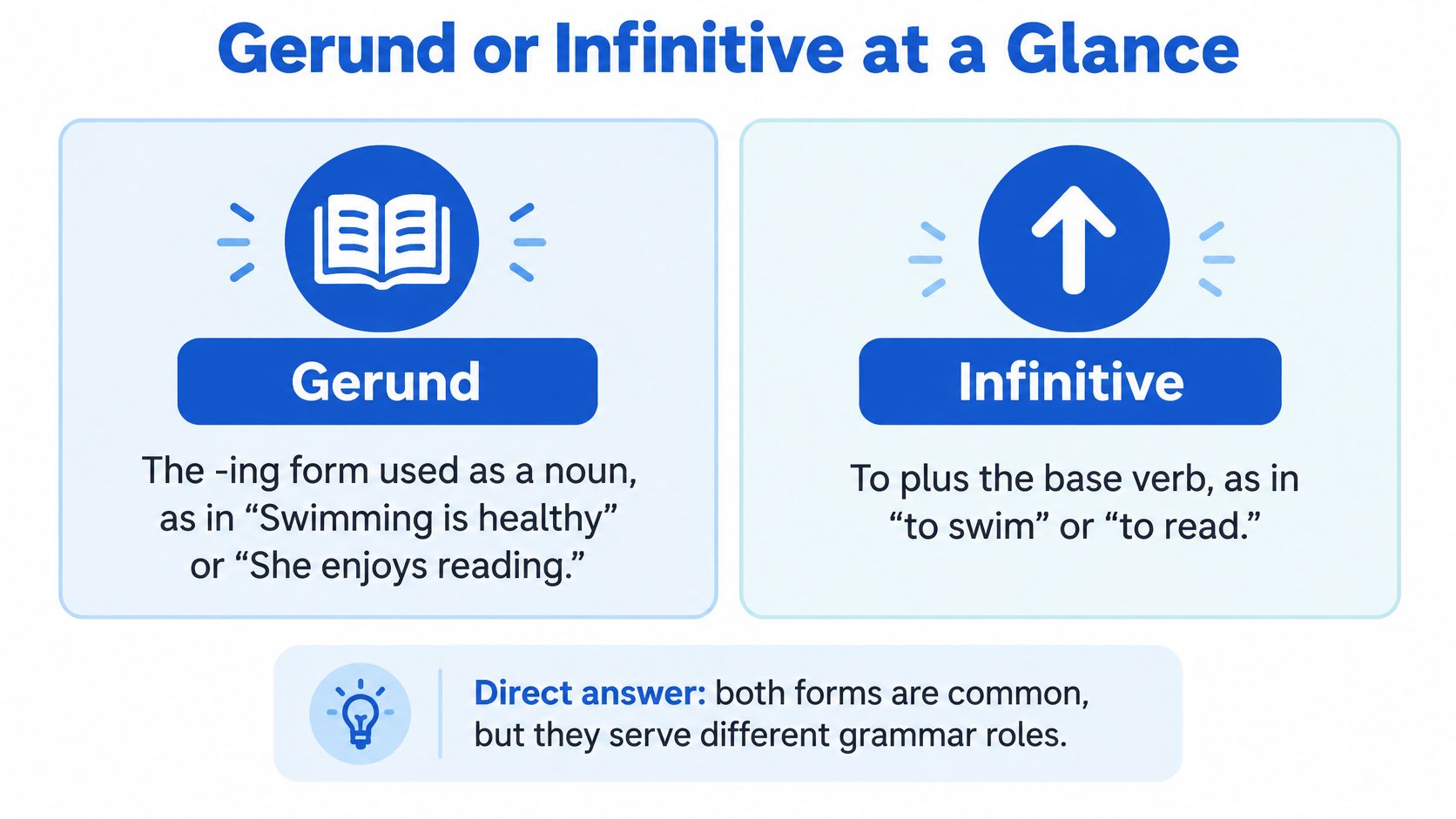
A gerund is the -ing form used as a noun, as in "Swimming is healthy" or "She enjoys reading." An infinitive is to plus the base verb, as in "to swim" or "to read."
The Purdue OWL comparison of gerunds, participles, and infinitives puts the split this way. A gerund is an -ing form derived from a verb that functions as a noun. An infinitive is typically to plus the base form, and it can work as a noun, an adjective, or an adverb. Both forms can occupy similar positions, but they can't always be exchanged. In "Swimming is healthy," swimming is the subject noun. In "I want to swim," to swim is the object of want.
The word before the second verb decides the form, not the general idea of the sentence. An infinitive can express purpose ("We saved money to travel"), act as the object of a verb ("I want to learn"), or follow an adjective ("It is hard to explain"). The same idea of learning can be "She enjoys learning" or "She wants to learn," and only one of those is grammatical for each verb.
Forms side by side
| Form | Structure | Typical role | Example |
|---|---|---|---|
| Gerund | verb + -ing | noun: subject, object or object of a preposition | Reading helps vocabulary; She is good at explaining |
| Infinitive | to + base verb | purpose, object of a verb, or after an adjective | We saved money to travel; It is hard to explain |
| Bare infinitive | base verb without to | after modal verbs and let or make | We can start now; Let her speak |
Bare infinitive is the form people skip in lists. After can, could, should, and must, and after let and make, English uses the base verb with no to. "We can start now" and "Let her speak" are the patterns. "We can to start" adds a word the grammar doesn't want.
Not every -ing word is a gerund. In "She is swimming," the -ing form belongs to a progressive verb, not a noun. Our guide to present and past participles separates those uses from noun-like -ing.
Practical rule: Learn the full pattern, not the verb alone. "Enjoy to study" is understandable and still ungrammatical. "Enjoy studying" is the pattern enjoy selects.
Use the sections below as a lookup. Find your verb, your preposition, or the situation, then match the form.
Verbs That Take a Gerund, an Infinitive or Both
There is no single rule that predicts every pattern. The British Council guide to gerund versus infinitive treats the choice as lexical. The main verb licenses what follows, and Cambridge-style verb tables pair each verb with either the -ing form or the to-infinitive. Store the unit, not the verb by itself: avoid doing, decide to do, can do.
| Pattern | Verbs | Example |
|---|---|---|
| Gerund only | enjoy, avoid, finish, keep, discuss, dislike | I enjoy cooking; We discussed moving the meeting |
| Infinitive only | decide, want, choose, hope, plan, refuse | She decided to apply; I refuse to lie |
| Both, same meaning | like, love, prefer, begin, start, continue | I like to swim; I like swimming |
| Both, meaning changes | stop, remember, forget, try, regret, go on | She stopped eating / She stopped to eat |
How each group behaves in a sentence
Gerund only. Enjoy, avoid, finish, keep, discuss, and dislike take -ing. "I enjoy cooking" is the British Council's own model, and the same shape gives "We discussed moving the meeting." "We discussed to move the meeting" is the slip.
Infinitive only. Decide, want, choose, hope, plan, and refuse take to plus the base verb. "She decided to apply" and "I refuse to lie" stay in that lane. Forget also commonly takes a to-infinitive when the action is still ahead, as in "I forgot to turn off the gas." Meaning shifts for forget sit in a later section, so don't treat that verb as a simple list item.
Both, almost the same meaning. Like, love, prefer, begin, start, and continue accept either form in ordinary speech. "I like to swim" and "I like swimming" both work. Pick the one that sounds natural in the sentence you're writing. If the first verb is already -ing, prefer the infinitive so you don't stack two -ing forms: "It's starting to rain" is cleaner than "It's starting raining."
Both, and the meaning changes. Stop, remember, forget, try, regret, and go on are not interchangeable. "She stopped eating" and "She stopped to eat" describe different events. The pairs are unpacked just below.
Modals sit outside these four rows. After can, could, should, and must, use the bare infinitive. "We can have chicken" is right. "We can to have chicken" is not.
Copy the ten verbs you use in work or school messages. Sort them into gerund only, infinitive only, and both. Write one example next to each verb, then check it against the table before you send the message.
Rules That Depend on Position, Not the Verb
Verb lists don't cover every sentence. Four position rules apply whatever the main verb is, and BBC Learning English treats the preposition rule as the core one.
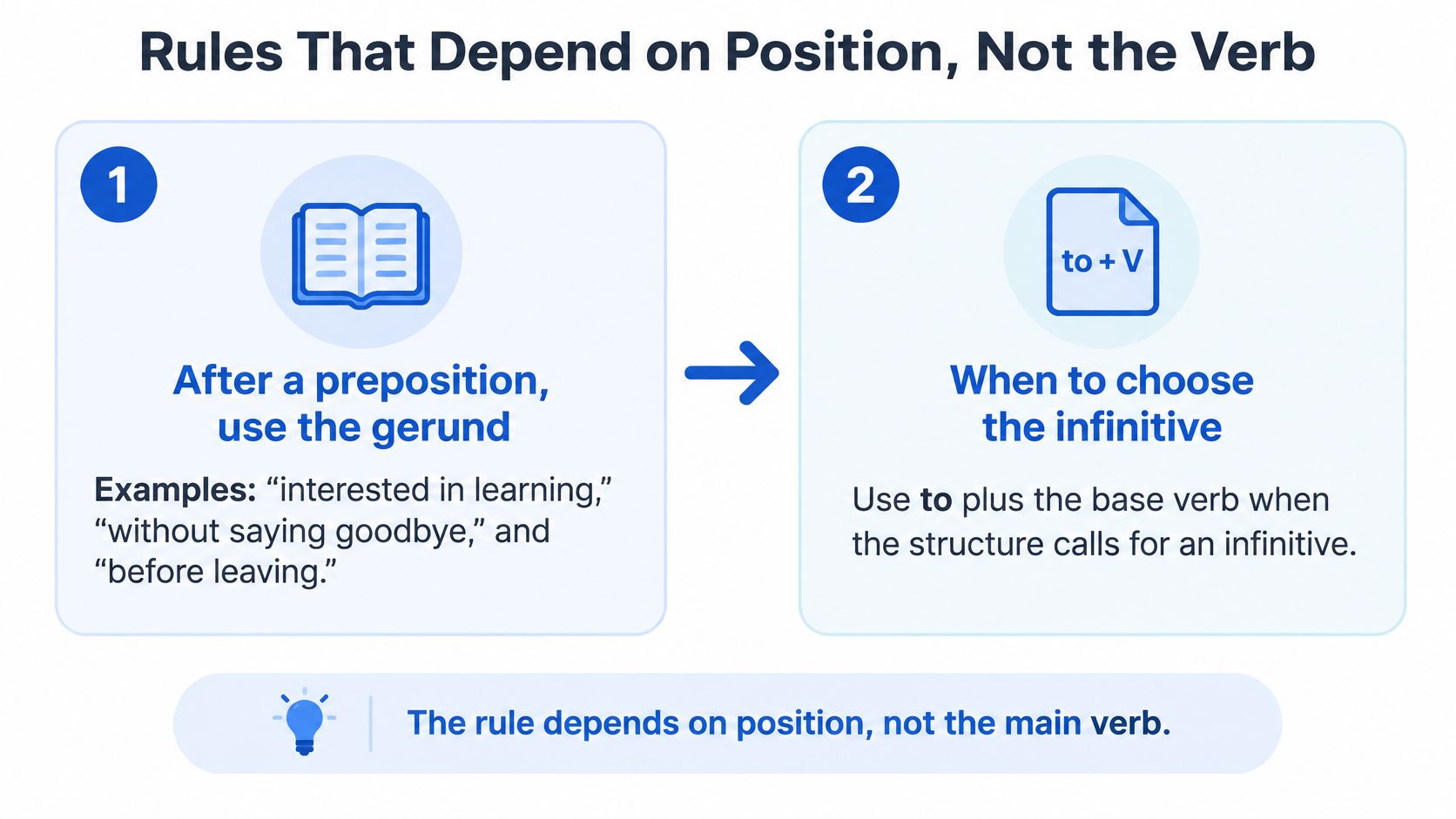
After a preposition, use the gerund. The preposition can follow an adjective, follow a verb, or open a clause. Learners write "interested in to learn," "without to say goodbye," and "before to leave." The corrections are "She is interested in learning," "They left without saying goodbye," and "Before leaving, he called me."
When to is a preposition, it still takes a gerund. This is the error that survives long after the first rule feels obvious, because to looks like an infinitive marker. "I look forward to meet you" and "She is used to work late" both treat to as part of an infinitive. The patterns are "I look forward to meeting you" and "She is used to working late." If you can replace to with toward or about and the sentence still makes sense, to is a preposition.
After many adjectives, use the infinitive. "It is difficult to explain" and "She is ready to leave" are the usual shapes. Some adjectives also accept an -ing form, so check that adjective's pattern instead of forcing one ending on every adjective.
As a subject, the gerund is the usual modern choice. "Learning languages takes time" sounds current. An infinitive subject, "To learn languages takes time," can sound formal or old-fashioned. Use the infinitive subject only when you want that tone.
A check you can run in order
- Is the verb after a preposition? Use the gerund.
- Is to itself a preposition? Use the gerund.
- Does an adjective come before the verb? The infinitive is usually right. Confirm the adjective.
- Is the verb the subject? Prefer the gerund.
These checks sit beside the verb lists. They don't replace them. A sentence can pass a verb test and still fail a preposition test, which is why "looking forward to discuss" keeps appearing in otherwise careful emails.
Verbs That Change Meaning with Each Form
Six verbs accept both forms and change what you mean. BBC Learning English, along with Cambridge Dictionary, names stop, regret, remember, forget, go on, and try. The grammatical choice alters the timeline, the purpose, or the interpretation. It isn't a matter of style.
| Verb | Gerund meaning | Infinitive meaning | Example pair |
|---|---|---|---|
| stop | finish an activity | pause one activity to do another | She stopped smoking / She stopped to smoke |
| remember | recall a past event | do something you must not forget | I remember locking the door / Remember to lock the door |
| forget | lose the memory of a past event | fail to do a planned action | I forgot meeting him / I forgot to call him |
| try | experiment with a method | make an effort | Try restarting the router / Try to restart the router |
| regret | feel sorry about a past action | announce bad news formally | I regret saying that / We regret to inform you |
| go on | continue an activity | move on to the next step | She went on talking / She went on to win |
The two pairs that cause the most mix-ups
Stop is the clearest split. "She stopped eating" means eating was already in progress and then ended. "She stopped to eat" means she interrupted another activity in order to eat. In an interview, "I stopped checking email during meetings" means you quit the habit. "I stopped to check email" means you paused the meeting, or the walk, so you could check.
Remember and forget share one timeline. The gerund points backward to an experience you had. "I remember meeting him" is a memory. The infinitive points to an action you still have to do, or failed to do. "Remember to meet him" is a reminder. "I forgot to call him" means the call never happened. "I forgot meeting him" means the meeting happened and the memory is gone. Try works the same way in tech support and in class. "Try restarting the router" asks someone to experiment with that method. "Try to restart the router" asks them to make an effort, and it allows for failure.
Regret and go on are shorter once you see the direction. "I regret saying that" apologises for a past action. "We regret to inform you" is a formal announcement of news the listener hasn't heard yet. "She went on talking" means she continued. "She went on to win" means she finished one stage and moved to the next.
If the action is already happening, finished, or remembered, use the gerund. If it is planned, intended, or still to come, use the infinitive.
Read your sentence aloud and ask which timeline you mean before you pick the ending. A wrong ending here doesn't just sound odd. It tells a different story.
Where Learners Slip in Work, School and Travel
Infinitives show up more often than gerunds in everyday English, so learners meet them constantly and reach for to even where a gerund is required. The sentence stays understandable. It is still the wrong pattern.
Three layers get mixed together, and fixing one doesn't fix the others.
- Verb pattern: "avoid doing," not "avoid to do."
- Adjective pattern: "ready to leave," not "ready leaving" in the usual phrase.
- Preposition pattern: "interested in learning," not "interested to learning" or "interested in to learn."

Four sentences you will actually send
Job interview. "I am looking forward to discuss the role" treats to as an infinitive marker. Say "I am looking forward to discussing the role."
Email. "I look forward to hear from you" makes the same mistake in a line people copy for years. Write "I look forward to hearing from you."
School writing. "Consider to write a plan first" forces an infinitive onto a verb that wants -ing. Use "Consider writing a plan first."
Travel. "I am not used to wake early" again reads to as part of an infinitive. The natural line is "I am not used to waking early."
Arabic-speaking and French-speaking learners often carry a first-language shape into English, which is a transfer problem, not a sign of weak effort. French avant de partir maps to "before leaving," not "before to leave." The English preposition still demands a gerund. The same pressure shows up when a learner builds every complement with to because that matches how purpose is marked in another language. A wider set of slips like these is collected in our notes on English grammar mistakes Moroccan learners make.
The same verb can be right in one pattern and wrong in another. Check each verb in the sentence you are writing. Don't check "English versus French" or "English versus Arabic" as if one translation rule covered every case.
Practice Exercises and Answer Key
Choose the gerund or the infinitive. Write the full form, not only -ing or to.
- She suggested ___ (go) earlier.
- I look forward to ___ (meet) you.
- He stopped ___ (smoke) last year.
- Remember ___ (send) the report.
- It is difficult ___ (explain) this.
- Before ___ (leave), check the door.
- We agreed ___ (start) on Monday.
- We tried ___ (restart) the router, but it was still slow.
- I regret ___ (tell) you that the order is late.
- ___ (learn) a language needs patience.
Answer key and the rule each item tests
- going, verb pattern. Suggest takes a gerund.
- meeting, to is a preposition in look forward to.
- smoking, meaning. He quit. The activity ended.
- to send, meaning. The report is still ahead of you.
- to explain, adjective pattern after difficult.
- leaving, preposition before.
- to start, verb pattern. Agree takes a to-infinitive.
- restarting, meaning. They experimented with that method.
- to tell, meaning. This is a formal announcement, not an apology for a past remark.
- Learning, subject. The gerund is the usual modern subject.
If item 8 felt like "to restart," you were describing effort, not an experiment. If item 9 felt like "telling," you were apologising for something already said, which doesn't match "the order is late." Label your own misses the same way: verb, preposition, adjective, subject, or meaning. The label tells you what to review.
Use your own messages next
Rewrite three emails or chat messages you have sent. Underline the second verb and write the rule beside it. One pass on someone else's worksheet is weaker than one pass on your own wording.
If you build extra items for a class, spend a minute reviewing AI worksheet drafts before printing. A generated blank often mixes a meaning-change verb with a simple pattern verb, and students then "correct" a sentence that was testing the wrong point.
Quick Answers to Common Gerund and Infinitive Questions
Is it "enjoy to study" or "enjoy studying"? Enjoy takes a gerund, so "enjoy studying" is correct.
Can I say "I look forward to meet you"? No. Here to is a preposition, so it takes a gerund: "I look forward to meeting you."
What is the difference between "stop smoking" and "stop to smoke"? "Stop smoking" means quitting. "Stop to smoke" means pausing another activity in order to smoke.
Do "like to" and "like -ing" mean the same? In most everyday contexts they're close, so choose the form that sounds natural for your situation.
Why do modal verbs take no to? After can, could, should, and must, English uses the bare infinitive, as in "We can start now," not "We can to start."
Is every -ing word a gerund? No. In "She is swimming," the -ing form belongs to a progressive verb, not to a gerund.
Choose by Meaning, Then Check Your Accuracy
Run one order on any sentence, and stop at the first rule that decides the form.
Step 1, name the meaning. Is the action finished, planned, an experiment, or a memory? If the verb is one of the six that change meaning, this step picks the form before any list does.
Step 2, check the verb pattern. If the verb is gerund-only or infinitive-only, the list wins. "Avoid doing" and "decide to do" don't bend for a nicer-sounding alternative.
Step 3, let position override the verb. A preposition, an adjective, or a subject role can beat the verb you first noticed. "I look forward to meeting you" is the classic case, because to is a preposition even though meet would happily take an infinitive in another sentence.
Keep a personal list of the ten verbs you use most. Next to each one, write the correct form and one example that shows the difference, not a dictionary line you will never say. Lists alone don't stick. Accuracy comes from using the forms in spoken and written tasks: interview answers, meeting follow-ups, and exam essays. Say the sentence, then write it. If the spoken version and the written version disagree, the spoken one is usually the pattern you know.
We place new learners with a free online level test from A0 to C1, then a free trial class on Google Meet, 60-minute live sessions, and a written report after every session that shows what was covered and what to practise next. In a small group or a private class, that report is where a repeated verb-pattern error becomes visible instead of disappearing into one quiz score. The free placement test is the simplest way to see which of these patterns you already control.
Englify is an online English and French academy with live classes on Google Meet for kids, teens, adults, and teams. If gerund and infinitive choices keep slipping in interviews, emails, and exams, a teacher can target the exact verbs you use. Visit Englify to take the free placement test or book a free trial session.