Knowledge hub
How to Introduce Yourself: Scripts for Every Situation
Learn how to introduce yourself in class, exams, interviews and casual talk, with ready-to-use English scripts, timing tips and quick speaking drills.
Your teacher calls your name, the interviewer says “Tell me about yourself,” or a new colleague asks you to speak on Google Meet. You know your own story, but choosing the right English words suddenly feels difficult.
To introduce yourself, greet the listener, say your name, add relevant context, and give them a way to respond. You don't need your whole biography. You need a short opening that suits the person listening and the reason you're speaking.
Table of Contents
- Ready-to-Use Introductions for Six Settings
- Build Your Own Introduction in Four Steps
- Introducing Yourself in Class and Exam Speaking
- Introducing Yourself in Interviews and Meetings
- Casual Introductions and Small Talk Phrases
- Handling Nerves, Freezing and Name Mistakes
- Say Your Name and Key Words Clearly
- Practise the Introduction Before You Need It
Ready-to-Use Introductions for Six Settings
Choose your introduction by setting and listener, keeping the same pattern throughout: greeting and name, relevant context, then an invitation or polite closing.
Introduction templates by setting
| Setting | Opening line | What to include | Target length | Closing move |
|---|---|---|---|---|
| Classroom turn | Hello everyone, my name is ... | Name, hometown or school, one hobby | About 20 seconds | Nice to meet you all. |
| Speaking exam | Good morning. My name is ..., and I'd like to tell you a little about myself. | Name, where you live, what you study or do, one interest | 30 to 45 seconds | I can tell you more if you'd like. |
| Job interview | Good morning, I'm ..., and I'm applying for the ... position. | Name, current role, one relevant achievement, why this role | 45 to 60 seconds | I'd like to hear more about the team. |
| Networking event | Hi, I'm ..., and I work in ... | Name, role, what you help people do | 20 to 30 seconds | What brings you to this event? |
| Casual meeting | Hi, I don't think we've met. I'm ... | Name, how you know the host, one shared topic | 10 to 20 seconds | How do you know Sara? |
| New colleague on a video call | Hi everyone, I'm ... and I joined the team last week. | Name, role, one thing you're working on | 20 to 30 seconds | Happy to talk more after the call. |
Treat these times as practice targets, not rules imposed by every school, employer, or examiner. A classroom turn leaves room for other students; an interview answer allows more detail because the recruiter needs to understand your suitability.
Choose what the listener needs
At a networking event, your contribution matters more than your complete employment history. For example: Hi, I'm Salma, and I work in digital marketing. I help local businesses explain their services online. What brings you to this event?
A new teammate needs different information: Hi everyone, I'm Youssef, the new project assistant. I'm working on the client onboarding checklist. Happy to talk more after the call. You haven't changed your identity, only the information you've selected.
If you also introduce other people at events or in recordings, Let's Make A Podcast's guide to how to introduce podcast guests is a useful companion resource for that separate task. Keep the distinction clear: introducing yourself establishes your connection to the conversation; introducing a guest prepares listeners to hear someone else.
Selection rule: Check how familiar the listener is, then how much time you have, and choose the template that fits both.
Use the table as your starting point, not a script you must recite exactly. In an exam or chaired meeting, the person leading the conversation decides when you speak and what comes next.
Build Your Own Introduction in Four Steps
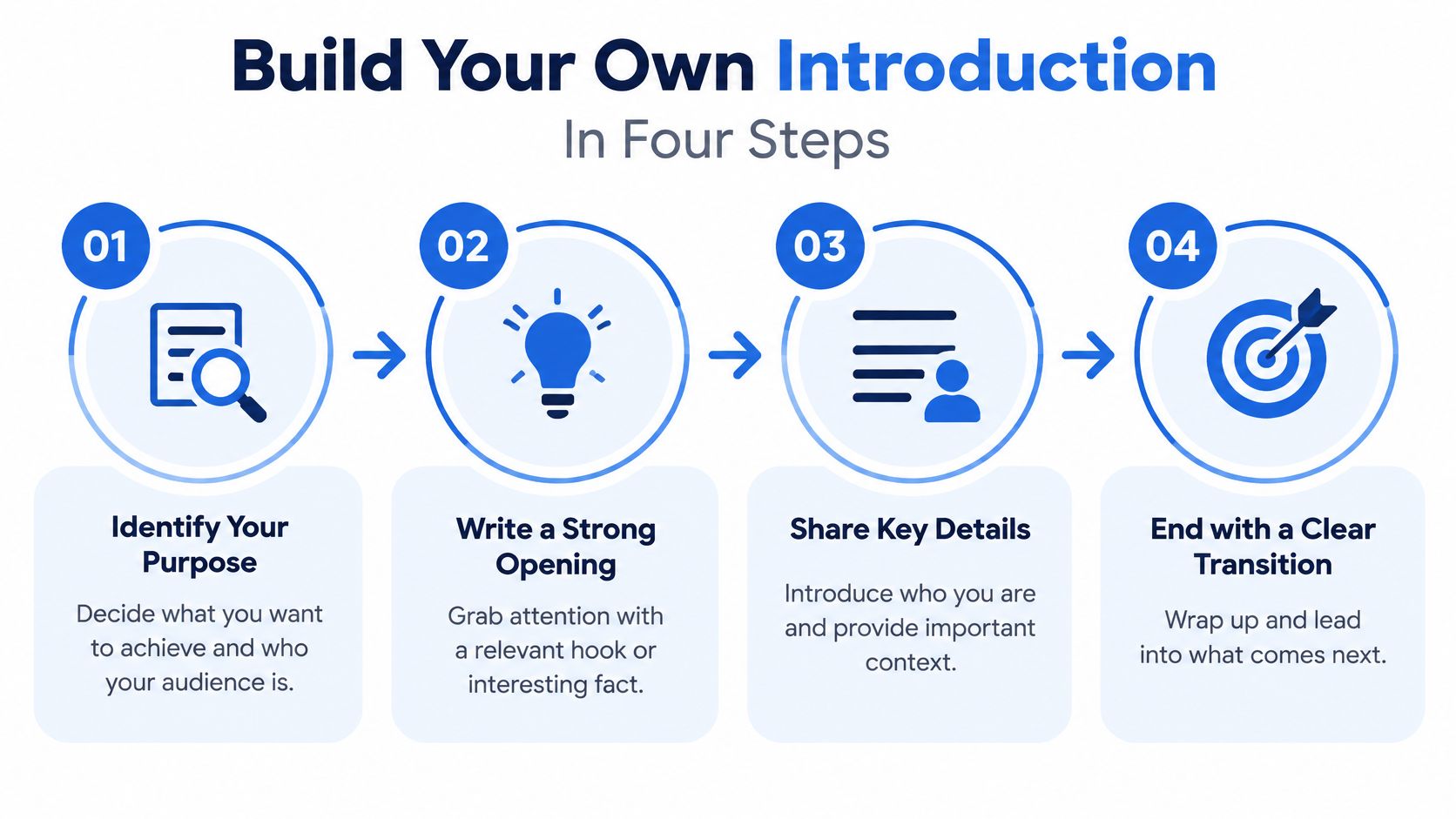
A useful introduction answers a small set of practical questions: Who are you? Why are you here? What should we discuss? Write those answers in spoken English rather than turning your CV into a paragraph.
Draft the words you'll actually say
Write your greeting and full name. Try: Hello, my name is Imane El Fassi, then say it aloud three times so the wording feels familiar. Avoid squeezing your name into a rushed opening that leaves the listener unsure what they heard.
Add a line explaining your situation: I'm studying biology at university, or I've recently joined the finance team. This establishes context; the common slip is adding unrelated achievements before explaining why you're speaking.
Choose a detail that matters to this listener. For a classmate, that might be your learning goal; for a recruiter, it might be a project relevant to the vacancy. Don't use the same middle sentence for a teacher and an employer just because you've memorised it.
End with a short question or invitation, such as What are you working on? or I'm looking forward to learning with you. This gives the other person a next move; once it's written, time the complete draft and remove anything that delays the main point.
Your draft might read: Hello, I'm Imane El Fassi. I'm a biology student, and I'm learning English to explain my research more clearly. What are you studying?
Each sentence has a job. The first identifies you, the next provides relevant context and purpose, and the last opens a conversation.
Check timing without rushing
Toastmasters' speech-writing guidance says speakers have about 30 seconds to capture an audience's attention before listeners may begin to tune out. Treat that as a reason to establish relevance early, not a universal deadline or a reason to speak faster.
Practise a 30-second version and a one-minute version with the same core message. Add a concrete example to the longer version rather than an unrelated personal history. Keep the timing suited to the setting: a brief classroom turn and an interview answer serve different purposes.
Use this final listening test:
- Name: Can someone repeat your name after hearing it?
- Context: Can they explain what you do or why you're there?
- Relevance: Does each detail help this particular conversation?
- Delivery: Can you finish comfortably, with pauses, rather than racing?
If your draft is too long, cut an extra fact before cutting a pause. Clarity matters more than fitting everything in.
Introducing Yourself in Class and Exam Speaking
Classroom introductions are usually short because everyone needs a turn. You don't need an impressive personal story; give classmates something understandable that they can respond to later.
“Hello everyone, my name is Imane. I'm from Fez, and I'm in my second year at university. I want to improve my speaking so I can present my research in English.”
The name comes first, so listeners immediately know who's speaking. Fez and university provide context, while the research goal gives classmates something to ask about.
A classroom introduction that sounds like you
You can replace the last sentence with a hobby if the teacher asks for a personal detail. Try: I enjoy drawing, especially buildings and street scenes. A specific interest creates more conversation than a vague statement such as I like many things.
You also don't need to share private information. Your address, family circumstances, or age can stay out unless they're relevant and you're comfortable discussing them.
- For a teenager: Mention your school year and a subject or activity you enjoy.
- For a university student: Name your field and what interests you about it.
- For an adult learner: Explain what you want to use English for, such as travel or workplace meetings.
Answering an examiner's questions
In a speaking exam, follow the examiner's prompt, not a prepared speech. If they ask only where you live, answer that question rather than launching into your studies, family, and hobbies.
For a practice prompt asking you to talk about yourself, aim for a 30-to-45-second answer such as:
“Good morning. My name is Imane El Fassi, and I live in Fez. I'm studying biology at university. I particularly enjoy practical lessons because I like understanding how things work. Outside university, I enjoy walking and taking photographs around the city. I'm learning English because I'd like to read more about my subject and feel comfortable discussing it with other students.”
The answer uses complete sentences, but each sentence can stand alone. That makes it easier to stop naturally if the examiner asks a follow-up question.
Prepare possible answers about your course, work, and interests. Practise your town and school names inside complete sentences, rather than assuming those familiar words will automatically feel easy in English.
For your next practice attempt, record the answer and listen for pauses and fillers. Rewrite any sentence you couldn't say without stopping, using shorter wording rather than adding more formal vocabulary.
Introducing Yourself in Interviews and Meetings
A professional introduction can be grammatically correct yet leave the listener wondering why your background matters. Your task is to connect your experience to the work you might do together, not announce your qualifications.
A meta-analysis of workplace first impressions, combining 204 independent samples from 145 studies, found that communication cues had the strongest and most consistent relationship with the impressions people formed. That supports practising how you explain your contribution, not just checking the grammar.
Make your experience relevant
The MIT Communication Lab's elevator-pitch guidance recommends identifying yourself, explaining the problem or expertise relevant to your audience, and creating a route to further conversation.
Consider this hypothetical interview opening:
“Good morning, I'm Karim Benali. I'm a customer support lead with three years of experience in online service, and I'm applying for the team coordinator role because I enjoy organising handovers between teams. Could you tell me more about the team's current priorities?”
Karim's experience and interest connect directly to coordination work. For a fuller answer, he could add a truthful example of a handover he organised and explain its outcome, without inventing a performance figure.
The closing question suits a conversational opening. If the recruiter has asked a formal interview question, finish your answer and let them lead rather than immediately interviewing them back.
For more preparation, use Englify's guide to introducing yourself in an English interview. The self-introduction tips from nexus IT group offer another interview-focused resource for preparing a relevant response to “Tell me about yourself.”
Change the middle for the audience
In a meeting, Karim needs to explain responsibility: Good morning, I'm Karim Benali from customer support. My department handles customer questions after purchase, and I'm here to clarify how we'll pass urgent cases to operations.
In a presentation, the topic can come first: Today, I'll explain how we can make customer handovers clearer. I'm Karim Benali, and I lead the customer support team. Please keep a recent handover example in mind for our discussion.
- Avoid credential lists: Explain what a qualification or experience helps you contribute.
- Avoid audience mismatch: A recruiter, colleague, and client need different details from you.
Rewrite the middle line if the listener can't tell why you're speaking after the opening sentences.
Casual Introductions and Small Talk Phrases
You arrive at a friend's birthday gathering and recognise the host, but hardly anyone else. Start with the connection you already share rather than trying to produce a clever opening.
You could say: Hi, I'm Lina. I know Sara from university. How do you know her? When the other guest answers, respond to that information before adding another question.

Useful phrases for different relationships
BBC Learning English's introduction lesson includes these openings and responses:
- To approach someone: “I just wanted to introduce myself. My name is ...”
- When you've crossed paths but haven't properly met: “I don't think we've met formally yet, but my name is ...”
- A neutral reply: “Nice to meet you.”
- A more formal reply: “Pleased to meet you” or “It's a pleasure to meet you.”
The longer opening is useful with a team member you've seen around but never spoken to. At a relaxed birthday gathering, Hi, I'm Lina usually does enough.
Nice to meet you works across many ordinary first meetings. It's a pleasure to meet you feels more formal, so it may suit a professional guest or formal host better than a conversation with a classmate.
Keep the exchange comfortable
Use first names with classmates and friends. With older people or formal hosts in Morocco, the UAE, or abroad, a cautious opening uses the title and surname they've provided until they invite you to be informal.
Don't assume that everyone in a country wants the same level of formality. Follow how the person introduces themselves, and ask what they prefer to be called if you're unsure.
You don't need an interesting speech. You need a small, comfortable exchange that both people can join.
Try a follow-up about the connection: How do you know Sara? Or comment on something you can both see: These photographs are lovely. Do you know where they were taken?
Listen to the answer and respond to it. If the other person mentions university, ask about their course instead of abruptly changing to your prepared question about work.
Handling Nerves, Freezing and Name Mistakes
You say your name, then the next sentence disappears. You still know what you wanted to say, but the words will not come. Pause, take a breath, and restart with a simpler line instead of searching for the exact sentence you prepared.
Settle before the first word
Sit or stand comfortably and breathe before you begin. On a video call, look toward the camera for your name and main point, then look back at the people on screen.
A pause gives you a moment to choose your next words. You do not need to hold eye contact for a set amount of time. Look toward the listener naturally, while respecting the setting and the other person's comfort.
Introduction problems and repair lines
| Problem | Possible reason | Repair move | Line or action to use |
|---|---|---|---|
| Blank mind after your name | You are trying to recall a prepared sentence | Pause, then state your purpose simply | Let me put that more simply. |
| Forgotten word | The word is hard to retrieve under pressure | Describe the idea or choose a simpler word | What I mean is ... |
| Mispronounced name or job title | The listener may not know the pronunciation | Repeat it slowly and clearly | Sorry, it's pronounced ... |
| Rushed first sentence | You started before settling your breath | Pause, breathe, then say the opening more slowly | Take a breath before you begin. |
| Silent or unclear listener | There may be a connection or microphone problem | Check that the listener can hear you | Can you hear me clearly? |
These are possible explanations, not diagnoses. A quiet listener may be waiting for you to continue, or there may be a problem with the connection or microphone.
Recover into conversation
If you forget a job title such as coordinator, explain what you do: “I organise tasks between teams.” A plain description keeps the conversation moving while you search for the exact term.
If your camera is off, give your name and context: “Hi, this is Lina from the finance team.” After your introduction, ask a relevant question, such as “What will you be working on?” A pause is a moment to collect your thoughts; you do not need to apologise for it.
Say Your Name and Key Words Clearly
You may already know how to introduce yourself but still find that listeners miss your name or job title. Work on intelligibility, meaning how easily someone understands you, rather than trying to remove your accent.
Practise the words inside real sentences
Start with your name. Say it slowly, then at normal speed, keeping your natural stress: Ka-rim Be-na-li or I-mane El Fas-si. These breaks are practice aids, not instructions to change how your own name is pronounced.
Check sounds that you personally find difficult. Some Arabic-speaking learners benefit from comparing p and b, practising v in university, th in three years, and the short vowel in live compared with leave; these aren't difficulties every learner shares.
Use complete lines: I'm pleased to meet you. I live in Fez. I have three years of experience in customer support. Complete sentences help you practise the transitions between words.
Record your name followed by your job title. Listen for a swallowed final consonant in support or lead, keeping the ending audible without adding an extra vowel.
If someone mishears your name, correct it calmly: Sorry, it's pronounced ... Then spell it once if needed.
Try a short name drill
Use this as a 60-second practice target: ten slow repetitions of your name, five at conversation speed, then your 20-second classroom script. If your name takes longer, extend the drill rather than rushing.
For additional exercises, use this guide to improving your pronunciation in English. Keep your voice comfortable and your attention on the listener; a clear pause still matters more than a perfect accent.
Practise the Introduction Before You Need It
You have a few minutes before class or an interview. Practise the introduction, then rehearse what you might say when the other person responds. A short routine can help you adjust your words to the setting instead of relying on one script.
Record and review. Practise a 30-second introduction and listen once. Notice pauses or fillers that interrupt your meaning. Keep pauses that help the listener follow you, and simplify any sentence that repeatedly trips you up.
Change the listener. Practise speaking to a classmate, recruiter, new colleague, or guest. Keep your name and basic details, but change the line that explains why you are there.
Answer a follow-up. Ask a partner to choose a question about your studies, current project, or reason for attending. Answer in two sentences: give the main point, then add one useful detail.
Turn practice into useful feedback
If you practise alone, use these ideas for practising English speaking on your own to build a routine between conversations. Save a recording so you can compare how clearly you speak, how well your introduction fits the listener, and how readily you answer a follow-up.
At Englify, live online English classes take place on Google Meet, with small groups, private classes, and written progress reports. A free placement test helps identify your level, and a free trial session lets you experience a class.
To get started, contact Englify on WhatsApp with your level, goal, and country of residence. A trial lesson time is suggested with a teacher. Bring an introduction to practise, then try answering the question that follows.