Knowledge hub
7 IELTS Speaking Practice Questions Resources
Explore 7 IELTS speaking practice questions resources for Parts 1, 2, and 3, with sample answers, topic practice, timing advice, and feedback tips.
The strongest IELTS Speaking practice plan combines an official source for format accuracy, a broad topic resource for repetition, and timed recording or teacher feedback for improvement. Practise the three-part interview, including Part 1 answers of about 4–5 minutes overall, a 1-minute preparation period for Part 2, and 1–2 minutes of speaking on the cue-card topic.
How to Use IELTS Speaking Questions for Real Progress
How many IELTS Speaking questions have you collected without becoming more confident when the timer starts?
Finding questions is easy. Turning them into fluent, coherent answers under pressure is the true skill. Part 1 requires short responses about familiar subjects, Part 2 asks you to prepare and deliver a sustained talk, and Part 3 moves into a deeper discussion connected to the same theme. The official IELTS Speaking format confirms that the section is a face-to-face interview divided into three parts, so practice shouldn't rely on isolated questions or memorized speeches.
This roundup compares seven resources by the job they perform: authentic exam simulation, official guidance, topic expansion, structured support, and high-volume timed drilling. Use a simple cycle with every resource: answer spontaneously, record yourself, review your coherence and language, then repeat under exam-style timing.
IELTS Speaking is assessed through Fluency and Coherence, Lexical Resource, Grammatical Range and Accuracy, and Pronunciation, with each criterion carrying equal weight according to the official assessment criteria. If you want guided correction, Englify provides live online IELTS preparation through Google Meet, with small-group or private classes, a free diagnostic, and actionable progress feedback.
Table of Contents
- 1. IELTS Preparation in Casablanca Online
- 2. IELTS.org Official Sample Speaking Questions
- 3. British Council TakeIELTS Speaking Practice and Mock Tests
- 4. IDP IELTS Speaking Practice Questions and Topics
- 5. IELTS Liz Extensive Speaking Question Lists
- 6. Magoosh IELTS Speaking Topics and Guided Practice
- 7. IELTS Online Tests Large Speaking Practice Library
- IELTS Speaking Practice, 7-Resource Comparison
- Build Your Speaking Routine and Keep It Honest
1. IELTS Preparation in Casablanca Online
Best for realistic practice with personal feedback
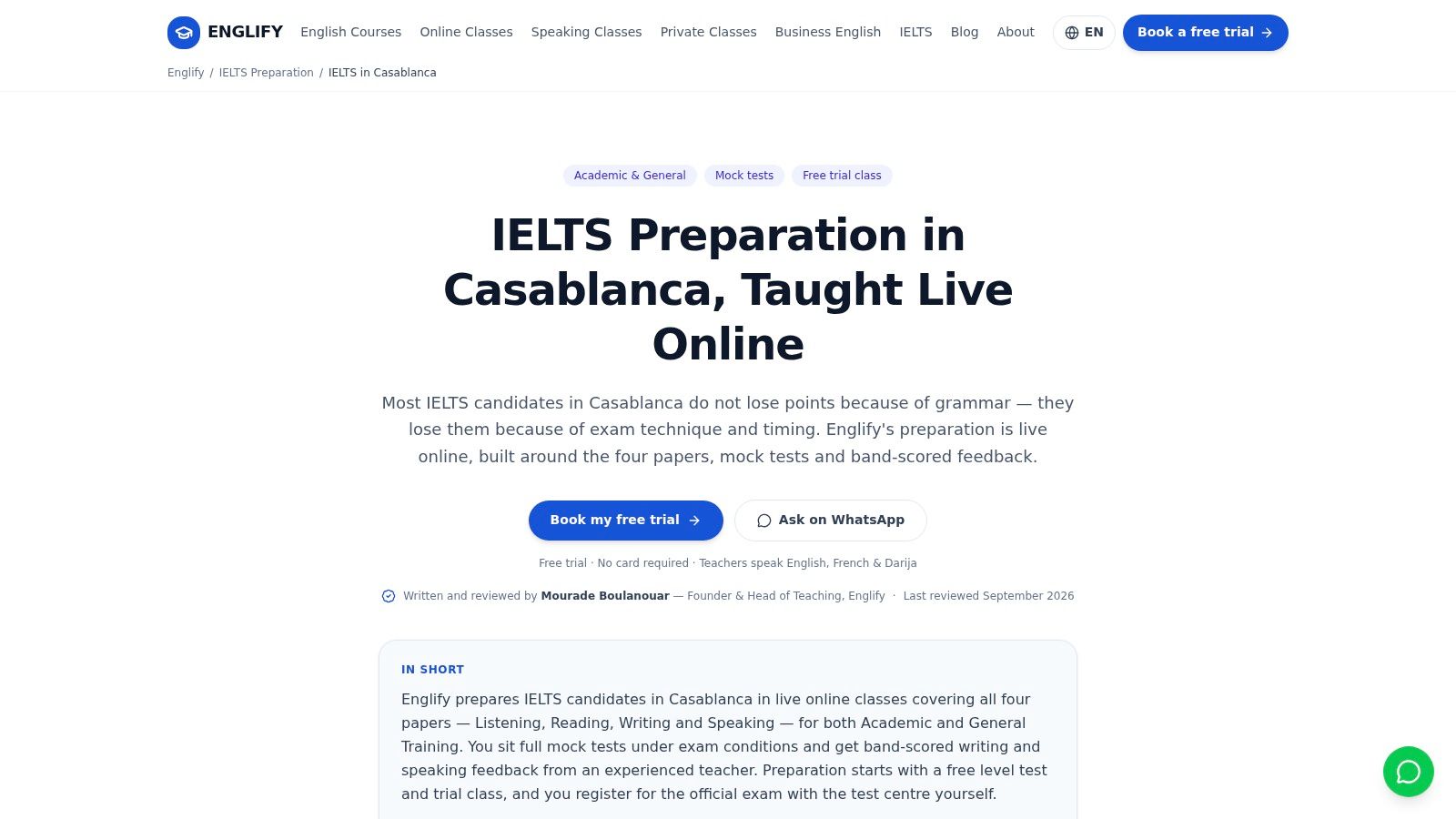
A question bank can show you what the exam may ask. It can't tell you why your answer sounds disconnected, why your pronunciation makes a familiar word unclear, or where you stop developing an idea. Englify's IELTS preparation in Casablanca is designed for learners in Casablanca and across Morocco who need regular, speaking-first preparation rather than another list of prompts.
The course rehearses Speaking Parts 1, 2, and 3 in examiner-style conditions. Learners complete timed and recorded mock tests, then receive band-scored feedback focused on practical areas such as pronunciation, grammar, vocabulary, fluency, and coherence. A free diagnostic helps establish a starting point, while written session reports turn each lesson into a clearer plan for the next practice session.
Classes take place live on Google Meet with TEFL/TESOL-certified tutors. Learners can choose small groups or private lessons, depending on how much individual correction and scheduling flexibility they need. Support in Arabic, French, and Darija can also make it easier for Morocco-based learners to understand feedback and ask precise questions about their speaking habits.
Why this resource fits the feedback stage
This is the strongest option on the list when you already practise questions but don't know what to fix. A teacher can interrupt unhelpful habits, ask a natural follow-up, and show you how to extend an answer without memorizing a model response. Session recordings and written reports also make progress easier to review between classes.
The trade-off is scope. The emphasis is on Speaking, so learners who need equal support for Listening, Reading, and Writing may need separate resources. Live online practice also depends on a reliable device and connection, and group availability may require flexible scheduling.
For a broader course route, explore online IELTS preparation in Morocco. This resource fits learners who want structured accountability, realistic interaction, and corrective feedback, not just more IELTS speaking practice questions.
2. IELTS.org Official Sample Speaking Questions
Best for format accuracy
Start with IELTS.org sample test questions before using large commercial question banks. Official materials help you understand the instructions, task types, and progression through Parts 1, 2, and 3 without having to guess whether a practice format resembles the assessment.
The sample resources include Speaking tasks and cue cards that reflect the official test structure. They also explain what happens in each part and provide printable materials for offline practice. That makes IELTS.org particularly useful for a learner preparing for a first mock test or checking whether a study routine has drifted away from the actual exam.
Use one sample set as a calibration exercise. Ask a partner to read the questions, give yourself the preparation time for Part 2, and record the complete interaction. Don't stop after one attractive question. The value comes from reproducing the movement from familiar personal questions to a longer talk and then a more analytical discussion.
Where it helps and where it stops
The main strength is official format reliability. The limitation is volume. You won't get the same breadth as a large topic library, and the pages don't provide automated scoring or personalized correction.
Pair the official material with online English speaking practice if you need more live interaction. Use IELTS.org to answer the question, then use a teacher or recording review to examine whether your response was connected, sufficiently developed, grammatically controlled, and easy to understand.
3. British Council TakeIELTS Speaking Practice and Mock Tests
Best for first-time test takers
The British Council TakeIELTS Speaking practice pages provide a dependable starting point for learners who aren't yet comfortable with the interview format. The pages cover Academic and General Training preparation, explain what to expect in each part, and offer free Speaking practice and mock-test guidance.
This resource is useful when your main problem is uncertainty. You can learn how the examiner moves through the interview, what Part 2 requires, and how Part 3 develops from the earlier topic. The British Council teacher guide also confirms that Speaking is conducted face-to-face with a trained examiner and digitally recorded, which supports practising aloud rather than completing written exercises alone.
A sensible way to use the pages
Read the guidance once, then close it. Ask a partner to act as the examiner, or record yourself asking and answering the prompts. Keep your attention on delivery:
- Fluency: Notice long pauses, repeated fillers, and unfinished sentences.
- Coherence: Check whether each answer has a clear beginning, development, and ending.
- Language: Mark useful vocabulary and grammar that you can reuse flexibly.
- Pronunciation: Listen for sounds, word stress, and endings that make meaning less clear.
The core materials are free, but the practice sets are relatively fixed rather than an expansive searchable database. Additional resources may depend on booking a test with the British Council. Choose this option when you need trustworthy orientation, then move to a broader bank once you can complete the format comfortably.
4. IDP IELTS Speaking Practice Questions and Topics
Best for official guidance plus strategy
IDP IELTS Speaking practice materials combine sample questions, topic prompts, and explanations of timing and examiner interaction. As an IELTS co-owner, IDP is a useful place to check the structure before trusting a topic list found elsewhere.
The pages cover Parts 1, 2, and 3, including cue-card-style practice and articles that connect prompts with preparation advice. That combination matters because a question is only useful if you know what kind of response it demands. A Part 1 question about your hometown shouldn't receive the same treatment as a Part 3 question about how cities should develop.
Try turning one IDP topic into three versions of practice. First, answer the personal question directly. Next, speak about a related experience in a sustained way. Finally, discuss the wider social issue and support your view with a reason and an example. This trains flexibility instead of teaching you to wait for an exact memorized topic.
The trade-off
IDP offers a good balance between official explanations and practical prompts, but it isn't a large searchable database. The depth can also vary between country pages and individual articles. Use it as a reliable bridge between understanding the test and practising broader topic groups.
The IELTS Speaking band descriptors are a useful companion when reviewing your recording. They emphasize average performance across all parts, so don't judge yourself only by your best Part 2 answer. A strong practice session includes short answers, a long turn, and discussion responses.
5. IELTS Liz Extensive Speaking Question Lists
Best for topic expansion
Need more practice with familiar subjects without collecting questions from several websites? Ielts Liz Speaking Part 1 topics gathers Part 1 questions, Part 2 cue cards, Part 3 discussion prompts, full mock tests, model answers, and video explanations in one place.
Its main practice job is topic expansion. You can move through family, work, studies, travel, technology, food, hobbies, and daily routines, building vocabulary for ordinary conversations. For Arabic-speaking learners, that range can support flexible language instead of encouraging advanced words that sound unnatural in a personal response.
Use the site as a question bank, then turn each prompt into a three-stage speaking routine:
- Part 1: Answer directly, add one detail, and connect the response to your own experience.
- Part 2: Take the same theme and develop it as a short story. Cover who, what, when, and why in a clear order.
- Part 3: Broaden the idea. State an opinion, explain the reason, and add an example or consequence.
Set a timer for each stage and record yourself. Check whether you answered the question promptly, kept the long turn moving, and reached a clear conclusion in the discussion. Linking words such as “because,” “for example,” and “as a result” can show how ideas relate, but they should support the message rather than replace it.
Model answers show an answer shape, not a script. For “Describe a useful device,” try a phone used for university work, a device used in a workplace, and a simple item from home. Keep the structure while changing the details and language.
Practical rule: Borrow the answer shape, not the answer itself.
IELTS Liz is not an official IELTS publisher, so treat its questions as representative practice, not guaranteed past papers. It also lacks automated feedback and analytics. Pair it with self-recording, peer review, or a teacher who can check whether your expanded answer stays relevant.
6. Magoosh IELTS Speaking Topics and Guided Practice
Best for learners who want explanation with practice
Can you answer Part 1 questions but freeze during the one-minute Part 2 planning period? Magoosh addresses that preparation gap by combining topic lists with explanations, sample questions, strategy guidance, and downloadable PDFs. Its main practice job is to show how an answer can become longer, clearer, and more relevant to the prompt.
Use the free materials as a planning workbook. Choose a topic, write keywords, and speak from those prompts instead of drafting a complete script. The paid course offers structured lessons and a guided Speaking workflow, which may suit learners who need a defined practice path.
Part 2 works like a route with checkpoints. The format gives you one minute to prepare and one to two minutes to speak, according to the IELTS General Training Speaking format. During preparation, choose a real example, note the main keywords, and decide why the experience matters. Full sentences encourage memorization. Keywords leave room for natural speech.
Build an answer from a cue card
Use this question:
Describe a skill you would like to learn.
Possible notes:
- skill, public speaking
- university presentations
- current difficulty, nervousness
- reason, confidence and work opportunities
Turn the notes into a sequence. Name the skill, describe your current situation, explain the difficulty, and finish with its value. If the answer ends too quickly, add a specific example, comparison, or likely future use. This method creates a repeatable shape without forcing the same wording each time.
Magoosh IELTS resources work best for topic expansion and guided practice. The blog and PDFs support independent study, while structured practice and analytics belong to the paid course. Magoosh is not an official IELTS publisher, so verify format details with IELTS.org, IDP, or the British Council.
7. IELTS Online Tests Large Speaking Practice Library
Best for high-volume timed drilling
Need repeated practice under realistic time pressure? IELTS Online Tests Speaking practice tests provides a large collection of Speaking sets arranged by date and cycle. Each set follows the examiner-style order of Parts 1, 2, and 3, so it is useful once you already know the test format and want to build faster responses.
Use the library as a timed circuit:
- Part 1: answer directly, then add a reason or brief example.
- Part 2: use the preparation minute to write keywords, then develop the topic in a clear sequence.
- Part 3: state an opinion, explain why, and support it with an example or consequence.
Keep an eye on the clock at each stage. If Part 1 answers become one-word replies, add a reason. If Part 2 stops early, extend one idea with a personal example, comparison, or future use. In Part 3, linking words such as “because,” “for example,” and “as a result” can make relationships between ideas easier to follow.
A recording turns each test into evidence for review. After listening, choose one correction in each area:
- Fluency and coherence: Did ideas connect, or did the answer sound like separate sentences?
- Lexical resource: Did you repeat basic words?
- Grammar: Did you try varied structures accurately?
- Pronunciation: Was every important word understandable?
High volume alone can create a false sense of progress. Repeating one test after correcting a specific weakness teaches more than leaving many recordings unreviewed. Use this IELTS preparation guide for broader study principles.
IELTS Online Tests is not an official IELTS source. Set quality may vary, and feedback or scoring tools are limited unless paid additions are used. It works best as the repetition layer in a wider plan.
IELTS Speaking Practice, 7-Resource Comparison
| Item | Implementation complexity 🔄 | Resource requirements ⚡ | Expected outcomes ⭐📊 | Ideal use cases 💡 | Key advantages |
|---|---|---|---|---|---|
| IELTS Preparation in Casablanca, Online | Medium–High, live lessons, scheduling, tutor coordination | Reliable internet & device; paid course (free diagnostic); small-group or 1:1 sessions | ⭐⭐⭐⭐, Measurable Speaking band gains, written reports and actionable next steps | Students in Morocco needing realistic examiner-style Speaking practice and personalised feedback | Examiner-style mocks, TEFL/TESOL tutors, local language support, band-scored feedback |
| IELTS.org – Official IELTS sample Speaking questions | Low, self-study materials, straightforward to use | Minimal, internet access; printable PDFs; free | ⭐⭐⭐, Exact exam format familiarity; limited volume, no feedback | Learners who want authoritative examples of test format and timing | Official, exam-accurate questions and downloadable sample pack |
| British Council – TakeIELTS Speaking practice | Low, self-guided practice pages and mock tests | Minimal, free online pages; some extras need test booking | ⭐⭐⭐, Trusted guidance; good for first-time test-takers; core materials free | Beginners needing clear step-by-step test-day guidance and sample mocks | Official co-owner content, up-to-date guidance, free core resources |
| IDP IELTS – Speaking practice and topics | Low, simple self-study with curated articles | Minimal, free web pages and articles | ⭐⭐⭐, Reliable sample prompts with strategy tips; variable depth by page | Learners seeking current topic banks plus examiner interaction rules | Direct co-owner content, balanced samples and strategy tips |
| IELTS Liz – Extensive free question lists | Low, self-study, topic-organised practice | Minimal, free website resources, transcripts, videos | ⭐⭐⭐⭐, Broad topic coverage and model answers; no automated feedback | Candidate-driven topic-focused practice and exam strategy review | Large organised question lists, transcripts, video walkthroughs |
| Magoosh IELTS – Topics, PDFs, paid practice | Medium, mix of free materials and structured paid course | Free PDFs/blog; paid subscription for guided practice | ⭐⭐⭐, Good strategies and guided workflow if paid; offline resources available | Learners who want structured lessons and paid analytics/guidance | Clear strategies, downloadable PDFs, paid structured lessons |
| IELTS Online Tests – Large bank of practice tests | Low, self-directed timed drills, high-volume selection | Minimal, free core library; optional paid add-ons for features | ⭐⭐⭐⭐, High-volume timed practice for fluency and stamina; variable quality | Learners needing frequent timed rehearsal and fresh test cycles | Very large, regularly updated test pool ideal for repeated drilling |
Build Your Speaking Routine and Keep It Honest
The best resource isn't always the one with the most questions. It depends on the practice job you need to complete.
Use IELTS.org, the British Council, or IDP when you need format accuracy and official explanations. Use IELTS Liz, Magoosh, or IELTS Online Tests when you need topic variety and repeated exposure. Use Englify when you need a live examiner-style exchange, recorded speaking practice, personalized correction, and written feedback that turns a weak answer into a specific improvement target.
A reliable weekly routine can combine all three layers. Begin with an official prompt so the task is authentic. Choose a related question from a broader bank for repetition. Then record your response or practise with a teacher who can challenge you with a natural follow-up.
For Part 1, keep each answer around 20–30 seconds. Give a direct response, add a reason or detail, and stop before the answer becomes a speech. For Part 2, plan in exactly 60 seconds, using keywords rather than full sentences, then speak for 1–2 minutes while covering the topic naturally. For Part 3, use a clear coherence pattern: state your answer directly, give one reason, and add one example or consequence.
Review recordings with a narrow focus. On the first listen, mark pauses and unclear connections. On the second, identify repeated vocabulary and grammar errors. On the third, repeat the same answer with one improvement, while keeping the ideas natural rather than memorized.
Remember that the Speaking test is the same for Academic and General Training, and the assessment covers all four criteria across the full interview. A confident Part 2 response can't compensate for consistently weak pronunciation, limited vocabulary, or underdeveloped Part 3 answers.
Pick one resource from this list and schedule three timed sessions this week. After each session, write one thing to keep and one thing to improve. Learners in Morocco who want guided practice and personalized feedback can book a free trial with Englify through the placement and trial flow on englifyacademy.online.
Englify offers live online IELTS Speaking preparation through Google Meet, with small-group and private classes, recorded practice, teacher feedback, and a free placement test. Visit Englify to choose a practical next step and start turning IELTS Speaking practice questions into clearer, more confident answers.