Knowledge hub
Private English Classes for Adults Explained
Private English classes for adults: formats, CEFR hour ranges, Morocco rates from 100 MAD per hour, a sample lesson, and a free trial.

If you already understand English emails, why can a simple question in a meeting leave you searching for words? Knowing English and producing it under time pressure aren't the same skill. Private English classes for adults should connect the two through realistic speaking tasks, selective feedback, and visible progress.
Table of Contents
- What Private English Classes for Adults Include
- Why Adults Freeze Despite Knowing the Rules
- How Many Hours Move One CEFR Level
- How a Sixty-Minute Adult Lesson Runs
- Online or In Person and What It Costs
- Frequently Asked Questions About Private Adult English Lessons
- How to Choose and Start a Private English Provider
What Private English Classes for Adults Include
Private English classes for adults are live one-to-one lessons shaped around one learner's level, goal, and timetable, rather than a shared syllabus. The teacher can adjust the material, pace, and correction to what that person needs to do outside class.
Say a professional in Casablanca reads a supplier's email comfortably but stalls when asked to explain a delivery problem on a call. Another grammar worksheet might help with sentence accuracy, but the immediate need is to explain the problem aloud, answer follow-up questions, and check that the listener understood.
A private course can make that situation the centre of the lesson. The advantage isn't having a teacher to yourself. It's having more opportunities to attempt the exact communication that currently feels difficult.
Private lessons, small groups and self-study
| Format | Best when | Speaking time | Feedback |
|---|---|---|---|
| Private one-to-one | Goal, pace or timetable is personal | Nearly the full hour can centre on your speaking turns | Immediate and selective, then a required repair |
| Small group, up to 6 | Peer practice matters and cost should stay lower | Turns are shared | Some personal correction, less repetition |
| Self-study between classes | Vocabulary or listening needs extra exposure | Little live pressure | Delayed or automated, not a conversation |
These formats serve different purposes. A small group offers practice with different speakers and viewpoints, while private instruction allows repeated attempts without waiting for classmates. Self-study is useful preparation, but it doesn't reproduce an unpredictable conversation.
For one academy option, Englify offers private online classes through Google Meet, with personalized content across its A0–C1 course range after a free placement check. Its small-group option has a maximum of six learners.
Name the task before choosing the course
A useful private plan should name something you want to accomplish, such as:
- A project update: Deliver a five-minute explanation of progress, problems, and next steps.
- An interview answer: Respond clearly to a common question about your experience.
- A travel exchange: Resolve a misunderstanding and ask for clarification instead of abandoning the conversation.
Cambridge English's guidance on adult speaking treats speaking as more than accurate sentences, including vocabulary, functional language, and fluency. That's why a plan should connect language practice to an adult task.
Practical rule: Choose the format that gives you the practice you need before comparing its price.
One-to-one teaching can still waste time on long explanations. You're choosing a learning design, not just a private video call.
Why Adults Freeze Despite Knowing the Rules
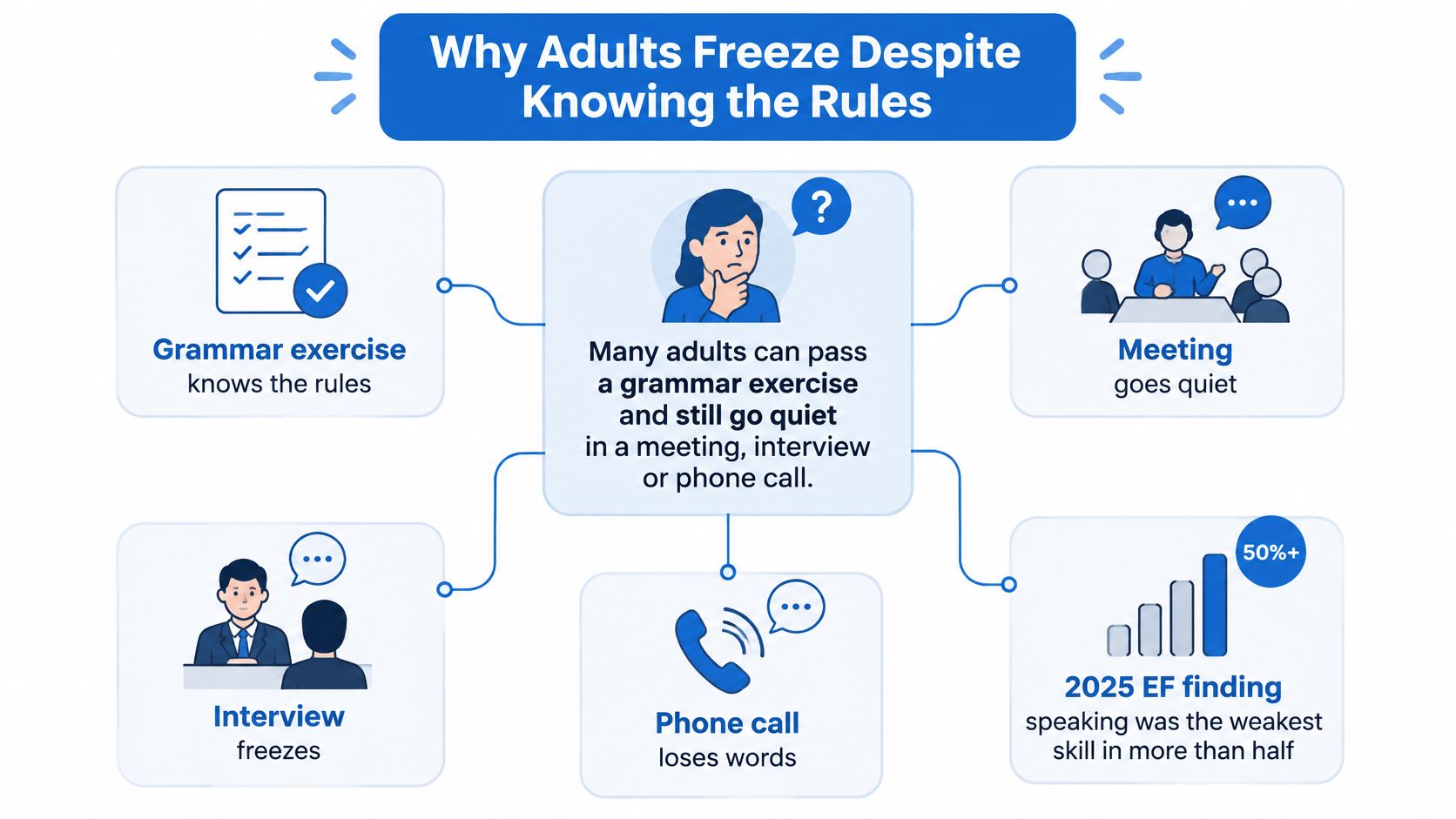
Many adults can complete a grammar exercise and still go quiet in a meeting, interview, or phone call. Recognizing a correct answer gives you time and clues. Conversation asks you to understand, choose words, pronounce them, and respond while someone is waiting.
The 2025 EF English Proficiency Index analyzed 2.2 million adults across 123 countries and found speaking was the weakest skill in more than half of the countries measured. That finding challenges the assumption that general English knowledge automatically produces confident speech.
Separate knowledge from performance
For a Moroccan university student, the gap might appear during an internship interview. They understand the question about a group project but can't organize an answer quickly enough, even though they could write it afterwards.
A useful assessment separates the parts of speaking rather than calling everything a fluency problem:
- Knowledge: Do you know the word, structure, or expression you need?
- Retrieval speed: Can you find it while the conversation is moving?
- Pronunciation intelligibility: Can the listener understand your message without repeatedly guessing?
- Listening under pressure: Can you catch the question while preparing your reply?
- Turn-taking: Can you enter the discussion, hold your turn, and ask for clarification?
- Confidence: Will you attempt an imperfect sentence rather than remain silent?
These aren't interchangeable. A learner with a vocabulary gap needs language input. A learner who already knows the words may need practice accessing them without reading a prepared script.
What freezing looks like in a meeting
Consider a professional who knows past-tense rules but can't explain a project delay in four sentences. They begin, stop to check a verb, translate the next idea mentally, and lose track of the question.
The teacher needs to identify where the difficulty occurs. Is the learner missing the phrase for a supplier delay? Are they trying to construct an unnecessarily complicated sentence? Or can they explain the problem when speaking alone but not when someone interrupts?
The answer changes the lesson. More explanation isn't always the right response, and one-to-one instruction isn't automatically speaking-focused.
Practical ways to improve English speaking should help you practise producing a message, not merely recognize correct language. Pronunciation work should support understanding, not pressure you to sound native.
If most lesson minutes go to worksheets, you aren't getting much practice handling the moment when another person expects an answer.
How Many Hours Move One CEFR Level
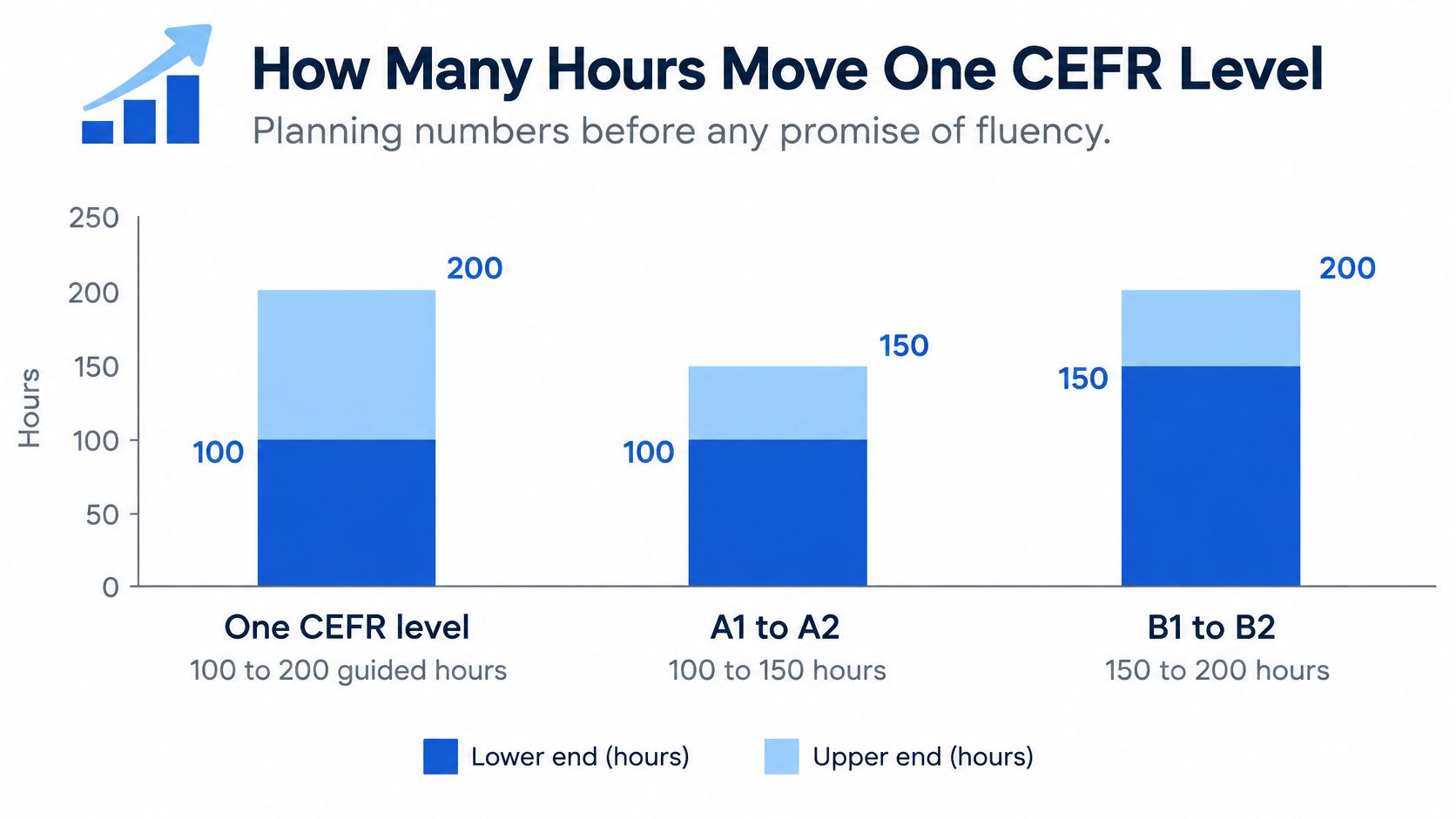
Plan around guided learning hours before accepting a promise about fluency. Cambridge English's guided-learning guidance estimates about 100–200 guided hours for a motivated adult to advance a CEFR level, with indicative ranges of 100–150 hours from A1 to A2 and 180–260 hours from B1 to B2.
Guided learning includes live lessons and structured work directed by the teacher. It isn't just the time you spend connected to a call, and it shouldn't include unrelated background exposure counted as if it were focused study.
Guided hours versus a 12-week private term
The following planning example assumes three sixty-minute lessons each week. Over twelve weeks, that produces thirty-six live hours, before assigned practice.
| Move | Guided hours | What 36 live hours can do |
|---|---|---|
| A1 to A2 | 100–150 | Survival tasks and clearer repair, not a full level |
| Typical one CEFR level | About 100–200 | A baseline plus one or two observable speaking outcomes |
| B1 to B2 | 180–260 | Stronger control of work tasks, not a complete B2 |
| Three 60-minute lessons for 12 weeks | 36 live hours | A progress cycle if homework adds guided exposure |
The hour ranges are planning estimates, not individual guarantees. Cambridge identifies prior language-learning experience, study intensity, age, and exposure outside lessons as factors that affect the timeline.
Set outcomes smaller than a whole level
A placement assessment should establish what you can currently do, not just produce a label. The Council of Europe's CEFR descriptors distinguish activities such as reception, production, interaction, and mediation, allowing a teacher to choose a specific communication target.
For example, a learner might work toward sustaining a workplace conversation and giving a short explanation without reading. At the review, the teacher should reassess speaking, listening, vocabulary, grammar, and pronunciation using comparable tasks.
Keep the conditions visible. An explanation delivered from memorized notes isn't the same performance as an explanation followed by an unexpected question.
For Arabic-speaking adults, assessment may identify particular vowel or consonant contrasts that affect intelligibility. Others may need more help moving from accurate written sentences to quick interaction. Don't assume every Arabic-speaking learner has the same difficulty.
Add purposeful work between sessions
If the deadline is close, ask for more directed exposure rather than expecting the live lesson to do everything. Useful assignments include:
- Speaking recordings: Explain a work problem without reading, then review a recurring difficulty.
- Spaced vocabulary retrieval: Recall useful phrases from prompts rather than repeatedly rereading a list.
- Goal-specific listening: Listen to a relevant exchange and prepare an appropriate spoken response.
For an intermediate target, the guide to hours needed to move from A2 to B1 can help frame the planning conversation.
Buy a term to measure improvement on a task, not to purchase a level.
How a Sixty-Minute Adult Lesson Runs
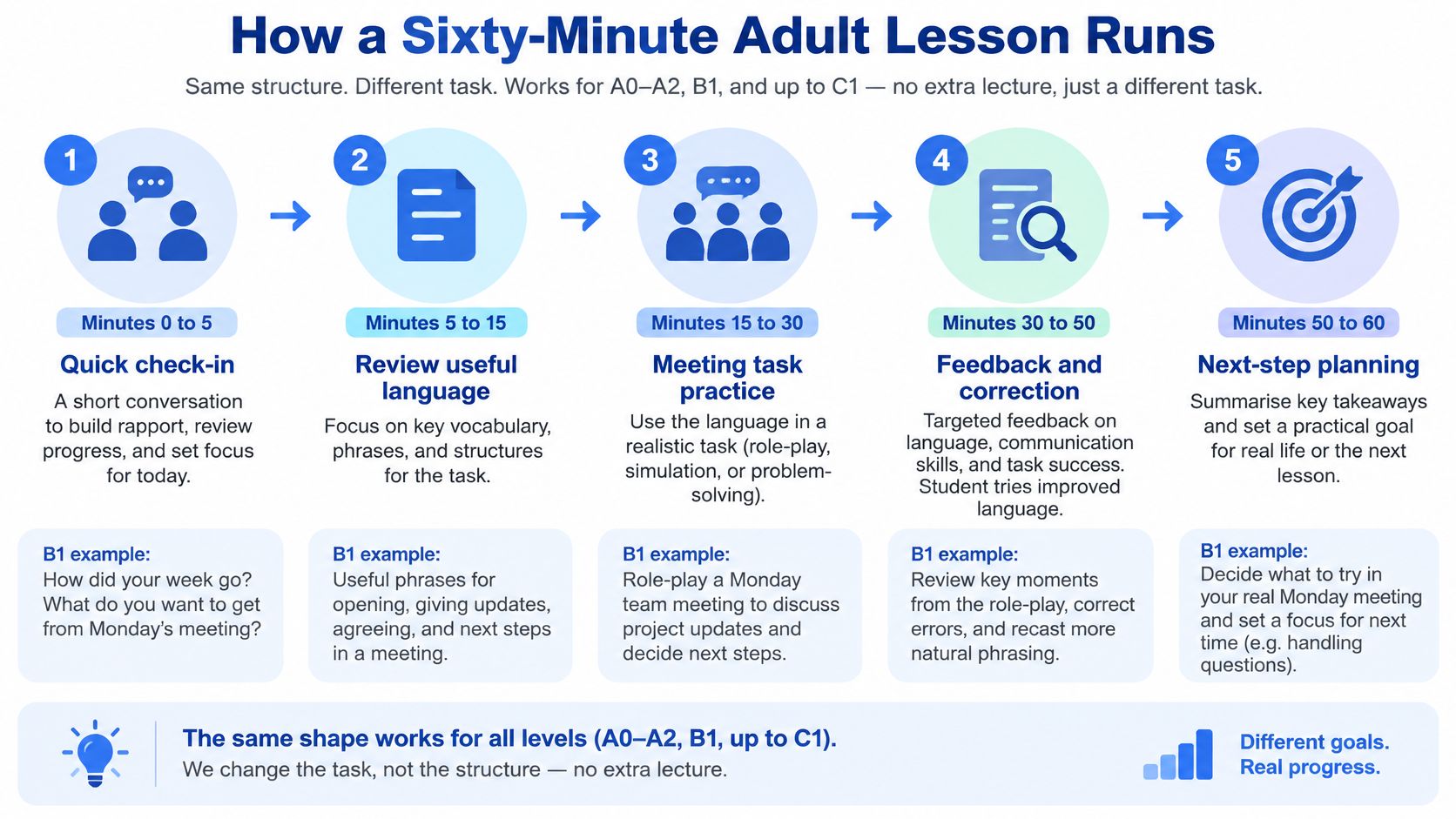
A useful private lesson gives the learner a reason to speak, enough language to attempt the task, and another opportunity after feedback. Consider this sample lesson for a B1 professional preparing for a Monday meeting.
The same shape can scale down for A0–A2 learners or up toward C1. Change the difficulty of the task and the support available, rather than filling the lesson with a longer lecture.
A sample meeting lesson
Minutes 0 to 5, enter the situation. Give a two-sentence status update about the project. The teacher listens for the starting point without turning the warm-up into a grammar explanation.
Minutes 5 to 15, prepare useful language. Practise a small set of expressions for sequencing events, softening a suggestion, or checking understanding. Each expression should serve the meeting task.
Minutes 15 to 35, attempt the main exchange. Role-play the meeting under light time pressure. The teacher asks follow-up questions so the learner must respond rather than recite a script.
Minutes 35 to 45, correct selectively. Review recurring errors that block understanding or weaken the task. The learner repairs the original sentence and then uses the corrected form in a new sentence.
Minutes 45 to 55, try again. Repeat the task with a changed detail or question. This shows whether the learner can use the correction while communicating.
Minutes 55 to 60, assign the next practice. Set a short recording or retrieval task. Add a learner-report note explaining what improved and what needs attention next time.
Why correction needs a response
A review of oral corrective feedback in second-language classrooms identifies feedback as an important part of instructed language development, while noting that effectiveness differs by linguistic target, learner age, and feedback type.
The practical implication is selective correction followed by repair. Hearing the teacher say the correct version isn't the same as producing it yourself.
For example, if a learner describes a completed event using an unclear verb form, the teacher can prompt a correction while the meaning is still fresh. Then the learner explains another completed event using the same form.
Not every mistake needs an interruption. During an extended answer, the teacher can note non-urgent errors and address them immediately after the attempt, preserving the learner's train of thought.
Track fewer repeated errors, successful self-correction, intelligibility, and task completion. Google Meet session recordings and learner reports can make those changes visible without treating the amount of grammar explained as evidence of progress.
Online or In Person and What It Costs
Englify's private classes run live on Google Meet, so for these lessons there is no classroom to reach. The location question only appears when you compare this format with an in-person course from another provider, and that comparison is still worth making carefully, because a classroom option only works if you can reach it every week.
If you are weighing an in-person course in Casablanca, Rabat, or Marrakech, check the actual journey at your proposed lesson time. Don't assess the schedule using only the teaching hour. Include leaving work, transport, and getting home, since a sixty-minute lesson can absorb far more of the evening once travel is counted.
Compare the practical conditions
| Consideration | Live online lesson | In-person course |
|---|---|---|
| Travel | Join from home or the office | Requires transport or walking time |
| Speaking environment | Needs a quiet space and reliable connection | Offers a shared physical setting |
| Schedule | Fits around work or university hours | Must also fit the journey |
| Main risk | Treating an accessible call as optional | Skipping sessions when the trip feels unmanageable |
Live Google Meet lessons can fit morning or evening routines, subject to available slots. For adults living abroad, agree on the time in both locations rather than assuming everyone means Morocco time.
Weekly private frequency, 12-week hours and cost
The academy's published private rate starts at 100 MAD per hour, as explained in its guide to private English class costs in Morocco. The calculations below are illustrative starting-rate budgets, not package quotations.
| Weekly pattern | Live hours in 12 weeks | Fits |
|---|---|---|
| 1 x 60 minutes | 12 | Maintenance or a very tight budget |
| 2 x 60 minutes | 24 | Busy professionals who still need steady speaking |
| 3 x 60 minutes | 36 | A progress cycle with homework, not a full CEFR jump |
Using that starting rate, the sample weekly budgets are 100 MAD, 200 MAD, or 300 MAD. Across the example term, the corresponding live-lesson totals are 1,200 MAD, 2,400 MAD, or 3,600 MAD. The academy's standard term runs three months with three sessions per week, so the 36-hour row matches its regular course rhythm. Confirm the actual quotation, inclusions, and payment terms before enrolling.
A lower-frequency plan still needs purposeful between-class work. Twelve hours across a term works like two gym sessions a month: it keeps a habit alive but rarely builds new strength. If interview preparation is urgent, a maintenance schedule may not offer enough opportunities to rehearse and respond to feedback.
Choose a routine you can protect during a difficult working week, not just during an unusually quiet one.
Ask about rescheduling before paying. Flexibility should help you preserve attendance, rather than create an assumption that missed sessions can always be replaced without limits.
A placement conversation should also identify confidence barriers, so a learner who feels embarrassed speaking starts with a manageable task before committing to a schedule.
Frequently Asked Questions About Private Adult English Lessons
What do I need for an online lesson?
Private classes run live on Google Meet, so prepare a device with a microphone, a camera, and a stable internet connection. Headphones can help you hear pronunciation clearly and reduce background noise, especially if you're joining from a shared home.
Test your setup before class and choose somewhere you can speak aloud. A reliable connection isn't enough if you feel unable to answer freely because colleagues or family members are listening.
Can a complete beginner start with private lessons?
Yes. The academy's A0–C1 course range includes complete beginners, and the free placement test identifies the starting point before you buy a term.
A beginner lesson should use manageable instructions, visual support, and useful everyday exchanges. You don't need to arrive ready for an unsupported conversation.
Are lessons recorded, and can I review them?
Session recordings and learner reports are available. Ask during the trial how recordings are shared, how long they're kept, and what consent arrangements apply.
For review, focus on the task you attempted and the correction you practised. You don't have to rewatch every minute to make the recording useful.
Do I need to prepare before the first lesson?
You don't need to study grammar or complete an extra test independently before the first lesson. Bring a real task, such as a job description, meeting agenda, interview question, or travel situation, so the teacher can understand what matters to you.
Remove confidential information from workplace documents before sharing them. If you don't have a document, explain the situation and describe what currently feels difficult.
How to Choose and Start a Private English Provider
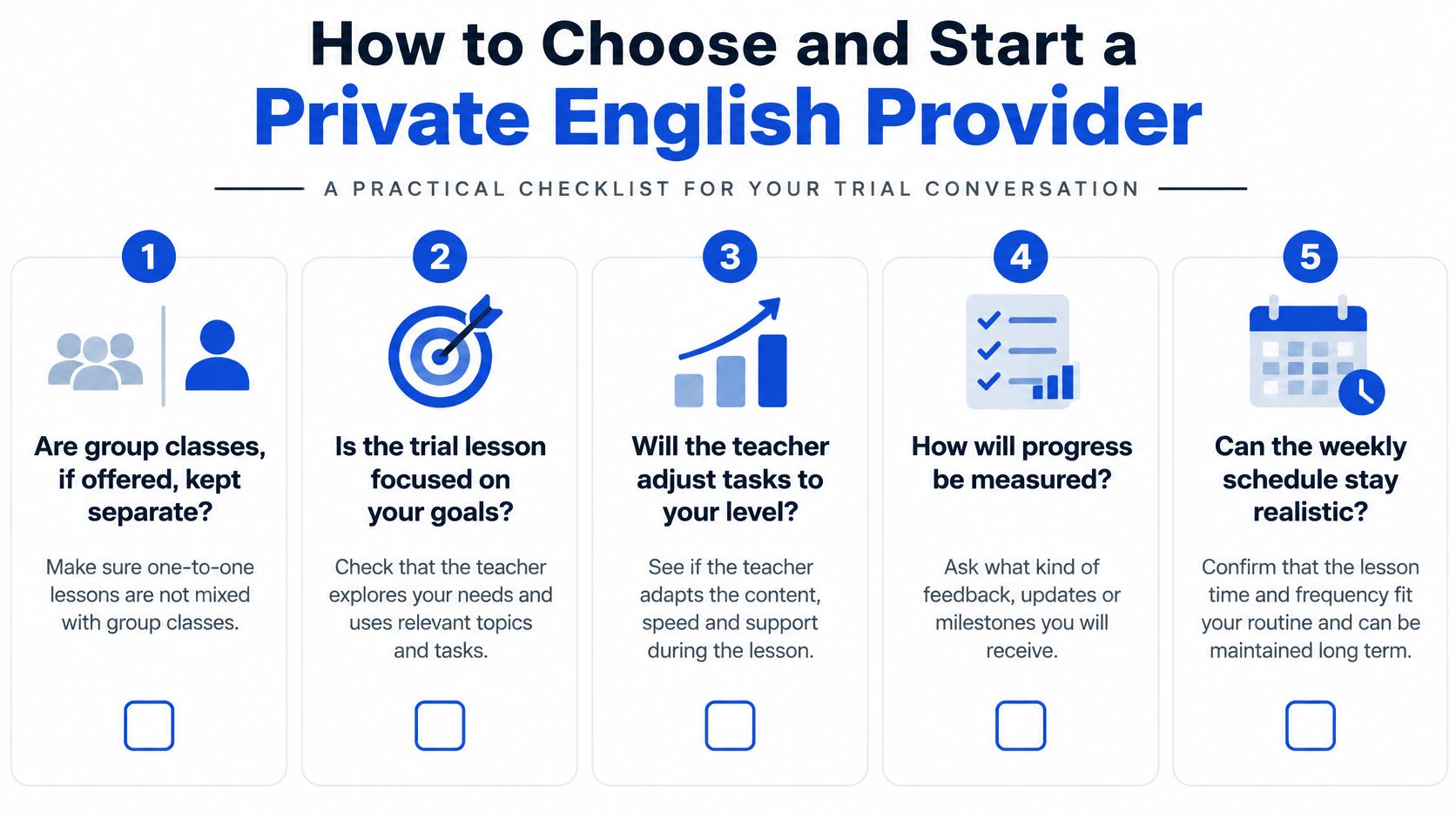
Once you've chosen one-to-one lessons and a manageable frequency, use the trial to evaluate the teaching. A friendly conversation is useful, but it doesn't tell you enough about how the course will address your difficulty.
Ask questions that require the provider to show its process. You're looking for a plan you understand and a routine you can sustain, not an impressive list of teaching terms.
Questions to ask during the trial
- Adult learning environment: If you also offer groups, are adults taught separately from children and teenagers?
- Placement: Do your courses cover A0–C1, and can you explain my starting point through things I can do rather than a single score?
- Speaking practice: Will I use role-play, timed answers, and another attempt after correction?
- Error selection: How do you choose which mistakes to correct, particularly when understanding or my work goal is affected?
- Written feedback: Will I receive a report after each class showing strengths, recurring problems, and next steps?
- Review access: Can sessions be recorded, and what are the sharing, consent, and retention arrangements?
- Teacher preparation: What TEFL or TESOL preparation and online teaching experience does the teacher have?
- Continuity: Will I normally work with the same teacher, and what happens if that teacher is unavailable?
- Attendance rules: What notice is required to reschedule, and what happens to a missed lesson?
Check that the content matches your purpose
For IELTS preparation, ask for task practice and awareness of scoring criteria, not a promised band. The teacher should explain which part of your performance needs attention and how practice will address it.
For work, bring situations that resemble your actual responsibilities. A university graduate applying for an international role may need interviews; an experienced professional may need presentations, meetings, or spoken follow-up to emails.
Ask how the teacher will adapt the task if it's too easy or too difficult. Personalized teaching should involve adjustments to language, preparation time, and conversational demands, not merely adding your job title to a worksheet.
Make sustainability part of the decision
Adults sometimes interpret hesitation about lessons as a lack of motivation when the actual issue is cost, embarrassment, or an unrealistic schedule. The Learning and Work Institute's adult participation survey found that 82% of UK adults who hadn't participated in learning during the previous three years reported at least one barrier. That isn't an estimate for Moroccan English learners, but it's a useful reminder to discuss obstacles openly.
Tell the provider if you work shifts, care for family members, or worry about making mistakes. Ask for a minimum routine that remains workable when those responsibilities become demanding.
Book the free placement test and free trial session before paying for a term. Bring your real task and ask the academy to confirm the proposed weekly slot in Morocco time.
If the suggested workload is too demanding, reduce the live frequency and agree on a short recording assignment between lessons. If the trial consists mostly of explanation, ask to see a speaking-focused task before committing.
Finish with a concrete agreement: a fixed weekly slot, a named speaking task, and a twelve-week review date. You should leave knowing what you'll practise, how feedback will work, and what evidence you'll review.
Englify offers live private English classes through Google Meet, with personalized content, a free placement test, and a free trial session. Visit Englify with a real speaking task in mind, and ask for a sustainable weekly plan and a clear progress-review date.