Knowledge hub
Adult English Classes Near Me: How to Choose in 2026
Find adult English classes near me in Morocco. Compare group, private and online options, check CEFR levels and ask the right questions before you enroll.

You've opened several course listings, checked the distance from home, and found a timetable that almost fits. But you still don't know whether you'll speak English in class or spend the evening listening to someone explain grammar.
Searching for adult English classes near me should be a fit test, not just a map search. Choose a course that gives you regular speaking practice, useful correction, and a schedule you can maintain when work and family get busy.
Table of Contents
- Where to Search for Adult English Classes Near You
- Choosing the Right Format
- Matching Your Level With the CEFR Scale
- How to Test Speaking Before You Commit
- How Many Hours You Really Need and How to Track Progress
- Confirm Your Choice With a Free Trial Session
Where to Search for Adult English Classes Near You
In Morocco, start with local language institutes, university and continuing-education programs, employer training, community programs, and online academies running live lessons. Apps and self-study media can supplement those options, but don't treat exposure as a substitute for teacher-led speaking practice.
Search locally if you want a classroom routine. Include live online providers if commuting would make attendance difficult. The right provider might be nearby, but proximity alone tells you nothing about teaching quality or whether the course suits adults.
Compare the channels before contacting providers
Search channels for adult English classes
| Channel | Usually good for | What to verify |
|---|---|---|
| Local language institute | Face-to-face routine close to home | Class size, level test, timetable and term dates |
| University or continuing education | Structured programs, sometimes exam-linked | Admission rules, enrolment dates and whether adults can join |
| Company or employer training | Job-related communication | Whether it is open to you or only to staff |
| Community program | Local access and everyday communication | Current availability, teacher support and course continuity |
| Online academy with live classes | Access from anywhere in Morocco and flexible timing | Live versus recorded lessons, platform used and written progress reports |
| Apps and self-study media | Low-cost daily exposure | Whether any teacher gives feedback on your speaking |
Ask university departments and community organizations directly about adult access. A course listed on a website may serve enrolled students or a particular local group, rather than accept general applications.
Morocco's learning context helps explain why informal familiarity doesn't always lead to confident conversation. The British Council's 2021 Shift to English survey, which surveyed Moroccan young people rather than adults separately, identified schools as the largest source of English learning at 37%, followed by films and series at 25%, the internet at 17%, English-language institutes at 6%, and apps at 7%.
Treat those findings as a signal about learning exposure, not as adult participation rates. If you recognize English from school, entertainment, or social media but struggle to answer spontaneously, look for a course that turns recognition into spoken responses.
Search for assessment, not just discounts
Combine your city with the search phrase, such as adult English classes near me Casablanca, then search the provider's name alongside placement test. Check whether the provider names CEFR levels and explains how learners enter the right class.
For online options, search by your goal as well as your location. Live English interview preparation Morocco is more useful than a broad search if an interview is your immediate priority.
Before discussing payment, ask:
- Delivery: Is the class live with a teacher?
- Group size: How many learners share the session?
- Placement: How do you decide which level I should join?
A provider should answer these plainly. If you can't establish the basic learning conditions before enrolling, keep looking.
Choosing the Right Format
In a group, each learner shares the session. In a private class, most of the teacher's attention is yours. That is the central trade-off, although well-run pair activities can give group learners more practice than a teacher-led discussion alone.
Do the arithmetic before you choose. In a 60-minute lesson shared by six learners, even a perfectly organized session gives each person about ten minutes of actual speaking time. A private class gives you most of the hour. Group formats earn their place through peer interaction and lower cost per learner, so pick based on what your goal demands, not on which sounds cheaper.
Delivery and class size are separate decisions. A live online course can be private or group-based, just as an in-person course can.
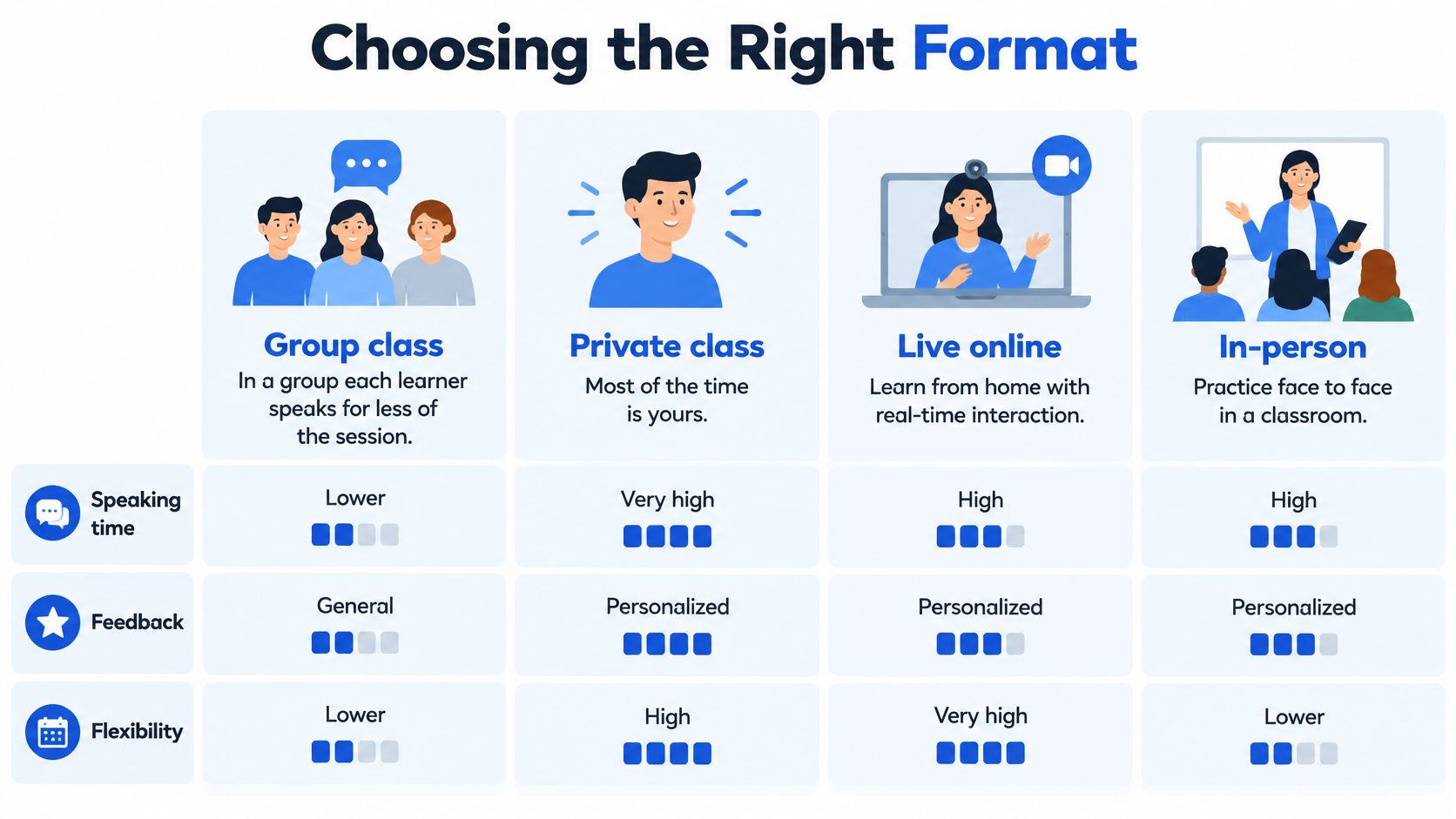
Class formats compared on speaking time and fit
| Format | Speaking time per learner | Cost signal | Best for | Trade-off |
|---|---|---|---|---|
| Small group class, Englify maximum 6 learners | Shared among the group | Englify's published 3-month plans start at 650 MAD | Conversation and peer practice | Fewer personal corrections per session |
| Private one-to-one class | Most of the lesson is yours | Englify lists classes from 100 MAD per hour; confirm the current rate | Interviews, presentations or meetings | Higher cost per hour |
| Live online class on Google Meet | Set by group or private format | No commuting expense; Englify's online 3-month plans start at 650 MAD | Busy professionals and parents | Requires stable internet and self-discipline |
| In-person institute class | Set by group size and lesson design | Include travel costs and time | Learners who prefer classroom contact | Commuting and fixed attendance times |
Choose a group for sustained conversation practice and shared learning costs. Choose private lessons when you need concentrated work on a specific task. The group or private English classes comparison can help you weigh those priorities.
Test the timetable against your actual week
The OECD's analysis of adult-learning barriers reports that half of adults participating in or wanting to participate in learning face barriers, with work or family time constraints accounting for 48%, unsuitable opportunities for 14%, and cost for 13%. Time pressure is the dominant obstacle, so a course that fits your real schedule beats a stronger course you cannot attend. Don't enrol around the week you wish you had.
Write down your fixed commitments, then mark the lesson slots you can reliably protect. If you can protect two weekly slots, reject a course requiring a third you cannot maintain. Compare morning, evening, and weekend availability against childcare, commuting, and changing work shifts.
Englify's stated structure is 60-minute lessons, three sessions weekly, in three-month terms, delivered through Google Meet. Before committing, ask what happens if you miss a live lesson, whether recordings are available, and whether make-up sessions exist. The answers matter more than the timetable itself, because every adult learner misses a session eventually.
Practical rule: A convenient course isn't sustainable unless you can attend consistently and practise between lessons.
Adults weighing a course against self-study face this same consistency question in other languages, and language learning advice for Irish beginners shows how it plays out for Irish learners specifically. Base your choice on the routine you can sustain.
Matching Your Level With the CEFR Scale
Labels such as beginner, intermediate, and advanced aren't precise enough for choosing a class. Ask what learners at that level can do, rather than assuming different schools use the same label consistently.
The Council of Europe's CEFR Companion Volume organizes proficiency into six levels, A1 through C2, grouped as Basic User, Independent User, and Proficient User, with ability described through can-do statements. That makes the framework useful for comparing courses and setting practical goals.
CEFR levels with example abilities and typical goals
| CEFR level | Example ability | Typical adult goal |
|---|---|---|
| A1, Breakthrough | Introduce yourself and ask simple questions | Basic travel and everyday exchanges |
| A2, Waystage | Handle routine exchanges such as shopping or appointments | Daily life and simple service interactions |
| B1, Threshold | Follow clear speech on familiar topics and describe experiences | Workplace conversations and social situations |
| B2, Vantage | Discuss work topics and interact with reasonable fluency | Meetings, negotiations and professional emails |
| C1, Effective operational proficiency | Give clear, structured presentations on complex subjects | Senior roles, presentations and academic study |
These are representative abilities, not promises that every learner at a level can handle every professional situation. Negotiating a contract, for example, also requires relevant vocabulary and familiarity with the subject.
Check what you can do without preparation
Use these questions before your assessment:
- Everyday exchange: Can I introduce myself and ask simple questions without preparing a script?
- Listening under pressure: Can I follow a meeting on a familiar topic without asking for repetition every few minutes?
- Extended speaking: Can I give a structured explanation for at least two minutes without switching languages to finish?
These are self-check prompts, not an official scoring system. Answer openly, including whether you need subtitles, written notes, or a patient listener to complete the task.
A placement result should identify both your starting point and your next target. The guide to English levels and the CEFR can help you interpret the terminology before discussing your course.
Englify's pathway runs from A0 to C1, allowing complete beginners to start before A1. A0 is a starting-course label, not an additional official CEFR level.
Don't accept a level label without an explanation of your strengths and gaps. You may read comfortably while struggling to respond aloud, so ask how the placement process handles uneven skills.
A completion certificate records course completion. It doesn't, by itself, demonstrate that you can manage an unscripted conversation.
A free placement test is useful when it leads to a suitable class and a concrete learning target. Confirm that someone will assess your speaking directly, not assign a level from grammar questions.
How to Test Speaking Before You Commit
Judge a class by what you do during it and what you can improve afterward, not by how polished the presentation looks. A trial should reveal how the teacher handles your actual speech, including hesitation, mistakes, and requests for help.
Use a practical task that matters to you. A professional might explain a delayed delivery; a university student might summarize a project; a traveller might resolve a booking problem.
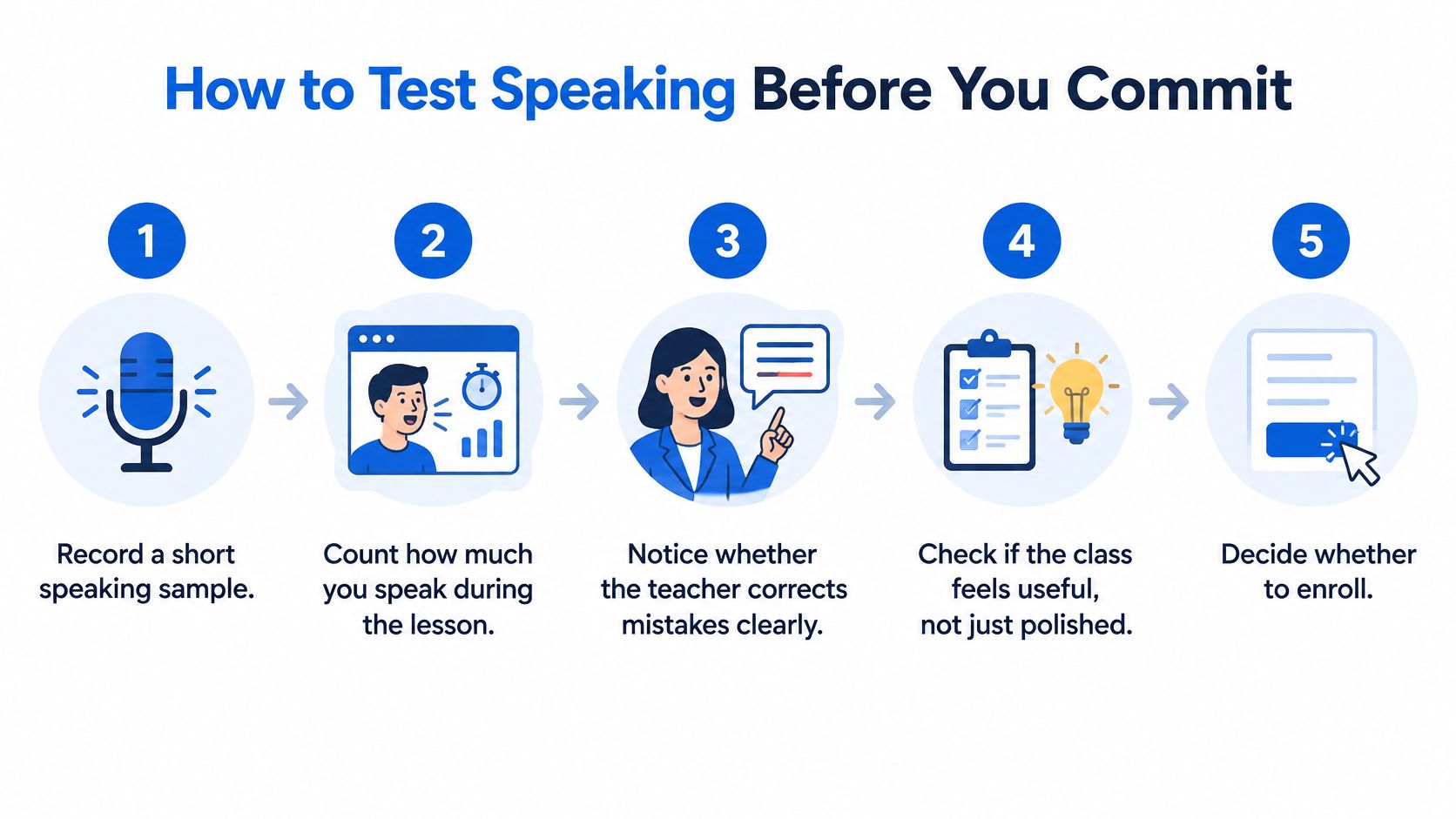
Run a short trial assessment
Record a starting sample. Answer an open question, such as describing your job, for two minutes. Use your phone's voice recorder before the session, or obtain permission before recording during it. Listen for unclear pronunciation, repeated pauses, and sentences you couldn't finish.
Count your active speaking time. Note when you produce your own answers rather than repeat a model or listen. In a group trial, notice whether the teacher invites everyone to contribute or allows confident learners to dominate.
Request a usable correction. Ask the teacher to identify an important error, model the improved phrase, and let you try again. Correction should give you something you can apply, not just tell you that an answer was wrong.
Try a realistic role-play. Explain a problem to a colleague or answer a follow-up interview question. Time your response, but also notice whether you can clarify meaning when the teacher asks something unexpected.
Record a fresh attempt. Repeat a comparable task after the feedback without reading a prepared script. Check whether you used the corrected phrase successfully, rather than merely remembering it while looking at your notes.
Ask for feedback you can act on
The Council of Europe's speaking descriptors distinguish range, accuracy, fluency, interaction, coherence, and phonology. Ask the teacher to use these dimensions to explain your performance.
Range concerns the vocabulary and structures you can use. Accuracy concerns control of those structures, while fluency concerns how smoothly you continue. Interaction includes responding and clarifying; coherence concerns connecting ideas; phonology covers pronunciation and related features of speech.
You don't need perfect scores across every dimension to make useful progress. You need a clear priority, such as organizing answers more logically or making a recurring pronunciation pattern easier to understand.
For additional task ideas, use these online English conversation practice suggestions. Arabic-speaking learners should ask teachers to diagnose their individual pronunciation and grammar needs rather than assume everyone shares the same difficulties.
Before leaving the trial, ask whether you'll receive a written evaluation with strengths, priorities, and recommended next steps. That document gives you something concrete to judge.
How Many Hours You Really Need and How to Track Progress
Cambridge English's guided-learning estimates put the cumulative guided hours needed to reach each CEFR level from a complete beginner start at roughly 90–100 for A1, 180–200 for A2, 350–400 for B1, 500–600 for B2, and 700–800 for C1. The steps are not equal: later levels generally absorb more guided hours than earlier ones, so plan against the cumulative figure rather than a flat number per level. These are planning estimates, not individual deadlines.
A term can still be worthwhile without producing a full level change. Improved answers in meetings, more accurate descriptions of past events, or clearer presentation structure are meaningful outcomes.
Guided hours from a standard weekly schedule
| Weekly schedule | Guided hours per week | Approx. hours per 3-month term |
|---|---|---|
| 1 lesson of 60 minutes | 1 | About 13 |
| 2 lessons of 60 minutes | 2 | About 26 |
| 3 lessons of 60 minutes, standard Englify term | 3 | About 39 |
| Full beginner-to-C1 path on Cambridge's cumulative estimate | 3 hours per week | About 700–800 total, or roughly 18–21 such terms |
The timetable calculations assume approximately thirteen teaching weeks per term, without cancellations or breaks. Sustained at three lessons a week, that cumulative path covers roughly four and a half to five years of back-to-back terms.
Don't turn that calculation into a promised completion date. Starting knowledge, practice outside lessons, assessment demands, and the type of guidance all affect your pace.
Separate attendance from active practice
Consider a hypothetical comparison: a learner speaking for ten minutes in a lesson has a different practice experience from someone speaking for thirty-five. Both may record the same attendance, but they haven't had the same opportunity to produce English.
Ask how the teacher creates speaking opportunities through pair tasks, short presentations, follow-up questions, and repeat performances. In a six-learner, sixty-minute lesson, a passive format can still leave you with only a few minutes of actual production, so don't assume a small class automatically uses its time well.
Measure the task, not the seat time. Completing a textbook chapter isn't the same as explaining a problem clearly when someone asks an unexpected question.
Choose a competence you can demonstrate. For workplace communication, that might be answering questions about a project without reading notes; for daily conversation, it might be describing a past experience accurately.
Keep a small progress portfolio
Save dated speaking samples, teacher feedback, and a short list of recurring errors. Use comparable tasks so you're not judging an easy recording against a much harder one.
For example, a professional preparing team presentations could record a presentation near the beginning, middle, and end of a term. Compare the organization, vocabulary choices, handling of questions, and reliance on notes.
Request a written progress summary at term end and ask what the next learning block should address. A useful report explains what you can now do, what still needs support, and which practice will help next.
Confirm Your Choice With a Free Trial Session
A free trial is a chance to test fit before payment, not an obligation to enrol. Arrive with your learning goal, a realistic timetable, and questions that require specific answers.
Use the checklist below in your notes. Record what the provider confirms, especially around missed lessons, assessment, and support.
Your enrolment checklist
Goal. Name the outcome you need: exam preparation, a job interview, daily conversation, or a presentation at work. Ask what classroom tasks will prepare you for it. A general English course may be appropriate, but the provider should explain the connection.
Format. Confirm live versus recorded delivery, group size, private options, and available time slots in Morocco time. If you're joining from the UAE or elsewhere abroad, request the corresponding local time rather than relying on a calendar assumption.
Level. Ask whether placement produces a named CEFR level and a next target. Request an explanation if your spoken performance differs from your written-test result.
Practice. Ask how the teacher allocates speaking opportunities and handles correction. You should understand what happens when you make a mistake, not just hear that lessons are interactive.
Evidence. Check whether you'll receive a written report and a completion certificate, and whether speaking is assessed directly. Ask to see the report format so you know what information you'll receive.
Flexibility. Establish what happens after a missed lesson. Ask separately about recordings, make-up options, cancellation notice, and private rescheduling. A recording can help you review content, but it doesn't replace live participation.
Support. Ask whether Arabic, French, or Darija support is available when you get stuck. Clarification can be useful, provided the lesson still gives you opportunities to work in English.
Teacher qualifications. Request the specific training teachers hold and how they work with adult learners. A clear answer should name the qualification rather than rely on vague claims about expertise.
Professional relevance. Morocco-based professionals should check whether business English includes meetings, emails, interviews, and presentations relevant to their work. Bring an anonymized example of a task you need to handle.
Decide from the evidence
Don't enrol because the teacher seems friendly or because a discount expires soon. Choose the course whose trial, timetable, and assessment process match your needs.
Take the free placement test to establish your starting point, then book the free trial session to test speaking, inspect the evaluation format, and confirm the schedule. Resolve unanswered policy questions before paying.
Englify offers live online English classes through Google Meet, with small-group and private options, personalized content, and CEFR-aligned learning. Visit Englify to take the free placement test and book a free trial, then use the session to check speaking practice, feedback, and timetable fit before committing.